The Best AI Tools to Launch Your Startup in 2026
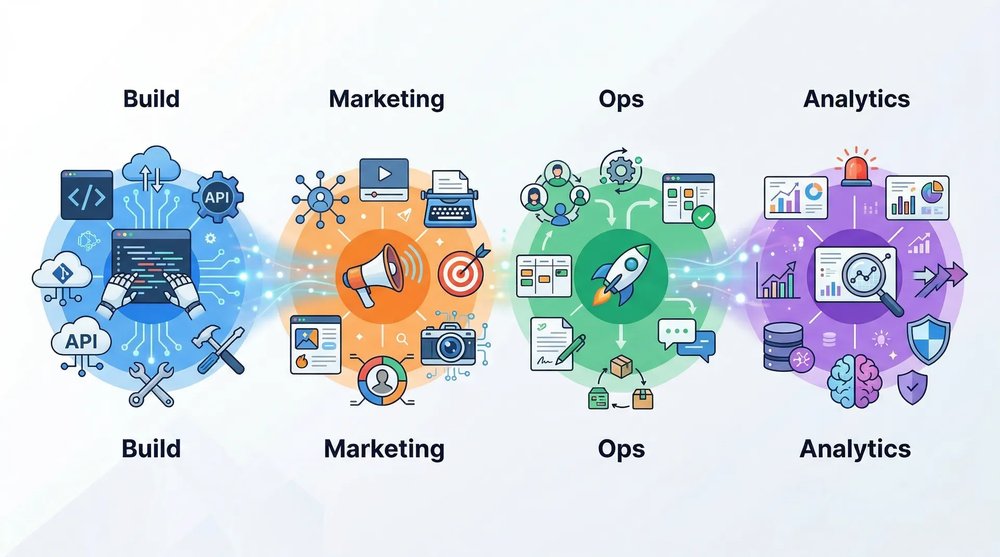
In 2026, a founder equipped with the right AI tools builds an MVP, launches their first acquisition channels, and runs operations with just two people. What took a team of five, six months of development, and €50,000 in 2022 now happens in a few weeks for under €200/month. The revolution isn't about a single tool: it's about the combination. Cursor or Claude Code to build the product. ChatGPT or Claude for content. HubSpot or Brevo for marketing automation. Notion AI for management. This guide gives you the complete stack, tool by tool, tailored to your startup's stage: from the pre-seed solo founder to the team preparing its Series A. A genuine action plan for founders who are building.
Why AI is a game-changer for founders in 2026
Two years ago, AI for startups came down to ChatGPT for drafting emails and Midjourney for generating visuals. Useful, but peripheral. In 2026, AI has become the central engine of company building. And the difference isn't cosmetic.
What AI makes possible in 2026 that it couldn't in 2024
In 2024, you could ask an LLM to fix a snippet of code or write a blog post. In 2026, you can ask it to build a complete application, design it visually, deploy it, then iterate on it in real time. This isn't an incremental improvement. It's a change in kind.
Three concrete shifts made this possible:
-
Models understand the context of an entire project. No more copy-pasting files one by one. Tools like Cursor and Claude Code analyze your full codebase and propose coherent changes across multiple files.
-
"Prompt-to-app" has become reality. Platforms like Bolt.new and Lovable turn a natural-language description into a working application, with front-end, back-end, and database. In a matter of minutes.
-
AI has embedded itself everywhere. Your CRM, your project management tool, your meetings: every tool you use day to day now has an AI layer that automates repetitive tasks.
The result: the cost of entry to launch a tech startup has dropped dramatically. An AI-based MVP can start from $15,000 (versus $50,000 to $200,000 for traditional development). Fortune describes an "AI cost collapse" that is redefining what a founder can build alone.
The augmented founder: doing the work of five with the right tools
You know the myth of the founder who codes at night, does marketing in the morning, and handles finances in the afternoon. In 2026, it's no longer a myth. It's a viable strategy (provided you choose the right tools).
A solo founder equipped with the right AI stack can now:
- Build and deploy a working MVP without hiring a developer
- Produce marketing content (articles, LinkedIn posts, emails) at a pace a team of three writers would struggle to match
- Automate their acquisition and nurturing sequences
- Analyze user feedback and continuously iterate on the product
- Manage their meetings, documentation, and internal processes
All for a tooling budget under €200/month at pre-seed. Compare that with the cost of a team of five (salaries, payroll taxes, offices). The ratio is brutal.
But be careful: "augmented" doesn't mean "replaced." AI amplifies your decisions, good or bad. A founder without a clear product vision will just produce useless code faster. The tool doesn't replace judgment.
Building your product with AI
This is what every "AI tools for startups" guide you'll find online leaves out. They talk about productivity, marketing, customer support. Nobody talks about the most fundamental part: building the product itself. Yet in 2026, that's where AI has the most impact for a founder.
Vibe coding: coding without knowing how to code
The term was coined by Andrej Karpathy (former AI director at Tesla, co-founder of OpenAI) in February 2025. Vibe coding means programming by describing what you want in natural language, instead of writing the code yourself. You describe it, the AI generates it, you test, and you iterate.
The concept exploded within a year. And for good reason: it lets non-technical founders build working prototypes without hiring a developer and without raising funds to pay a technical team. Got an idea, a solid lean canvas, and the ability to articulate a need clearly? You can build.
(Note that "coding without knowing how to code" doesn't mean "coding without thinking." Vibe coding demands clarity of thought, rigor in how you phrase things, and the ability to test and iterate. It isn't magic.)
Cursor, Claude Code, GitHub Copilot: the augmented IDEs
These three tools represent the cutting edge of AI-assisted coding. Each has its own philosophy.
Cursor is a full IDE (based on VS Code) that integrates AI directly into the editor. You write code and the AI completes, fixes, and refactors. You can also ask it to modify several files in a single instruction. It's the most popular tool for vibe coding in 2026: over a million paying developers and an ARR that has passed the billion-dollar mark.
| Plan | Price | Included |
|---|---|---|
| Hobby | Free | 2,000 completions/month, limited access to premium models |
| Pro | $20/month | Unlimited completions, full model access, premium requests |
| Business | $40/user/month | Everything in Pro + centralized admin, SSO, privacy policy |
Claude Code is Anthropic's coding agent. It runs directly in the terminal. No graphical IDE: you give it an instruction, it analyzes your project, proposes changes, applies them, and can even run the necessary commands (install dependencies, run tests, deploy). Its strength: contextual understanding of an entire project and autonomy in executing complex tasks.
Claude Code is available through the Claude Pro subscription ($20/month) or Claude Max (from $100/month for heavy use), or directly via the Anthropic API (usage-based billing by tokens).
GitHub Copilot is Microsoft/GitHub's AI assistant, integrated into VS Code, JetBrains, and other editors. It's the most widespread: over 77,000 organizations use it. Its advantage: deep integration with the GitHub ecosystem (pull requests, issues, actions).
| Plan | Price | Included |
|---|---|---|
| Free | $0 | Limited completions, chat access |
| Individual | $10/month | Unlimited completions, chat, multiple models |
| Business | $19/user/month | Everything in Individual + enterprise policies, IP exclusion |
Which tool should you choose? Cursor if you want a full IDE and vibe coding is your primary use. Claude Code if you're comfortable in the terminal and looking for maximum agent autonomy. GitHub Copilot if you already work within the GitHub ecosystem and want integrated assistance without changing your habits.
Bolt.new and Lovable: from prompt to application
If Cursor and Claude Code are tools for those who want to get their hands into the code (even AI-assisted), Bolt.new and Lovable are for those who don't want to see a single line of code.
Bolt.new (by StackBlitz) runs entirely in the browser. You describe your application in a few sentences, and Bolt generates the code, sets up the development environment, and lets you see the result in real time. You iterate through chat: "Add a signup form," "Change the button color to blue," "Connect this to a Supabase database." No local setup, no installation, no terminal.
Lovable (formerly GPT Engineer) takes a similar approach but puts more emphasis on design. The interface is built to produce visually polished applications from the very first prompt. Lovable also handles deployment: you can publish your application in one click.
| Criterion | Bolt.new | Lovable |
|---|---|---|
| Approach | Code-first in the browser | Design-first, polished visuals |
| Deployment | Via StackBlitz / Netlify | Built-in, one click |
| Back-end | Supabase, Firebase | Supabase built-in |
| Best for | Fast prototypes, technical MVPs | Landing pages, apps with polished UX |
| Price | Limited free tier, Pro ~$20/month | Free, Pro $25/month, Business $50/month |
From prompt to MVP: a concrete four-step workflow
You have a startup idea. Here's how to go from concept to a working MVP with AI tools, in one to two weeks:
Step 1: Frame the project (day 1). Use ChatGPT or Claude to refine your value proposition. Stress-test it: what problem are you solving, for whom, why now. Formalize it in a lean canvas. This framing work determines everything that follows.
Step 2: Prototype the interface (days 2-3). Open Lovable or Bolt.new. Describe your application in 3-5 precise sentences: "A web app where users can [core action]. The home screen shows [key element]. The user can [main journey]." Iterate on the result through chat. Within a few hours, you have a navigable visual prototype.
Step 3: Connect the back-end (days 4-7). Add authentication, the database, the business features. With Bolt.new or Cursor, connect Supabase for data storage. This is where vibe coding truly comes into its own: you describe the business logic, the AI generates the code.
Step 4: Test and deploy (days 8-10). Ship a beta version. Share it with 10-20 potential users. Collect feedback and iterate.
Total cost of the operation: between €0 (if you stay on the free tiers) and €50-100 (if you use the pro plans). Compare that with a development agency's quote for the same result (€20,000 to €80,000 on average for an MVP in France).
Automating your marketing and growth
Building the product is half the job. The other half: getting it known. And here too, AI has changed everything.
Content creation (ChatGPT, Claude, Jasper)
Content production is AI's most mature use case for startups. Three tools dominate:
ChatGPT (OpenAI) remains the go-to for versatile content generation. Blog posts, LinkedIn posts, video scripts, emails: its versatility is unmatched. The Plus plan at $20/month gives access to GPT-4o and advanced features (image analysis, web browsing, custom GPT creation).
Claude (Anthropic) excels at long-form, nuanced content. If you're writing detailed guides, in-depth analyses, or technical content, Claude produces text that is more structured and more faithful to complex instructions. The Pro plan is $20/month.
Jasper is aimed at marketing teams that want a dedicated tool with templates, a configurable brand voice, and approval workflows. More expensive (from $59/month billed annually), but built specifically for marketing.
The practical takeaway: at pre-seed, ChatGPT or Claude are enough. Jasper becomes relevant once you have a marketing team of two or more people that needs brand consistency.
SEO and organic acquisition
For a startup founder, SEO is the most cost-effective acquisition channel in the medium term (and the most underrated at early stage). AI speeds up every step:
- Keyword research: Tools like Semrush and Ahrefs now include AI features to identify content opportunities and competitive gaps.
- SEO writing: ChatGPT and Claude produce optimized first drafts. But be careful: raw AI content isn't enough. What you add that is genuinely unique compared to competitors remains your advantage.
- Technical optimization: Tools like Screaming Frog and Sitebulb automate technical audits. The llms.txt file has become a standard for making your site readable by AI.
To go deeper on SEO applied to startups, check out our guide on SEO for startups.
Email, CRM, and automation (HubSpot AI, Brevo)
Marketing automation is the lever that turns an overwhelmed founder into a methodical acquisition machine.
HubSpot has built AI into its entire suite: email writing, lead scoring, chatbots, churn prediction. The free CRM remains an unbeatable entry point for early-stage startups. The paid plans (from $20/month per user for Starter) unlock advanced automation.
Brevo (formerly Sendinblue) is the French alternative. Less complete than HubSpot on the CRM side, but excellent for email marketing and marketing automation, with a generous free plan (300 emails/day). The built-in AI helps with writing and optimizing send times.
For a founder focused on growth marketing, the combination of CRM + email automation + AI is the minimum foundation. Don't over-complicate beyond that.
Managing your team and operations
A startup isn't only product and marketing. It's also coordination, documentation, meetings. AI makes these tasks invisible (which is exactly what we ask of them).
Project management (Notion AI, Linear)
Notion AI has transformed Notion from a simple wiki into a full management assistant. Document summaries, project plan generation, extracting action items from meeting notes, automatic writing: it's all accessible by adding AI to your existing workspace. The cost: $10/member/month on top of your Notion plan (included in the Business and Enterprise plans).
Linear is the project management tool of choice for startup product teams. Its interface is fast, minimalist, and built for developers. Its AI features (automatic ticket triage, priority suggestions, cycle summaries) make it a natural choice for tech startups. Free for small teams.
The choice depends on your profile. Notion if you need an all-in-one space (docs, wiki, tasks, databases). Linear if your technical team wants a dedicated tool for product tracking, without the noise.
Meetings and note-taking (Fireflies, Fathom)
How many hours a week do you spend in meetings? How many of those hours are productive? (Don't answer, the question is rhetorical and the answer is depressing.)
Fireflies.ai records, transcribes, and summarizes your meetings automatically. It identifies action items, decisions made, and topics discussed. It integrates with Google Meet, Zoom, and Teams. The free plan includes a limited number of transcriptions. Paid plans start at $10/month (Pro, billed annually).
Fathom positions itself as the simpler, faster alternative. Fewer features, but near-instant transcription and a remarkably accurate summary. Free for individual use, with unlimited recordings and transcriptions.
For a solo founder or a small team, these tools eliminate manual note-taking. You focus on the conversation. The AI handles the rest.
Communication and collaboration
AI is working its way into everyday communication tools:
- Slack offers channel summaries, suggested replies, and an AI search engine to find information in your history.
- Gmail / Google Workspace offers assisted writing, thread summaries, and smart categorization.
- Loom (for async video) adds automatic summaries and chapters.
These features seem minor taken individually. Added together, they represent hours saved every week. For a startup of 3-5 people, that's the equivalent of a recovered part-time role.
Analyzing your data and making decisions
Data without analysis is useless. Analysis without action, equally so. AI steps in at both levels.
Analytics and prediction
Mixpanel and Amplitude remain the references for product analytics in startups. Both have added AI features: natural-language queries ("Show me the retention rate of users who completed onboarding last week"), automatic anomaly detection, and insight suggestions.
Google Analytics 4 (free) now includes AI insights and basic predictive analytics. Enough to get started, but limited for fine-grained product analysis.
For an early-stage founder, the recommendation is simple: GA4 for web traffic, Mixpanel or Amplitude (free tiers) for product analytics. Don't invest in premium tools until you've found product-market fit.
Customer support and chatbots
Intercom has partly replaced its human support agents with Fin, its AI chatbot that resolves tier-1 requests based on your documentation. The result for startups using it: roughly 50% of tickets resolved without human intervention (the rate varies with the quality of the documentation).
Crisp is the accessible alternative (free plan available) with a built-in AI chatbot, suited to startups starting out with customer support.
Zendesk has also added AI agents, but its pricing makes it more relevant for startups in the scaling phase.
The trap to avoid: don't deploy an AI chatbot before you have clear, complete documentation. A bot trained on an empty knowledge base is worse than a contact form.
The ideal AI stack by startup stage
This is the section you won't find anywhere else. Competing guides throw a list of 20 tools at you with no distinction. A pre-seed founder and a Series A CEO don't have the same needs, the same budget, or the same priorities.
Solo founder (pre-seed): the survival kit for under €50/month
You're on your own. You have an idea and maybe a little savings. Every euro counts. Here's the stack:
| Category | Tool | Cost |
|---|---|---|
| Product build | Bolt.new or Lovable (free/starter tier) | $0-20/month |
| Code (if technical) | Cursor Hobby | $0 |
| Content & strategy | ChatGPT Plus or Claude Pro | $20/month |
| Email & CRM | HubSpot CRM (free) + Brevo (free) | $0 |
| Management | Notion (free) | $0 |
| Analytics | Google Analytics 4 (free) | $0 |
| Meetings | Fathom (free) | $0 |
| Total | $20-40/month |
With this stack, you can build an MVP, write content, launch your first email campaigns, and track your metrics. All for the price of two lunches.
Team of 2-5 (seed): structure and automate
You've raised a first round (or you have your first revenue). You've hired one or two people. Processes start to matter.
| Category | Tool | Cost |
|---|---|---|
| Product build | Cursor Pro + Claude Code | $20-40/month |
| Content | Claude Pro + ChatGPT Plus | $40/month |
| Email & CRM | HubSpot Starter | ~€20/month |
| Management | Notion (Team) + Linear (free) | ~$10/user/month |
| Analytics | Mixpanel (free) + GA4 | $0 |
| Meetings | Fireflies.ai (Pro) | ~$10/month |
| Support | Crisp (free) | $0 |
| Total (team of 3) | ~$150-250/month |
The key investment at this stage: marketing automation. Every process you automate frees up founder time for product and sales.
Scale-up (Series A+): industrialize
You've found product-market fit. The goal is to scale. The stack evolves toward tools capable of handling complexity.
| Category | Tool | Cost |
|---|---|---|
| Product build | Cursor Business + GitHub Copilot Business | ~$60/dev/month |
| Content | Jasper (Team) + Claude API | ~$100+/month |
| Email & CRM | HubSpot Pro | ~€400+/month |
| Management | Notion (Business) + Linear (Standard) | ~$15-20/user/month |
| Analytics | Amplitude or Mixpanel (Growth) | Variable |
| Meetings | Fireflies.ai (Business) | ~$20/user/month |
| Support | Intercom (with Fin) | ~$75+/month |
| Total (team of 10) | ~$1,500-3,000/month |
It sounds like a lot. But compare it with the salaries of the team these tools replace or augment. At this stage, the ROI is rarely up for debate.
How to choose your AI tools: the criteria that matter
Faced with the proliferation of AI tools (a new one launches every day, literally), you need clear selection criteria. Otherwise, you'll spend more time evaluating tools than building your startup.
Integration, cost, learning curve
Three criteria, in this order:
1. Integration with your existing stack. A brilliant tool that doesn't connect to your other tools is a useless tool. Check the native integrations (API, Zapier, Make) before committing. Notion + Slack + HubSpot form a coherent ecosystem. Notion + an obscure CRM + an exotic management tool, not so much.
2. Total cost, not the advertised price. Tool X's free plan is appealing. But when you're five users with real needs, what will it cost? Look at the price of the plan you'll be using in six months, not today's.
3. The learning curve. You don't have time to spend a week learning a tool. If a founder can't be productive in under 2 hours, the tool isn't right for an early-stage startup. Bolt.new and Lovable get this: you type a prompt, you get a result. Zero friction.
Security and sensitive data
This is the subject nobody addresses in "AI tools for startups" guides (and that's a problem).
When you use ChatGPT or Claude to draft a pitch deck, you're potentially sharing strategic information with a model whose training you don't control. When you use Cursor to code, your source code passes through third-party servers.
The precautions to take:
- Read the data policies of each tool. OpenAI and Anthropic offer options to exclude your data from training (paid plans, API). Turn them on.
- Use the Business plans when your data is sensitive. They generally include confidentiality guarantees and data processing agreements (DPAs).
- Never put secrets (API keys, passwords, customer data) into an AI prompt. It seems obvious. It isn't for everyone.
- GDPR compliance: if you handle data from European customers (and if you're a French startup, that's your case), verify that your AI tools are compliant. HubSpot and Brevo are. For American tools, check the standard contractual clauses.
Security isn't a Series A luxury. It's a reflex to build from day one.
One last point: some open-source tools like OpenClaw let you keep full control over your data by hosting it yourself. An option worth considering if confidentiality is critical for your sector. And if you're looking for support to structure your AI stack and your launch strategy, that's exactly what the swanbase program does: helping founders build, test, and scale with the right tools.
FAQ
Can you really build an MVP using only AI?
Yes, provided you define "MVP" correctly. An MVP is the simplest version of your product that lets you test a market hypothesis. With tools like Bolt.new, Lovable, or Cursor, a non-technical founder can build a working web application in a few days. It won't be a product ready to scale: the architecture won't be optimal, the code won't be perfect. But to validate an idea and get your first user feedback, it's more than enough.
How much does a complete AI stack cost for an early-stage startup?
A solo founder can start with a budget of $20 to $50/month: a ChatGPT or Claude subscription ($20), a build tool like Bolt.new ($0-20), and free tools for CRM (HubSpot), management (Notion), and analytics (GA4). A team of 3-5 people at seed stage will spend between $150 and $250/month for a complete stack. That's a fraction of the cost of a single salary.
Will AI replace developers in startups?
No. AI replaces the repetitive tasks of development (boilerplate, unit tests, refactoring), not the developer's craft. A developer augmented by AI is considerably more productive than one without it. What changes is the barrier to entry: non-technical founders can now build viable prototypes. But as soon as the product needs to scale (performance, security, architecture), a real developer remains essential.
Which free AI tools do you recommend to get started?
For a zero budget: HubSpot CRM (free, up to 1,000 contacts), Notion (free individual plan), Google Analytics 4 (free), Fathom for meetings (free for individual use), Cursor Hobby (free, limited), and the free tiers of Bolt.new or Lovable for prototyping. You can validate a startup idea without spending a euro on tooling.