Claude Code and Cursor are the two leading tools for coding with AI in 2026. The difference fits in one line: Claude Code is an autonomous agent you drive from the terminal ("the AI drives, you supervise"), while Cursor is an IDE (a VS Code fork) where the AI helps with every keystroke ("you drive, the AI assists"). On SWE-bench Verified, Claude Opus 4.5 scores 80.9%1 and Opus 4.7 (April 2026) climbs to 87.6%2. Cursor publishes its own results for its Composer 2 model: 73.7% on SWE-bench Multilingual, 61.7% on Terminal-Bench 2.0, and 61.3% on CursorBench (Cursor, March 2026)3. According to morphllm's comparison, Claude Code uses 5.5× fewer tokens per task and produces about 30% less rework4. On pricing: Claude Code Pro at $20/month, Cursor Pro at $20/month, Cursor Hobby for free, and Claude Max at $100 or $200/month depending on the tier. For a founder who vibe-codes: start with Cursor, then add Claude Code once you want to run tasks in parallel or delegate them. The combo costs ≈ $40/month (~€37 excl. VAT) and covers both ways of working: hands-on sessions in the editor and delegated tasks.
Claude Code or Cursor: quick comparison
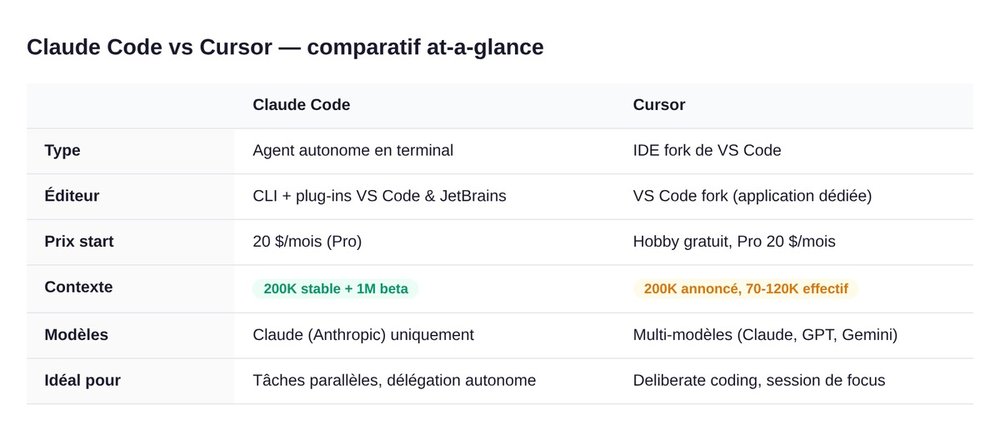
| Dimension | Claude Code | Cursor |
|---|---|---|
| Type | Autonomous terminal agent | IDE (VS Code fork) with built-in AI |
| Editor | CLI + VS Code and JetBrains integrations | Its own IDE (VS Code fork) |
| Starting price | Pro $20/month, Max $100 / $200 | Hobby free, Pro $20, Teams $40/user |
| Context | 200K tokens stable, 1M in beta | 200K advertised |
| Models | Claude (Sonnet, Opus) | Multi-model (Claude, GPT, Gemini, Auto) |
| Reference benchmark 2026 | SWE-bench Verified: 80.9% (Opus 4.5) → 87.6% (Opus 4.7) | Composer 2: 73.7% SWE-bench Multilingual, 61.3% CursorBench |
| Best for | Parallel tasks, refactors, well-scoped bugs | Focused coding sessions, design, debugging |
The rest of the article unpacks each row in detail. If you're short on time: try Cursor Hobby first (free), then add Claude Code Pro ($20) as soon as you're running several tasks in parallel. Together they cost about €37 excl. VAT per month and cover both of a founder's working modes.
Two philosophies: agent-first vs IDE-first
The choice comes down to how you work first, and price second. Both tools solve the same problem (coding faster with AI) using two opposite paradigms.
Claude Code, the autonomous terminal agent
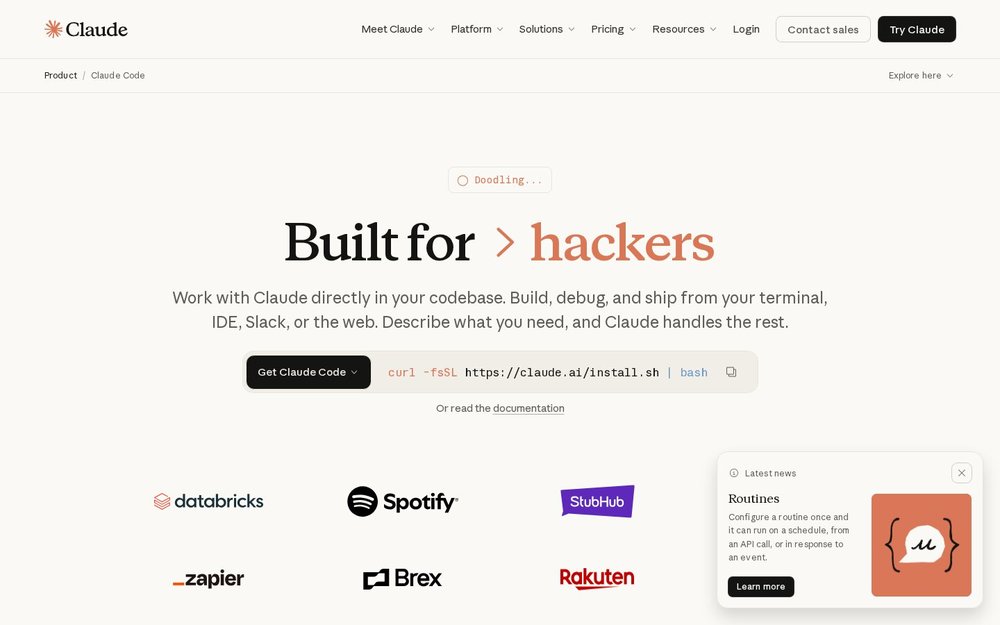
Claude Code is a CLI (command-line interface). You run the command in your terminal from the root of your project and describe a task in plain language. The agent reads the code, makes a plan, edits files, runs the tests, and commits. You step in to approve or correct course. The AI is in the driver's seat and you act as copilot.
Extensions available in 2026: Claude Code for VS Code and for JetBrains, which bring the same agent logic into a side panel of the IDE you already use. Same underlying model (Sonnet or Opus depending on your plan), same philosophy: the AI does the work, you supervise.
Cursor, the IDE rebuilt around AI
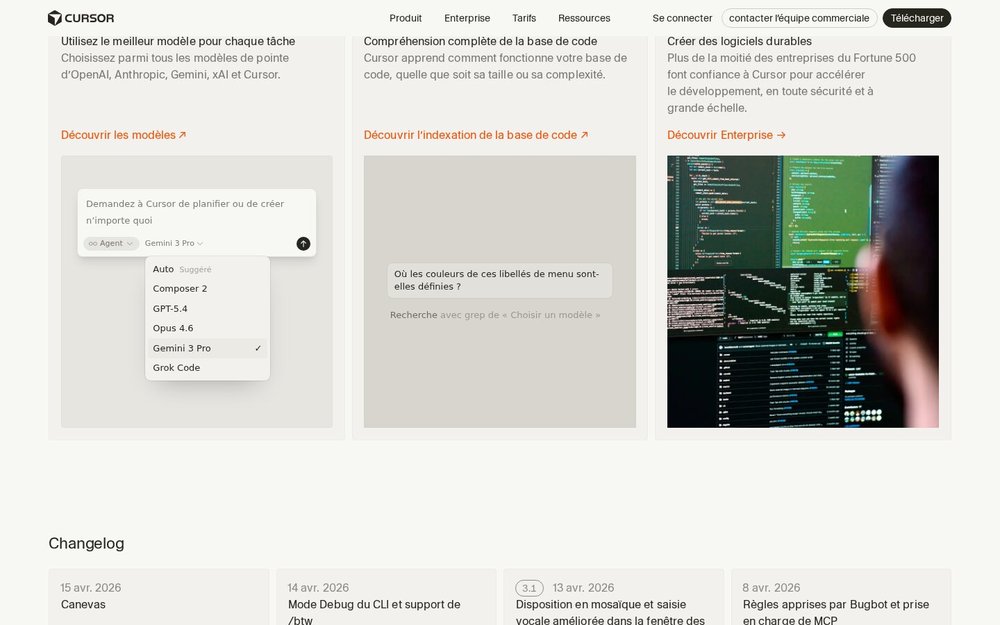
Cursor is a full IDE forked from VS Code. You code in it exactly as you would in VS Code, with the same shortcuts, the same extensions, and the same UI. Cursor builds AI into three places:
- Tab (aggressive, multi-line, cross-file autocomplete)
- Cmd+K (inline editing: select some code and ask for a change)
- Agent (a side panel that can plan and edit in a more autonomous mode)
Which model does the work depends on your selection: Auto (the cheapest, picked by Cursor), Claude Sonnet/Opus, GPT, or Gemini. You stay in the driver's seat while the AI assists.
Two workshops, two ways of working
Picture two workshops. In the first (Claude Code), you hire a developer who works in the background while you do something else, then brings you a pull request to review. In the second (Cursor), a developer sits next to you and finishes your sentences as you type.
Both are useful, at different moments of your day. The real question is when to use which, and the hybrid workflow section below answers it.
Feature-by-feature comparison
Context window
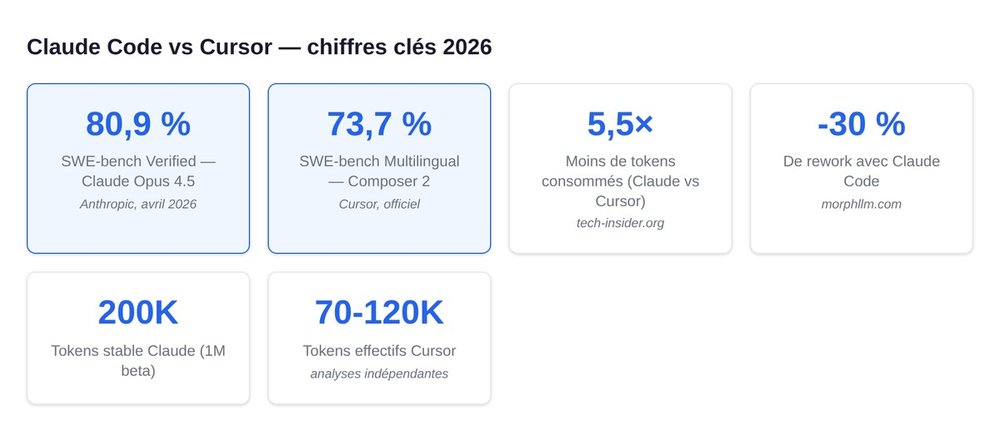
Claude Code offers a stable 200,000-token window and a 1 million-token mode in beta. Those tokens represent how much code and context the agent can read at once. Cursor also advertises 200K tokens, with internal context compaction that depends on the selected model. In practice: on a monorepo where 50 files need reading before any change, Claude Code keeps everything in mind, while Cursor sometimes has to go back and forth.
Supported models
- Claude Code: Claude family only (Sonnet for simple tasks, Opus for complex reasoning). You get guaranteed consistency, but no diversification.
- Cursor: multi-model. You pick Claude, GPT, Gemini, or Grok, or let Auto route requests. Handy if you prefer different models for different tasks (GPT for legacy code, Claude for architecture).
IDE integration
- Claude Code: native CLI + VS Code extension + JetBrains extension. It also runs in any terminal (iTerm, Warp, tmux).
- Cursor: standalone IDE, forked from VS Code. You can migrate your VS Code setup in one click (settings, extensions, themes).
If your dev workflow is already heavily VS Code or JetBrains, both integrate well. If you're terminal-first or write code across a mix of apps, Claude Code adapts better.
Multiple agents and parallel tasks
Claude Code natively handles several sessions in parallel. You can open 3 terminals with 3 Claude Code instances working on 3 subtasks in the same repo (refactor, tests, docs). In 2025, Cursor added a Cloud Agents mode that runs tasks in the background, but fine-grained parallelism remains smoother with Claude Code.
Automated code review
Both handle code review, from different angles. Claude Code reviews an entire diff via claude review and flags risks, missing tests, and potential regressions. Cursor builds review into its agent panel, and lets you ask for refactors during the review.
Benchmark performance
Figures published between November 2025 and April 2026, with sources in the footnotes:
- SWE-bench Verified: Claude Opus 4.5 scores 80.9%1. Opus 4.6 holds at 80.8% and Opus 4.7 takes the lead at 87.6% (April 2026)2. Cursor doesn't publish a SWE-bench Verified score and instead reports on its in-house Composer 2 model: 73.7% on SWE-bench Multilingual, 61.7% on Terminal-Bench 2.0, and 61.3% on CursorBench (Cursor, March 2026)3.
- Token efficiency: Claude Code uses 5.5× fewer tokens for equivalent tasks according to morphllm (a one-off benchmark: 33,000 tokens vs 188,000 tokens for the same task)4.
- Rework: 30% less rework with Claude Code according to the same morphllm comparison4.
Take these with a grain of salt: benchmarks shift every quarter, and each new Claude or Cursor model reshuffles the deck. In day-to-day use, the difference in philosophy and workflow matters far more than 5 points on SWE-bench.
2026 pricing in euros and real-world usage
Claude Code Pro ($20/month) and the Max plans
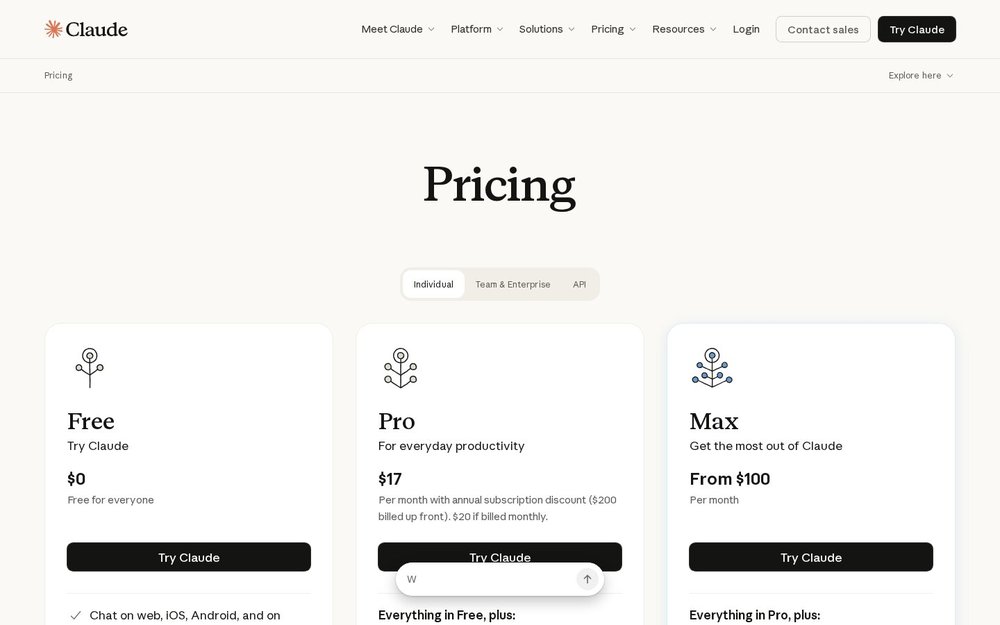
- Pro ($20/month, ~€18.50 excl. VAT): moderate daily use for a solo founder5.
- Max 5x ($100/month, ~€92 excl. VAT): 5 times the Pro limits6. Built for heavy-use developers.
- Max 20x ($200/month, ~€185 excl. VAT): 20 times the Pro limits. For power users running Claude Code all day across several projects.
Cursor Hobby free, Pro $20/month, Teams $40/user/month
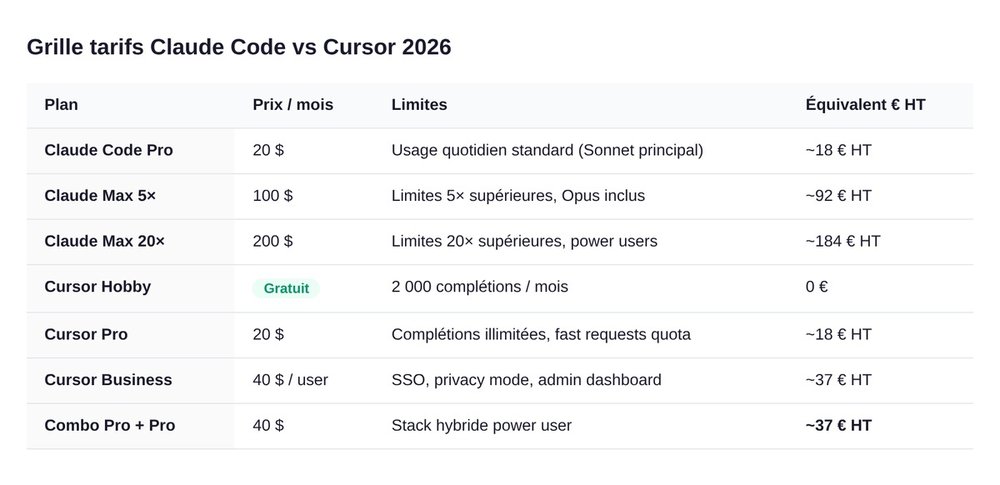
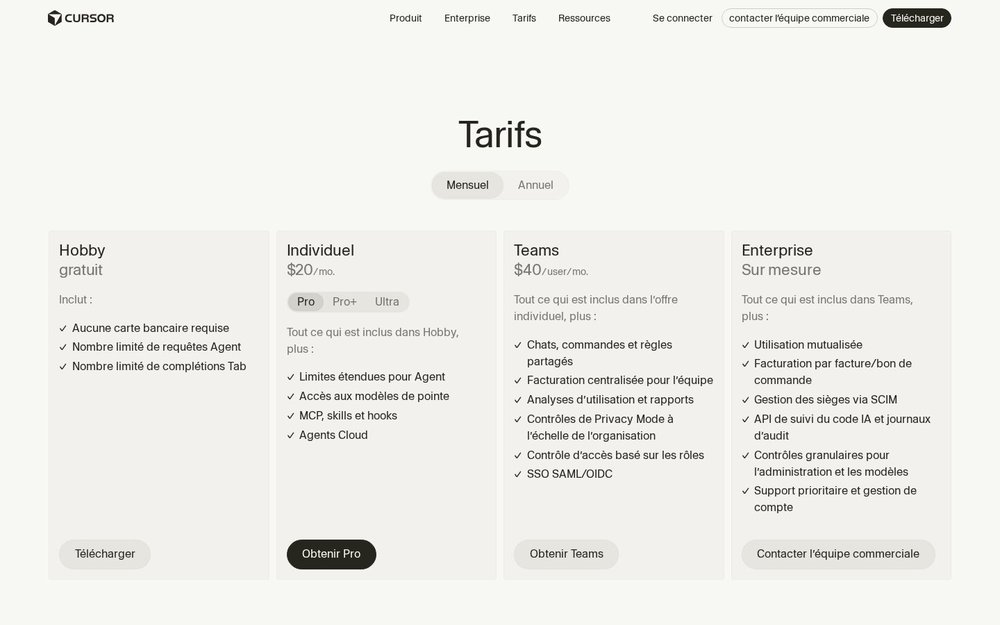
- Hobby (free): limited Tab completions and agent requests, on the Auto model7. Fine for testing or very occasional use.
- Pro ($20/month, ~€18.50 excl. VAT): unlimited Tab completions, access to frontier models (Claude, GPT, Gemini), MCPs, skills, hooks, and cloud agents.
- Teams ($40/user/month, ~€37 excl. VAT): centralized billing, Bugbot code reviews, SSO.
Cursor bills model usage in credits included with your plan. Auto mode routes each request to the cheapest model, while picking a frontier model (Opus, GPT-5) burns through the monthly pool faster. In practice, a founder on the Pro plan who lets Auto run stays within the plan, and a founder who forces Opus on every request empties the pool before the month is out.
Monthly cost for a solo founder vibe coding
A concrete case (April 2026, rate €1 ≈ $1.08):
| Setup | Monthly price | Who it's for |
|---|---|---|
| Cursor Pro alone | $20 (~€18.50 excl. VAT) | Getting started, mostly Auto mode, occasional Opus credits |
| Claude Code Pro alone | $20 (~€18.50 excl. VAT) | Solo founder comfortable with the CLI |
| Cursor Pro + Claude Code Pro | Hybrid workflow (see below) | |
| Cursor Pro + Claude Max 5x | Parallel tasks all day long |
The Anthropic API key option
If you'd rather pay as you go than pay a flat subscription, Claude Code accepts a personal Anthropic API key. Pricing (April 2026):
- Sonnet 4.6: $3 input / $15 output per million tokens.
- Opus 4.7: $5 input / $25 output per million tokens8.
For daily use, the Pro or Max subscription works out cheaper than the API. The API makes sense if your usage is very irregular (one big coding session every 3 weeks) or if you're plugging Claude Code into an automated pipeline.
Which one to choose for your profile
Non-technical founder at the MVP stage
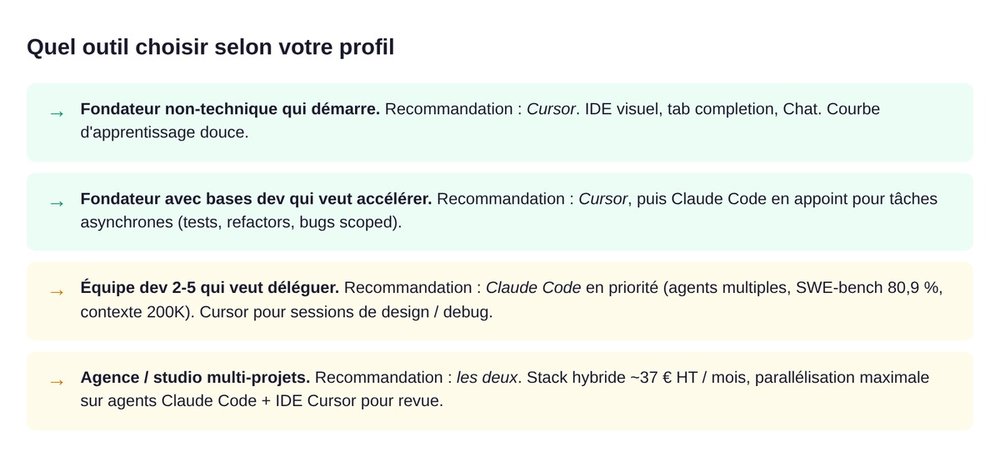
Our pick: Cursor Hobby, then Pro. Cursor is more intuitive when you're discovering what an IDE is. Tab completion is visible, Cmd+K is direct, and the agent panel helps when you get stuck. You watch the AI work in real time and understand what's happening. Claude Code in the CLI requires being comfortable with a terminal, and that learning curve doesn't help when all you want is to ship an MVP.
Founder with some coding background
Our pick: Cursor Pro + Claude Code Pro. You get the comfort of a familiar IDE (Cursor) plus the ability to send tasks off to run in the background (Claude Code). You code in Cursor and hand side tasks (tests, fixtures, docs, cosmetic refactors) to Claude Code in the terminal while you stay focused on the main feature.
Dev team of 2 to 5 people with tasks to delegate
Our pick: Claude Code (Pro or Max) for each developer, with Cursor as an option. A team fluent in the CLI will get the best ROI from Claude Code: you assign tickets to the agent and it delivers PRs for the team to review. Cursor remains handy for group debugging sessions or AI pair programming.
Agency or studio running several projects in parallel
Our pick: both, with Claude Code Max. You need massive parallelism (3, 4, or 5 projects at once) and the ability to delegate entire tasks. Claude Code Max gives you the quota, and Cursor gives you IDE comfort for design work on whichever project is front and center.
Hybrid workflow: using both together
The most productive choice in 2026 is to use both, at different moments. haihai.ai and morphllm document this combination in English.
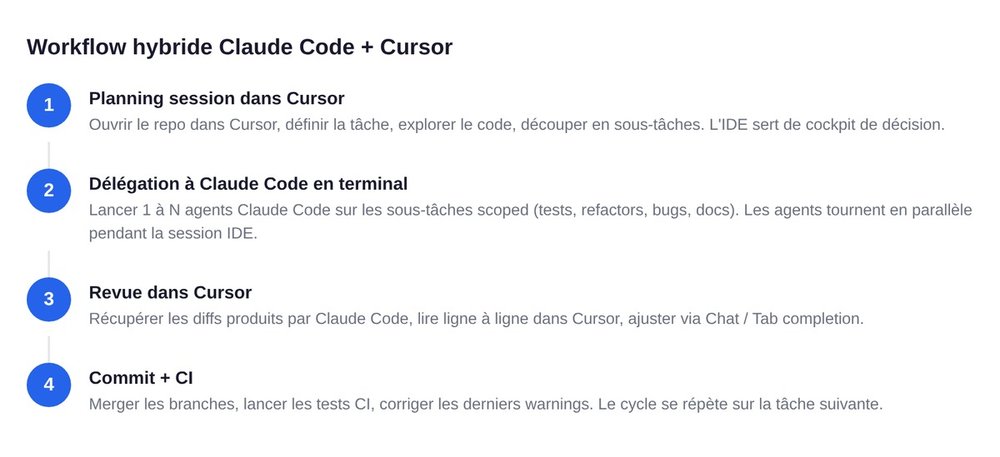
Claude Code for background tasks
- Missing unit tests on a freshly built feature.
- Targeted refactors (renaming an entity across the whole repo, extracting a module).
- Fixing a well-described bug with enough context.
- Writing or updating documentation.
- Generating fixtures, seeds, and mocks.
You run claude in the terminal, describe the task, and carry on with your main work. The agent delivers, you review, you merge.
Cursor for focused coding sessions
- Designing a new feature (thinking it through, structure, naming).
- Debugging a complex bug that means digging through several key files.
- Pair programming with Cmd+K on sensitive code (auth, payments, data).
- Exploring a legacy repo to understand what's already there.
You code in Cursor. Tab suggests, Cmd+K edits, and the agent panel answers structural questions.
Combined cost
The Cursor Pro + Claude Code Pro combo = $40/month (€37 excl. VAT). You pay for two subscriptions to cover both modes: hands-on sessions in the editor and delegated tasks. The payoff shows up in revisions: morphllm counts 30% less rework with Claude Code on delegated tasks4, thanks to the agent's own quality checks before your review.
Real-world hybrid stack examples
- Solo B2B SaaS founder: Cursor Pro for design work, Claude Code Pro for background tasks (tests, overnight refactors via cron).
- French dev studio (5 developers): Cursor Pro for everyone, plus a shared Claude Code Max for heavy lifting (migrations, audits, large refactors).
- Product founder + 1 developer: Cursor Pro for the developer, Claude Code Pro for the founder (who writes specs as tasks and lets the agent produce drafts).
When to stop vibe coding and bring in a freelance developer
Three signs you've hit the threshold
- You can no longer review the generated PRs without accepting them blindly. That means the project has outgrown your ability to understand it, and you're shipping code you no longer control.
- Production bugs are getting hard to diagnose. When AI wrote most of the code and nobody kept hold of the architecture, each bug costs more than the last. A senior developer restores readability.
- You spend more time orchestrating the AI than producing. If your day goes to prompts and reviews without a single shipped feature, the problem is structural.
Four limits of AI in 2026
On long-term architecture, AI optimizes file by file and lets structural debt pile up quietly. On sensitive security (auth, payments, secrets management), a senior developer should review every line. On fine-grained performance (DB bottlenecks, N+1 queries, indexing), it sometimes spots the problem and sometimes misses it. On decisions that sit between product and tech (framework choice, migrations, scalability), you need a human who knows your business.
The right time to hire is when velocity plateaus despite the AI, before production breaks.
swanbase supports early-stage founders over the long term, in Paris and remotely, at no cost, by application: swanbase takes equity. If you're building your MVP with either of these tools, apply.
Further reading
- Vibe coding: definition and complete guide
- Claude Code: definition and features
- Vibe coding tools compared: Cursor, Lovable, Bolt
- swanbase, support for early-stage founders in Paris and remotely
FAQ: Claude Code or Cursor
What's the main difference between Claude Code and Cursor?
Claude Code is an autonomous agent you drive from the terminal (CLI). You give it a task, and it reads the code, edits, tests, and hands you a result. Cursor is an IDE (a VS Code fork) where the AI helps with every keystroke: Tab autocomplete, Cmd+K inline editing, and an agent panel. Opposite philosophies: one drives, the other assists.
Is Claude Code free?
No. Claude Code starts at $20/month (Pro plan). The Max tiers cost $100 or $200/month. There's also a pay-as-you-go option via an Anthropic API key (Sonnet 4.6 at $3/$15, Opus 4.7 at $5/$25 per million tokens) if you'd rather pay per request than a flat fee.
Does Cursor use Claude?
Yes. Cursor is multi-model and includes Claude (Sonnet, Opus) among its options. You pick the model per request, or let Cursor route automatically with Auto mode. Cursor also offers GPT, Gemini, and other frontier models.
Can you use Claude Code and Cursor at the same time?
Yes, and it's the most productive setup in 2026. Use Cursor for focused coding sessions (design, debugging, exploration) and Claude Code for tasks delegated to the background (tests, refactors, fixtures, docs). Combined cost: about $40/month (Cursor Pro $20 + Claude Code Pro $20), or ~€37 excl. VAT.
How much does Claude Code cost per month in France?
Pro: $20/month, or about €18.50 excl. VAT at April 2026 exchange rates. Max 5x: $100/month (€92 excl. VAT). Max 20x: $200/month (€185 excl. VAT). VAT is added depending on your status (French micro-entrepreneurs pay VAT as B2C customers in the EU, while companies with an intra-EU VAT number don't pay it thanks to the reverse-charge mechanism).
Does Claude Code replace a developer?
No, not in 2026. Claude Code amplifies a developer or lets a non-technical founder build an MVP. Real limits remain on long-term architecture, sensitive security, fine-grained performance, and strategic product/tech decisions. You still need a senior developer once the project moves past the MVP stage, or for any critical system (payments, sensitive data, compliance).
Which is best for a beginner?
Cursor on the Hobby plan (free). The IDE feels familiar if you've ever used VS Code, and you learn by reading the Tab suggestions. Claude Code requires terminal comfort and a paid subscription from day one, two unnecessary hurdles when you're just discovering development.