Claude Managed Agents: The Complete Guide to Deploying Your AI Agents in Production
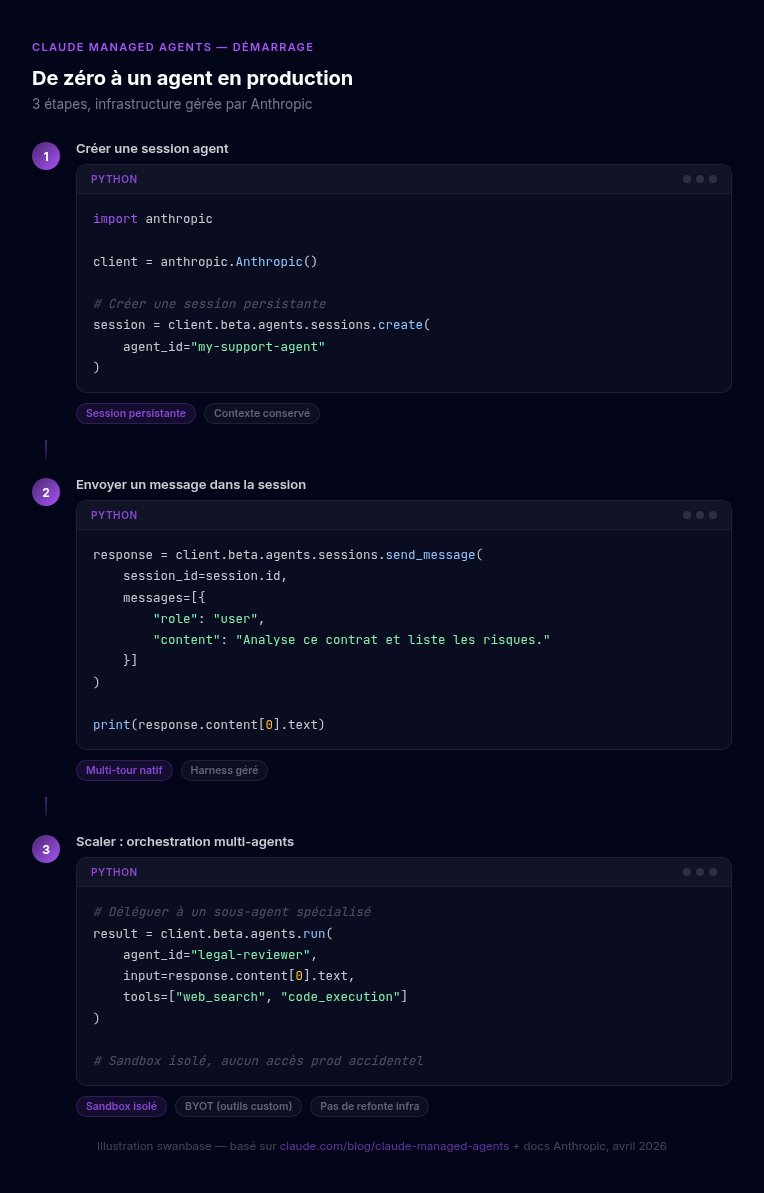 swanbase illustration, based on claude.com/blog/claude-managed-agents + Anthropic docs
Claude Managed Agents, launched April 8, 2026 by Anthropic, is a cloud infrastructure for deploying AI agents to production without managing sandboxing, state management, permissions, or long-running sessions. You define what your agent should do. Anthropic runs it. The result, according to teams already in production: from several months of infrastructure work down to a few days of development. Available in public beta on the Claude Platform. Pricing: standard Claude token rates plus $0.08 per active session-hour.
If you're building a prototype that works and production infrastructure is your next roadblock, Managed Agents cuts through that cycle. If you need maximum control over your agent loop, the Messages API remains the better fit.
The problem Managed Agents solves: from 3 months to a few days
The infrastructure you had to build before
Putting an AI agent into production used to mean managing an entire stack yourself: a sandboxed environment for code execution, state management across sessions, a scoped permissions system, secure credentialing, checkpointing for long tasks, and end-to-end tracing to debug failures. Each layer is a project in its own right. And with every model update, you have to rework the agent loops.
The result: weeks, sometimes months, before you had anything in production. Engineering time that never went toward the product.
What Managed Agents hands off to Anthropic
Everything above. You define the tasks, the available tools, and the guardrails. Anthropic runs it on its infrastructure. John Han, co-founder of a meeting-prep product, sums it up: "3x faster to build a production-ready agent. From idea to shipping in a few days. We were able to focus on the product, not the infrastructure."
Messages API vs. Claude Managed Agents: when to choose which
| Messages API | Claude Managed Agents | |
|---|---|---|
| What it is | Direct model access | Preconfigured agent harness, managed infrastructure |
| Best for | Custom agent loops, fine-grained control | Long-running tasks, asynchronous work |
| Infrastructure | Build and maintain it yourself | Managed by Anthropic |
| Sessions | Stateless by default | Persistent, long-running (multiple hours) |
| Multi-agent | Implement it manually | Native (research preview) |
| Tracing | Local logs | Built into the Claude Console |
| Model update | Rework the agent loop | Handled by the harness |
Rule of thumb: if you're building a demo or an internal tool with a simple agent, the Messages API is enough and costs less. If you're shipping to users, with tasks that run for hours and need to survive disconnections, Managed Agents is the right infrastructure.
The 4 core concepts
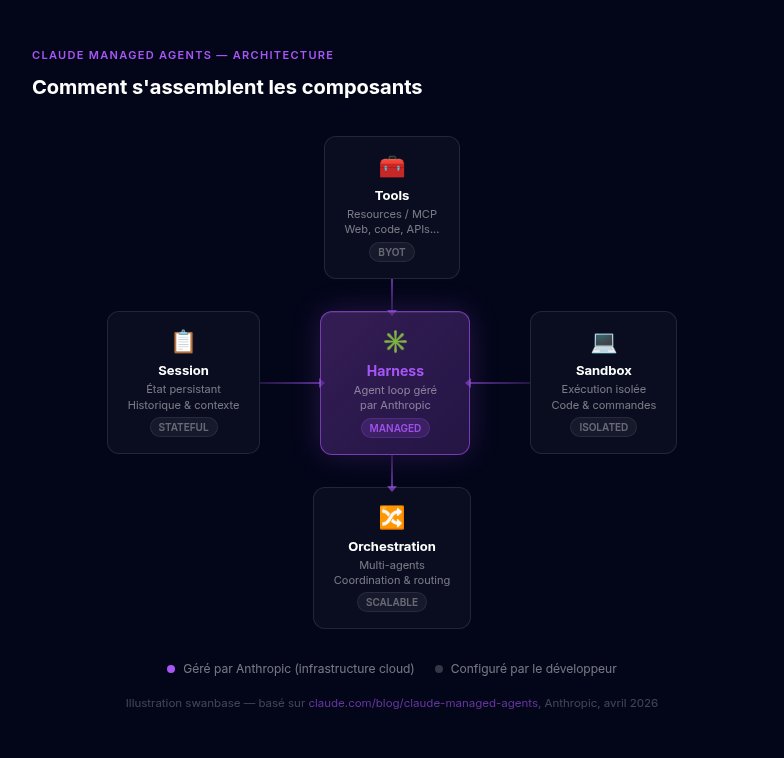
Managed Agents rests on four concepts. That's the whole mental model.
Agent
The configuration: which Claude model to use, which system prompt, which tools are available, which MCP servers are connected, which skills are enabled. You create an agent once and reference it by ID across every session.
Environment
A preconfigured cloud container: Python, Node.js, and Go packages pre-installed, network access rules, mounted files. You define the environment once. Every session starts in this clean, secure container.
Session
A running instance of your agent inside an environment. It can last a few minutes or several hours. State persists for the entire duration: the agent creates files, edits them, and reads them back in later steps. If your connection drops, the session keeps running on Anthropic's side and the outputs are available when you reconnect.
Events
The real-time trace of everything the agent does: every tool call, every decision, every intermediate output. This is what enables precise debugging without having to reconstruct the history. Visible directly in the Claude Console.
What the infrastructure handles for you
 swanbase illustration, based on claude.com/blog/claude-managed-agents, Anthropic
Sandboxing and scoped permissions
Code execution happens inside an isolated container. The agent doesn't touch your machine, your file systems, or your credentials unless you explicitly configure it to. The permissions system has two modes: workspace (read-write inside the container) and internet (controlled network access). According to the Sentry team: this permissions system alone is what makes Managed Agents more production-ready than LangGraph, CrewAI, or any open-source framework.
Long-running sessions and disconnections
Agents run autonomously for several hours. If your connection drops, the session keeps going. The outputs persist. You pick up where the agent left off without restarting. That's the fundamental difference from a classic API call, which fails if the connection is lost.
Context engineering: how Anthropic solved "context anxiety"
This is a technical detail documented in Anthropic's engineering blog, and it's worth understanding. Claude Sonnet 4.5 tended to wrap up its tasks prematurely as it sensed its context limit approaching, a behavior known as "context anxiety." The agent rushed to conclude even when the task wasn't finished.
The solution: context resets in the harness. The harness automatically manages the context window, compresses history when needed, and resumes cleanly. You don't have to handle this problem in your code. It's solved underneath.
In internal tests on structured file-generation tasks, Managed Agents improves the success rate by up to 10 points compared to a standard prompting loop, with the biggest gains on the hardest tasks.
Multi-agent coordination
Agents that spawn other agents
Agents can create and direct other agents to parallelize complex work. A parent agent breaks down a task, delegates subtasks to child agents, and aggregates the results. Inside Notion: dozens of tasks running in parallel while the team collaborates on the outputs.
How to request access
This feature is in research preview, available on request. The form is accessible from the Managed Agents announcement page on claude.com. The rest of Managed Agents (single sessions, tooling, sandboxing) is available immediately to every developer with API access.
Real pricing: what it costs in practice
Structure: tokens + $0.08/session-hour
Two dimensions:
- Claude tokens: standard Claude Platform rates, identical to normal API usage
- Session-hours: $0.08 per active session hour
Concrete cost examples by use case
A code-review agent that runs for 20 minutes: $0.027 in session-hours, plus the tokens consumed (variable depending on the volume of code). A document-processing agent that runs for 3 hours: $0.24 in session-hours, plus the tokens.
In most cases, tokens remain the dominant cost driver. The session-hour is marginal for well-designed agents. Compare that with the cost of an engineer spending a week setting up sandboxing, state management, and tracing. The ROI adds up fast.
One important point: pricing applies to active hours, not to hours since the session was created. An idle agent doesn't cost a session-hour.
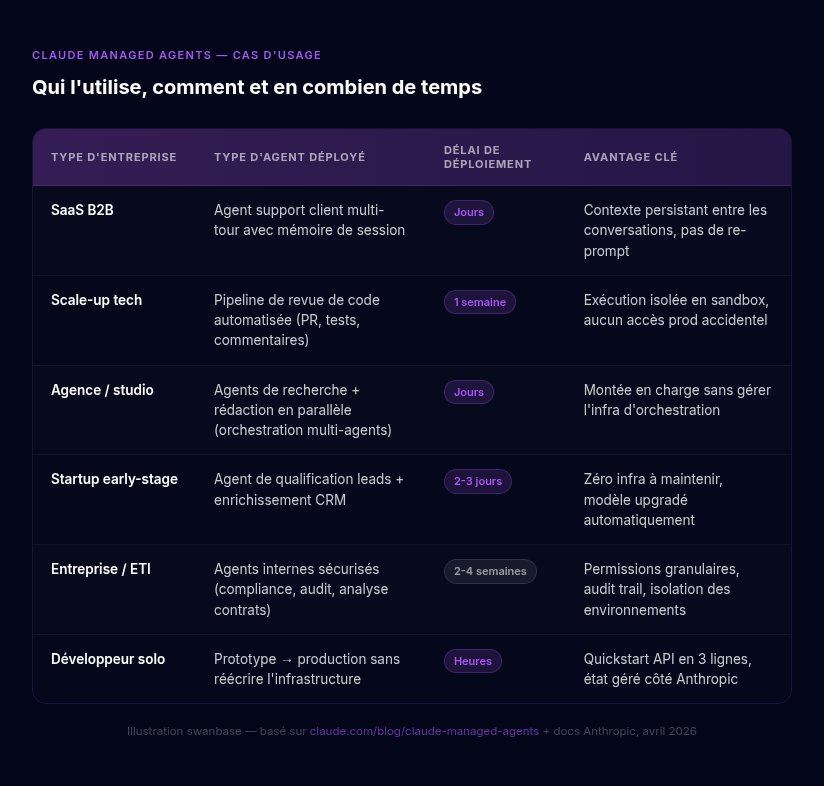
Use cases: what teams have already shipped
 swanbase illustration, based on claude.com/blog/claude-managed-agents, Anthropic
Notion, Rakuten, Asana, Vibecode, Sentry
These teams have been in production since the beta launch:
Notion: work delegation directly from the workspace. Engineers ship code, knowledge workers produce slides and sites. Dozens of tasks running in parallel with collaboration on the outputs.
Rakuten: specialized agents for product, sales, marketing, and finance, wired into Slack and Teams. Employees assign tasks and get deliverables back. Each agent deployed in under a week.
Asana: AI Teammates that work alongside humans inside Asana projects, picking up tasks and drafting deliverables. Advanced features built "dramatically faster" than with a classic setup.
Sentry: their Seer agent detects a bug, a Claude agent writes the patch and opens the PR. From bug detected to fix ready for review in a single flow. Integration shipped in weeks, not months.
Vibecode: Managed Agents as the default integration for going from prompt to deployed app. Infrastructure spin-up 10x faster than before.
How to get started in under 10 minutes
Via the Claude Console
The fastest route. Head to platform.claude.com/workspaces/default/agent-quickstart. A visual interface to configure an agent, test a session, and copy the agent ID into your code. No command line required for a first test.
Via the CLI
Anthropic launched an ant CLI alongside Managed Agents:
brew install anthropic-cli
ant --version
Then create your first agent via the API:
curl https://api.anthropic.com/v1/agents \
  -H "x-api-key: $ANTHROPIC_API_KEY" \
  -H "anthropic-beta: managed-agents-2026-04-01" \
  -d '{
    "name": "code-reviewer",
    "model": "claude-sonnet-4-6",
    "system_prompt": "You are a code reviewer...",
    "tools": [{"type": "agent_toolset_20260401"}]
  }'
Via Claude Code
If you already use Claude Code, this is the fastest route of all. Type directly into Claude Code:
start onboarding for managed agents in Claude API
The built-in skill walks you through the entire setup interactively.
What kind of project is it for?
Managed Agents makes sense if:
- You're shipping an agent for your end users (not a one-off internal tool)
- Your tasks run longer than a few minutes and need to be reliable
- Your dev team is small and you don't want a parallel infrastructure project
- You need multi-agent (in research preview, but available soon)
The Messages API is still better if:
- You're prototyping or doing quick tests
- You need very fine control over the agent loop's behavior
- Your use case is simple and synchronous (one question, one answer)
FAQ
Is Claude Managed Agents available now?
Yes, in public beta since April 8, 2026 on the Claude Platform. Every developer with access to the Anthropic API can use it right away. Multi-agent coordination (agents that spawn others) is in research preview on request.
How is it different from Claude Code?
Claude Code is a local, interactive development tool that runs on your machine. Managed Agents is a cloud infrastructure for deploying agents to production. The two are complementary: you can use Claude Code to build and test, then deploy via Managed Agents. The start onboarding for managed agents in Claude API command from Claude Code kicks off the connection between the two. If you're still weighing your dev environment, our Claude Code vs. Cursor comparison helps you decide, and our overview of AI tools for startups in 2026 places Managed Agents in the full stack.
How much does a typical session cost?
A 10-minute agent costs roughly $0.013 in session-hours ($0.08/hour × 1/6). Tokens add up depending on the volume of work. For a one-hour document-processing task, count on $0.08 in session-hours plus tokens. In the vast majority of cases, tokens dominate the total cost, not the session-hour.
Can you use your own tools with Managed Agents?
Yes. The API supports custom tools and MCP (Model Context Protocol) integration for connecting external systems. The meeting-prep agent example uses calendar and contact data through custom tools, and third-party systems (CRM, notetakers) through MCP.