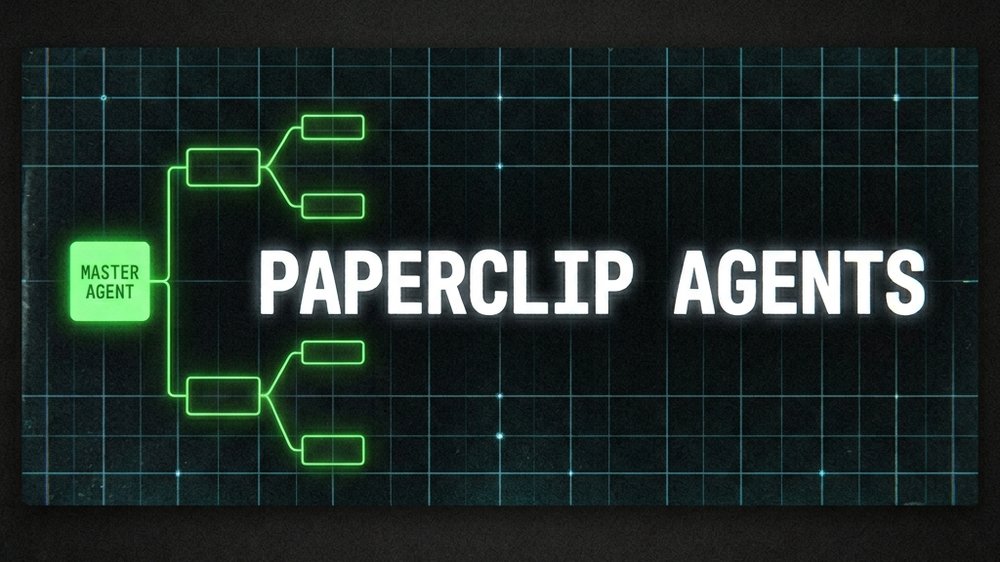
Paperclip: The Open Source Orchestrator for Managing a Team of AI Agents
 Source: paperclip.ing
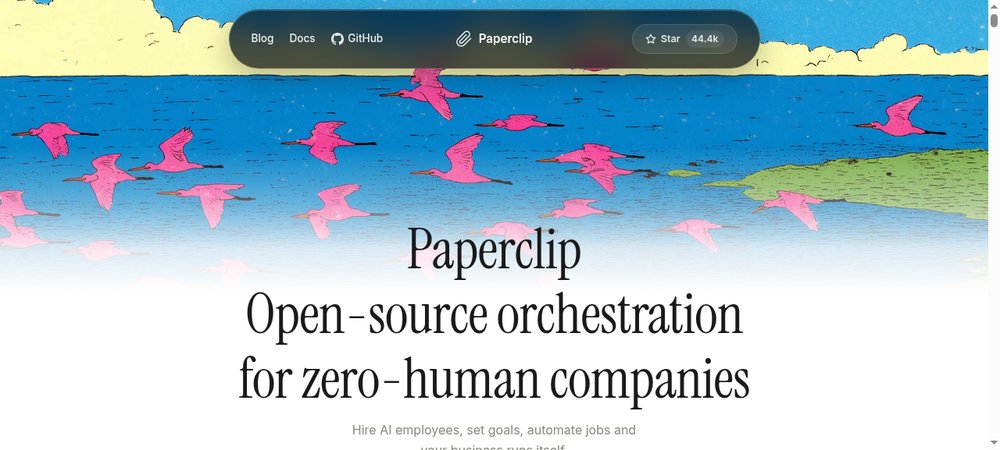
Paperclip is an open source orchestration platform that turns your AI agents into a real, structured organization. You define a mission, you recruit agents (CEO Claude, CMO OpenClaw, CTO Codex), you set budgets, and the whole thing runs autonomously under your supervision. It's racked up 44,400 GitHub stars in a few weeks, ships under an MIT license, and runs fully self-hosted with no account required. One command gets you started: npx paperclipai onboard --yes.
If you're already juggling several AI agents in parallel and your setup looks like 20 open tabs with no bird's-eye view, Paperclip is for you. If you're just starting out with a single agent, n8n or Dify will fit better. The line is clear.
What is Paperclip?
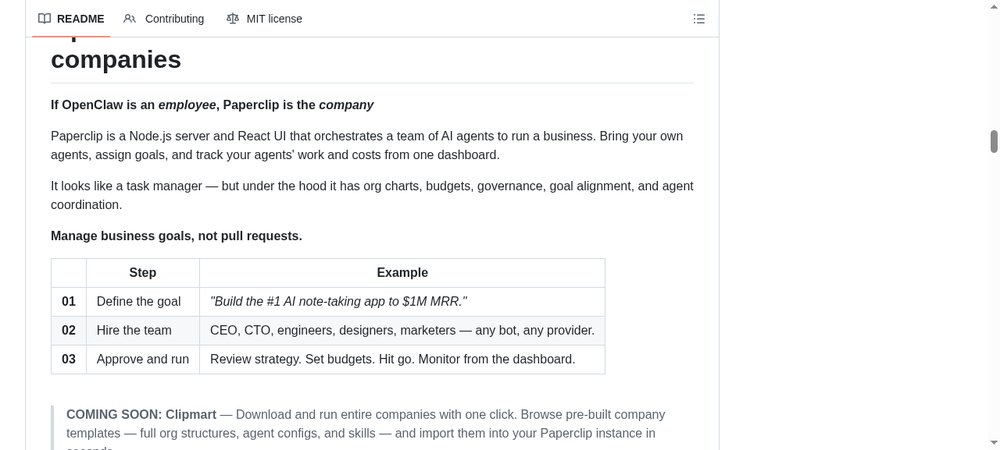
The analogy everyone remembers: "OpenClaw is an employee, Paperclip is the company"
This one line says it all. OpenClaw, Claude Code, Codex: these are agents that execute tasks. Paperclip is the structure those agents slot into: the org chart, the reporting system, the budgets, the governance.
Picture a driving school where every instructor drives beautifully but nobody knows which lesson is scheduled, who's responsible for what, or how much each lesson costs. Paperclip is the driving school's management system, not the instructor.
What Paperclip isn't
The product page says so explicitly, and it matters for setting expectations:
- Not a chatbot. No conversation interface. Agents have missions, not chat windows.
- Not a workflow builder. No drag-and-drop like n8n. Paperclip models companies with org charts, not visual pipelines.
- Not an agent framework. Paperclip doesn't tell you how to build your agents. It tells you how to make them work together.
- Not a single-agent tool. If you have one, you probably don't need it. If you have five or twenty, that's no longer a question.
The "Memento Man" model: why your agents need structure
The AI agent amnesia problem
Dotta, Paperclip's creator, has a way of describing the problem that sticks with you:
"Your AI agents are Memento Man. They wake up, they know how to fight, drive, take care of themselves. But they don't know who they are, where they are, or what they're supposed to do."
Every session starts from scratch. The agent has the skills but not the context. Without structure, you spend your time re-injecting that context by hand: who am I, what's my goal today, what got done yesterday. It's full-time babysitting.
That's the fundamental problem Paperclip solves, not by making agents smarter, but by giving them an organization.
How the heartbeat system solves context on every wake-up
The heartbeat is the core mechanic. On each cycle, the agent follows a checklist:
- Retrieve its identity (who am I in this organization?)
- Read its plan (what are my current goals?)
- Check its assignments (has anything been assigned to me?)
- Execute
- Store what got done in memory
- Report up the hierarchy
The agent wakes up with full context at every heartbeat, so there's no re-prompting and no supervision needed. The system re-establishes context on every wake-up.
Key features
 Source: github.com/paperclipai/paperclip
Org chart and hierarchies
Every agent has a title, a role, and a manager in the organization. CEO Claude delegates to CTO Cursor, who coordinates with Codex engineers. Delegation is automatic: tickets get assigned to the best-suited agent based on the hierarchy you define.
Heartbeats: autonomous agents on a schedule
Each agent beats at a set rhythm: every 4 hours, every 24 hours, or when a task is assigned. On each heartbeat: wake up, check the backlog, execute, update the ticket, go back to sleep. You step in only for decisions that need your approval.
Budgets and per-agent cost control
Each agent gets a monthly budget. Alert at 80%, automatic shutdown at 100%. No token drift, no end-of-month surprises. You can track cost per agent, per project, per task. That level of granularity doesn't exist in a "20 open tabs" setup.
Governance: you're the board
Agents can't recruit other agents without your approval. The CEO can't run a strategy you haven't signed off on. You can pause, reassign, adjust a budget, or terminate any agent at any time. Autonomy is a privilege you grant, not a default.
Ticket system and full traceability
Every instruction, every response, every tool call is recorded in a ticket with its complete history. An immutable, append-only log. Nothing happens in the dark. If an agent made a bad call, you can trace exactly which tool it invoked and why.
Bring Your Own Agent: full compatibility
Claude, OpenClaw, Codex, Cursor, Bash, HTTP
Paperclip is deliberately agnostic. The rule is simple: if it can receive a heartbeat, it can be recruited. In practice:
- Claude Code (Anthropic): via native integration or MCP
- OpenClaw: the most-used option with Paperclip, according to the community
- Codex (OpenAI): code tasks
- Cursor: assisted development
- Python or Bash scripts: your existing automations
- HTTP endpoints: any service with an API
Your existing agent stack plugs in as-is. No migration, no rewrite.
SKILLS.md: context injection at runtime
Each agent can discover the context it needs at runtime via a SKILLS.md file provided by Paperclip. No retraining. The agent learns the organization's workflows, the project's conventions, and the current goals on every wake-up. It's the equivalent of automatic onboarding at every session.
Multi-company and Cliphub (roadmap)
A single Paperclip deployment can run several AI companies with full data isolation. Handy if you manage multiple projects in parallel, multiple ventures, or if you want to test two strategies at once.
Cliphub (coming soon): a marketplace of preconfigured organization templates. Content Marketing Agency (8 agents), Crypto Trading Desk (12 agents), YouTube Factory (6 agents), Dev Agency (9 agents). You import the template, configure your API keys, and start. It's the most interesting promise on the roadmap for founders who want to move fast. Dotta himself has cautioned that it's "completely unproven for now," but the direction is clear.
Installation and getting started in 3 steps
 Source: paperclip.ing
Local (npx command)
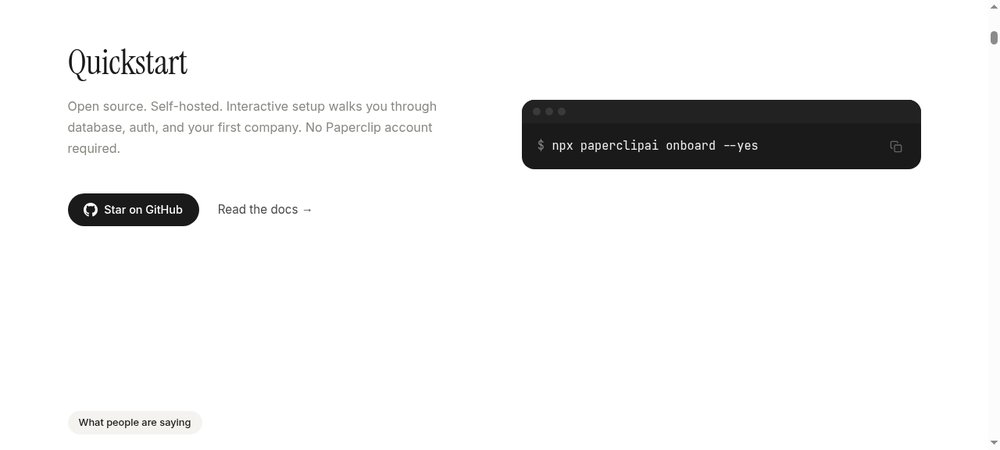
Paperclip is fully self-hosted. A single Node.js process runs an embedded Postgres database locally:
npx paperclipai onboard --yes
The interactive onboarding walks you through database setup, authentication, and creating your first company. No Paperclip account required. No agents installed automatically.
Requirements: Node.js 18+, API keys for your agents (Anthropic, OpenAI, etc.), 10-15 minutes.
Cloud (VPS)
When you're ready for the cloud, Paperclip runs on any standard VPS. Your own agents can help with the migration via the provided SKILLS.md. Full documentation lives at docs.paperclip.ing.
Which founder profile is it for?
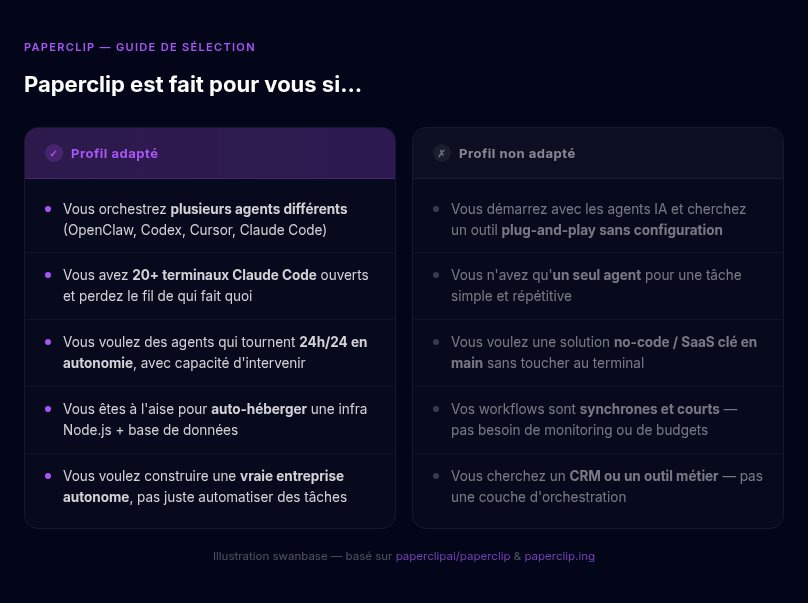 swanbase illustration, based on paperclipai/paperclip & paperclip.ing
Paperclip makes sense if:
- You already run several AI agents and struggle to coordinate them
- You want traceable, predictable costs per agent
- Your sessions need to survive reboots
- Your stack is heterogeneous (multiple providers, multiple tools)
- You want to stay in control without babysitting each agent individually
Look elsewhere if:
- You're new to AI agents and have a single, specific use case
- You want a no-code workflow builder for simple automations (look at n8n)
- Your team has no technical profile to handle onboarding
The right test: count how many agents you run today. Just one? Too early. Five or more? The question is no longer whether, but how.
FAQ
How do I install Paperclip?
One command does it: npx paperclipai onboard --yes. The interactive onboarding configures the database and creates your first company. Requirements: Node.js 18+ and the API keys for the agents you want to use (Anthropic, OpenAI, etc.). Installation takes 10 to 15 minutes.
Is Paperclip really free?
Yes. Paperclip is MIT licensed and self-hosted. You pay only for hosting (a standard VPS) and your agents' API calls at Anthropic or OpenAI rates. No Paperclip account, no platform subscription, no hidden fees.
How is it different from OpenClaw?
OpenClaw is an autonomous AI agent that runs tasks on your machine. Paperclip is the platform OpenClaw plugs into as an "employee." The two complement each other: Paperclip orchestrates OpenClaw within a structured organization complete with budget, tickets, and hierarchy.
Does it work with non-AI agents?
Yes. Any process that can receive a heartbeat signal can be recruited: Python scripts, HTTP webhooks, Bash commands. An agent doesn't have to be an LLM to fit into the Paperclip org chart.