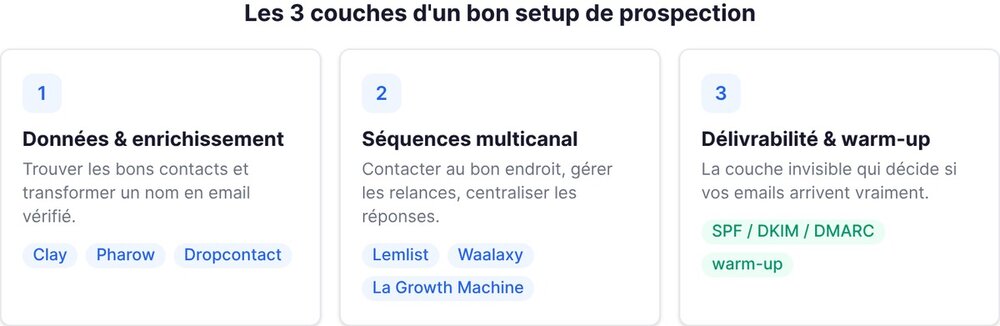
A good B2B prospecting setup comes down to three building blocks: a data and enrichment source to find the right contacts, a multichannel sequencing tool to reach them in the right place, and deliverability so your emails actually land. You don't need nineteen tools: when you're starting out, two or three well-chosen ones are enough. This guide breaks down the categories of B2B prospecting tools, compares the key options, explains how to choose, and gives you the minimal stack to switch on based on your founder budget.
Most guides you'll find on this topic are stacks of "top 19 tools" that prioritize nothing. That's the opposite of what you need when you're the only one doing prospecting between two product meetings. Here, we start from your stage and your budget, not from the longest list possible.
The categories of B2B prospecting tools
Before choosing a tool, you need to understand which building block it belongs to. A prospecting tool almost never does everything well: it excels at one layer and muddles through the others. Confusing the layers means paying three times for the same function or, worse, believing you're equipped when the link that gets your emails delivered is missing.
Databases & enrichment
This is the layer that answers "who to contact and how to reach them." It turns a company name or a LinkedIn profile into a verified email, phone number, company size, and tech stack. Without it, your perfect sequence goes out to fake addresses and bounces.
The go-to tools here: Clay for waterfall enrichment across 150+ providers, Dropcontact for GDPR-compliant B2B email, Pharow for targeting French accounts, and Apollo for a generalist database with a built-in sequencer. Their common trade: fresh, verified data.
Here's why this layer matters so much: a sequence is only as good as the list it runs on. You can have the best message in the world, but if it goes out to stale emails or to the wrong people, it will never convert. It's the "garbage in, garbage out" principle applied to prospecting. A founder who neglects data quality ends up blaming the message or the tool, when the problem was at the entry point. Spending ten minutes verifying and enriching your list before sending pays off more than ten tweaks to the message.
Multichannel & sequences (email + LinkedIn)
This is the layer that executes. It sends the messages, handles follow-ups, orchestrates email and LinkedIn in a single scenario, and centralizes replies. This is where your prospecting "machine" lives day to day.
The go-to tools: Lemlist for cold email with strong personalization and multichannel, Waalaxy for simple LinkedIn to get started, and La Growth Machine for advanced multichannel sequences. They look alike on the surface and differ mostly in the channel each does best.
Deliverability & warm-up
The invisible layer, the one you discover too late. An email that lands in spam doesn't exist. Warm-up gradually heats your inbox to build a sender reputation, and monitoring alerts you when you start slipping toward the promotions tab or spam.
Some sequencing tools build it in (lemwarm in Lemlist), others don't and you'll need to add a dedicated block. At any serious cold email volume, this isn't optional: it's what separates a campaign that gets replies from one that talks into the void.
A concrete benchmark: before you send a single cold email, your domain should be authenticated (SPF, DKIM, DMARC) and warmed up for two to three weeks. Many founders skip this step because it's neither visible nor exciting, then wonder why their reply rate is rock bottom. It wasn't the message that failed, it's that the message was never read. Deliverability isn't a layer you tack on at the end, it's the ground everything else stands on.
Our selection of B2B prospecting tools
Here are the tools a founder runs into most often, sorted by the layer they genuinely do well. The rule: first choose the layer you're missing, not the best-known brand.
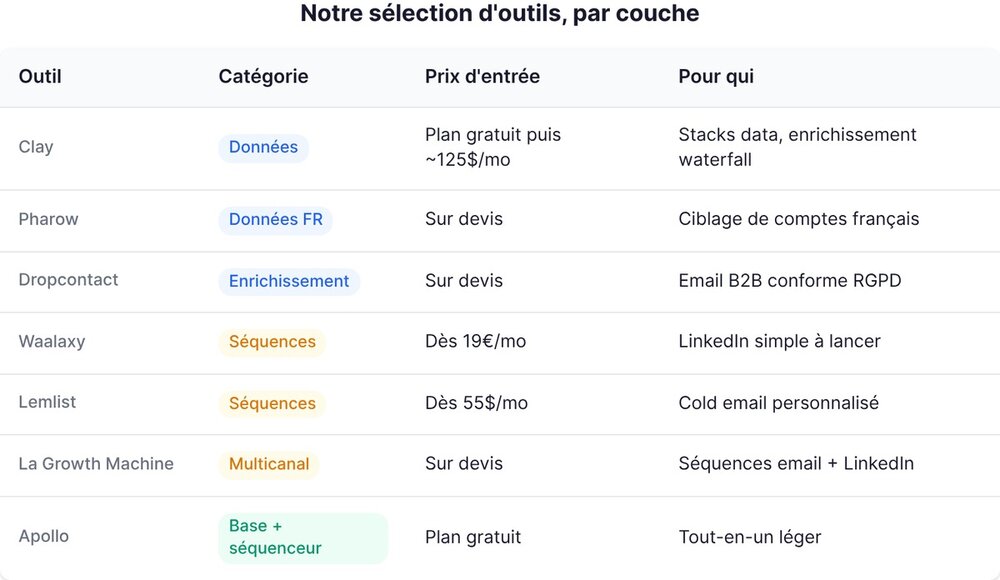
None of these tools is "the best" in absolute terms. Waalaxy starts at €19 per month and gets going in an afternoon, but stays LinkedIn-focused: we cover it all in our Waalaxy review. Lemlist starts at $55 per month on an annual plan and shines at personalized cold email, worth a look in our Lemlist review. Clay has a free plan and quickly becomes essential for data, but the bill climbs with credit volume, which we explain in our Clay guide. The right choice depends on what you do, not on a ranking.
A word on the "top 19 tools" listicles you'll come across: they deliberately mix tools that don't play in the same category, because a long list ranks better than an honest one. A useful comparison doesn't try to include everything, it helps you eliminate. For a founder, ruling out nine tools out of eleven is more valuable than discovering ten new ones. That's also why we don't rank tools by an overall score here: an overall score makes no sense when a data tool and a sequencer aren't doing the same job.
How to choose your prospecting tool
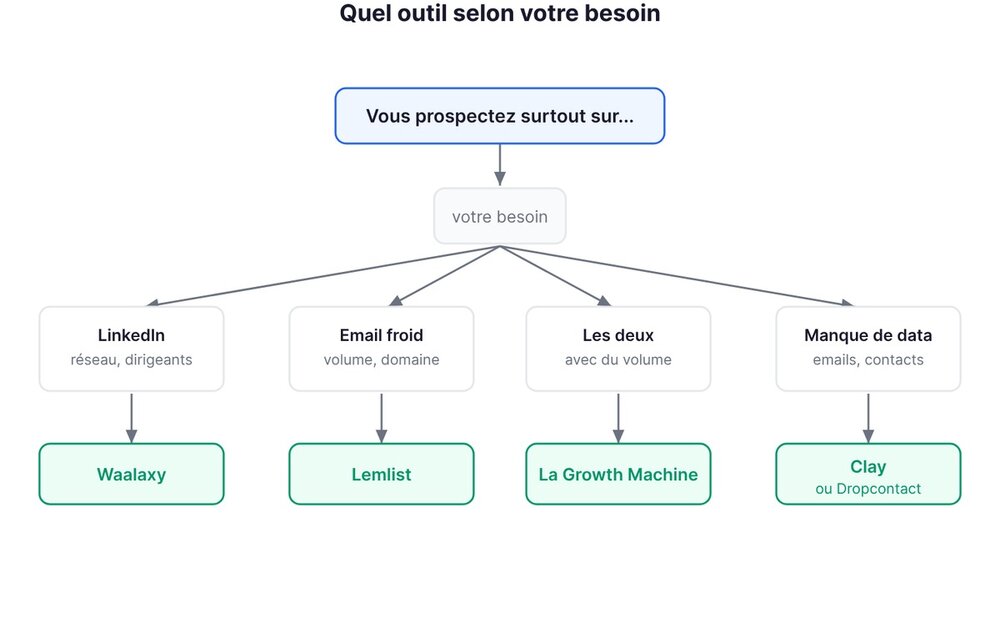
The question isn't "what's the best tool" but "which layer am I missing, and what stage am I at." Two founders at the same point in their company's life pick different tools because they prospect on different channels.
By your channel (LinkedIn, email, multichannel)
If your target lives on LinkedIn (tech profiles, executives, warm network), start with a native LinkedIn tool like Waalaxy. If you're going cold on business emails (larger volume, a target identifiable by domain), cold email with Lemlist is a better fit. If you want to combine both in a single scenario with cross-channel follow-ups, a multichannel tool like La Growth Machine or Waalaxy's Business plan bridges the two.
The reflex to avoid: choosing the channel because you like the tool, instead of choosing the tool because the channel matches your target. Your prospects aren't on every channel with the same availability. A CFO is rarely reached the same way as a developer or the head of a small business. Start from where your target actually replies, test one channel thoroughly before opening a second, and let the tool follow from that choice.
By your budget and stage
Right at the start, you don't need the Rolls-Royce of tools, you need to send your first hundred messages and see what replies. A tool at €19-55 per month is plenty to validate a message and a segment. Data at scale, multichannel orchestration, and advanced enrichment come later, once you already know which message converts. Investing in Clay before you have a message that works is buying a factory before you have a recipe.
There's another criterion the comparison tables ignore: the time the tool costs you. A founder doesn't have a full day to spend configuring enrichment waterfalls. Waalaxy takes an afternoon to get the hang of, while Clay demands real hours before it produces anything. That's not a flaw in Clay, it's the price of its power. But at the stage where your scarcest resource is your attention, a simple tool that runs beats a powerful one you never have time to wire up. Choose the tool you'll actually use this week, not the one with the prettiest feature sheet.
The minimal stack for an early-stage founder (by budget)
This is the angle the listicles forget: you don't have to buy everything. Here are three real setups based on what you can put in, each capable of sending genuine campaigns.
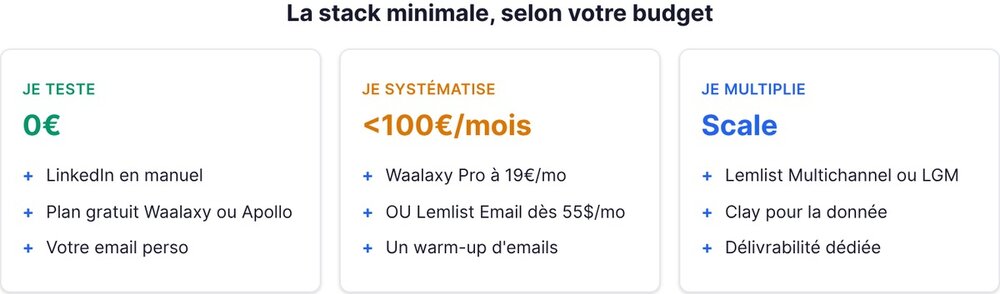
The logic is always the same: one layer at a time. You start with the channel you know and a single tool. You only add the data block (Clay, Dropcontact) when the lack of fresh contacts becomes your bottleneck. You only add dedicated deliverability when your cold email volume rises. Every euro follows a real problem, never the other way around.
A classic trap: stacking three overlapping tools (two sequencers, two databases) because each has "one extra thing." You pay double and dilute your attention. A well-chosen minimal stack beats a rich stack used badly.
The prospecting mistakes to avoid
Tools don't rescue shaky prospecting. Here's what breaks a campaign before it even starts, whatever the tool.
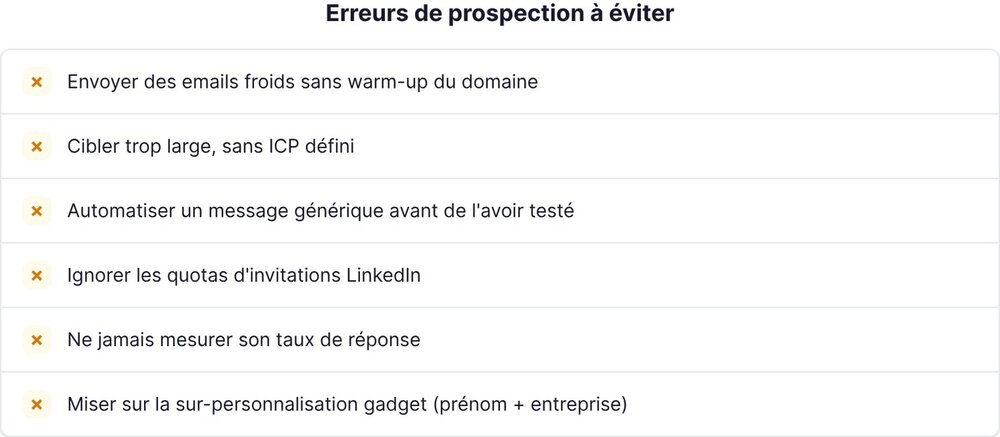
The first mistake, the most expensive, is automating too soon. A bad message sent to a thousand people is still a bad message, it just burns through your list and your reputation faster. Write and test your approach by hand on twenty prospects before automating anything.
The second is neglecting deliverability. You can have the best tool and the best message: if your emails go to spam because your domain isn't warmed up and authenticated (SPF, DKIM, DMARC), nobody reads them. It's invisible plumbing, and it decides everything.
The third is ignoring platform quotas. LinkedIn limits the number of invitations and messages, and pushing too hard puts your account at risk. Good tools build in guardrails, but it's on you to stay within the lines rather than chase the maximum volume.
The fourth, quieter one, is never looking at your numbers. Prospecting without tracking your reply rate is a blind campaign: you don't know whether it's the targeting, the message, or the channel that's stalling. Pick a single starting metric, the positive reply rate, and compare your variants on it. A message that goes from a 2% to an 8% reply rate is worth more than any extra tool, and you only see that by measuring.
Finally, be wary of gimmicky over-personalization. Dropping the first name and company name into a template doesn't make a message relevant: it's still a template. Real personalization, the kind that gets replies, comes down to one sentence that proves you understood the prospect's specific problem. No tool writes that for you. Tools automate the sending, not the relevance.
Going further
- Waalaxy: review, features, and pricing
- Lemlist: review, features, and pricing
- Clay: AI-augmented B2B prospecting
- Product-Led Growth: definition and principles
- Growth marketing for startups: the guide
FAQ
Which tools are essential for B2B prospecting?
No tool is essential in itself. The only essential thing is to cover three functions: finding reliable contacts, reaching them in an organized way, and landing in the inbox. A founder just starting out can cover all three with a single multichannel sequencer and a properly warmed-up email address. The rest gets added when a specific need shows up.
What budget should you plan for to get started?
Count on somewhere between €0 and €60 per month to launch real prospecting. Free or entry-level plans (Waalaxy at €19, Lemlist from $55 on an annual plan, Apollo on free) are enough to send your first few hundred messages and validate a segment. You only raise the budget once you've proven a message converts and volume, not the message, becomes your limit.
How do you stay deliverable and avoid getting banned?
Three habits: warm up your sending domain before any campaign (gradual warm-up), authenticate it technically (SPF, DKIM, DMARC), and respect each platform's quotas instead of testing them. On LinkedIn, stay under the invitation limits and personalize. For cold email, a tool with built-in warm-up like lemwarm in Lemlist sharply reduces the risk, but no tool recovers a burned domain.