Lemlist is a French cold email and multichannel outreach tool that sends your sequences by email, LinkedIn, calls, SMS, and WhatsApp from a single platform. You import or find leads, personalize at scale, protect your deliverability with lemwarm, and track your replies in a unified inbox. The trial is free for 14 days, no credit card required.
What is Lemlist?
Lemlist is an outbound prospecting platform born in France. The original bet was simple and a little against the grain: make cold email less cold. Where most tools blasted the same generic message to thousands of addresses, Lemlist pushed personalization at scale, all the way to inserting variables into images or landing pages.
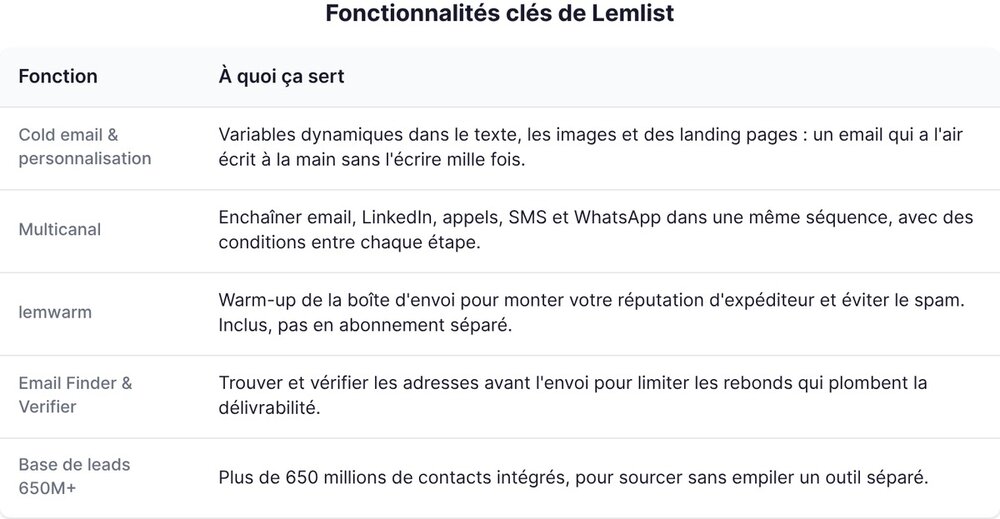
By 2026, the tool has grown well beyond its original box. It's no longer just cold email software: it's a full multichannel platform that orchestrates email, LinkedIn, calls, SMS, and WhatsApp within a single sequence. On top of that, there's a lead database of more than 650 million contacts, an email finder and verifier module, a warm-up system for deliverability (lemwarm), a unified inbox, and an AI layer called lemAgent.
For an early-stage founder, the promise is clear: centralize all of your outbound in one tool instead of stacking an email finder, a sequencer, a LinkedIn tool, and a separate warm-up. That's the real question to settle, and we'll come back to it below.
A word on context before we get into the details. Outbound prospecting has a bad reputation with many founders, often deservedly: done badly, it produces generic emails no one reads and that damage your sending reputation. Done well, it remains one of the most predictable channels for landing your first hundred customers when you have no brand awareness, no ad budget, and no community. Lemlist positions itself around that version of outbound: the one where every message is supposed to earn a reply. That's the frame to keep in mind when judging the tool, because it explains why so many features revolve around personalization and deliverability rather than raw volume.
Key features (cold email + multichannel + lemwarm)
Lemlist is judged on three pillars: cold email personalization, multichannel orchestration, and deliverability. The rest (lead database, finder, unified inbox, AI) orbits around them.
Cold email & personalization (images/liquid syntax)
This is Lemlist's home turf, and it's still its strong suit. Beyond the classic variables (first name, company), the tool offers advanced personalization that goes further than most competitors.
In practice, you can:
- Insert dynamic variables into text, but also into personalized images (the prospect's logo on a screenshot, their first name in a visual).
- Use conditional syntax (called liquid syntax) to display a different block of text depending on industry, job title, or any field in your list.
- Generate personalized landing pages for each recipient.
The upside: an email that looks handwritten without you having to write it a thousand times. The honest catch: this personalization doesn't fill itself in. It assumes clean data on your prospects and a bit of time to build the templates. Many users stick to the basic variables and never tap half the power. If you want to go deep on data, an enrichment tool like Clay plugs in upstream.
Multichannel (email + LinkedIn + calls)
Lemlist's real shift in recent years is multichannel. A sequence is no longer limited to email: you can chain an email, a LinkedIn profile visit, a connection request, a message, a call, an SMS, or a WhatsApp, with conditions between each step.
The thinking behind it is solid. A prospect who ignores three emails will sometimes reply to the first LinkedIn message. Multiplying touchpoints mechanically raises your chances of a reply, as long as you don't turn the sequence into harassment.
This is also where Lemlist's positioning sets it apart from purely LinkedIn tools like Waalaxy: email stays the central channel, and LinkedIn and the rest come in to reinforce it. If your motion is LinkedIn-first, the balance flips, so compare with our Waalaxy review.
In practice, multichannel only makes sense if you have something to say on each channel. Sending the same copy-pasted message by email and then on LinkedIn won't lift your replies, it annoys people. The right way to use it: think of each step as a follow-up that brings a fresh angle, not a repeat. That's more work at the design stage, but it's what separates a sequence that converts from one that gets flagged as spam. Lemlist gives you the rails; the content that runs on them is still your part of the job.
Lemwarm (deliverability)
The best email in the world is worthless if it lands in spam. That's cold email's problem number one, and Lemlist answers it with lemwarm, a warm-up tool for your sending inbox.
The principle: lemwarm automatically generates email exchanges between participating inboxes, which open and reply to each other, to signal to providers that your address is active and legitimate. Over the weeks, your sender reputation climbs and your emails have a better chance of landing in the primary inbox rather than in spam.
Having this built in rather than as a separate subscription is a real plus. That said, worth noting: no warm-up makes up for a bad foundation. If your list is bought blind, your content aggressive, and your volume too high, deliverability will drop anyway. Warm-up is hygiene, not a magic trick, and good authentication practices (SPF, DKIM, DMARC) remain your responsibility, as Google's documentation on sending email points out.
Lemlist pricing 2026
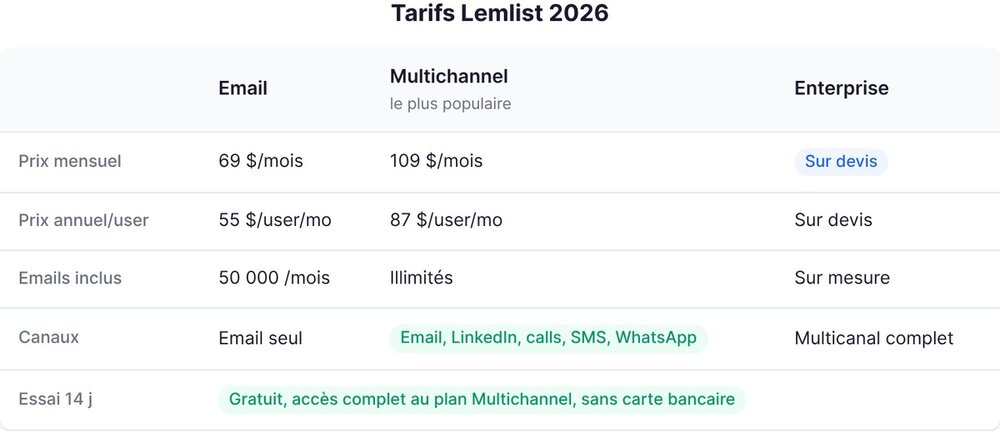
Lemlist offers three plans, with a free 14-day trial that gives access to the full Multichannel plan, no credit card required. Billing is available in dollars, euros, or pounds. Here's the official grid, which you should verify on Lemlist's pricing page, the source of truth:
- Email: $69/month billed monthly, or $55/user/month on an annual commitment. Includes 50,000 emails per month and an unlimited number of users. This is the plan for anyone doing pure cold email, without multichannel.
- Multichannel (the most popular): $109/month billed monthly, or $87/user/month annually. Unlimited emails and messages, full multichannel (LinkedIn, calls, SMS, WhatsApp). This is the plan that matches the tool's real promise.
- Enterprise: custom quote ("Talk with sales"), for high volumes and specific needs.
One thing to watch closely as a founder: the price climbs fast once you move to multichannel and add seats. At $87/user/month annually, a small three-person team goes past $260/month. That's not expensive for the value if you push the tool to its limits; it becomes so if you pay for multichannel only to use email. Choose the plan that fits your real motion, not your ambition.
Two practical tips on billing. First, the annual commitment noticeably lowers the cost per seat ($55 vs $69 on Email, $87 vs $109 on Multichannel), but it locks you in for twelve months: only take it once the tool is validated on your process, not on day one. Second, actually use the 14-day trial. Full access to the Multichannel plan without a card lets you test multichannel, advanced personalization, and lemwarm before paying anything. Many founders skim the trial and then subscribe on a hunch; use it to launch a real small campaign and measure your actual reply rates.
Pros and cons (founder's take)
The verdict, no sugarcoating: Lemlist is one of the most complete outbound tools on the market, with a genuine strength in personalization and serious multichannel. Its price and richness can work against you if your usage stays basic.
What works
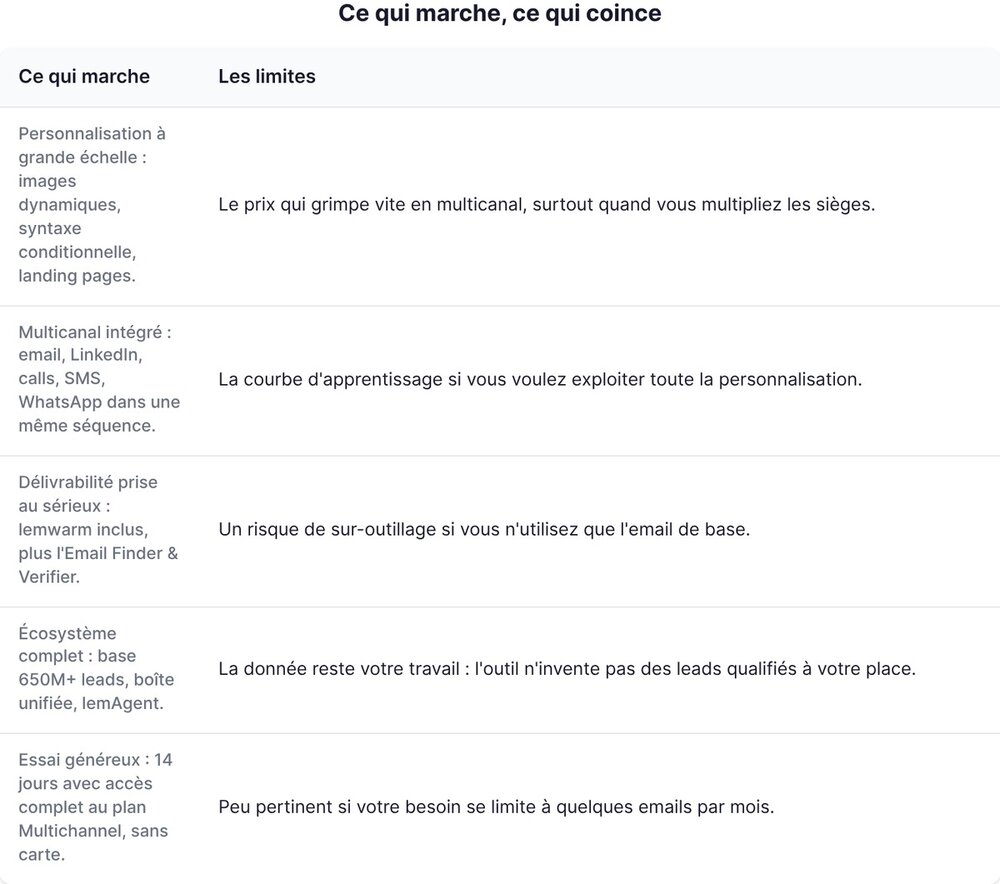
- Personalization at scale. Dynamic images, conditional syntax, landing pages: few tools go this far, and it's what makes your emails stand out.
- Built-in multichannel. Email, LinkedIn, calls, SMS, WhatsApp in a single sequence, without gluing three tools together.
- Deliverability taken seriously. lemwarm included, plus the Email Finder & Verifier to clean your lists before sending.
- A complete ecosystem. A 650M+ lead database, a unified inbox, lemAgent: you can run all of your prospecting in one place.
- A generous trial. 14 days with full access to the Multichannel plan, no card, which lets you judge on the evidence.
The limits
- The price that climbs fast in multichannel, especially as you add seats.
- The learning curve if you want to make the most of all the personalization: it has to be earned, it doesn't configure itself in five minutes.
- A risk of over-tooling. If you only use basic email, you're paying for features you never open.
- The data is still your job. The tool is powerful, but it won't invent qualified leads or clean variables for you.
Lemlist vs Waalaxy vs La Growth Machine
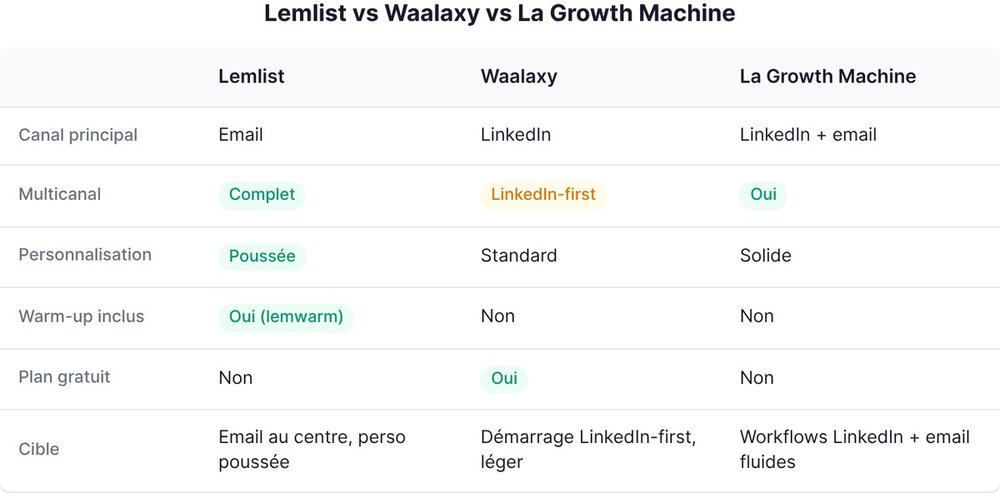
Three tools come up again and again when a founder looks to do outbound in French. They don't aim at exactly the same thing.
In short, and without turning it into a boxing match:
- Lemlist is strongest when email is your central channel and you want to push personalization far, with multichannel as backup. It's also the most complete, and therefore the richest to get to grips with.
- Waalaxy is first and foremost a LinkedIn tool, with a free plan and a simpler learning curve. Ideal if your motion is LinkedIn-first and you're starting light. The details are in our Waalaxy review.
- La Growth Machine plays the multichannel game with a reputation for polished automation, often chosen by teams that want smooth LinkedIn + email workflows.
The right choice depends on your dominant channel and your appetite for configuration. For a broader overview of the options, see our guide to B2B prospecting tools.
Who is Lemlist for?
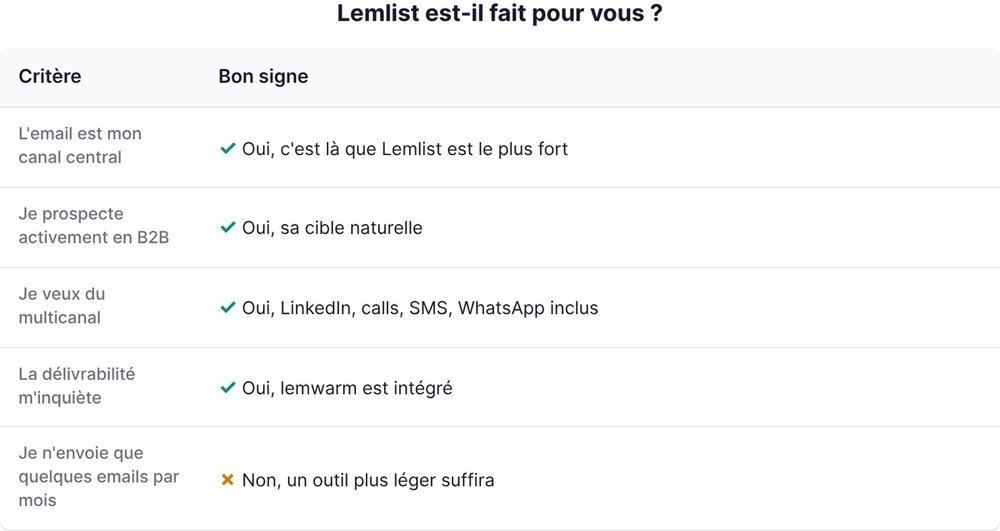
Lemlist is a good bet if you do serious outbound with email at the center and you're ready to invest a bit of time in personalization. Sales teams, agencies, and founders who actively prospect in B2B are its natural target.
The tool is less relevant if your need is limited to a few emails a month, if you're just getting started and looking for the cheapest option possible, or if your motion is purely LinkedIn without email. In those cases, a lighter or more specialized tool will do the job for less.
The classic founder trap is choosing Lemlist for its reputation and then using only 20% of its features. You end up paying for the full multichannel plan just to send basic emails. The tool won't do the prospecting for you: it amplifies an approach you've already thought through. If there's no prospecting strategy behind it, no tool will replace one.
Going further
- Waalaxy: review, features, and pricing
- B2B prospecting tools: the founder's guide
- Clay: AI-augmented B2B prospecting
- Product-Led Growth vs Sales-Led
- Growth marketing for startups: the guide
FAQ
Is Lemlist worth the price?
Yes, if you make the most of what you're paying for. On the Multichannel plan, the advanced personalization, multichannel, and included lemwarm justify the cost for active prospecting. No, if you only send a few basic emails: you'll be paying for features you never open. Check the up-to-date grid on the official pricing page and try the 14 free days before deciding.
Lemlist or Waalaxy for a founder?
It depends on your channel. If email is central and you want to push personalization, Lemlist is the better fit. If your motion is LinkedIn-first and you're starting on a tight budget, Waalaxy and its free plan are a better entry point. Our Waalaxy review breaks down the comparison.
Is the Lemlist email database worth it?
The built-in 650M+ lead database saves you from stacking a separate sourcing tool, and the Email Finder & Verifier limits the bounces that drag down deliverability. It's a real gain in centralization. Still, a heads-up: a broad database doesn't replace precise targeting. Fine enrichment, via a tool like Clay, stays useful if you're aiming at tight segments.