Product market fit (PMF) is the moment when a product meets a need so well that the market "pulls" growth instead of the team pushing it. Marc Andreessen, who popularized the term, defines it as "being in a good market with a product that can satisfy that market." It isn't a gut feeling, it can be measured: the Sean Ellis test considers that a product has reached PMF when at least 40% of its users would be "very disappointed" if they could no longer use it. Below that, you're not there yet. Before PMF, almost nothing matters: not hiring, not fundraising, not growth. After it, almost everything gets easier. This guide gives the clear definition, the exact measurement protocol, a real example (Superhuman), the limits of the famous 40% threshold, and the concrete steps to get there.
What is product market fit?
Product market fit is the alignment between what you're building and what a market actually wants to buy. The term was popularized by Marc Andreessen in the mid-2000s (the idea is often credited to Don Valentine, founder of Sequoia). His phrasing: "being in a good market with a product that can satisfy that market."
In practice, before PMF, you push. You chase every customer, you convince them one by one, you explain why your product is useful, and the moment you stop pushing, growth stops. After PMF, the market pulls. Customers arrive faster than you can serve them, they come back, they tell others, and your problem becomes keeping up with demand rather than creating it.
It's the difference between rowing against the current and feeling the current carry you. As long as you're still rowing, you don't have PMF. And deep down you know it, even if you tell yourself otherwise.
It's worth clearly separating three things that often get confused. Problem-solution fit means you've validated that a real problem exists and that your solution solves it on paper (often at the mockup or prototype stage). Product market fit is the next step: people actually use your product, keep it, and would be unhappy to lose it. Channel fit, or go-to-market fit, comes later still: you've found an acquisition channel that brings you customers in a repeatable, profitable way. Many founders think they're chasing PMF when they haven't even confirmed problem-solution fit, or the reverse, believing they've lost it when all they have is a channel problem. Knowing where you stand changes what you need to fix.
Why PMF is the only milestone that truly counts
An early-stage startup has just one job: finding its product market fit. Everything else is secondary until that's sorted out.
It's counterintuitive, because it's tempting to do "what you see" successful startups do: hire, raise money, build a brand, optimize your funnel. But those levers only amplify what already exists. Running growth on a product without PMF is like pouring water into a leaky bucket: you just speed up the leak. Raising money before PMF buys you time to look for it, not proof that you've found it.
The practical consequence is radical: before PMF, the one metric that truly matters is retention. Do people come back? Would they be unhappy without you? The rest (acquisition, awareness, fundraising) can wait. Find the fit first, amplify second.
How do you know you've reached PMF?
That's the real question, and it's where most guides stay vague. "You'll know," "the market will tell you": not wrong, but useless. There are qualitative signals and a numeric test. Use both.
The qualitative signals
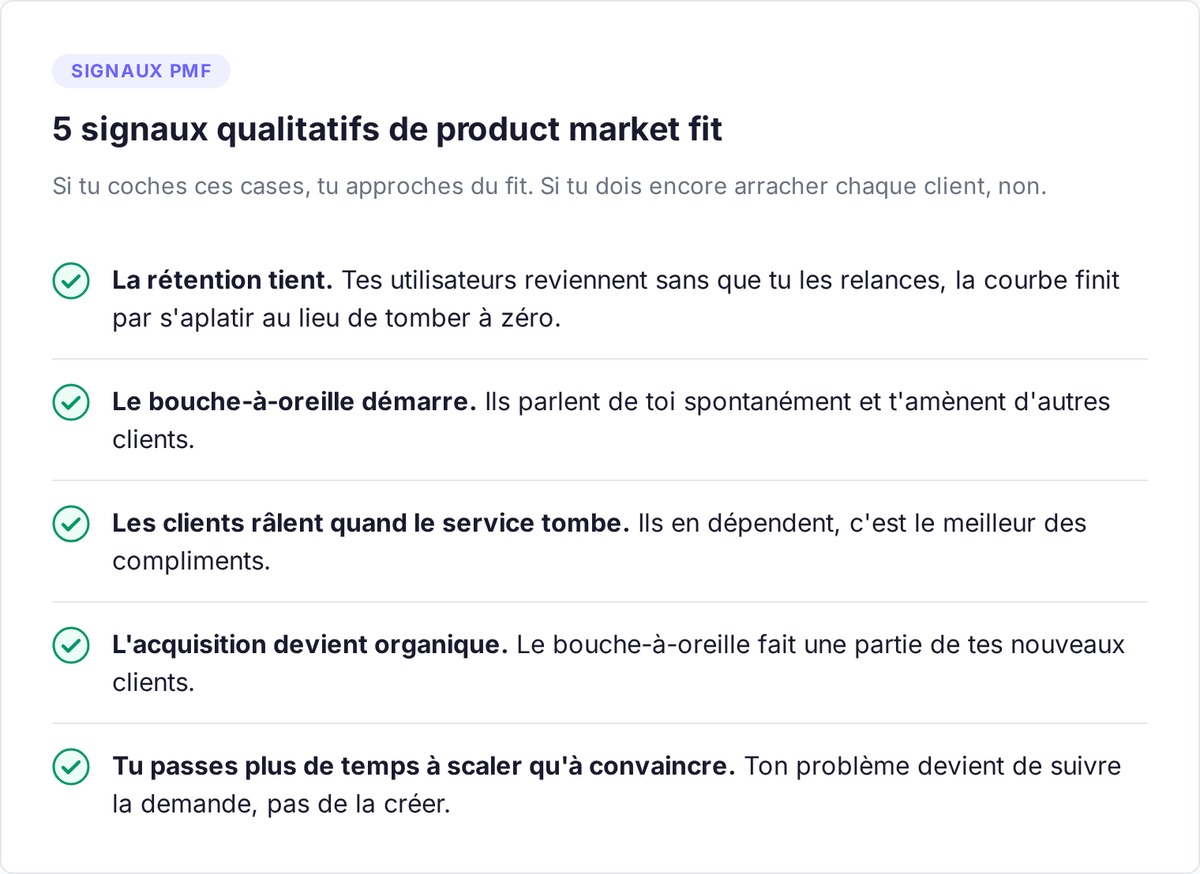
Even before you measure, some signs don't lie. Your users come back without you nudging them (retention holds over time). They mention you spontaneously and bring you other customers. They complain when the service goes down, because they depend on it. Word of mouth starts to drive part of your acquisition. And you spend more time hiring and scaling than convincing. If you tick these boxes, you're closing in on fit. If you still have to wrestle every customer over the line, you're not.
The hardest but most reliable signal is the retention curve. Plot, cohort by cohort, the percentage of users still active week after week. Without PMF, this curve falls to zero: everyone eventually leaves. With PMF, it eventually flattens, at 20%, 40%, whatever the level, but it stabilizes instead of falling. That flat line is the most concrete proof that a core of users has found real value and won't let go. A curve trending toward zero, even with flattering acquisition at the top of the funnel, means you're filling a leaky bucket.
Watch out for false signals too. A successful fundraise proves nothing about PMF (it proves you can raise). Neither does a traffic spike after a Product Hunt launch: that's curiosity, not retention. And compliments in user interviews are the most treacherous of all, because people are polite. The only question that matters isn't "do you like it?" but "do you come back, and would you be unhappy without it?"
The Sean Ellis test: 40% "very disappointed"
The most widely used test comes from Sean Ellis. You ask your users a single question: "How would you feel if you could no longer use this product?" Three possible answers: very disappointed, somewhat disappointed, not disappointed.
The threshold: if at least 40% of respondents say "very disappointed," you have a strong signal of product market fit. Below that, the product hasn't found its audience yet, or not the right one. The power of this test is that it turns a fuzzy intuition into a number you can track over time, segment by segment.

The Superhuman method (Rahul Vohra)
The best-known application is Superhuman's, told by its founder Rahul Vohra. Rather than accept a 22% score and wait, he turned the test into an improvement engine.
His method, which you can reproduce, comes in four steps. One, survey only genuinely active users (those who used the core of the product at least twice in two weeks), not your dormant sign-ups who would skew everything. Around forty respondents is enough for a usable direction. Two, focus on the "very disappointed" group: who are they, what job, what use case, what do they love about the product? That persona becomes your target, and the reason they cite most often becomes your core message. Three, look at the "somewhat disappointed" users who resemble your fans and ignore the ones who never will: ask the former for the single improvement that would tip them into "very disappointed," and build exactly that. Four, split your roadmap: half to deepen what fans already love, half to remove the blockers for the convertible fence-sitters.
Vohra's conceptual breakthrough was turning a static score into a product engine. Instead of seeing "22%, failure" and waiting for inspiration, he treated the test as a weekly compass: who loves it, why, and how to make the segment right next door love it too. In a few quarters, Superhuman pushed its score well past 40% by focusing on the fans and converting the lukewarm, without ever diluting the product to please people who would never have become fans.
Why 40% isn't an absolute truth
Here's what the articles that cite the test forget to say: the 40% threshold is a heuristic, not a law. It comes from Sean Ellis's experience and intuition, not from a validated academic study. Nobody has shown that at 39% you fail and at 41% you succeed.
Above all, the number depends on your sample size. At 50 respondents, your confidence interval is wide: a reported score of 40% could actually cover a range of roughly 27% to 53%. In other words, with few respondents, don't treat a 38% as a failure or a 42% as a victory. The test is excellent as a compass and as a tracking tool over time; it's dangerous as a binary verdict. Look at the trend over several months, not the number from a single survey.
The steps to reach product market fit
PMF can't be declared, it's built through iterations. The loop is always the same: a problem, a hypothesized solution, a launch into the market, a measurement, a lesson, and you start again.
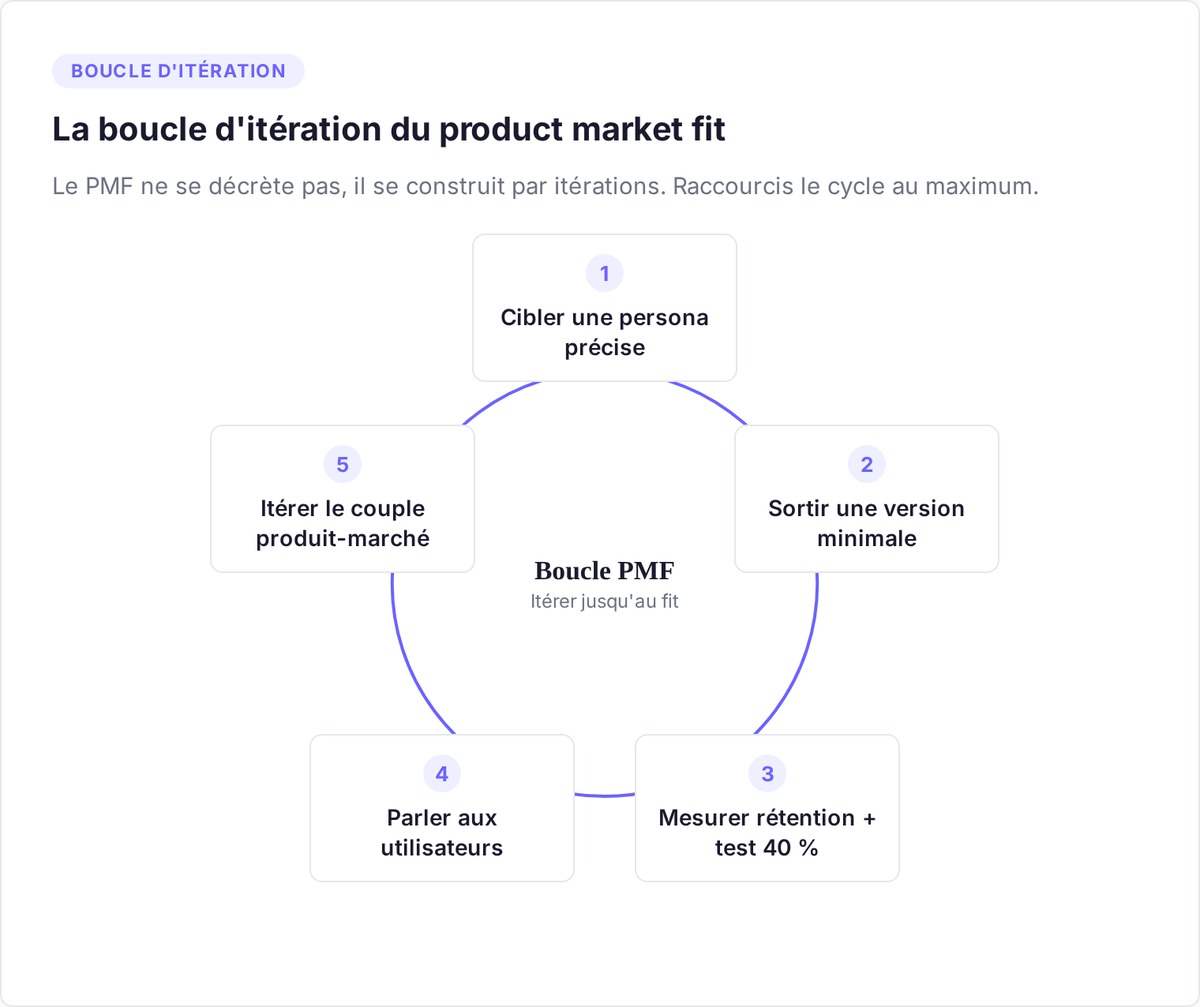
- Target a precise problem for a precise persona. PMF is found on a narrow segment before it widens. "Everyone" isn't a market. Start with the people who feel the problem most painfully.
- Ship a minimal version and put it in real hands. No perfect product before your first user. You learn by selling, not by polishing. To do that, finding your first customers is the step that teaches you the most.
- Measure retention and run the 40% test. Do they come back? Would they be disappointed to lose you? That's your guiding signal.
- Talk to those who leave and those who stay. The "very disappointed" tell you what to keep, the others tell you what to fix. The gap between the two is your roadmap.
- Iterate on the product-market pair, not just the product. Sometimes the product is good but the segment is wrong. Changing your target is as powerful a lever as changing a feature.
Two principles run through this loop. First, shorten the cycle as much as you can: what determines your odds of finding fit before you run out of money isn't the brilliance of one iteration, it's the number of iterations you can string together. A team that loops in a week learns ten times faster than a team that ships one version per quarter. Second, change one variable at a time when you can: if you change the target, the price, and the promise all at once, you'll never know what moved the score. Experimental discipline is worth more than raw speed.
It's slow, it's repetitive, and there's no shortcut. PMF isn't a flash of genius, it's the result of a series of disciplined iterations.
What to do when you don't have PMF (yet)
If your test is stuck below 40% and retention is leaking, don't rush into growth. You'd be amplifying a product no one keeps. Three levers, in order.
First, narrow your target. Many products without PMF actually have a hidden fit on a sub-segment, buried inside a target that's too broad. Identify your core of "very disappointed" users and build for them, even if it means disappointing others at first.
Next, dig into the problem before the solution. PMF that won't come often signals that you've solved a problem no one finds painful enough to pay for. Go back and talk to users, listen to what keeps them up at night, not what they think of your feature.
Finally, protect your runway. Finding PMF takes time, and you want to last long enough to find it. That's the whole point of a lean startup before fit: minimize burn to maximize the number of iterations you can afford. Before PMF, your number one enemy is running out of attempts.
There's one question no one likes to ask: what if the problem wasn't the target or the product, but the market itself? A market that's too small, or people who have the problem but will never pay to solve it, will never produce PMF, no matter how good your execution. Andreessen is blunt about this: in a bad market, the best product and the best team still lose. Before grinding away for twelve months, honestly check that the market you're aiming at is big enough and ready enough to pay. If the answer is no, the most powerful pivot isn't a feature, it's changing markets while you still have the runway to do it.
FAQ
What is product market fit, in simple terms?
It's the moment when your product satisfies a market so well that growth becomes pulled by demand instead of pushed by brute force. Marc Andreessen defines it as "being in a good market with a product that can satisfy that market." Before, you chase customers; after, they come to you.
How do you know if you've reached product market fit?
Cross two readings. The qualitative signals (retention that holds, word of mouth, users who depend on the product) and Sean Ellis's numeric test: if at least 40% of your active users would be "very disappointed" if they could no longer use it, you have a strong PMF signal. Look at the trend over time, not an isolated score.
What is Sean Ellis's 40% test?
You ask your active users: "How would you feel if you could no longer use this product?" with three options (very disappointed, somewhat disappointed, not disappointed). If 40% or more answer "very disappointed," that's an indicator of product market fit. Survey genuinely active users; around forty is enough for a first direction.
Is the 40% threshold reliable?
It's a useful heuristic, not a law. The number comes from Sean Ellis's experience, not from academic validation, and it's sensitive to sample size: with 50 respondents, a score of 40% actually covers a wide range. Use it as a compass and a tracking tool, never as a binary verdict decided by a single point.
What should you do if you don't have product market fit yet?
Don't launch growth. Narrow your target to your core of most enthusiastic users, dig back into the problem to check it's painful enough to pay for, and preserve your runway so you can multiply iterations. PMF is often found by going narrower, not broader.