With more than 250,000 GitHub stars and a community that has exploded since late 2025, OpenClaw has established itself as the reference point for autonomous open source AI agents. But between the documented security flaws (42,900 publicly exposed instances), the setup complexity, and the 430,000 lines of code to maintain, many founders are looking for alternatives better suited to their situation. The good news: the ecosystem has grown considerably. NanoClaw, Nanobot, n8n, AnythingLLM, Open WebUI, Dify: each of these tools answers a different need. This guide helps you choose the open source AI agent that actually fits your startup, without needless jargon and with concrete criteria.
Why look for an OpenClaw alternative
OpenClaw's real limitations
OpenClaw is impressive. Jensen Huang compared it to Linux at GTC 2026, and OpenAI acquired its creator, Peter Steinberger. But "impressive" does not mean "right for every case."
Three problems come up consistently among users:

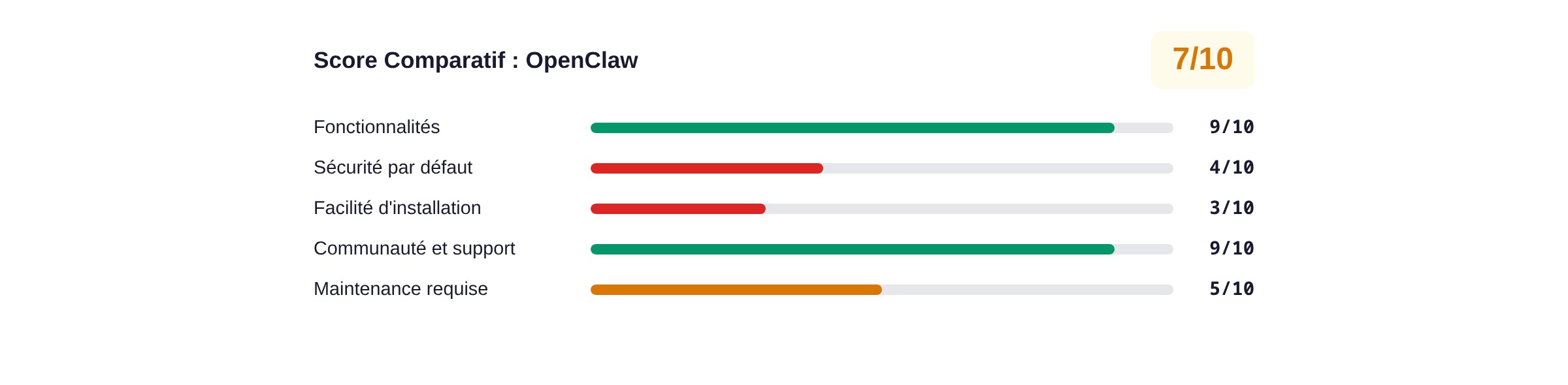
Security. OpenClaw runs with full access to your machine: file system, shell commands, browser. Security researchers have identified critical vulnerabilities, including plaintext storage of API keys and CVE-2026-25253. In March 2026, Bitdefender documented OpenClaw deployments on enterprise endpoints without IT teams being aware of them (what's known as "Shadow AI").
Complexity. 430,000+ lines of code. For a founder who just wants to automate a few tasks, that's the equivalent of buying a Boeing to fly Paris to Lyon. Installation requires Node.js 22+, API keys, a gateway configuration, and a healthy dose of patience.
Maintenance. An agent running 24/7 on your server with root access needs monitoring. The frequent updates, the gateway issues (the infamous "gateway closed 1006"), the WhatsApp reconnections every 14 days: it's ongoing work.
What to look at before choosing an AI agent
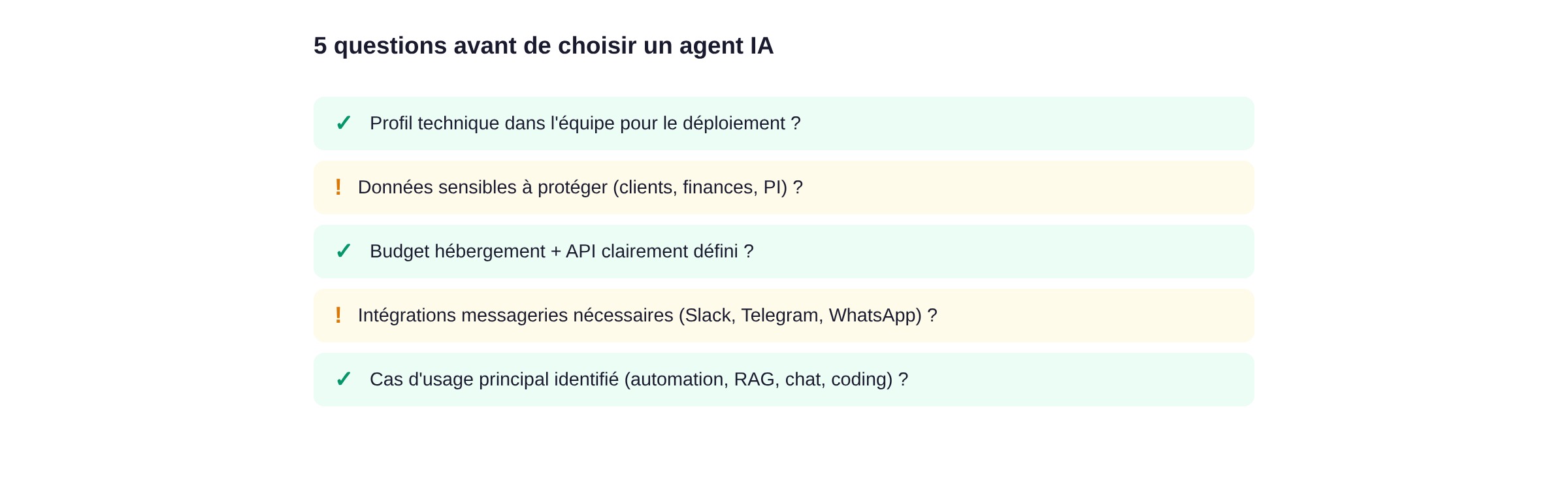
Before diving into the alternatives, ask yourself five questions:
- Ease of deployment: do you have a technical profile on the team, or do you need no-code?
- Security: are you handling sensitive data (customers, finances, intellectual property)?
- Cost: hosting budget plus API. A €5/month VPS isn't always enough.
- Integrations: which platforms do you need to connect (Slack, Telegram, WhatsApp, internal tools)?
- Primary use case: workflow automation, chatting with documents, coding assistant, or conversational agent?
The answers to these questions determine which tool to choose. There is no single "best universal alternative" to OpenClaw.
The 6 best OpenClaw alternatives in 2026
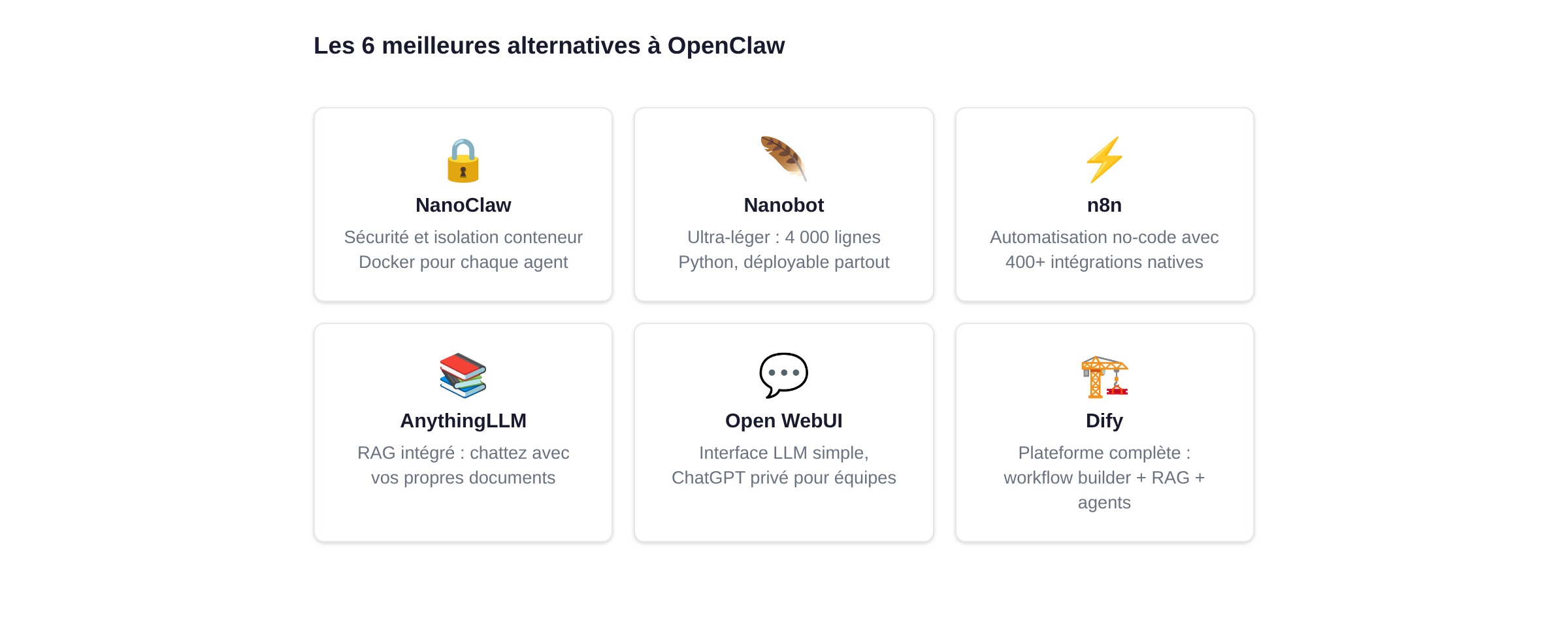
NanoClaw: security first
If your number one priority is security, NanoClaw is the direct answer. This OpenClaw fork forces the agent to run inside isolated Docker containers (or Apple containers on macOS), eliminating OpenClaw's fundamental problem: direct access to the host machine.
What sets it apart:
- Container isolation for each agent (Docker or Apple Containers)
- WhatsApp integration with separate memory and context per group
- Runs on a Raspberry Pi 4 with 4 GB of RAM
- Multi-agent coordination (agent swarms) for complex tasks
Limitations: the plugin ecosystem is smaller than OpenClaw's, and the community, while active, is smaller too.
Who it's for: founders who handle sensitive data and want an AI agent without compromising the security of their infrastructure.
Nanobot: ultra-lightweight, 4,000 lines of code
Built by a team at the University of Hong Kong, Nanobot proves you can do a lot with a little. Where OpenClaw weighs in at 430,000+ lines of code, Nanobot contains 4,000 lines of Python. That's 99% less code for the essential features.
What sets it apart:
- Persistent memory across sessions (conversations don't disappear)
- Built-in web search for real-time answers
- Background agents (sub-agents) for parallel tasks
- Control via Telegram and WhatsApp
- MCP (Model Context Protocol) architecture for standardized tool integration
Limitations: fewer advanced features than OpenClaw (no native browser control, no skills marketplace).
Who it's for: developers and technical founders who want a lightweight agent that's fast to deploy and easy to understand (you can read the entire source code in an hour).
n8n: no-code automation with AI
n8n isn't an "AI agent" in the strict sense, but it's often what founders are really after when they say they want to "automate with AI." It's a visual, open source workflow automation platform with more than 400 native integrations.
What sets it apart:
- Drag-and-drop interface for building workflows
- 400+ native connectors (Slack, Gmail, Notion, Airtable, Shopify, HubSpot, and more)
- Built-in AI nodes: calls to OpenAI, Anthropic, local models
- Self-hosted or cloud (n8n.cloud)
- Massive community and ready-to-use templates
Limitations: n8n isn't an autonomous agent. It runs predefined workflows; it doesn't "think" on its own. No conversational memory.
Who it's for: non-technical founders who want to automate business processes (lead nurturing, CRM sync, Slack alerts, reporting) without writing a line of code. If your need is "when X happens, do Y," n8n is probably your best choice.
AnythingLLM: the local Swiss Army knife
AnythingLLM positions itself as a unified interface for interacting with any LLM, locally or via API. Its strength: RAG (Retrieval-Augmented Generation), which lets you "chat" with your own documents.
What sets it apart:
- Multi-LLM support: OpenAI, Anthropic, Ollama, local models
- Built-in RAG: load PDFs, CSVs, and websites and ask questions about them
- Self-hosted with full control over your data
- Extensible plugin system (web search, code execution)
- Simple desktop interface
Limitations: no native integration with messaging apps (WhatsApp, Telegram). No autonomous agent in the OpenClaw sense.
Who it's for: founders who want a private AI assistant to analyze documents, explore data, and work with local models without sending anything to the cloud.
Open WebUI: the simplest LLM interface
If you're simply looking for a clean web interface to use AI models (local via Ollama or remote via API), Open WebUI is the most direct solution. No autonomous agent, no workflows: just an elegant, self-hosted chat interface.
What sets it apart:
- One-command Docker installation
- Compatible with Ollama (local models) and the OpenAI API
- Polished user interface, inspired by ChatGPT
- Multi-user management with permissions
- Persistent conversation history
Limitations: it's an interface, not an agent. No automation, no messaging integrations, no background task execution.
Who it's for: teams that want a "private ChatGPT" available to everyone on staff, hosted on their own infrastructure. Ideal for privacy-conscious startups that don't need automation.
Dify: the complete AI agent platform
Dify is probably the most complete OpenClaw alternative for those who want to build AI applications without starting from scratch. It's an open source platform that combines a visual workflow builder, RAG, and AI agent capabilities.
What sets it apart:
- Visual workflow builder for creating complex AI agents
- Built-in RAG with knowledge base management
- Production-ready API (deploy your agents as APIs)
- Multi-LLM support (OpenAI, Anthropic, local models, Hugging Face)
- Built-in monitoring and logs
Limitations: more of a "development platform" than a "personal assistant." The learning curve is real, even if it's gentler than OpenClaw's.
Who it's for: technical founders who want to build custom AI applications for their startup (customer chatbot, internal assistant, data processing pipeline).
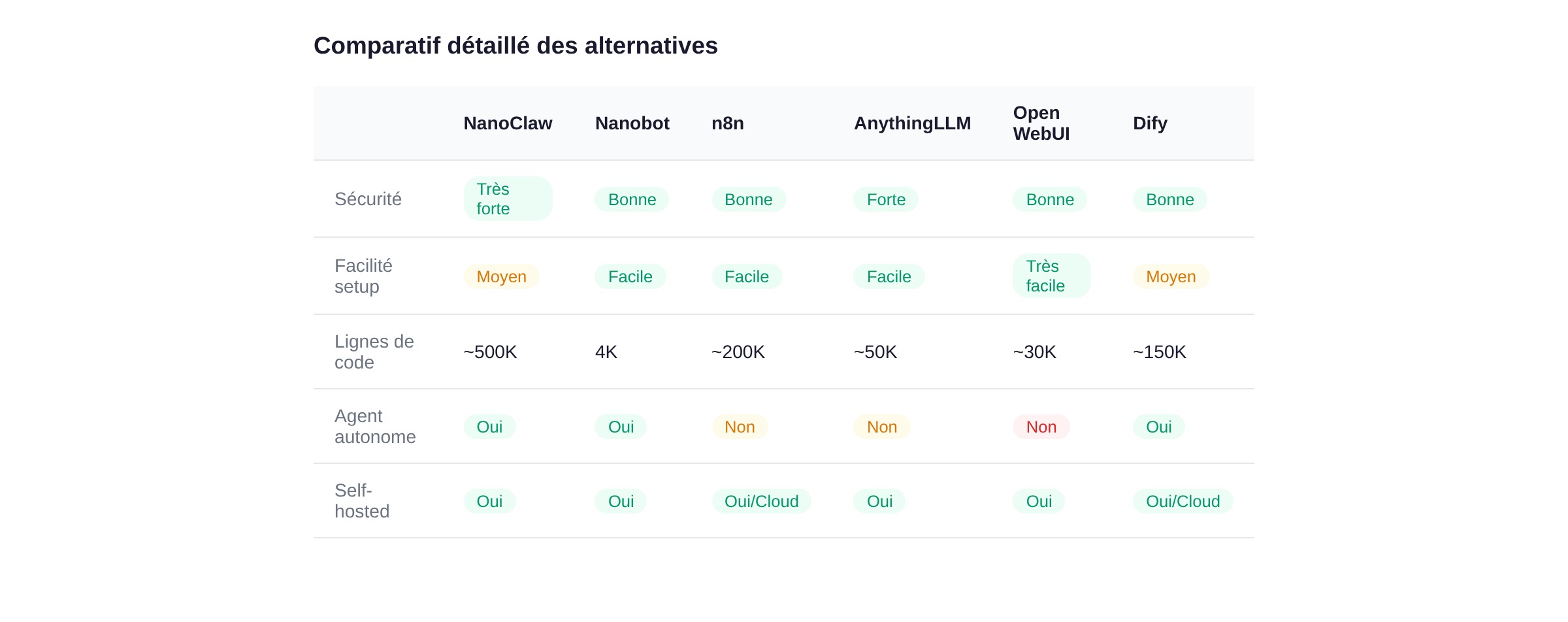
OpenClaw alternatives comparison table
| Tool | Type | Open Source | Self-Hosted | Setup Ease | Primary use case |
|---|---|---|---|---|---|
| OpenClaw | Autonomous agent | Yes | Yes | Hard | Multi-platform personal AI assistant |
| NanoClaw | Secure agent | Yes | Yes | Medium | AI agent with container isolation |
| Nanobot | Lightweight agent | Yes | Yes | Easy | Minimalist Telegram/WhatsApp assistant |
| n8n | Workflow automation | Yes | Yes/Cloud | Easy | No-code business automation |
| AnythingLLM | RAG interface | Yes | Yes | Easy | Chat with documents, multi-LLM |
| Open WebUI | LLM interface | Yes | Yes | Very easy | Private ChatGPT for teams |
| Dify | Agent platform | Yes | Yes/Cloud | Medium | Custom AI applications |
How to choose the AI agent that fits your startup
The right choice depends on your profile and your actual need. Here are four concrete scenarios:
You're a developer and want a secure personal agent. Go with NanoClaw if security is critical, or Nanobot if you want something lightweight and easy to grasp. Both deploy on a VPS starting at €5/month.
You're not technical and want to automate business tasks. n8n is your best ally. Build workflows visually: when an email arrives, analyze it with AI, create a task in Notion, send a summary to Slack. All without writing code.
You need to chat with your own documents. AnythingLLM with local models (via Ollama) gives you a private assistant that can answer questions about your contracts, reports, or internal knowledge bases.
You want a private ChatGPT for your team. Open WebUI + Ollama. Ten-minute installation, familiar interface, data that stays with you.
And if none of these profiles matches? Maybe OpenClaw is still the right option. Despite its limitations, it's the most complete tool for a multi-platform autonomous AI agent. The key is understanding what you're getting into before you run npm install -g openclaw@latest.
To go further on the AI tools that are useful to startups, check out our guide to AI tools for startups in 2026.
FAQ
What is the best free OpenClaw alternative?
All the alternatives listed in this article are open source and free. Nanobot is the lightest (4,000 lines of Python, deployable on any VPS). Open WebUI is the simplest to install for basic conversational use. The real cost comes from hosting (a VPS starting at €5/month) and LLM APIs if you're not using local models.
Can you use OpenClaw with local models like Ollama?
Yes, OpenClaw supports local models via Ollama, which reduces API costs and keeps your data entirely local. That said, performance depends on your hardware. Plan for at least 8 GB of VRAM to get decent results with models like Llama 3 or Mistral.
Is OpenClaw safe for sensitive startup data?
Security experts agree: OpenClaw, in its default configuration, is not recommended for sensitive data. The documented vulnerabilities (plaintext API key storage, unrestricted shell access, 42,900 publicly exposed instances) are real risks. If confidentiality is a priority, favor NanoClaw (container isolation) or AnythingLLM (local processing, no system access). NVIDIA has developed NemoClaw, a hardened version for enterprises, but it isn't widely available yet.