You can ship a vibe-coded MVP in 4 weeks if you accept three constraints: a scope that solves a single problem, a lean stack (Lovable or Bolt for web, Cursor or Claude Code for logic, Supabase and Stripe for services), and 3 to 5 weeks of full-time founder time. Verified 2026 budget: €200 to €800 for tool subscriptions and related costs, before you put a price on your own time. The upside is clear: you put your idea in front of real users without handing your roadmap to an outside dev. The recurring trap: wanting a "complete" product instead of an MVP. This guide gives you the week-by-week timeline, the detailed budget, the exact tools, and the signals that tell you when to move to real code. If you first want the definition of what vibe coding is, start there, then come back here to ship.
Why vibe code your MVP instead of hiring a dev
The question comes up in every founder coffee: "Do I code it myself with an AI, or do I find a dev?" The answer depends on what you want to test, and how long you're willing to wait before you have a user in front of you.
Three practical reasons to vibe code your MVP
-
Speed. A vibe-coded MVP starts within the hour. A hired dev starts in three months (sourcing, interviews, onboarding, first ticket). On an MVP, the cost of a lost quarter is rarely offset by technical quality.
-
Cash cost. You pay €20 to €90 in subscriptions over the build, not €6,000 to €20,000 in freelance fees. For an idea you might kill in 2 months, that's the right ratio.
-
Product control. You decide in real time which feature to cut, which flow to simplify, which copy to change. No Slack ping to a freelancer who comes back 48 hours later with "can you clarify?". Iteration is instant.
Two cases where vibe coding your MVP is a bad idea
If your MVP handles sensitive, regulated data (healthcare, fintech with custody, identity). A SecNumCloud, HDS or ISO27001 audit doesn't read the context of an MVP, it reads SQL and logs. You need a human who knows what they're doing.
If your MVP is core-tech (a proprietary matching algorithm, serious ML, peer-to-peer infra). Vibe coding ships clean CRUD with a tidy UI fast. It doesn't reinvent an algorithm. If your value is the algorithm, hire first.
For everything else (90% of early-stage MVPs: simple B2B SaaS, niche marketplace, internal tool, content app), vibe coding is the short path.
Before you write a line of code, scope your MVP
This is the part everyone skips, and it's what ruins 80% of vibe-coded MVPs.
The one-problem rule: your MVP does ONE thing
Not two. Not three. A single problem, solved faster or better than the current alternative. If you have to use the word "and" to describe your MVP, you don't have an MVP, you have a V2 in disguise.
Bad framing: "A platform to connect freelancers and startups, and handle invoicing, and track payments."
Good framing: "A form that matches a startup with a qualified freelancer in 24 hours."
If your first users don't come back for the first thing, the other six are useless.
MVP scope by product type
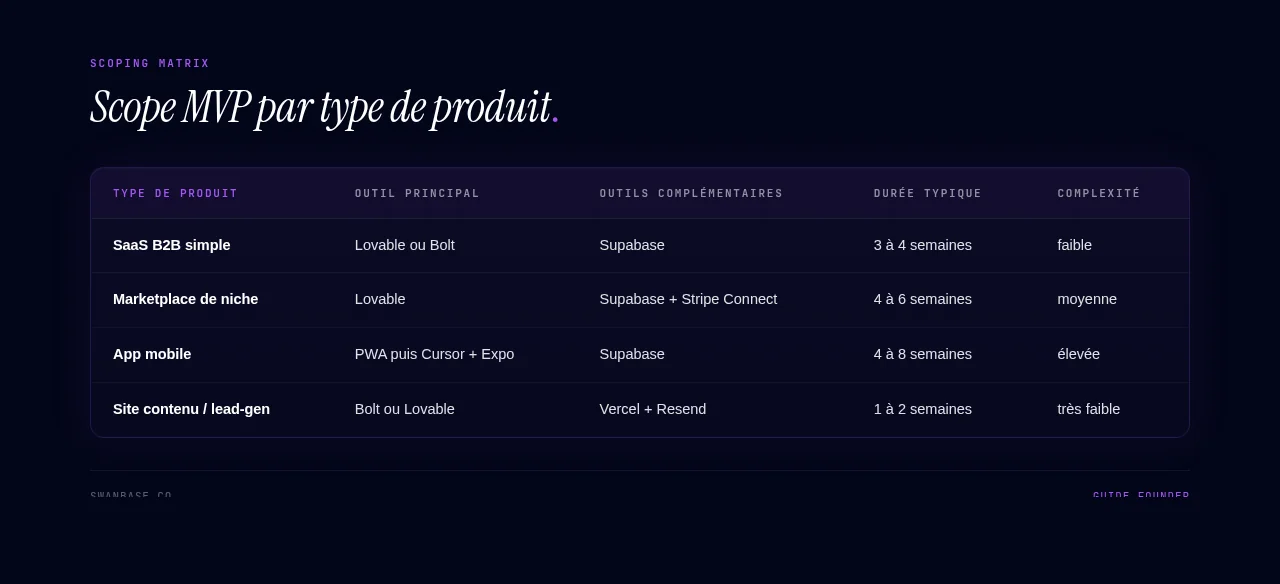
Not all MVPs are equal. Here's how to scope by product type.
- Simple B2B SaaS (dashboard, form, internal automation): Lovable or Bolt on the front, Supabase on the back. 3 to 4 weeks.
- Niche marketplace (supply, demand, matching): Lovable + Supabase + Stripe Connect. 4 to 6 weeks (two sides to manage).
- Mobile app: avoid pure vibe coding here. Lovable and Bolt produce web. Ship a PWA first, or plan for Cursor + Expo. 4 to 8 weeks.
- Content and lead-gen site (landing + capture + email automation): Bolt or Lovable, deploy on Vercel, Resend for emails. 1 to 2 weeks.
If your idea doesn't fit any box, either it isn't an MVP or it's core-tech.
The 2026 vibe coding stack for an MVP
Lovable, Bolt, Cursor, Claude Code: which one for which MVP
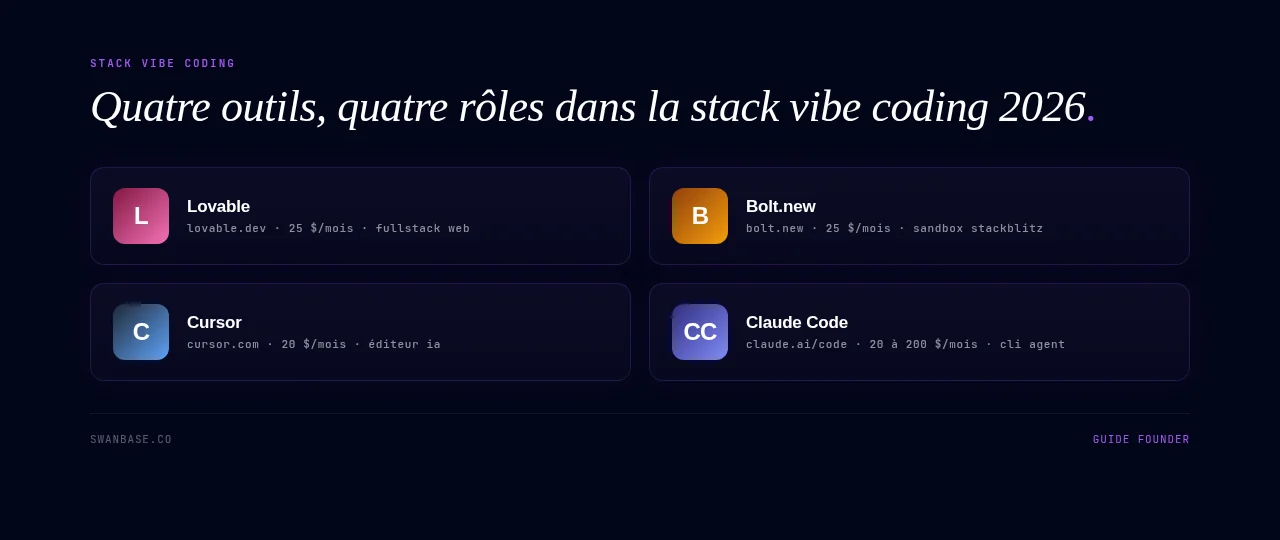
The four tools don't do the same thing. Confusing their roles costs you a week.
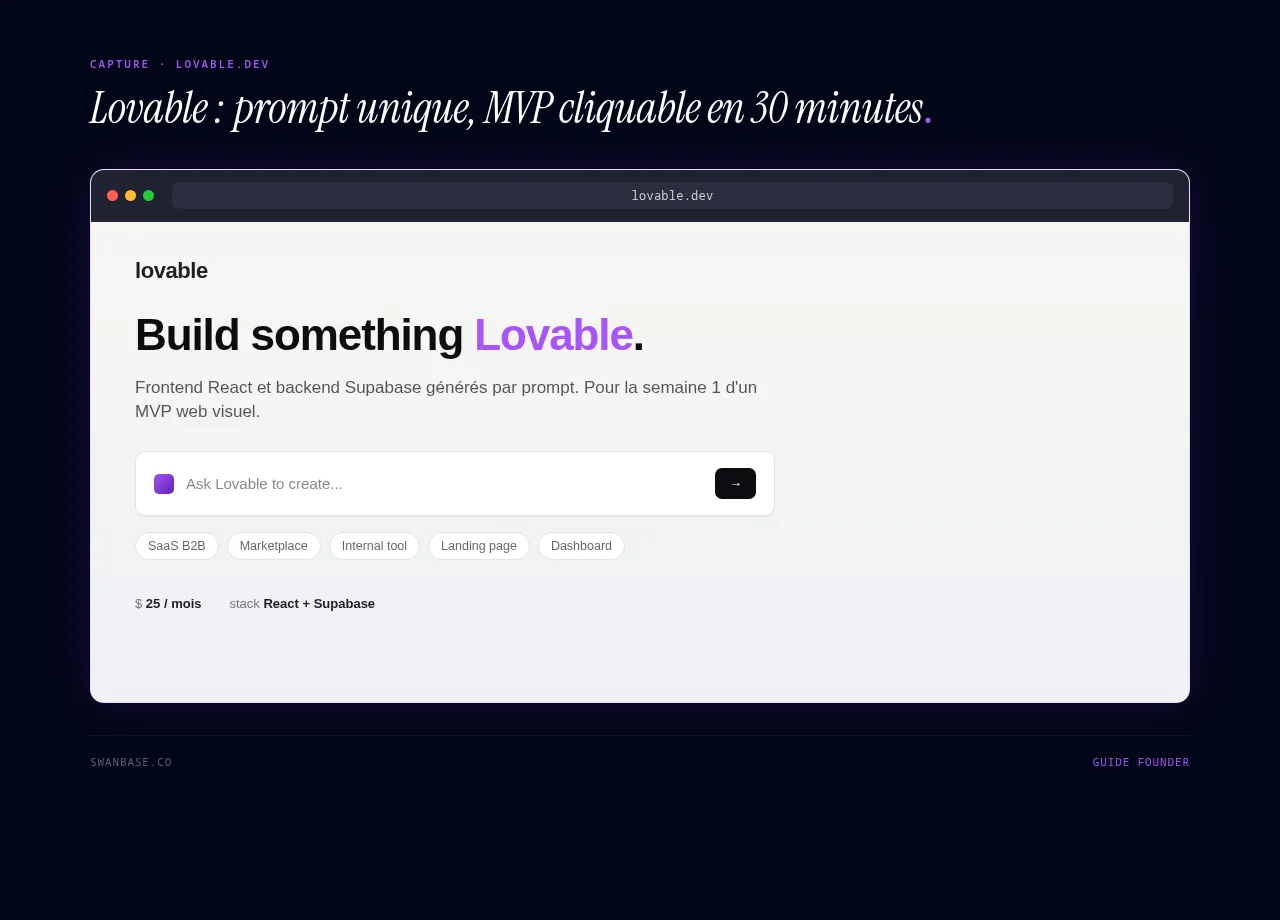
Lovable (product page): full-stack generation from a prompt, React frontend + integrated Supabase backend. Strong for a visual web MVP where you want something clickable in 30 minutes. Pro at $25/month.
Bolt.new (product page): a direct competitor to Lovable, StackBlitz sandbox in the browser. Faster on iterations, slightly less clean on the delivered code. Pro at $25/month.
Cursor: a "real" code editor with AI on top. You write directly in files you can version on GitHub. Essential the moment a project goes beyond 2 or 3 evolution prompts. Pro at $20/month.
Claude Code: a CLI agent that codes in your terminal on a local repo. More powerful than Cursor on long refactors and multi-file work. Pro at $20/month (Max at $100 or $200 for heavy use).
Practical 2026 rule: Lovable or Bolt for week 1, then Cursor or Claude Code once the project has real structure. To dig into the tool choice, see the Cursor / Lovable / Bolt comparison.
The complementary tools you can't skip
Four external building blocks show up on almost every B2B MVP.
- Authentication: Supabase Auth (included) or Clerk. Don't "code your own login": you'll shoot yourself in the foot.
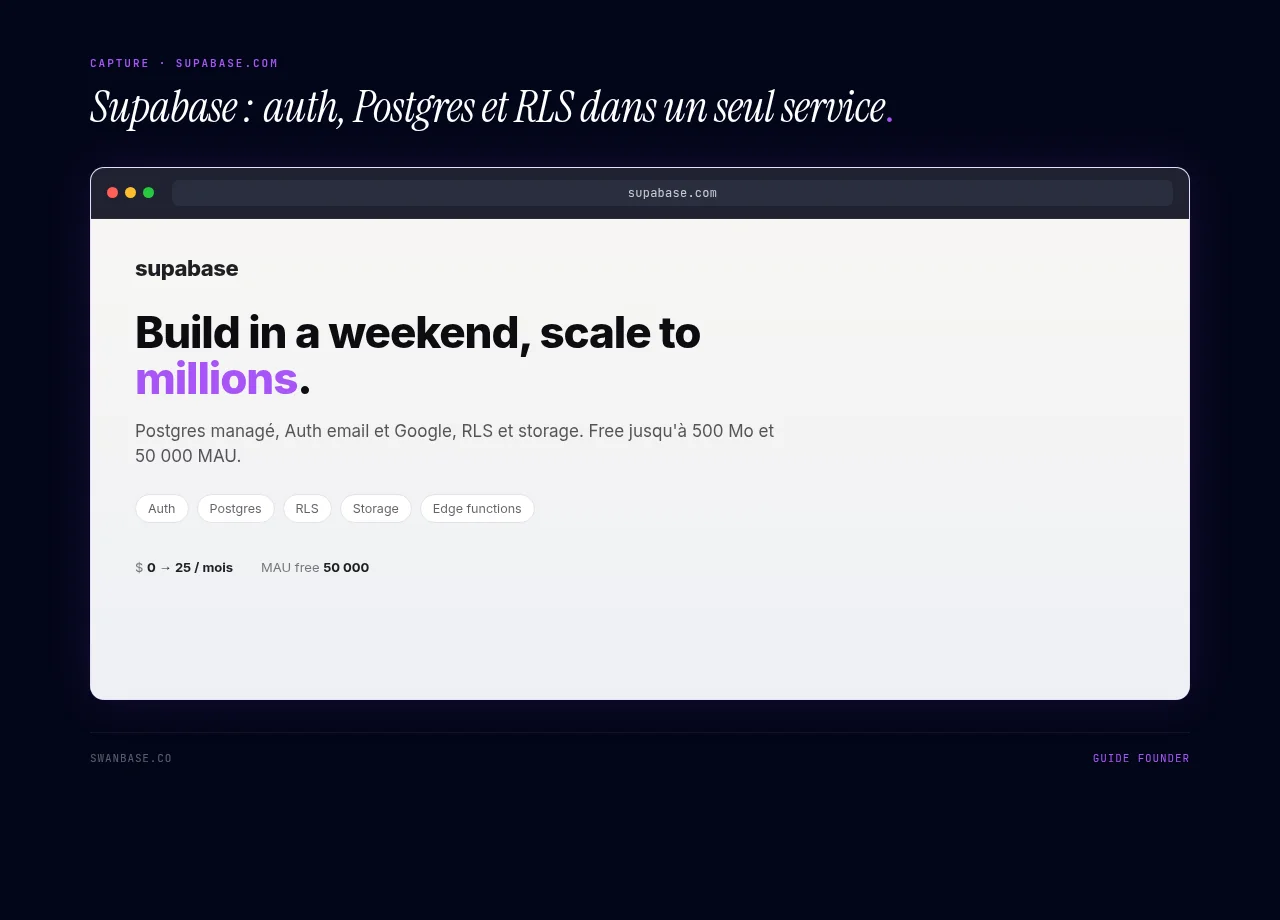
- Database: Supabase Pro at $25/month if you expect more than 50,000 MAU. Free below that (500 MB, 50,000 MAU).
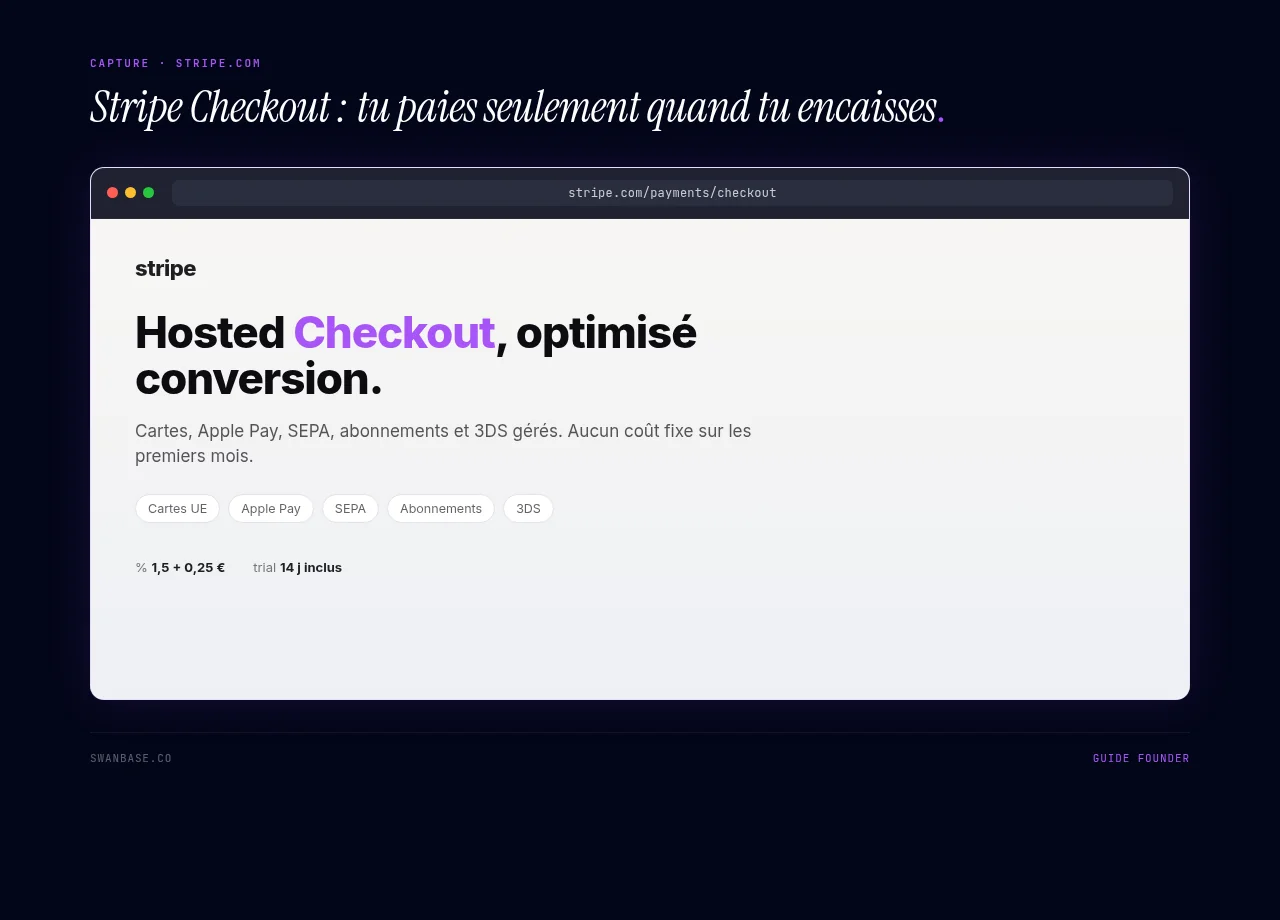
- Payments: Stripe Checkout. 1.5% + €0.25 per transaction on standard European cards. You only pay when you get paid.
- Hosting: Vercel Hobby (free) for MVPs. Pro at $20/user/month only if you go past 100 GB of bandwidth.
If someone sells you a stack with 12 different tools for an MVP, be suspicious. You're paying 12 subscriptions for 1 product with no revenue.
The 4-week walkthrough (real B2B SaaS case)
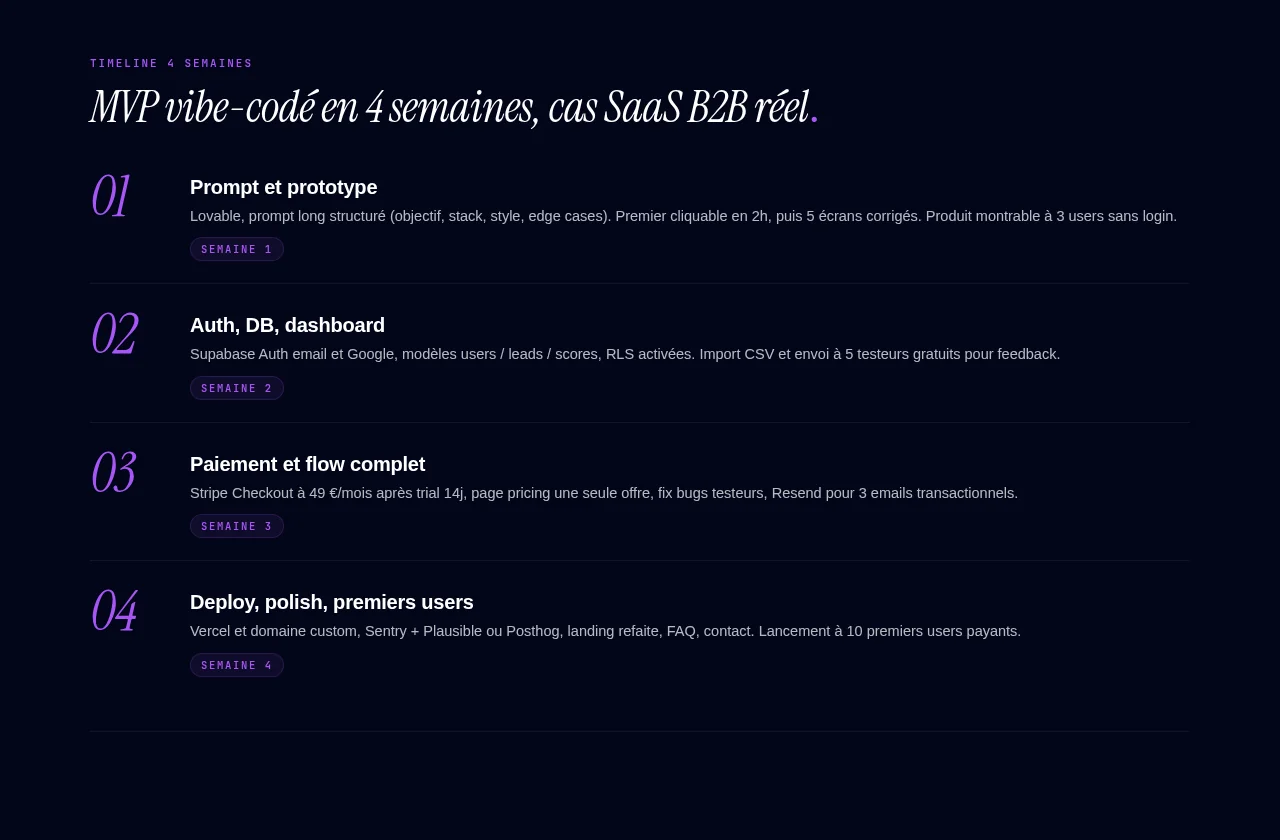
Typical case: a B2B lead-scoring tool for a sales team, accessible via login, priced at €49/month.
Week 1: initial prompt and first clickable prototype
You open Lovable. You write a long, structured prompt (goal, stack, style, constraints, edge cases). You get a first clickable version in 2 hours.
For the rest of the week, you iterate: you fix the home page, you add onboarding, you rework 2 screens that don't work, you connect Supabase to store the leads. You finish with a clickable product you can show to 3 users, no login, no payment, just the main flow.
Classic trap: spending week 1 on the design system. Don't. Ship something ugly but clickable. You'll have time to polish in week 4.
Week 2: auth, database and main screen
You wire up Supabase Auth (email + Google). You create the models: users, leads, scores. You check the RLS policies (row-level security) so each user only sees their own data. Don't skip this step.
You build the main dashboard: leads table, scoring displayed, filter by status. You add a CSV import. At the end of week 2, you send it to 5 free testers for feedback.
Week 3: payments and the complete user flow
You integrate Stripe Checkout. A €49/month subscription, triggered at the end of a 14-day free trial. You build the pricing page (one plan, definitely not three) and the "My subscription" page.
You fix the bugs the testers reported: the scoring that resets on refresh, the sort that breaks on names with accents, the welcome email that never arrives. You add Resend for the 3 transactional emails (welcome, trial-ending, payment-received).
At the end of week 3, the product is fully usable and payable.
Week 4: deployment, debugging, polish, first users
You deploy on Vercel with a custom domain. You set up a production environment separate from your dev env. You add Sentry (free) for errors and Plausible or Posthog for analytics.
You polish. You rebuild the landing with real copy. You go through the 3 critical flows with a fine-tooth comb: signup, first import, first payment. You write an FAQ page and a contact page.
You launch to your first 10 paying users. You measure.
Total ship-to-prod: 28 calendar days, roughly 130 to 180 hours of founder time. Not 4 weeks at 70h. 4 weeks at 30-45h, with days that swing between "nothing works, I'm sleeping badly" and "everything's clicking, I ship 3 features in an afternoon."
What does it really cost?
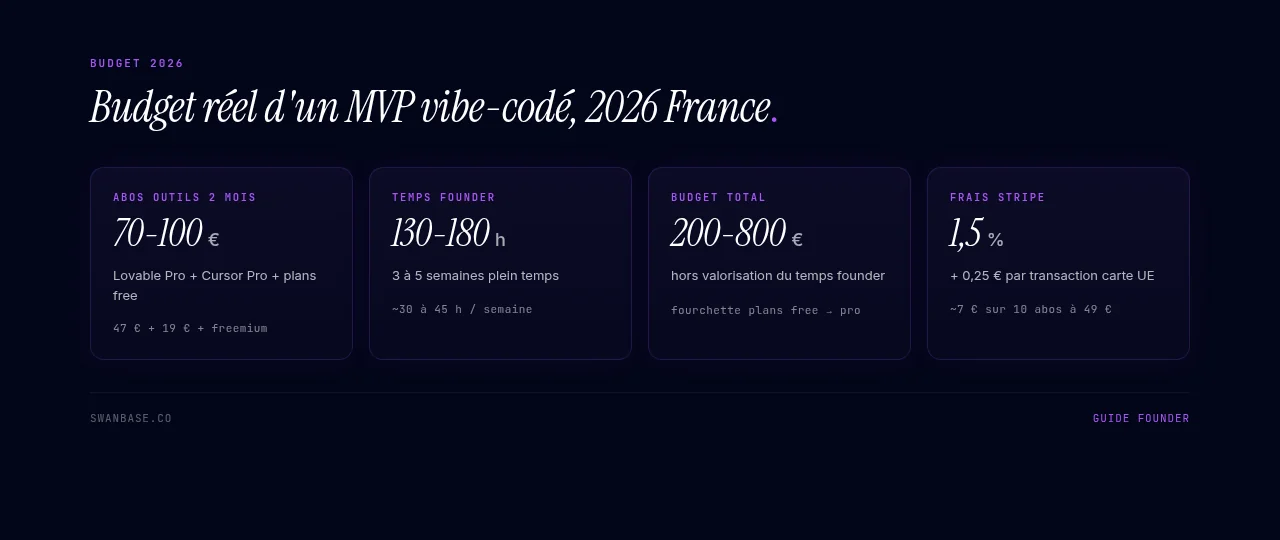
Nobody writes this number down clearly. Here's the verified 2026 budget, before you put a price on your founder time.
The tool subscriptions
For the B2B SaaS MVP described above, over 2 months (1 month of build + 1 month post-launch):
- Lovable Pro: $25/month × 2 = $50 (≈ €47)
- Cursor Pro (from week 2): $20/month × 1 = $20 (≈ €19)
- Supabase: free as long as you're under 500 MB and 50,000 MAU. Pro at $25/month if you go over.
- Vercel Hobby: €0
- Resend: free up to 100 emails/day
- Domain: €12 to €30/year
- Sentry, Posthog, Plausible: free plans are enough
Subscription subtotal over 2 months: €70 to €100.
Founder time
This is the real cost, and the one nobody puts a number on. If you value yourself at €50/h (reasonable in early-stage), 150 hours is €7,500. At €200/h (a senior consultant switching lanes), €30,000.
The real question isn't how much you're worth per hour. It's how much less you'll be worth if you wait 6 months to ship.
The hidden costs people forget
- Stripe fees: 1.5% + €0.25 per transaction on European cards. On 10 subscriptions at €49, about €7 in fees the first month.
- Design assets: €0 if you use Lucide + Heroicons + a generated logo. €50 to €200 if you hire a designer on Malt for a clean logo.
- Day-one marketing tools: Calendly and Notion free, Google Workspace €7/month for your professional email.
- Tax compliance: from month 3 if the traction is there, count on €80 to €150/month for an accountant.
Realistic range
2026 vibe-coded MVP budget, before founder time: €200 to €800. The low end if you stay on free plans as long as possible. The high end if you take Lovable + Cursor + Supabase Pro + Vercel Pro + a paid logo. Above €800, you've added tools your MVP doesn't need.
The only cost that can blow up is your time: 3 to 5 weeks full-time. Not alongside your job, not in two evenings a week. Otherwise the MVP drags on for 4 months and the traction slips away.
The mistakes that ruin a vibe-coded MVP
Vibe coding speeds up the building. It also speeds up the building of invisible bugs. Here are the three that come up most.
-
Putting API keys in plaintext in the generated code. The AI has no shame. It'll drop an
OPENAI_API_KEY=sk-...in the frontend if you ask it the wrong way. Reread your.envfiles on every generation. -
Stacking prompts instead of refactoring. Past 1,000 lines, prompting "add X" without cleaning up creates an unreadable lasagna. Open Cursor or Claude Code for a real refactoring pass.
-
Confusing prototype with release-ready. An MVP that works in a demo won't necessarily survive 50 concurrent users. Test the critical flow on two browsers, check your Supabase RLS, disable the test seeds.
For the full list (10 mistakes ranked by severity and probability), check out vibe coding mistakes.
After the MVP, what comes next?
Three questions show up within 30 days of launch.
Secure and monitor (the bare minimum)
You don't need an €8,000 pentest. Five checks are enough.
- All your API keys are in environment variables, not in the code.
- Your Supabase RLS is enabled on every table.
- Sentry pings you when there's an error in prod.
- You have an automatic database backup (Supabase Pro does it; on free, you export every week).
- You have a plan if Stripe flags a chargeback or fraud.
Enough for the first 6 months.
When to move to "real" dev (concrete signals)
Three signals tell you it's time to hire or outsource.
- Your volume outgrows the free / pro plans and the code can't take a rewrite anymore.
- You spend more time debugging than shipping. The return on prompting has flipped.
- You sign a client who demands SLAs, SOC2 or HDS. Vibe coding no longer covers you.
If one or two signals show up, look for a senior freelancer or a first full-time dev depending on your runway.
Pre-seed raise with a vibe-coded MVP: what flies, what doesn't
In 2026, most French pre-seed funds look at traction and team before the technical purity of the code. A vibe-coded MVP with 30 paying customers positions better than clean code with no users.
What doesn't fly: claiming you have a "proprietary ML" product when you're making plaintext OpenAI calls, hiding the vibe-coded stack when a VC asks for a code audit, or pitching scalability your tools can't hold. A pre-seed VC looks at traction and team, not the technical purity of the code.
FAQ
Is my vibe-coded MVP "real" or a throwaway prototype?
It's a real product if you can deploy it on your domain, the auth works, the payment collects, and you can keep evolving it. It's a prototype if you can't deploy it outside Lovable or Bolt, or if every change breaks something else. Open a file of the delivered code: if it makes sense, it's a real product.
How many users can my MVP handle?
With a Lovable / Supabase / Vercel stack on their Pro plans, you'll comfortably handle 1,000 to 5,000 monthly active users. Beyond that, you hit limits (Supabase Edge functions, Vercel bandwidth) that call for an upgrade or a refactor. For 90% of early-stage MVPs, that ceiling doesn't arrive before 12 to 18 months.
Will a VC take a vibe-coded MVP seriously?
In 2026, yes, as long as you're transparent about the stack. Pre-seed and seed funds evaluate the team, the market, the traction, not the nobility of the code. A vibe-coded MVP with recurring monthly revenue is valued higher than custom code written by a CTO hired too early with no customers.
Do you need to have coded before to vibe code an MVP?
No. You need to understand three things: what a database is (rows, columns, relationships), what an environment variable is, and what a deployment is. You can learn these three concepts in an afternoon. To go further on getting to grips with the tools and prompts, see the learn vibe coding tutorial.
Vibe coding doesn't turn you into a developer. It turns you into the project manager of an AI that codes, and that's exactly what an MVP demands. Four weeks later, you have a product in production, users who pay or who complain (both are useful), and a starting point to decide what's next: hire, outsource, or keep vibe coding. To place this article in the bigger picture, see the pillar what vibe coding is.