Clay is a B2B data enrichment and orchestration platform. Starting from a plain list of prospects, Clay pulls emails, details and signals from 150+ providers in a waterfall, then uses AI agents to automate sorting and copywriting. Put simply, you give Clay a name and it gives you back a complete, ready-to-contact profile. This article covers what Clay is, how it works, what it really costs, and when it becomes overkill for a founder.
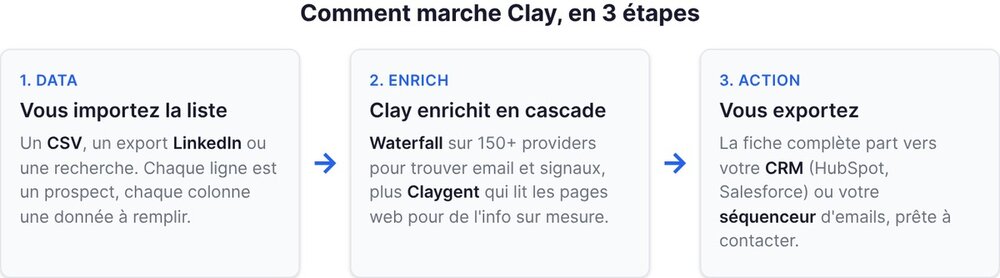
What is Clay?
Clay sits one step before your email sender and goes well beyond a static directory-style database. It's the layer that builds and enriches your prospect list. You import a list (or generate one from LinkedIn, a CSV import or a search), and Clay fills it in. For each row, it queries dozens of sources until it finds the work email, job title, company, headcount, tech stack, a recent funding round or a job change. Everything that helps you decide who to contact and what to say to them.
Here's how it differs from a classic tool like Apollo or ZoomInfo: those sell you access to their own database. Clay queries theirs, plus 150 others, and keeps the best result. You're no longer tied to a single provider's coverage. Add AI agents that read a website or a profile to pull out a custom insight, and you get a machine that prepares highly targeted outreach, replacing the intern copy-pasting rows into a spreadsheet.
If you're new to this space, our overview of B2B prospecting tools shows where Clay fits in the wider market.
How Clay works (enrichment + waterfalls)
Clay is built on one simple principle: never depend on a single source. Here's how that breaks down.
Enrichment sources (waterfall)
The waterfall, or cascading enrichment, is Clay's signature mechanism. Take a concrete example: you want a prospect's work email. Instead of querying one provider and accepting its "email not found", Clay queries the first provider. If that fails, it moves to the second. Then the third. And so on, until it gets a result or runs through all 150+ connected sources.
The result is far higher coverage than any single-source tool. Where Apollo alone leaves part of your list without an email, a well-configured waterfall climbs much higher, because it stacks the coverage of every provider. You only pay for data when a source finds it, and you put the cheapest sources at the top of the cascade.
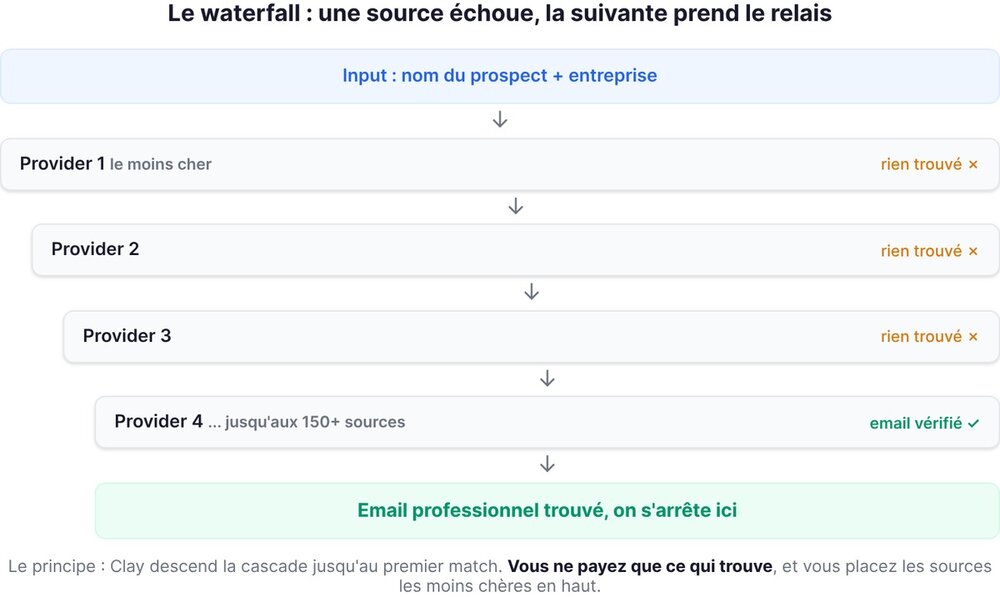
This setup has a direct impact on your budget, and it pays to be clear-eyed about it: the more providers you leave in the cascade, the more credits you burn per row when the first ones fail. More on that in the pricing section.
AI agents (Claygent)
Claygent is the AI agent built into Clay. You give it a plain-language instruction and a URL (the company website, a LinkedIn profile, a product page), and it reads the page to extract what you asked for. Real-world examples: "does this company have a sales team?", "what's their main offering?", "find the founder's name and their latest public statement".
This is what sets Clay apart from a plain structured-data enricher. Any tool can fetch an email or a job title. A qualitative read of a website to judge whether a prospect matches your target is new, and it replaces hours of manual research. Every Claygent call uses credits, so it's powerful but gets expensive at scale.
Integrations & tables
Clay's interface looks like a supercharged spreadsheet. Each row is a prospect, each column a piece of data you enrich, filter or generate. You add an "email" column, a "funding signal" column, an "AI-written opening line" column, and Clay fills them in row by row.
On the integration side, Clay connects to CRMs (HubSpot, Salesforce, Pipedrive), sending tools (Lemlist, Smartlead, La Growth Machine), LinkedIn, and pretty much everything else through webhooks and the API. The logic: Clay prepares and qualifies the data, then pushes it to the tool that runs the campaign. It sits at the center of your stack and works alongside your existing tools.
Key features
A summary of what Clay actually does, so you can size up the tool at a glance.
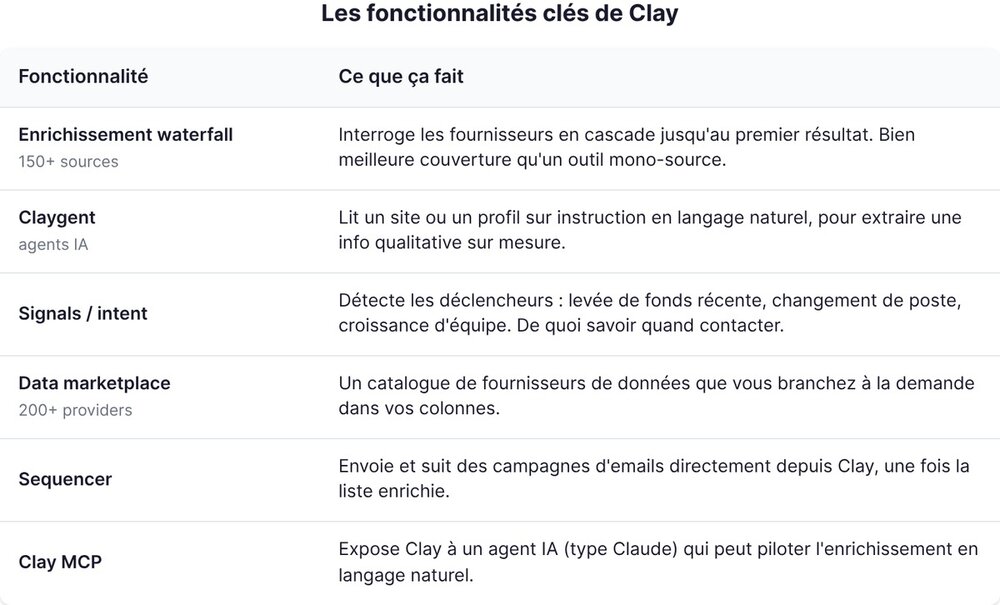
What matters for a founder:
- Data coverage. This is the main reason to use Clay. With multi-source waterfalls, you get emails and phone numbers that your single-source tools miss.
- AI automation. Claygent turns manual research into an automated column. The time savings are real once you're handling more than a few dozen prospects.
- Flexibility. Everything is configurable. That's both a strength and a trap: unlike a turnkey directory, the tool does nothing until you've built your workflow.
Clay pricing 2026
This is the part to read carefully, because the listed price says little about what you'll actually pay. Clay doesn't run on a flat subscription: it uses a credit system. The official price list is on Clay's pricing page. There's a 14-day free trial and a 10% discount for annual billing.
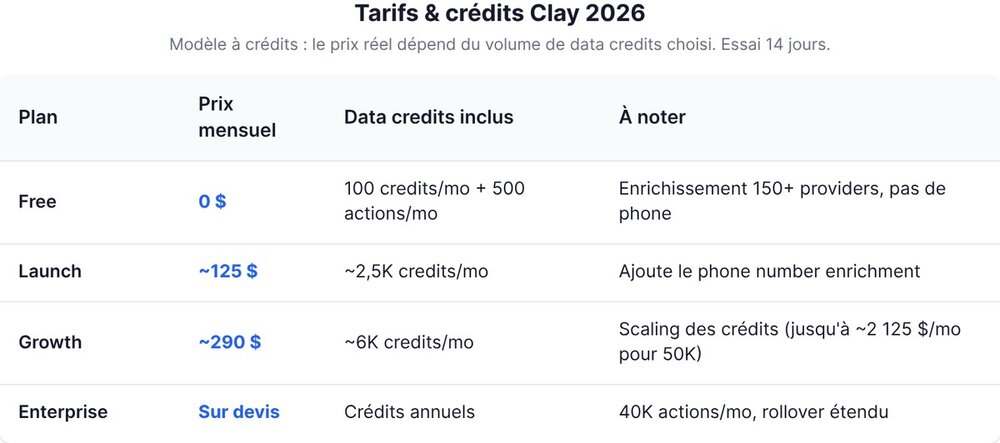
Plan breakdown:
- Free: 500 actions/month and 100 data credits/month. Enrichment through 150+ providers is already included, which is enough to test how it works on a small list. No phone number enrichment.
- Launch: around $125/month, with roughly 2,500 data credits/month. This plan unlocks phone number enrichment, useful if you do cold calling on top of cold email.
- Growth: around $290/month for about 6,000 data credits/month, and above all the option to scale your credit volume much higher. For example, 50,000 credits/month comes to around $2,125/month.
- Enterprise: custom pricing. Credits billed annually, 40,000 actions/month, extended rollover.
Two mechanics bring the bill down and are worth knowing: cached enrichments cost 50% fewer credits (if a piece of data has already been found, finding it again costs half), and unused credits roll over up to 2x your monthly quota, capped at 20,000 credits on the Launch and Growth plans.
The credit system (and why costs climb fast)
Clay's entry price is deceptively low, because what you're really paying for is credit volume, and credit volume depends on how you actually use it.
Every action uses credits: each source queried in a waterfall, each Claygent call, each phone number enrichment. In practice, if you set up an aggressive ten-provider waterfall and run it on 5,000 rows, you can burn through your monthly credits in a single campaign. The good news: credits get cheaper per unit as volume grows, and caching limits the damage on lists you re-enrich.
The practical takeaway for a founder: ignore the plan price and estimate your usage. How many prospects per month, how many enriched columns per prospect, how many AI calls. That calculation gives you your real cost, and it can go from $125 to several thousand without changing plans, just by adding credit volume. Clay is upfront about this in its pricing, but the "I'll take the $125 plan and be done" reflex won't hold up.
Clay for founders: concrete use cases (and when it's overkill)
Clay is a superb tool, and it pays off for a specific kind of team.
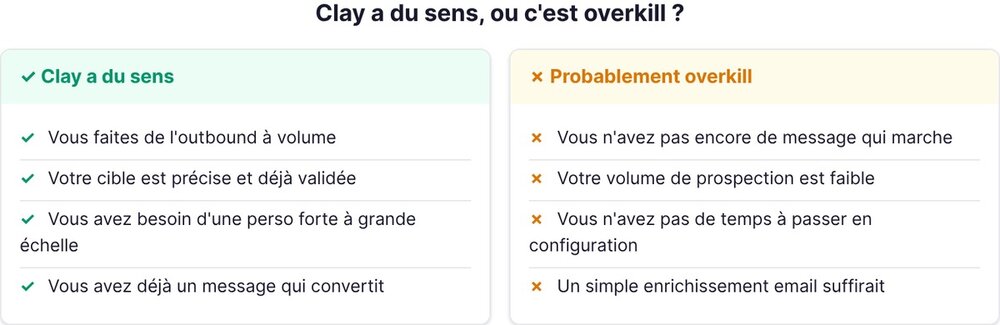
Clay makes sense if you run high-volume outbound on a precise target with a strong need for personalization. Examples where it shines: building a list of 2,000 French SaaS companies that raised funding this year and getting their head of growth's email, enriching a LinkedIn Sales Navigator export with missing emails, or generating a personalized opening line for each prospect from their website. Once manual research becomes unmanageable, the subscription pays for itself.
Clay is overkill if you're on your first 50 prospects, if you don't yet know who your target is, or if you just want to send a simple email sequence. In those cases, an all-in-one prospecting tool does the job without Clay's learning curve. And if what you really need is sending and tracking campaigns rather than enrichment, check out our Lemlist review before investing in Clay.
The classic trap: building an overengineered Clay setup before validating that your message converts. Enriching 5,000 perfect prospects is pointless if your email gets zero replies. Clay amplifies outreach that already works; it won't create it for you. Start small, prove your approach converts on 50 hand-picked prospects, then move to Clay to scale it up.
Clay alternatives
Clay has competition in its niche, and depending on your needs an alternative may be enough, or even a better fit.
- Apollo: all-in-one database + sequencer. Less flexible than Clay on multi-source enrichment, but much easier to pick up, with its own built-in contact database. A good starting point for standard volume.
- Dropcontact: French specialist in email enrichment and verification, with a strong focus on GDPR compliance. More focused and simpler than Clay, without the AI orchestration layer.
- ZoomInfo: the long-established B2B database heavyweight, very rich on the US market, with a high entry price and built for large sales teams.
- Pharow: French sourcing and enrichment tool designed for the French B2B market, more accessible than Clay for targeting specific French companies.
The right question is "do I need orchestration?" rather than "what's the best tool?". If yes, go with Clay. If you just want a clean contact database and a sequencer, a simpler alternative will save you time and money.
Further reading
- B2B prospecting tools: the founder's guide
- Waalaxy: review, features and pricing
- Lemlist: review, features and pricing
- Product-Led Growth: definition and principles
- Growth marketing for startups: the guide
FAQ
Does Clay replace Apollo / ZoomInfo?
Not exactly, because they play different roles. Apollo and ZoomInfo sell their own database. Clay queries hundreds of sources (potentially including those) in a waterfall and keeps the best result. So Clay can replace their enrichment function with better coverage, but it takes more setup. If you want a turnkey database with no configuration, stick with Apollo. If you want the best possible data coverage, go with Clay.
Is Clay suitable for beginners?
It's a demanding tool. The supercharged-spreadsheet logic, waterfalls and credit system take real time to learn. A founder who's completely new to prospecting will move faster with an all-in-one tool. Clay becomes relevant once you know exactly who you're targeting and manual research is costing you too much time.
How much does enrichment cost at scale?
It depends entirely on your volume, and that's Clay's main trap. The listed price (from around $125/month) doesn't reflect your real cost, which tracks your credit usage. The more prospects you enrich, and the more waterfall sources and AI calls you add, the higher the bill. Heavy usage can reach several thousand dollars a month. Estimate your volume before committing, and use the official price list to project your cost.