Vibe Coding: Definition, Tools and Complete Guide (2026)
You open your terminal on a Monday morning, you type "build me a booking app with Stripe payments and an admin dashboard," and ten minutes later, the application is running. No React to learn. No documentation to dig through. No developer to hire. That is exactly what vibe coding is: programming by describing what you want to an artificial intelligence, instead of writing the code yourself. The term was coined by Andrej Karpathy (former head of AI at Tesla, co-founder of OpenAI) in February 2025, and in a single year, it has transformed the way startup founders build their first products. Tools like Cursor, Claude Code, Bolt.new and Lovable make this approach accessible to anyone who can articulate an idea clearly. For non-technical founders, it is a paradigm shift: building a working MVP in a few days, without raising money to fund a technical team.
What is vibe coding?
Vibe coding is a software development method where you describe your need in natural language and an AI generates the corresponding code. You do not read every line. You do not necessarily understand every function. You test, you iterate, you move forward. It is programming through conversation.
The difference with traditional development is radical. A conventional developer writes code, understands each instruction, debugs manually. The vibe coder describes an outcome, lets the AI produce it, tests the result, and fixes it through dialogue. The code is a by-product, not a craft.
The origin: Andrej Karpathy and the concept of "coding on vibes"
On February 2, 2025, Andrej Karpathy published a post that would come to define an emerging practice. His message has become the movement's reference quote:
"There's a new kind of coding I call 'vibe coding', where you fully give in to the vibes, embrace exponentials, and forget that the code even exists."
Karpathy is no amateur. A Stanford PhD in artificial intelligence, former head of AI at Tesla, co-founder of OpenAI. When he describes his new way of coding, he is talking about a paradigm shift he observes in himself: an expert who willingly gives up control of the code in exchange for speed and iteration.
He explains that he uses Cursor with the Sonnet model, sometimes by voice command through SuperWhisper. He requests simple changes ("cut the sidebar margin in half") and accepts the generated code without necessarily reading it in detail. As he sums it up: "It's not really coding. I just see things, say things, run things, and copy-paste things, and it mostly works."
Within a few weeks, the term "vibe coding" was adopted by the global tech community. The word even entered the Merriam-Webster dictionary as a notable new coinage of 2025.
The principle: describe in natural language, the AI generates the code
Vibe coding rests on a simple principle: the most powerful programming language is English (or French). You describe what you want. The AI translates your intention into working code.
In practice, it works like this:
- You describe your need in natural language: "I want a sign-up page with email validation and a secure password"
- The AI generates the complete code: front-end, back-end, database
- You test the result in your browser
- You iterate through dialogue: "Add a Google Sign-In button" or "The validation error isn't showing, fix it"
This is neither no-code (you get real code, deployable and editable) nor assisted programming (the AI does not complete your lines, it writes the entire application). It is a third path, and open-source projects like OpenClaw show that this approach is starting to flow into the collaborative ecosystem too.
How vibe coding actually works
You will hear that vibe coding is "talking to the AI and everything happens by magic." In reality, it is a structured process that requires clarity, method and a healthy dose of pragmatism.
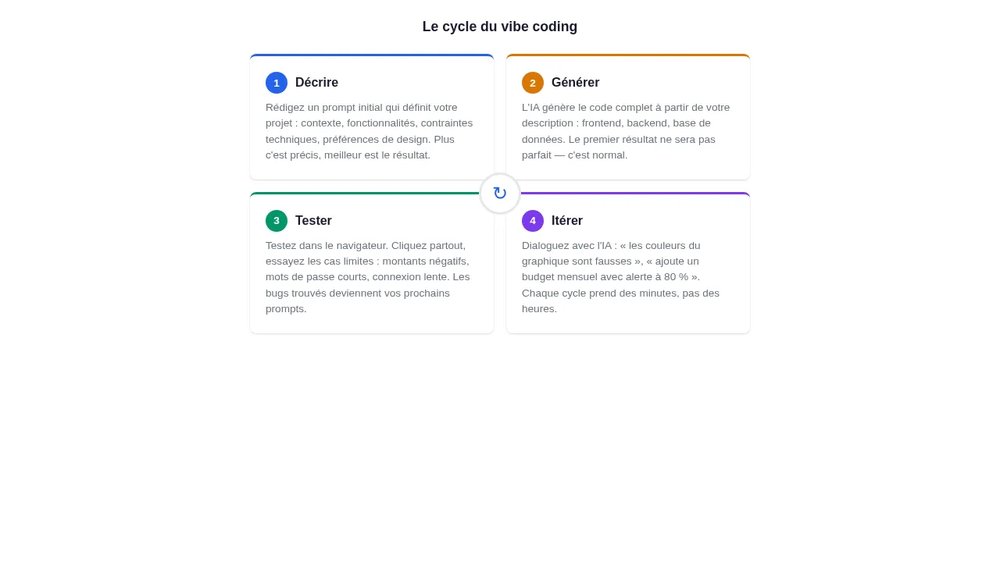
The 3-step process (describe, iterate, test)
Step 1: Describe. You write an initial prompt that defines your project. The more precise the prompt, the better the result. A bad prompt: "Make me an app." A good prompt: "Build a personal budget management web app with React and Supabase. The user can create an account, add expenses by category, view a monthly chart of their spending, and export to CSV."
Step 2: Iterate. The first result will never be perfect. You talk with the AI: "The chart isn't showing the right colors per category," "Add a monthly budget feature with an alert when spending exceeds 80%," "The expense form should close after it's submitted." Each exchange refines the product.
Step 3: Test. After each iteration, you test in the browser. You click everywhere. You try the edge cases. What happens if the user enters a negative amount? If the password is 3 characters long? If the internet connection drops mid-save? The bugs you find become your next prompts.
This cycle repeats, sometimes dozens of times, until you reach a working result. The speed of each cycle is what makes vibe coding so powerful: a few minutes per iteration, where traditional development would take hours.
The "trust but verify" philosophy
Vibe coding rests on a fundamental tension: you trust the AI to write code, but you never trust the result blindly.
Karpathy himself admits that "the code often goes beyond my usual understanding." That is the deal. You accept that you will not understand every line, but you systematically check that the result does what you expect.
For non-developers, this is actually a natural stance. You cannot read the code anyway. Your validation criterion is the behavior of the application: does it work as intended? It is binary. And that is enough for a prototype.
For experienced developers, "trust but verify" means rereading the code on the critical parts (authentication, payment, sensitive data) and trusting the AI on the rest (layout, UI components, simple logic).
The best vibe coding tools in 2026
The market for vibe coding tools has exploded since Karpathy's post. Four tools stand out, each with a different positioning. The right choice depends on your profile and your goal.
Cursor: the IDE supercharged by AI
Cursor is a code editor based on VS Code (the most widely used editor in the world) that natively integrates AI models. It has grown at a staggering pace: from 40,000 paying customers in early 2025 to over a million today, with annual revenue exceeding a billion dollars.
What sets Cursor apart: you work in a real development environment. You have access to your files, your terminal, your Git history. The AI (Claude Sonnet, GPT-4, or other models of your choice) understands the context of your entire project, not just the current file. You can select code and ask it to "refactor this function," or type in the chat "add a settings page with these options," and Cursor edits the right files.
Who it's for: developers who want to speed up their workflow, technical founders who have already touched code. The interface is still an IDE, so you need a minimum level of comfort with that environment.
Pricing: Free (limited), Pro around $20/month, Business around $40/month.
Claude Code: the AI terminal for developers
Claude Code is Anthropic's tool that runs directly in your terminal. No graphical interface, no windows: you type your instructions on the command line and Claude Code edits your files, runs commands, launches tests, and manages your project.
It is the tool least mentioned by competitors (no French-language article on vibe coding covers it in detail), and yet it is one of the most powerful. Claude Code understands the full architecture of your project. It can read thousands of files, navigate across dependencies, and make coordinated changes to multiple files at once.
Its unique strength: autonomy. You can hand it complex tasks ("migrate this database from MySQL to PostgreSQL" or "add unit tests for all the API endpoints") and it executes them, step by step, showing you what it does.
Who it's for: technical founders and developers who prefer the terminal, existing projects with a codebase to evolve, refactoring or migration work.
Pricing: Based on Anthropic API usage (metered by tokens).
Bolt.new: from prompt to deployed app
Bolt.new, built by StackBlitz, is the most "magical" of the bunch. You open your browser, you describe your application, and Bolt.new generates it, previews it and deploys it, all without ever leaving your browser.
No terminal. No installation. No server configuration. You go from an idea to a shareable URL in a few minutes. Bolt.new generates full-stack applications (React, Node.js, databases) with a real-time visual interface.
It is the tool that has done the most to democratize vibe coding for non-developers. You watch your application take shape before your eyes, and you can step in at every stage through dialogue.
Who it's for: non-technical founders, designers who want to prototype, anyone with an idea who wants a prototype in 30 minutes without installing anything.
Pricing: Free (limited), Pro around $20/month.
Lovable: design + code in a single prompt
Lovable (formerly GPT Engineer) sits at the intersection of design and code. Its strong point: the visual quality of the applications it generates. Where other tools produce functional but basic interfaces, Lovable generates applications that look like finished products.
You describe your application and the design you want ("a SaaS dashboard with a dark sidebar, statistics cards, and a style similar to Linear"), and Lovable produces an application with genuine design work. It integrates Supabase for the back-end and allows direct deployment.
Who it's for: founders who want a visually convincing prototype for investor demos, designers who want to turn their mockups into code, B2B SaaS products where design matters.
Pricing: Free, Pro $25/month, Business $50/month.
Comparison table: which tool for which use
| Criterion | Cursor | Claude Code | Bolt.new | Lovable |
|---|---|---|---|---|
| Type | IDE (code editor) | Terminal | Browser | Browser |
| Level required | Intermediate | Intermediate | Beginner | Beginner |
| Strong point | Full project context | Autonomy, complex tasks | Zero installation | Design quality |
| Ideal for | Building a real product | Refactoring, migrations | Prototyping an idea | Investor demos |
| Deployment | Manual (you handle it) | Manual (you handle it) | Built-in (1 click) | Built-in (1 click) |
| Entry pricing | Free / ~$20/month | API usage | Free / ~$20/month | Free / ~$20/month |
| Existing codebase | Yes | Yes | No (new project) | No (new project) |
The choice depends on your situation. Non-technical founder with an idea? Bolt.new or Lovable. Technical founder who wants to move fast? Cursor or Claude Code. Existing project to evolve? Cursor or Claude Code. And if you want a European alternative to the American models, Mistral for vibe coding is worth a look.
Vibe coding vs traditional development
What really changes
Vibe coding does not change what you build. It radically changes how, and how fast, you build it.
What used to take weeks now takes hours. A contact form with validation, email sending and database storage: 2 hours in vibe coding, 2 days in traditional development. A dashboard with charts and filters: half a day in vibe coding, a week in conventional development.
Cost follows the same logic. Where hiring a freelance developer for an MVP cost 10,000 to 30,000 euros, a founder equipped with Bolt.new or Cursor can build a working prototype for the price of a monthly subscription.
But the real revolution is not the time saved. It is the change in access. Before, building a tech product required knowing how to code or paying someone who does. That barrier shut out millions of entrepreneurs, designers and domain experts who had the best product ideas but no way to build them. Vibe coding removes that barrier.
What does not change (tests, architecture, security)
It would be too good if vibe coding solved everything. It does not solve everything. (And be wary of anyone who tells you otherwise.)
Tests remain necessary. AI-generated code compiles and works in the nominal case. But the edge cases, the input errors, the unexpected behaviors: you have to test them manually or ask the AI to generate automated tests (and check that those tests are relevant). Most MVPs that go off the rails fall into the same traps, which we have gathered in our guide to vibe coding mistakes to avoid.
Architecture still matters. For a prototype, the architecture the AI generates is enough. For a production product with thousands of users, you will need to rethink the structure. The AI generates code that works, not necessarily code that scales.
Security is not optional. The AI can generate code with security flaws: SQL injections, poorly managed authentication tokens, exposed sensitive data. For an internal prototype, that is not critical. For a production product that handles user data, a security audit is essential.
Tutorial: building an app from A to Z with vibe coding
Let's move from theory to practice. Here is how to build a complete application with vibe coding, step by step. The example: a user feedback collection app for a SaaS product.
Step 1: frame your need (the initial prompt)
The initial prompt is the most important moment. A good prompt contains four elements:
- The context: what the project is, for whom, why
- The features: what the application must do, concretely
- The technical constraints: preferred stack, required integrations
- The design: visual style, references
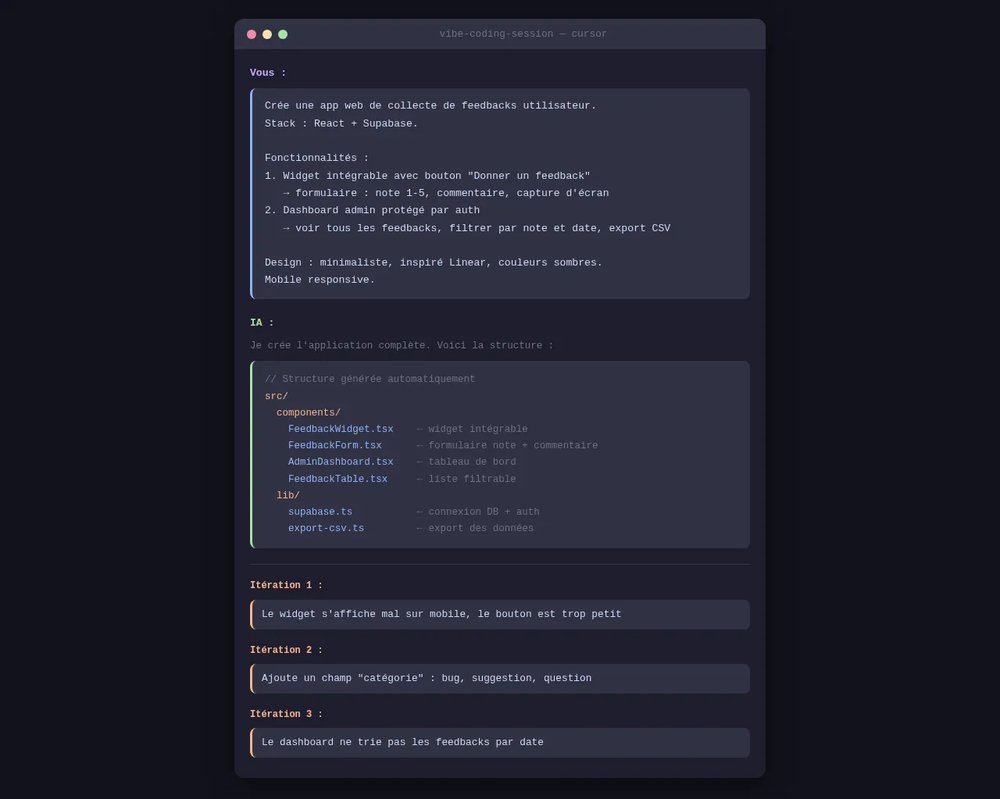
Example of an initial prompt for our feedback application:
"Build a user feedback collection web app. Stack: React + Supabase. Features: (1) an embeddable widget that end users see on the product, with a 'Give feedback' button that opens a form (rating from 1 to 5, free-text comment, optional screenshot), (2) an admin dashboard protected by authentication where the founder sees all the feedback, can filter it by rating and by date, and export to CSV. Design: minimalist, inspired by Linear, dark colors. Mobile responsive."
This prompt is 80 words long. It contains everything the AI needs to generate a first version.
Step 2: iterate with the AI (refine, fix, enrich)
The first version will be functional but imperfect. That is normal. Iteration is the heart of vibe coding.
Typical first fixes:
- "The widget displays poorly on mobile, the button is too small"
- "Add a 'category' field to the form with the options: bug, suggestion, question"
- "The dashboard isn't showing the feedback in chronological order"
- "I want a tagging system so the admin can manually categorize the feedback"
Each iteration adds a layer of sophistication. After 10-15 exchanges, you have an application that looks like a real product.
The trick that few guides mention: copy-paste the error messages straight into the chat. The AI reads the error, understands the context, and fixes it. No need to understand what "TypeError: Cannot read properties of undefined" means. The AI knows.
Step 3: test and harden the code
Testing in vibe coding happens on two levels:
Manual testing: you use the application like a real user. You click everywhere. You enter absurd data. You open it on mobile. You test it with a slow connection. Every bug you find becomes a prompt.
Automated testing: ask the AI to generate tests. "Write unit tests for the feedback form component" or "Add integration tests for the feedback submission API." The AI generates the tests AND the code to run them.
Step 4: deploy and share
With Bolt.new or Lovable, deployment is built in: one click and your application is accessible via a URL. With Cursor or Claude Code, you deploy to Vercel, Netlify or Railway in a few commands.
The result: in one working day (not a senior developer's day, a day for a founder discovering vibe coding), you have a working application, deployed and shareable.
That speed is what changes everything for startup founders.
Vibe coding for founders: building your MVP without hiring
Here is the section you will not find anywhere else. Every guide on vibe coding is written for developers or tech enthusiasts. None of them answers the question that matters to a startup founder: how do I use vibe coding to validate my business idea, fast and without breaking the bank?
Why non-technical founders should get into it
The classic problem of the non-technical founder is well known. You have an idea, you have identified a market, you may even have your first prospects. But you cannot build the product. Your historical options:
- Hire a CTO: 6 months of searching, 15-25% equity, and half the CTOs hired at this stage leave within 18 months
- Outsource to an agency: 20,000 to 80,000 euros for an MVP, 3-6 months of development, and a product you do not control
- Learn to code: 6-12 months of training before you are operational, while the market does not wait
Vibe coding creates a fourth option: build a working prototype yourself in a few days, for a few dozen euros a month.
It is not a finished product. It is not scalable. But it is enough to do the one thing that counts at the early stage: put your idea in the hands of real users and watch what happens.
From lean canvas to working prototype
If you are a founder, you are probably familiar with the lean canvas. This framework helps you frame your assumptions about the problem, the solution, the channels, the revenue model. Vibe coding fits directly into this methodology: it turns your assumptions into a testable prototype in record time.
The connection with Eric Ries's "Build-Measure-Learn" cycle is direct:
- Build: vibe coding radically speeds up this phase. What took weeks (building an MVP) takes days.
- Measure: with a working prototype in the hands of real users, you measure what counts: do people use it? Do they come back? Do they pay?
- Learn: the insights from that measurement feed your next iteration. And vibe coding lets you iterate the product as fast as you learn.
Here is the concrete workflow for a founder:
- Day 1: Write your lean canvas. Identify your riskiest assumption (usually: "people have this problem and would pay for this solution").
- Days 2-3: Build a prototype with Bolt.new or Lovable. It does not need to be perfect. The user needs to be able to test the core value proposition.
- Days 4-7: Put the prototype in the hands of 10-20 target users. Observe. Gather feedback.
- Day 8: Iterate the prototype based on the feedback. Pivot or persevere.
This 8-day cycle replaces a 3-month one. You can test 4-5 assumptions in the time it used to take to test a single one. That is a massive competitive advantage.
Several startups supported through the swanbase program have used exactly this approach to validate their idea before hiring their first technical person.
The limits: when to hire a real developer
Vibe coding does not replace developers. It buys you time and clarity.
Here are the signals that it is time to hire:
- You have validated product-market fit and you have paying users. The prototype has done its job, now you need to build for the long term.
- Your application handles sensitive data (medical, financial, personal). Security demands expertise that vibe coding alone does not guarantee.
- You need performance at scale. With 100 users, vibe coding code holds up. With 10,000 concurrent users, you need an architecture designed by a professional.
- Technical debt is piling up. After dozens of vibe coding iterations, the code can turn into a plate of spaghetti. An experienced developer will know how to restructure it.
The right strategy: use vibe coding to go from idea to product-market fit. Hire a developer (or a team) to go from product-market fit to scale. You will arrive at the hiring table with a considerable advantage: a working product, paying users, and a clear vision of what needs to be built. If you are still torn between doing it all yourself and delegating, we dug into the question in vibe coding: agency or solo?.
The limits and criticisms of vibe coding
Vibe coding is not a magic bullet. The enthusiasts who tell you otherwise are doing you a disservice. Here are the real problems, without playing them down.
Code quality and maintainability
AI-generated code works. But "working" and "being maintainable" are two very different things.
Simon Willison, AI researcher and creator of Datasette, puts it this way: "Vibe coding your way to a production codebase is clearly risky. Most of the work we do as software engineers involves evolving existing systems, where the quality and understandability of the underlying code is crucial."
The concrete problem: vibe coding code has no deliberate structure. No consistent architecture patterns. No naming conventions. Each iteration adds code with no overall vision. After 50 iterations, the project can become incomprehensible, even to the AI itself.
For a prototype, that is not a problem. For a production product, it is a ticking time bomb.
Security and sensitive data
The AI does not think about security by default. It generates code that works, not code that is secure. The common risks:
- SQL injection: the AI can generate vulnerable database queries
- Weak authentication: poorly managed tokens, unsecured sessions
- Data exposure: API keys in the source code, sensitive data in the logs
- Missing validation: unfiltered user input
These problems are manageable if you are aware of them. Explicitly ask the AI to "secure the authentication according to OWASP best practices" or to "check for security flaws in this code." The AI knows how to write secure code. You just have to ask.
Invisible technical debt
The most dangerous technical debt is the kind you do not see. With vibe coding, you accumulate debt with every iteration: duplicated code, unnecessary dependencies, orphan functions, contradictory configurations.
This debt is "invisible" because the application works. Everything seems fine. Until the day a simple change breaks three seemingly unrelated features. That is the spaghetti effect: when everything is connected with no structure, touching one strand moves the others.
The pragmatic solution: treat vibe coding code as a throwaway prototype. If it validates your business assumption, rewrite it cleanly (with the AI's help, but this time with a developer supervising the architecture). If the assumption is invalidated, the code goes in the bin with no regrets.
The future of vibe coding
Toward production-grade vibe coding?
The question stirring the tech community: will vibe coding stay confined to prototypes, or will it become a viable development mode in production?
The signals point to convergence. AI models are advancing fast. What was rough in 2025 is becoming more reliable in 2026. Tools are adding layers of automatic verification: generated tests, security analysis, technical-debt detection. Cursor already integrates AI code review features.
Around 25% of the startups in Y Combinator's Winter 2025 batch reported codebases largely generated by AI. That figure will rise. The question is no longer "will AI code?" but "how much human supervision will remain necessary?".
The most likely scenario: the vibe coding of 2027-2028 will be supported by AI agents specialized in testing, security and optimization. The founder describes the need, one AI codes, and other AIs check, test and harden the code. The human stays the decision-maker, not the executor.
The impact on software development jobs
Vibe coding is not going to "replace developers." That is an intellectual shortcut that ignores the reality of what developers actually do.
What it will change: the ratio between developers and products. Where a startup needed 3 developers to build an MVP, it will need one (supercharged by AI). Where a company needed 10 developers to maintain an application, it will need 5.
The developers who thrive will be the ones who move up in abstraction: system architecture, security, performance, supervision of AI agents. The repetitive tasks (writing a CRUD, implementing a form, connecting a standard API) will be largely automated.
For founders, this means easier access to technical talent. A single senior developer supercharged by AI can do the work of a team of three. The cost of building a tech product drops. The barrier to entry lowers. Competition intensifies. Only products that solve real problems survive.
The market is a perfect filter.
FAQ
Can vibe coding replace a developer?
No. Vibe coding lets you build working prototypes and MVPs without a developer. But for a production product, with stakes around security, performance and maintainability, a developer (or a team) is still necessary. Vibe coding does not replace technical expertise, it democratizes access to building software. Think of it as a lever: it lets you validate an idea before investing in a technical team.
Do you need to know how to code to do vibe coding?
No, and that is the whole point. Tools like Bolt.new and Lovable are designed for users with no programming skills at all. You describe your need in plain language, the AI generates the code. That said, having some technical basics (understanding what an API, a database or a server is) will let you write more precise prompts and iterate more effectively. It is not a prerequisite, it is an accelerator. To start off on the right foot, follow our guide to learning vibe coding.
What is the best vibe coding tool in 2026?
There is no universal "best," it all depends on your profile. For a non-technical founder who wants a quick prototype: Bolt.new or Lovable. For a technical founder or a developer: Cursor or Claude Code. For an existing project to evolve: Cursor or Claude Code. For a visually polished investor demo: Lovable. Start with the tool that fits your situation, you can migrate later.
Can you build a real startup with vibe coding?
Yes, for the validation phase. Vibe coding lets you build an MVP, put it in the hands of users, and validate (or invalidate) your business assumption in a few days. Several Y Combinator startups and startups from acceleration programs like the swanbase program have used this approach. But "building a real startup" goes beyond code: you also need growth marketing, a viable business model, and, eventually, a technical team to scale the product. Vibe coding is a powerful starting point, not a destination.