You have a product, a handful of users, and you want to get from 10 customers to 1,000 without draining your cash. Growth marketing is a method for growth: the team tests every stage of the customer journey and keeps what works, backed by numbers. This page gives you the definition, compares growth marketing with traditional marketing and growth hacking, walks through the six stages of AARRR and shows you where to start. For the step-by-step method (growth model, ICE, experiment sheet), the Growth chapter of the swanbase guide goes deeper.
Growth marketing: a definition
Growth marketing is a growth method built on rapid experimentation, data analysis and continuous improvement of every stage in the customer journey. Traditional marketing thinks in campaigns and annual budgets. A growth marketer thinks in loops: form a hypothesis, measure the result, keep what works, drop what doesn't, and repeat.
Silicon Valley unicorns hold no monopoly on this method. A three-person startup can apply it from day one with a budget close to zero. The only requirement: you accept that your intuitions are hypotheses to be tested.
Three principles hold the method together. Every marketing action is an experiment, with a hypothesis, a success metric and a decision rule set in advance (scale it, iterate, or stop). The work covers the entire funnel, from acquisition to referral, well beyond acquisition alone. Decisions rest on numbers, and playbooks copied from a Medium post count as hypotheses, never as proof.
Growth marketing vs. traditional marketing
Traditional marketing means TV campaigns, highway billboards and media budgets planned six months ahead. It works for large companies that have millions to spend and can wait twelve months for results. A startup that copies that calendar burns through its cash before it has learned anything.
| Criterion | Traditional marketing | Growth marketing |
|---|---|---|
| Time horizon | 6 to 12-month campaigns | 1 to 4-week cycles |
| Budget | High, fixed in advance | Variable, reinvested based on results |
| Goal | Awareness, brand image | Acquisition, activation, retention |
| Measurement | Impressions, reach | CAC, LTV, conversion rate, retention |
| Decision-making | The marketing director's intuition | Experiment data |
| Scope | Top of the funnel | Full funnel (AARRR) |
The growth marketer's question is whether CAC dropped 15% this week, rather than whether the campaign looked good.
Growth marketing vs. growth hacking
Growth hacking is growth marketing's impulsive cousin. Sean Ellis coined the term in July 2010 to describe someone whose "true north" is growth. The textbook cases: Hotmail added "PS: I Love You. Get your free email at Hotmail" to the signature of every email sent, an idea from investor Tim Draper, and reached one million users in six months. Airbnb built a script that reposted its hosts' listings on Craigslist to capture traffic from an established platform. Dropbox gave free storage to both the referrer and the person invited.
These moves are spectacular and can't be repeated. The Hotmail hack only works once, Craigslist closed the door, and a competitor copying Dropbox can't expect the same result. Growth marketing is a system that improves with every cycle.
| Growth hacking | Growth marketing | |
|---|---|---|
| Approach | Tactical, opportunistic | Strategic, systematic |
| Duration | Short term | Long term |
| Repeatability | Low, the hack wears out | High, the system improves |
| Skills | Technical creativity | Analysis, creativity, strategy |
| Risk | High (terms of service violated, annoyed users) | Contained (bounded experiments) |
The AARRR framework in six stages
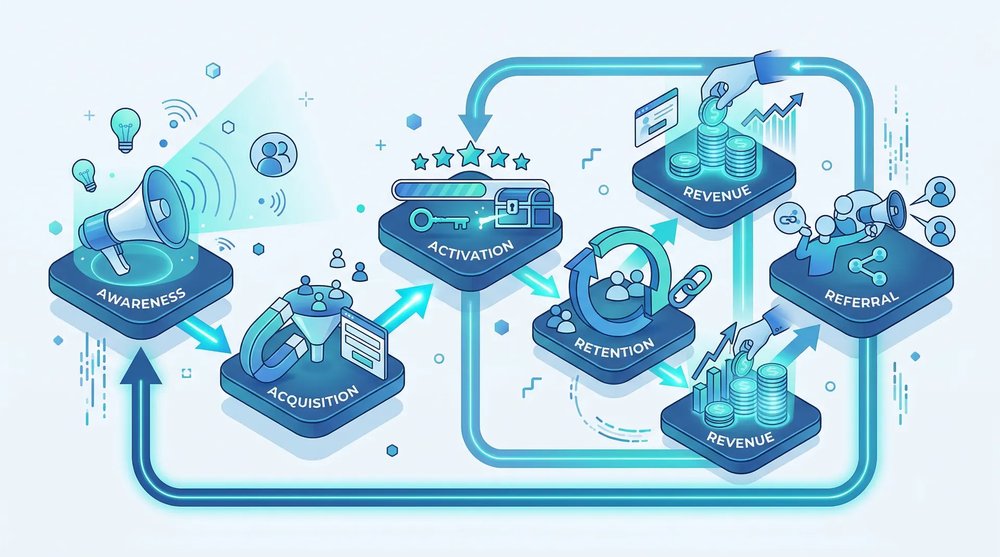
Dave McClure, founder of 500 Startups, introduced the AARRR framework under the title "Startup Metrics for Pirates", because AARRR sounds like a pirate's cry. His version has five measurable stages: acquisition, activation, retention, referral and revenue. This page adds a sixth stage upstream: awareness.
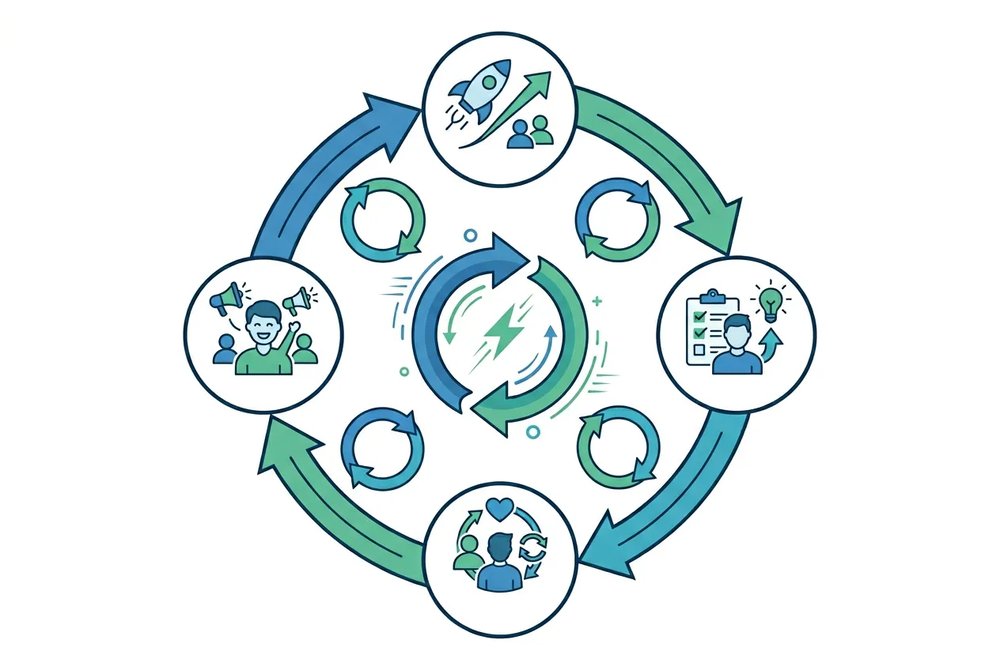
The six stages form loops. A referral program feeds acquisition. Retention raises LTV, and a higher LTV lets you bid more on paid acquisition.
| Stage | Definition | Question to ask |
|---|---|---|
| Awareness | Potential customers discover the brand | How many people hear about my brand? |
| Acquisition | Users visit the platform | How many people come to my site? |
| Activation | Users experience the value for the first time | How many visitors take the first meaningful step? |
| Revenue | Users become paying customers | How many prospects pay, and how much? |
| Retention | Customers come back | How many customers buy again or stay subscribed? |
| Referral | Customers bring in new users | How many customers recommend the brand? |
Awareness: getting known by the right audience
Before visiting your site, a potential customer hears about you: a LinkedIn post, a recommendation, a podcast episode. In B2B, this phase carries a lot of weight: an average of 76 touchpoints across 3.7 channels influence a purchase, and 272 days pass between first touch and revenue, according to Dreamdata's LinkedIn Ads benchmarks. A founder who doesn't measure how people discover the brand is blind to a large part of the customer journey.
Four signals are enough to start: branded searches in Google Search Console, direct traffic, brand mentions and the number of followers who belong to your target audience. At the early stage, founders often drive awareness themselves, with a founder-led content strategy. To connect that visibility to acquisition, read how to turn LinkedIn views into customers, then build the channel step by step with the Marketing chapter of the swanbase guide.
Acquisition: attracting the right users
Acquisition feeds everything else, and some visitors are worth far more than others. The growth marketer looks for the traffic most likely to become customers.
A startup has five families of channels to choose from. SEO is free and slow, and a well-ranked article brings in traffic for years; it's one of the most underrated channels for early-stage startups. Paid advertising (Google Ads, Meta Ads, LinkedIn Ads) is fast and measurable, and its trap is dependency: the day you cut the budget, the traffic stops. Outbound (cold email, LinkedIn) works in B2B as long as you personalize every message and keep the volume up. Content (blog, newsletter, podcast) builds authority and feeds SEO. Founders often neglect community and partnerships, even though these two channels cost the least.
For your first ten customers, start with manual channels (your network, calls, messages sent one by one): read our method for finding your first customers. Paul Graham makes the same case in his essay "Do Things That Don't Scale", which we summarize here.
The benchmark metric for acquisition is CPA (cost per acquisition): ad spend divided by the number of conversions. If your CPA exceeds your LTV, you lose money on every customer.
Activation: turning first contact into an experience
Activation is the moment a user grasps your product's value, and a sign-up alone falls short of that. For a SaaS, it's when the user completes onboarding and uses the feature they came for for the first time. For e-commerce, it's adding an item to the cart. For a marketplace, it's the first search that returns relevant results.
If your activation rate is low, no amount of acquisition will save you: you're filling a leaky bucket. To raise it, shorten the time between sign-up and first success (time-to-value), strip unnecessary steps out of onboarding, show the value before asking for commitment (free trial, freemium) and personalize the first screen based on what the user told you at sign-up.
Revenue: monetizing without killing growth
Revenue flows from the other five stages. If awareness, acquisition, activation, retention and referral work, revenue follows. That's why revenue rarely makes a good North Star Metric (see the metrics section).
| Metric | Definition | Relevant model |
|---|---|---|
| MRR (Monthly Recurring Revenue) | Monthly recurring revenue | SaaS |
| AOV (Average Order Value) | Average basket size | E-commerce |
| ARPU (Average Revenue Per User) | Average revenue per user | All |
| ROAS (Return on Ad Spend) | Revenue divided by ad spend | Paid acquisition |
The classic temptation: boosting short-term revenue at the expense of retention. You raise prices abruptly, pile on pushy upsells, cut back on service. Revenue climbs for a quarter, then churn wipes out the gain. A growth marketer makes the call for the long term.
Retention: bringing people back
Startups die quietly at the retention stage. You acquire 100 new users a month, and if 80 disappear after the first month, you're building nothing.
The metrics depend on the model. A SaaS tracks monthly churn and its DAU/MAU ratio. An e-commerce business tracks repeat purchase rate and purchase frequency. A mobile app tracks D1, D7 and D30 retention. Set your targets based on your own cohorts: a point of retention gained today compounds every month.
A retention curve that flattens out is the most reliable signal of product-market fit. Check for that signal before spending anything on acquisition: without retention, you're paying to acquire customers who leave.
Referral: turning your users into ambassadors
When your customers become your acquisition channel, the marginal cost of each new customer approaches zero. Dropbox's referral program, covered below, is still the most cited example.
The referral metric is the K-factor: the number of invites per user multiplied by the invite conversion rate. If K is above 1, each user brings in more than one other and growth becomes viral. With K = 0.5, 100 acquired users bring in 50 more in the first generation of invites, a 1.5x multiplier on your paid acquisition. If those newcomers invite others in turn, the following generations add 25, then 12.5, and the multiplier approaches 2 (the formula is 1 / (1 - K)). To choose the right loop for your product, read section 6 ("Growth loops at every level") of the Growth chapter.
Getting started with three people and a small budget
You have the framework, a team of three, a six-month-old product and a tight budget. Start by choosing your growth engine and writing your growth model, then launch a first experiment. If your target audience and sales motion are still fuzzy, lay down your go-to-market strategy first.
Choosing your growth engine
Every startup runs on one main engine, sometimes two. With virality, your users spread the product, like the Hotmail signature or the Dropbox referral program. With a sticky product, switching tools is costly for the user: your churn stays low and each customer you acquire adds lastingly to your base. With profitable paid acquisition, a customer brings in more than they cost to acquire, and you can increase the budget. Focus most of your effort on a single engine. When that engine is the product itself (self-serve, freemium), you're in product-led growth territory, a choice to weigh with our PLG vs. sales-led comparison. To decide, run the three-question test in section 5 ("The three paths to growth") of the Growth chapter.
Writing your growth model
The growth model is the equation behind your growth: a row of rates (the marketing KPIs, the causes) and a row of volumes (the business KPIs, the consequences), linked by Volume[n+1] = Volume[n] x Rate[n to n+1]. For an e-commerce business, the equation connects the number of product pages, traffic per page, conversion rate, average order value and repeat purchases. Once the equation is written, you change one variable at a time and read the effect on revenue: you know which lever to pull instead of guessing. You'll find a worked example and a variable-by-variable simulation in section 2 of the Growth chapter.
Asking six first-principles questions
Before copying the playbook from the latest trending LinkedIn post, ask yourself six questions.
- What are the irreducible truths of my market, and which assumptions am I making without checking them?
- Which constraints are real (budget, regulation) and which are just habits?
- If I had to cut 90% of my marketing actions, what would be left?
- If my growth strategy failed completely, what would the root cause be?
- If I started from scratch, what would I build?
- What breaks if I scale by 10x?
A founder who answers these six questions in writing before launching a first campaign usually avoids spending that first budget on a channel picked by imitation.
Launching your first growth experiment
Write up each experiment before launching it, on a four-field sheet: the fuel (budget, time, effort), the OMTM (One Metric That Matters, the single metric that decides success), the numeric target and the result. The result takes one of three states: success, you scale it; promising, you iterate; inconclusive, you stop. Test the audience and the message first, then the channel and the format; you'll find the full template and an example from brief to verdict in section 9 of the Growth chapter.
Example: you're testing a LinkedIn Ads campaign for your B2B SaaS. Fuel: a €500 budget and two days of work. OMTM: number of demos booked. Target: 15 demos in two weeks. Variables: audience (CIO or marketing director), message ("save time" or "cut your costs"), channel (LinkedIn Ads), format (carousel or video).
Result after two weeks: 8 demos, all from the marketing director, "cut your costs", carousel combination. The state is "promising". You keep the message and the audience, test a new format, and throw nothing away. Before declaring a variant the winner, run your numbers through our A/B test calculator to check that the difference goes beyond chance.
Prioritizing with the ICE framework
You have dozens of experiment ideas and the capacity to run three per cycle. With ICE scoring, you rate each idea from 1 to 10 on three factors: expected Impact, your Confidence in that impact and Ease of execution. Add the three scores for a total between 3 and 30: with addition, a high-impact, low-confidence idea gets a modest score, and its risk becomes visible. Launch the ideas at the top of the list. The scoring grid, two side-by-side examples and the quick-win threshold are in section 4 of the Growth chapter. Out of ideas? Start with our growth experiment generator.
The essential growth marketing metrics
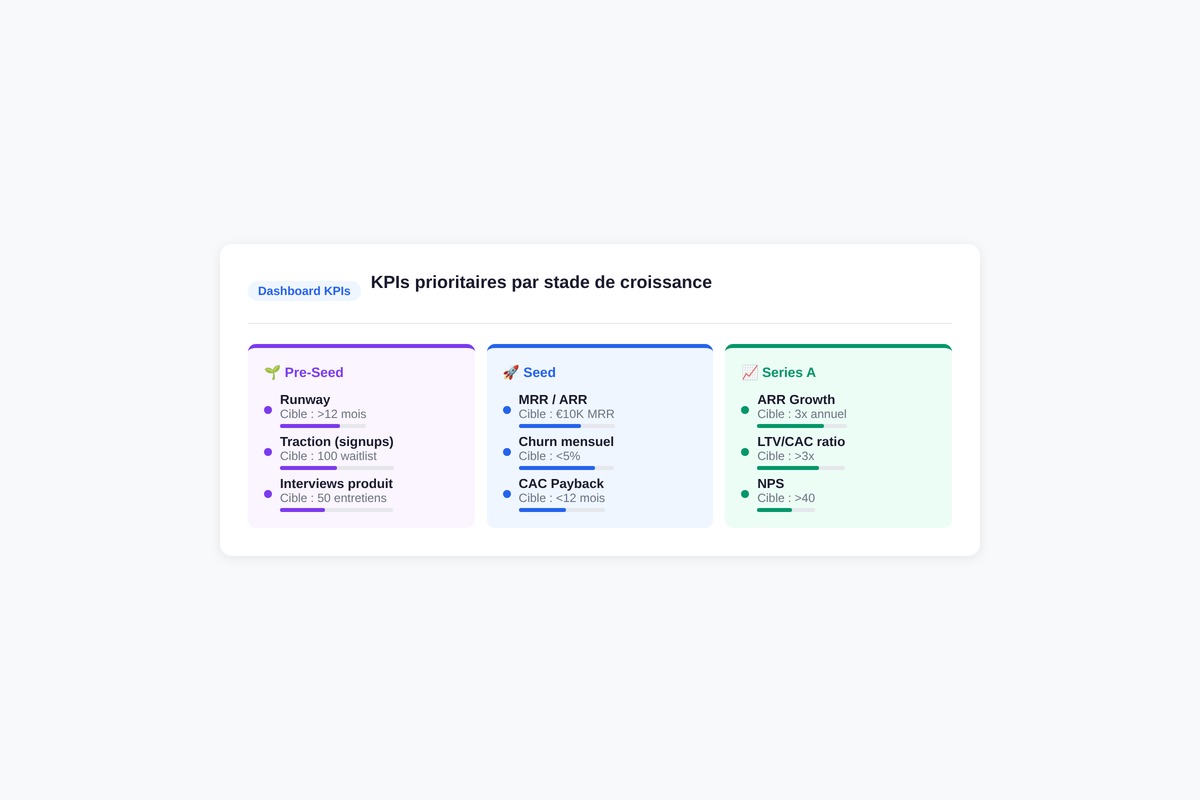
Five metrics structure how you steer, and each one sheds light on the next. Here's one line per metric; for the breakdown by stage of maturity, read our article on the essential startup KPIs.
- CAC (customer acquisition cost) = total marketing budget / number of customers acquired. A fully loaded CAC includes marketing salaries, tools and content on top of advertising.
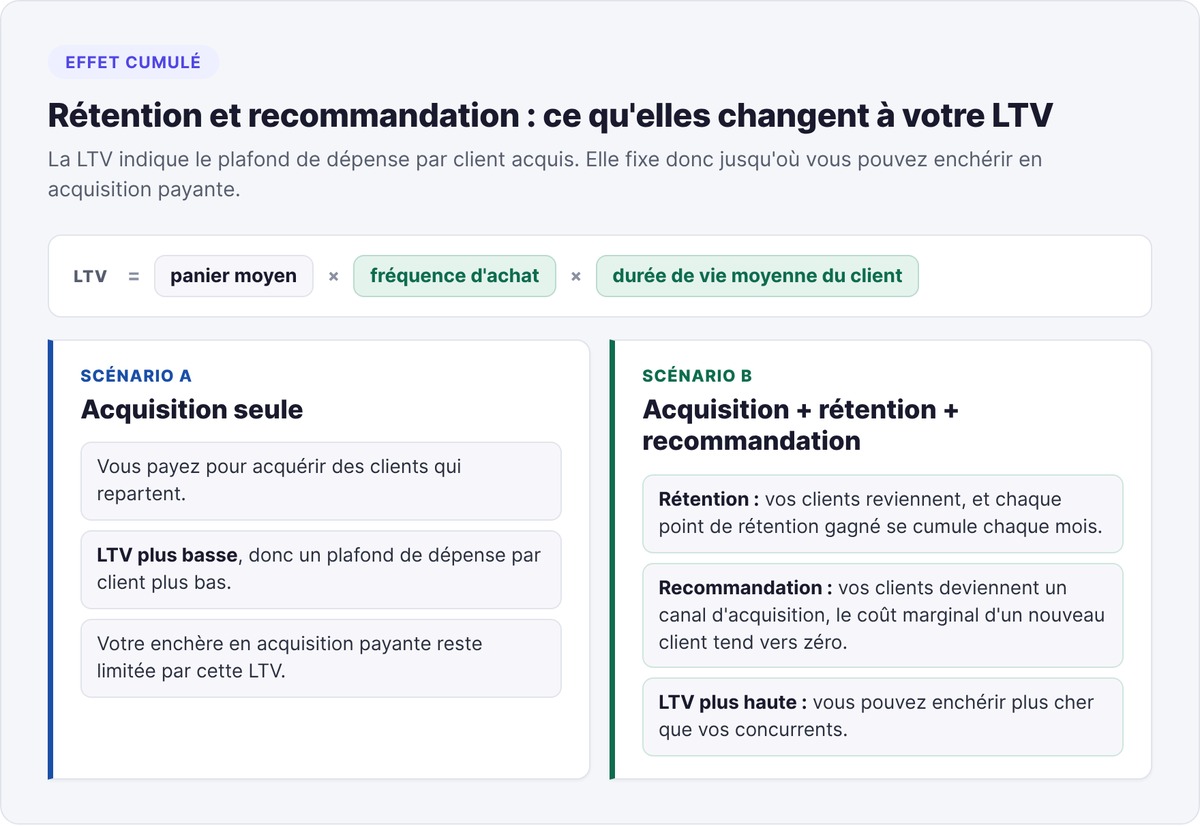
- LTV (customer lifetime value) = average order value x purchase frequency x average customer lifespan. It sets the ceiling on what you can spend per acquired customer.
- LTV:CAC ratio = LTV / CAC. David Skok, on For Entrepreneurs, writes that the best SaaS companies exceed a ratio of 3, sometimes reaching 7 or 8. Below 2:1, fix retention or lower CAC before increasing the budget.
- CAC payback = CAC / monthly revenue per customer. With a €300 CAC and €50 in monthly revenue per customer, you recover your outlay in six months. According to Skok, the best SaaS companies recover their CAC in five to seven months, and profitability becomes anemic beyond twelve months.
- Net New MRR = New MRR + Expansion MRR - Churned MRR. If it's negative, you're shrinking, even if your acquisition is rising.
The overall conversion rate (visitors to customers) becomes a vanity metric if you don't break it down. Split it by stage: visitor to sign-up, sign-up to activation, activation to payment, payment to repeat purchase. If your sign-up rate is excellent and your activation rate sits at 15%, the problem lies in onboarding, and extra acquisition budget won't fix it. To plug in your own numbers, use the CAC and LTV calculator.
Choosing your North Star Metric
The North Star Metric (NSM) is the single metric that best captures the value your product creates for its users. Revenue is a consequence of that value, which rules it out as an NSM: a SaaS will track how often its core feature gets used, a music app will track minutes listened. When the NSM rises, engagement and retention rise, and revenue follows. The six criteria of a good NSM and a table by business type are in section 1 of the Growth chapter.
The compounding effect
A startup that works on retention and referral as well as acquisition gets a higher LTV, and can therefore outbid its competitors on paid acquisition. Section 8 of the Growth chapter puts numbers on that gap over twelve months with three scenarios.
The growth marketer's toolkit
Tools change fast. Three categories are enough to get started; the full list is in our guide to AI tools for startups.
Acquisition tools (SEO, ads, outbound)
- SEO: Ahrefs or Semrush for keyword research and rank tracking, Surfer SEO for content optimization, Google Search Console (free and essential).
- Paid advertising: Google Ads, Meta Ads Manager, LinkedIn Campaign Manager. For cross-channel reporting, Triple Whale or Databox.
- Outbound: La Growth Machine, Lemlist, Apollo.io. For lead extraction, Phantombuster and Clay. To find professional email addresses, compare Dropcontact and FullEnrich. The full overview is in our guide to B2B prospecting tools.
Analytics and tracking tools
- Analytics: Google Analytics 4 (free), Mixpanel or Amplitude for product analytics, Hotjar or Microsoft Clarity for heatmaps and session recordings.
- Attribution: Segment to centralize your data, or an in-house setup with Google Tag Manager.
- Dashboards: Looker Studio (free), Databox, Metabase.
Automation tools
- Email and CRM: HubSpot (free tier), Brevo (formerly Sendinblue, French), ActiveCampaign.
- Workflow automation: Zapier, Make (formerly Integromat), n8n (open source).
- Generative AI: ChatGPT and Claude for content creation, email writing and data analysis. AI tools are now part of every growth marketer's standard kit.
Three documented growth strategies
Dropbox and Airbnb
Dropbox: two-sided referrals. The problem, according to Drew Houston's 2010 slides: a cost per acquisition of $233 to $388 through search engine advertising, for a $99 product. The answer: a referral program where both the referrer and the invitee earn extra storage. The result: from 100,000 registered users in September 2008 to 4 million in January 2010, a lasting 60% lift in sign-ups, and 35% of daily sign-ups coming from referrals.
Airbnb: borrowing an existing platform's traffic. Airbnb built an unofficial integration that reposted its hosts' listings on Craigslist, a classifieds site that already drew heavy traffic. Every Craigslist listing linked back to Airbnb. Andrew Chen documented the mechanism in April 2012: it took a script capable of filling out Craigslist's forms.
Respire, a French case
Respire (natural personal care). Justine Hutteau launched Respire with a pre-order campaign on Ulule. The campaign far exceeded its goal, driven by a video of the founder that went viral on LinkedIn. It's the content virality loop in action: a moment of awareness feeds straight into acquisition and revenue.
Growth marketing in France
Growth marketing in France has its own channels and its own blind spots. Channels that work in the US (Product Hunt, Reddit, Hacker News) carry less weight. LinkedIn dominates B2B, and founders underestimate the distribution role of accelerators and incubators: a cohort brings together potential first customers and their networks.
Three roadblocks for early-stage startups
A product-first culture. In the French Tech scene, priority often goes to product and engineering: "we'll finish the product, then do marketing." Without market feedback, the product gets built in a vacuum. By making experimentation and measurement the rule from day one, a founder corrects that bias. Work through the question with a lean canvas before writing a single line of code.
Confusing growth with paid ads. A founder who reduces growth to Facebook campaigns misses five of the six stages. Paid acquisition is one channel among many, rarely the first to switch on at pre-seed, because a CAC without a measured LTV means nothing.
A lack of data skills. A startup with no Google Analytics setup, no conversion tracking and no cohorts is steering its growth blind. Check those three things before your first experiment.
You can clear these three roadblocks in a few weeks of work, and get ahead of competitors who steer without a method.
Growth training and communities
Le Wagon runs a growth marketing bootcamp. On the podcast side, Gabriel Gourovitch interviews growth marketers and founders on Growth Makers (Mantra) about their acquisition channels, metrics and experiments. The podcast remains the cheapest way in to hear French examples.
swanbase supports early-stage founders over the long term, in Paris and remotely, at €0, by application, and takes equity: start with the free guide, then pitch your project if you're building your growth model.
FAQ
What's the difference between growth marketing and growth hacking?
Growth hacking looks for creative, one-off tactics to accelerate growth, like the Dropbox referral program or the Airbnb-Craigslist integration. Growth marketing is a continuous system that covers the entire AARRR funnel, from awareness to referral. Growth hacking is a subset of growth marketing: it feeds the machine rather than replacing it.
How much does a growth marketing strategy cost?
A growth marketing strategy can start on a near-zero budget if you lean on SEO, content and manual outbound. The main costs are tools, where the free tiers of HubSpot, Google Analytics and Brevo cover the first few months, and people's time. Your ad budget depends on your model and your target CAC. Only increase ad spend once your LTV:CAC ratio exceeds 3:1, the benchmark published by David Skok.
Does growth marketing work for B2B startups?
Growth marketing works just as well in B2B as in B2C, with different channels. In B2B, awareness takes longer (76 touchpoints and 272 days on average before a purchase, according to Dreamdata), outbound (cold email, LinkedIn) often pays off better than paid ads, and retention is measured in months of subscription rather than purchase frequency. The AARRR framework applies in exactly the same way, with adapted metrics: sign-ups, completed onboarding, MRR, churn, NPS.
When should a startup start growth marketing?
From day one, without waiting for a "finished" product, because a product is never finished. Growth experiments at the pre-seed stage let you validate your value proposition, find your first customers and refine your lean canvas with real data. A startup that waits for a perfect product loses months of market feedback. Start small, measure everything, adjust.
What's the difference between growth marketing and product-led growth?
Growth marketing is a method: you test and measure every stage of the AARRR funnel, whatever the channel. Product-led growth is a growth model where users discover, adopt and then buy the product through self-serve or freemium, with no salesperson involved. A product-led startup therefore applies growth marketing to its product. More in our guide to product-led growth.