Cursor, Lovable, or Bolt: Which Vibe Coding Tool Should You Choose in 2026?
Lovable, Bolt.new, and Cursor are not interchangeable. Lovable generates a complete application from a plain-language description, which is ideal if you have no technical background. Bolt.new is a browser-based sandbox, perfect for validating an idea in 30 minutes. Cursor is an AI code editor, more powerful but reserved for people who already know how to code. This guide compares the three tools on the criteria that matter to a founder: startup speed, real cost, production limits, and which tool to choose depending on your development phase. A Lovable app deployed in an hour is worthless if it can't scale. A well-configured Cursor can replace an entire dev team, provided you have the skills. Choosing the wrong tool costs weeks.
The 3 tools at a glance
| Tool | Type | Best for | Free tier | Pro price |
|---|---|---|---|---|
| Lovable | Full-stack app generator | Non-technical founders | 5 messages/day | $25/month |
| Bolt.new | Browser IDE (WebContainers) | Rapid prototyping | Limited tokens (~150K/day) | ~$20/month |
| Cursor | AI code editor (VS Code fork) | Founders with technical basics | 2,000 completions/month | $20/month |
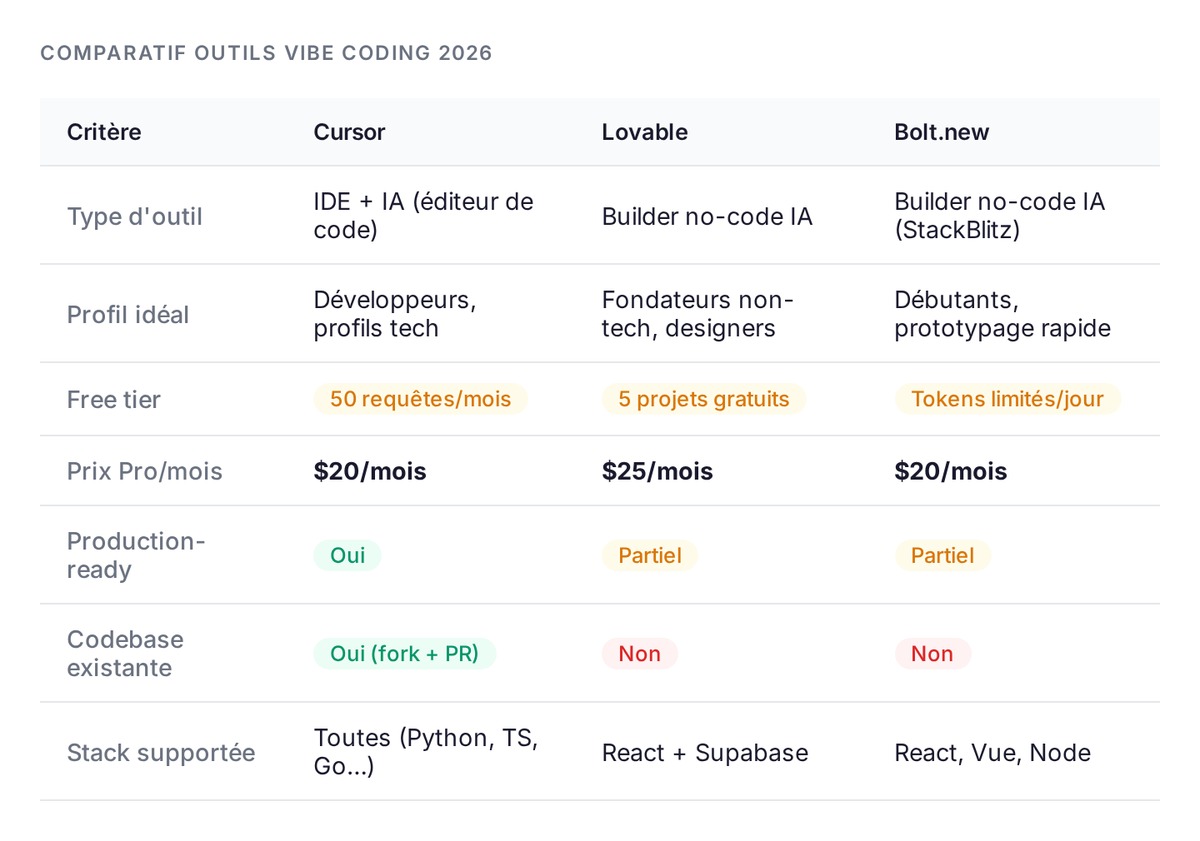
These three tools represent three different philosophies of the founder-code relationship. Lovable wants you to forget that you're coding. Cursor wants to make you better at the code you're already writing. Bolt.new sits between the two: code, in the browser, no installation, and near-zero friction to get started.
Lovable: build a complete app without coding
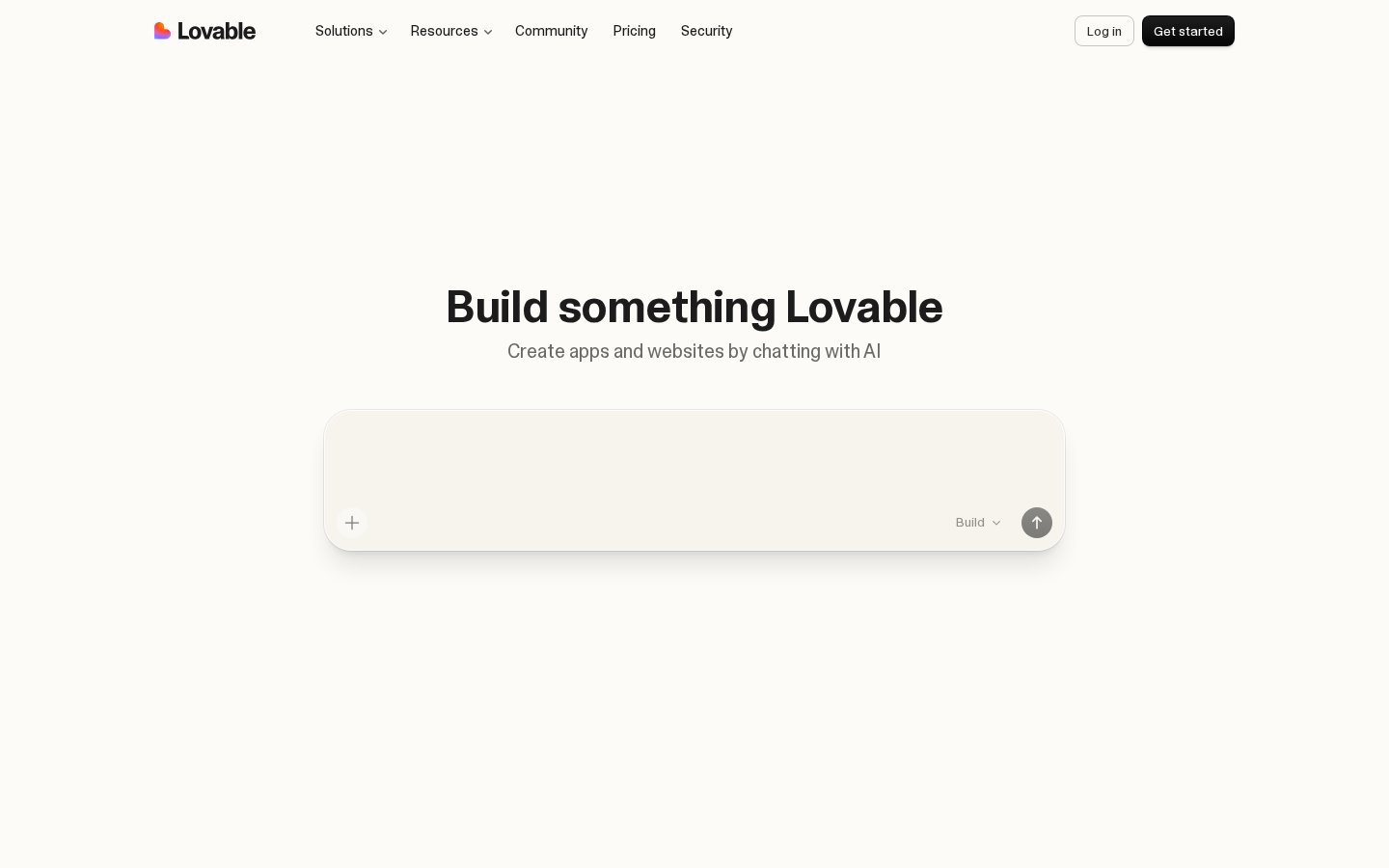
You describe your product in plain English. Lovable generates a React + Supabase application, with a database, authentication, and a complete interface. You never see a line of code unless you want to.
What Lovable does well
Lovable excels at building greenfield apps: starting from scratch, with no existing codebase. The generation is often complete, covering frontend, backend, and database. For a validation MVP (a signup form, a simple dashboard, an internal tool), it's the shortest path from an idea to a shareable URL.
The generated code can be exported to GitHub. You can hand it off to a developer without starting over. That's a critical difference from classic no-code tools like Webflow or Bubble, where the code belongs to the platform. With Lovable, you own what you build.
Lovable's limits
Lovable is poorly suited to an existing codebase. If you already have a code base with your own architecture conventions and stack, Lovable will be more of a hindrance than a help. It generates in its own style, which is hard to constrain.
Production-readiness is partial. For an app with performance, security, or advanced infrastructure requirements (queues, workers, microservices), Lovable quickly hits its limits. Technical debt piles up fast if you don't review what gets generated.
Pricing and the real free tier
- Free: 5 messages per day, enough to test but not enough to develop seriously
- Pro: $25/month, 100 credits per month (messages consume credits based on the complexity of the request)
- Business: $50/month, SSO, extra credits, team features
One Lovable credit corresponds to a complex instruction ("add a profile page with an avatar and permission management"). 100 credits per month cover roughly 3 to 4 serious development sessions. During intensive iteration, the real cost climbs with add-on credit packs.
Bolt.new: prototype fast in the browser
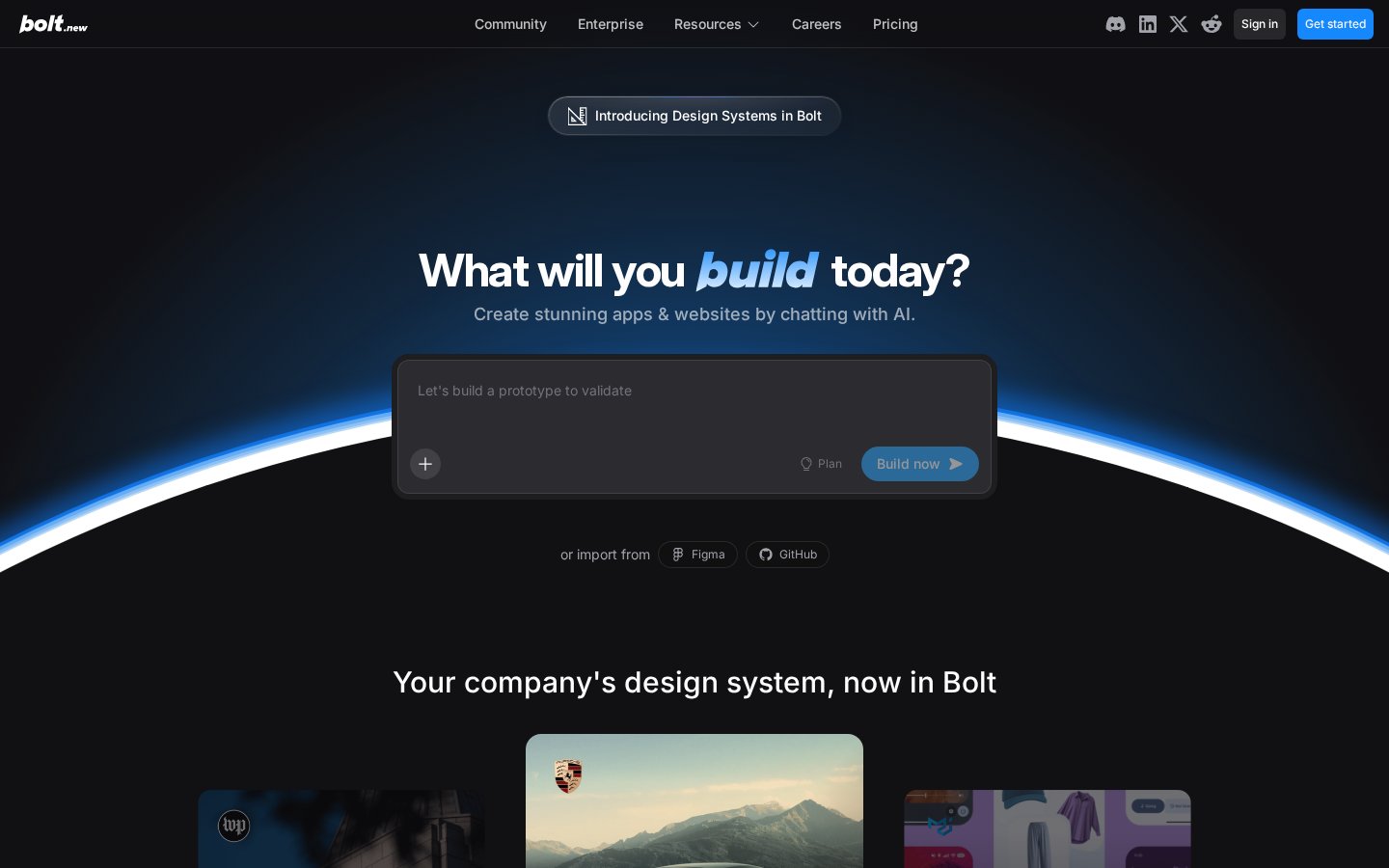
Bolt.new runs entirely in the browser via WebContainers, a StackBlitz technology that compiles Node.js to WebAssembly. No installation, no local configuration. You open bolt.new, describe your app, and a complete development environment spins up in a few seconds.
What Bolt does well
Its execution speed is unmatched for idea validation. Going from "I want a booking MVP for a coaching service" to a shareable live preview: Bolt.new is the shortest path.
Since August 2025, Bolt Cloud has significantly broadened its capabilities: a built-in database, authentication setup, and native hosting on bolt.host with custom domains on paid plans. The "demo-tool-only" phase is over. Bolt has become a real development tool, not just a generator of interactive wireframes.
Bolt's limits
Technical debt shows up fast on complex projects. Bolt handles simple apps well. For real SaaS infrastructure with Postgres, Redis, and job queues, you export the code to a real environment and spend time adapting it.
Generation errors accumulate on advanced projects. Several developers report loops where Bolt fixes one error while creating two more. On projects beyond a few hundred lines, reliability drops and debugging becomes time-consuming.
Pricing and the real free tier
- Free: limited tokens (~150,000 tokens/day), enough for short demos but not for a prolonged development session
- Pro: ~$20/month, 10 million tokens/month, no daily cap, unused tokens roll over for 2 months
- Teams: $30/user/month, 20 million tokens/month
One Bolt token corresponds roughly to one character of generated code. 10 million tokens is a comfortable volume for serious individual use, unless you're building a complex app in intensive daily sessions.
Cursor: for founders with technical basics
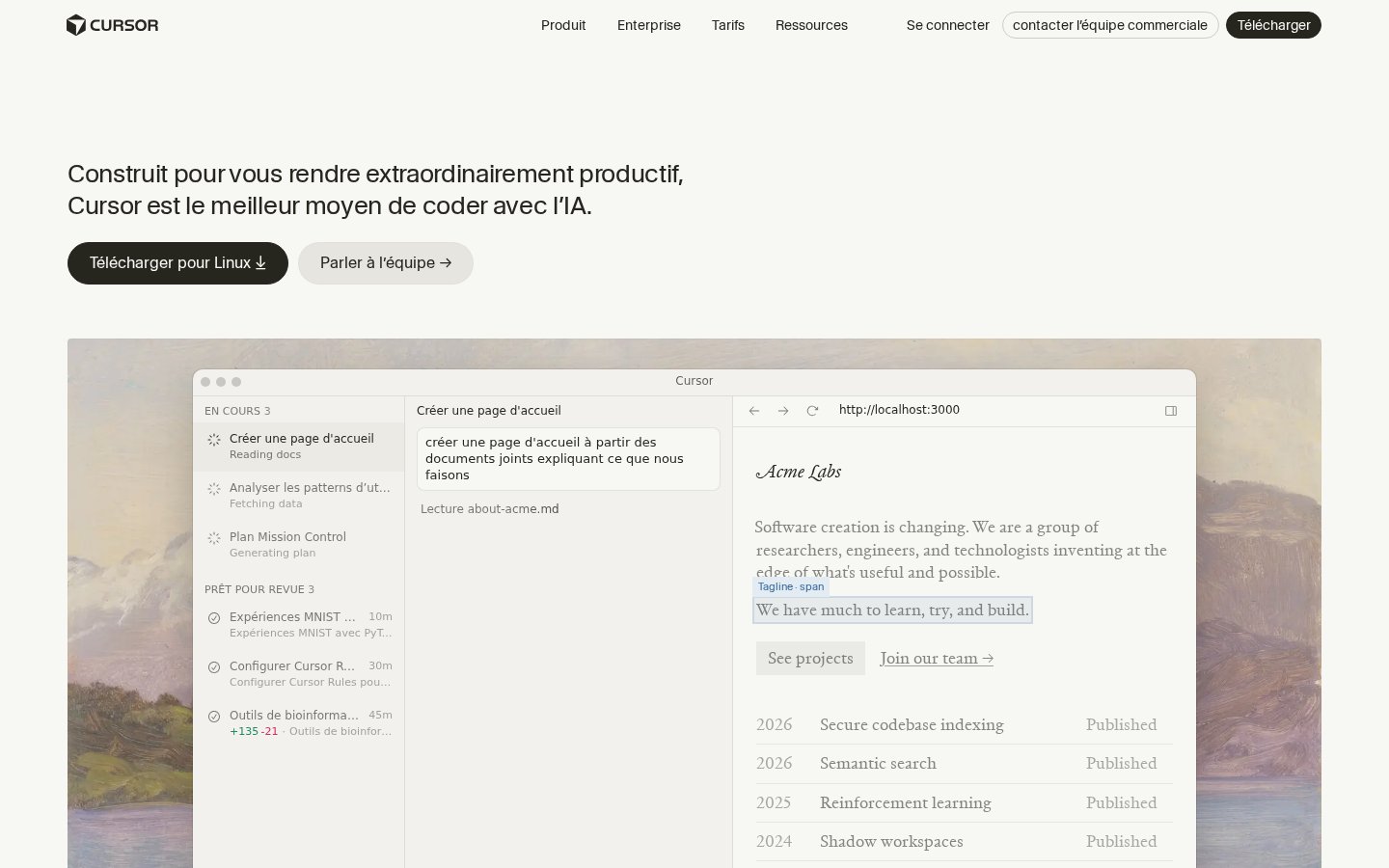
Cursor isn't an app generator. It's VS Code with deeply integrated AI, an augmented code editor. The conceptual difference is total: Cursor improves what you already do. It doesn't build in your place.
What Cursor does well
Cursor understands your entire codebase. If your project is 20 files and 3,000 lines, Cursor reads it all, understands your conventions, and suggests changes consistent with your existing architecture. That's its superpower.
Multi-file generation is unrivaled among the tools in this comparison. "Add a JWT authentication system with refresh tokens, following the pattern I use in /api/users.ts": Cursor edits the right files, in the right style, respecting your conventions. No no-code generator can do that on an existing codebase.
Cursor's limits
If you can't code, Cursor is useless. It augments a developer, it doesn't replace one. You need to understand what it generates in order to review it, fix it, and deploy it. The risk of approving buggy code you don't understand is real and expensive.
Setup takes time. Mastering Cursor properly (writing effective .cursorrules, framing prompts with the right context, managing large contexts) takes several weeks of regular practice.
Pricing and the real free tier
- Hobby (free): 2,000 completions/month, 50 slow requests, enough to evaluate the tool seriously
- Pro: $20/month, unlimited completions, 500 fast requests, access to advanced models (Claude, GPT-4o)
- Business: $40/user/month, team features, privacy mode, admin
At $20/month, Cursor is the best ROI on the list for a technical founder. A few hours of productivity gained per week are enough to justify the subscription.
Which one should you choose for your startup phase?
Every comparison handles these tools by feature. None answers the real question for an early-stage founder: which tool now, at this exact stage of the project?
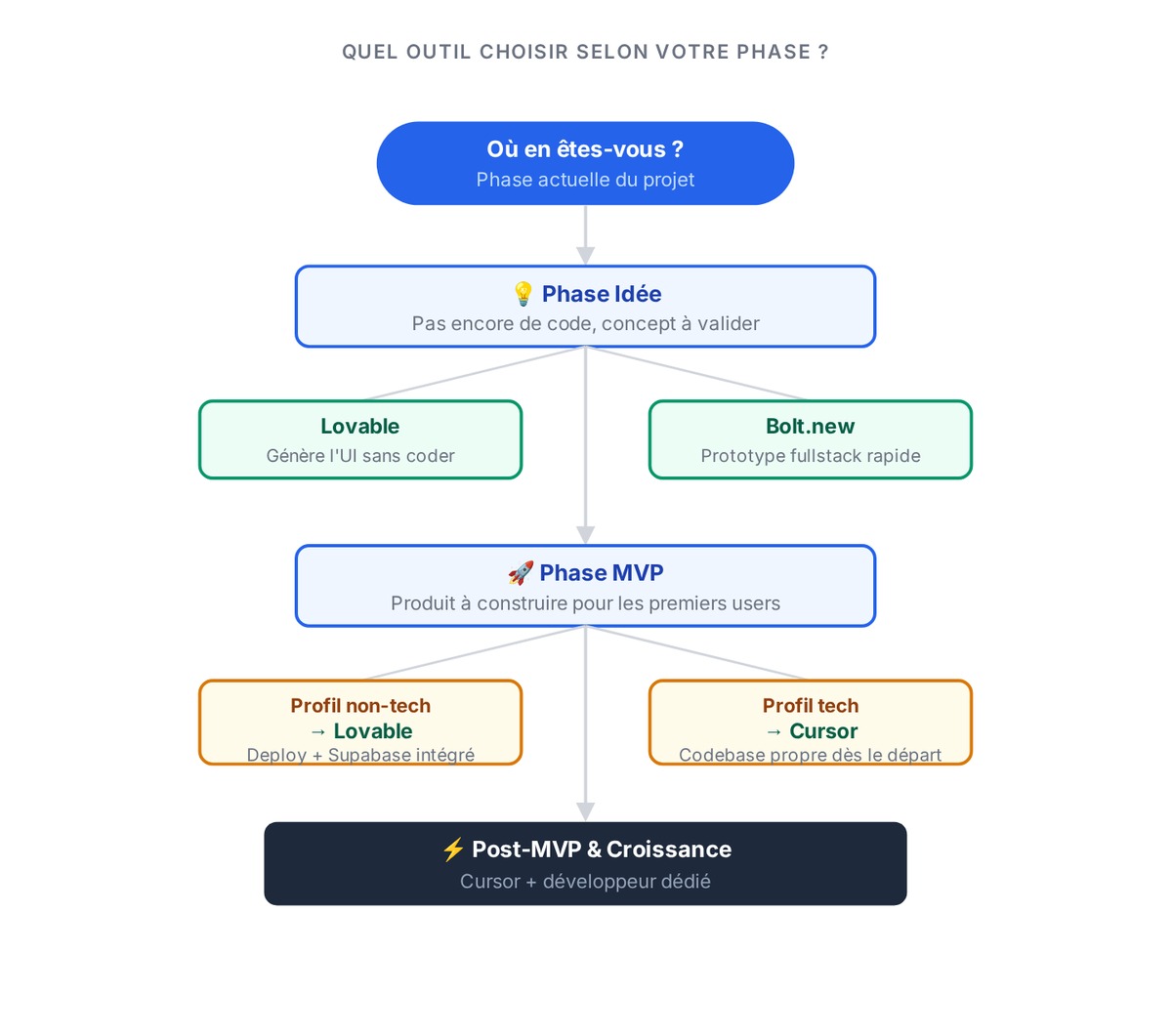
Idea / validation phase (no revenue, no code)
You have an idea. You want to show it to ten people to validate the concept. You need a URL, not a codebase.
Lovable or Bolt.new. The goal is a presentable demo in under a day. Lovable if you want something that looks like a real app with persisted data. Bolt.new if you want to iterate live on the result during a user call. The code doesn't matter at this stage. Only user feedback matters.
MVP phase (first users)
Your idea is validated. You're building the first version usable by real users.
Lovable if you have no technical background. Lovable's React + Supabase stack is exportable, tested on real products in production, and ready to hand off to a developer if you raise funding. You don't lock your growth into technical debt from day one.
Cursor if you have technical basics. You go further, faster, and the code stays clean. For a founder-CTO or engineer profile, Cursor transforms productivity significantly and the code stays maintainable.
Post-MVP phase (refactoring, new features)
You have active users. The code is starting to cause scalability and maintenance problems.
Cursor only. At this stage, generators hit their limits. You need control over architecture, performance, and security. If you started on Lovable: export the code to GitHub, open it in Cursor, and continue from there. It's the natural transition.
Can you combine the tools?
Yes, and it's often the optimal strategy for semi-technical founders.
The pattern that works: Lovable for the initial scaffolding, Cursor for the business logic. You generate the base architecture, the UI components, and the Supabase setup in Lovable (1 to 2 days of work). You export to GitHub. You open it in Cursor and refine the logic, the validation rules, and the complex API integrations.
It's the ideal combination: Lovable's startup speed with Cursor's control. The only prerequisite: being able to read React code, even if you don't write it from scratch.
Another useful combination: Bolt.new to test a new feature, Cursor to integrate it. You prototype the idea in Bolt (30 minutes), then copy the logic into your real codebase with Cursor. Bolt becomes an R&D sandbox, not a main codebase.
When should you stop vibe coding and bring in a developer?
The honest answer: sooner than you think, if your product works.
The concrete signals that you need a developer:
- Performance: your app lags with 50 simultaneous users. Vibe coding tools don't optimize infrastructure.
- Security: you handle personal data, payments, or sensitive access. Security is designed, not generated.
- Infrastructure: you need queues, workers, background jobs, or a database that scales. The limits of Supabase's free plans arrive quickly.
- Team: as soon as several people work on the codebase, it has to be readable, versioned, and documented. Solo-generated code isn't always up to that.
- Complex integrations: webhooks with state logic, real-time syncs, APIs with sophisticated error handling. Lovable and Bolt hit a ceiling fast.
Vibe coding is a validation and early-stage tool. Its job ends where scaling begins. Founders who don't hand off at the right moment lose months patching generated code instead of building the product.
FAQ
What's the difference between Lovable and Bolt?
Lovable generates a complete full-stack application (React + Supabase) from a plain-language description. Bolt.new is an in-browser development environment, closer to a fast IDE with built-in AI. Lovable suits non-developers who want a working, deployed app; Bolt suits people who want to prototype quickly with a bit more visible control over the generated code.
Is Cursor free?
Cursor offers a free Hobby plan with 2,000 AI completions and 50 slow requests per month, enough to evaluate it seriously. The $20/month Pro plan unlocks unlimited completions and access to advanced models (Claude, GPT-4o). A Business version exists at $40/user/month for teams, with privacy mode and admin features.
Can you launch a SaaS with a vibe coding tool?
Yes, for a validation MVP. Lovable and Bolt let you deploy a simple SaaS with authentication, a database, and payment integration. To go to production with real users and reliability requirements, you'll need to harden security, optimize performance, and take back control of the infrastructure. Vibe coding is a viable starting point, not a final solution.
Which vibe coding tool should you choose without technical skills?
Lovable is the most direct answer. You describe your app, it gets generated and deployed, and you own the code. The free tier (5 messages/day) lets you test with no financial commitment. Bolt.new is also accessible but takes a bit more intuition to use well. Cursor isn't suitable without a codebase and development knowledge. If you're interested in AI tools for founders, our Claude Code for founders guide covers an even more advanced approach.