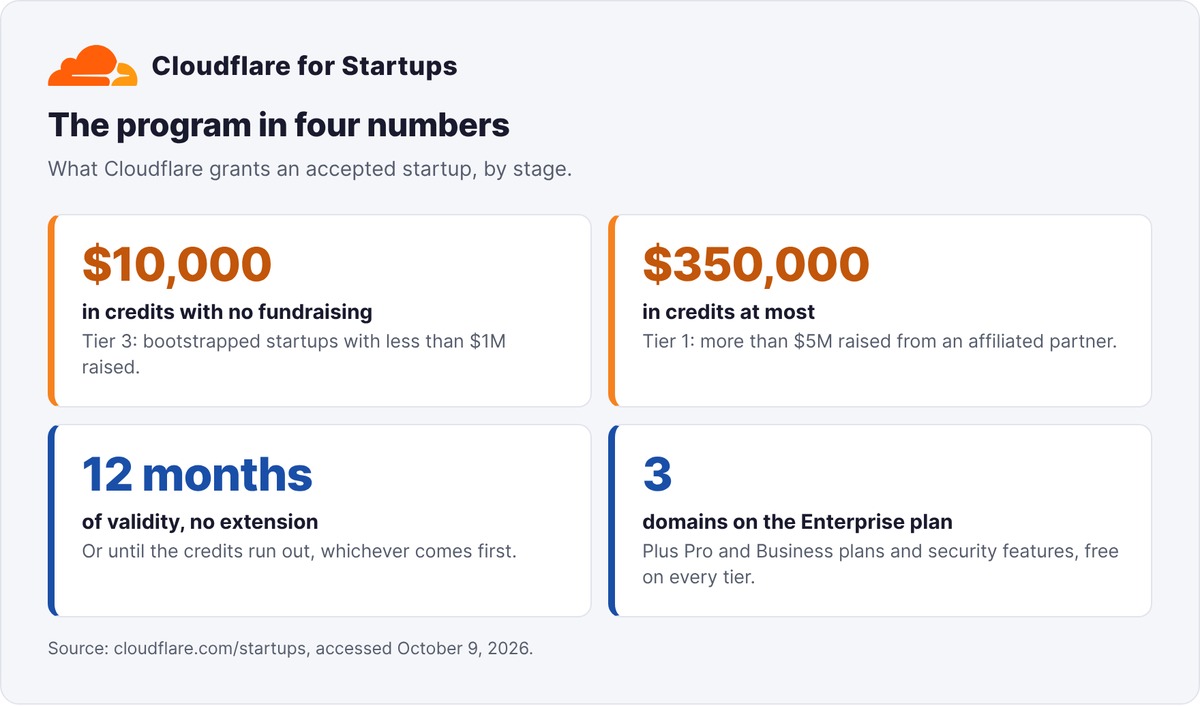
Cloudflare for Startups is Cloudflare's program for young tech companies. An accepted startup gets between $10,000 and $350,000 in credits, valid for one year. Startups spend them on Cloudflare's developer platform: Workers, R2, D1, Workers AI and about fifteen other services. Accepted startups also get three domains on the Enterprise plan, plus the security and network features at no cost.
The amount depends on your stage. A bootstrapped startup that has raised less than $1 million qualifies for $10,000. The $100,000 and $350,000 tiers require funding from one of Cloudflare's partner funds or accelerators.
You apply from the program page through a four-step form. Cloudflare says it replies within 48 hours in most cases.
All the conditions below come from the official Cloudflare for Startups page and its application form, as of October 9, 2026.
What is Cloudflare for Startups?
Cloudflare for Startups provides usage credits, technical support and access to a community of founders. Cloudflare targets startups building their product on its developer platform. These startups run serverless code on Workers, storage on R2, a SQL database on D1 and inference on Workers AI.
Credits are not cash. Cloudflare deducts them each month from your usage of pay-as-you-go services, for twelve months or until they run out.
Three versions of the program in two years
Cloudflare overhauled the program during its September 2024 Birthday Week, introducing a credit system capped at $250,000. The April 11, 2025 blog post split it into four tiers: $5,000, $25,000, $100,000 and $250,000.
The current version has three tiers. Cloudflare raised the first from $5,000 to $10,000 and the top one from $250,000 to $350,000. Several pages ranking on Google still show the old amounts, so check the date of whatever you're reading.
A separate program from Workers Launchpad
Workers Launchpad is a different program. It connects startups built on Workers with Cloudflare's partner VC funds, in cohorts. Cloudflare for Startups provides credits and stays open all year round, with no cohorts.
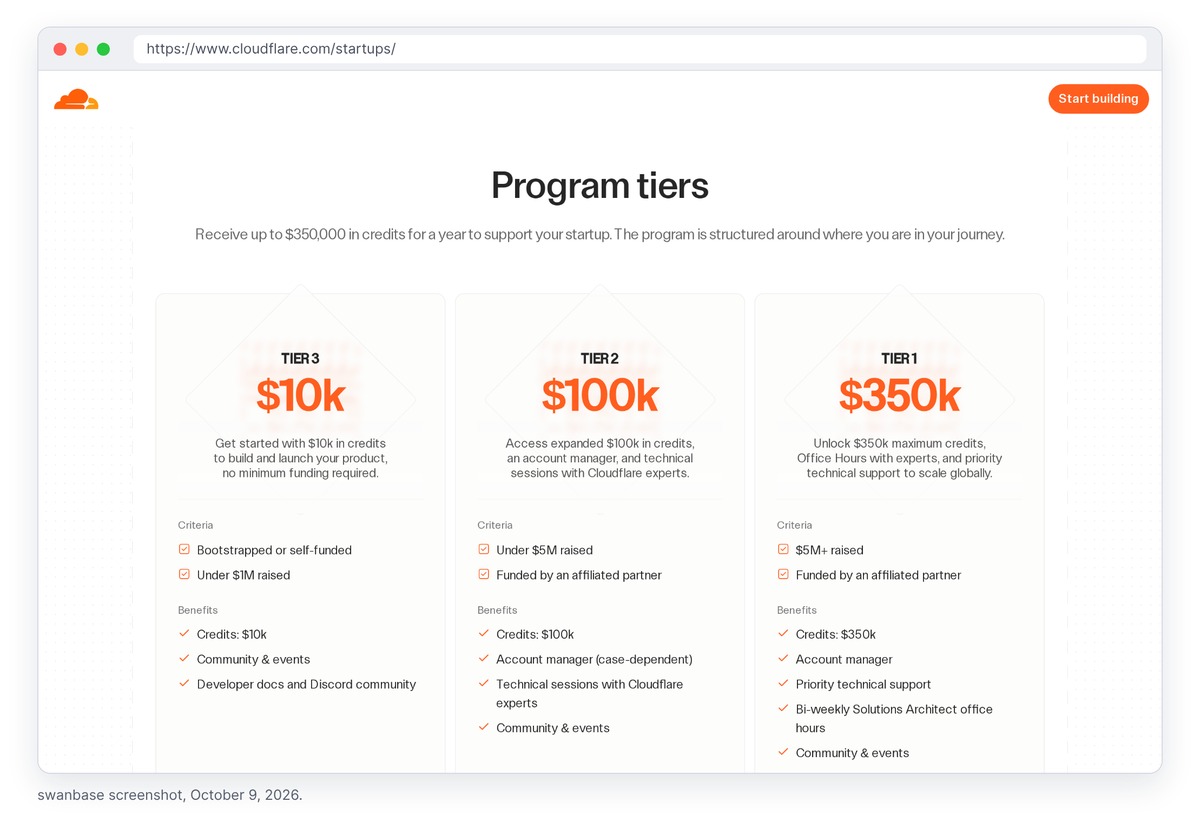
The three Cloudflare for Startups tiers
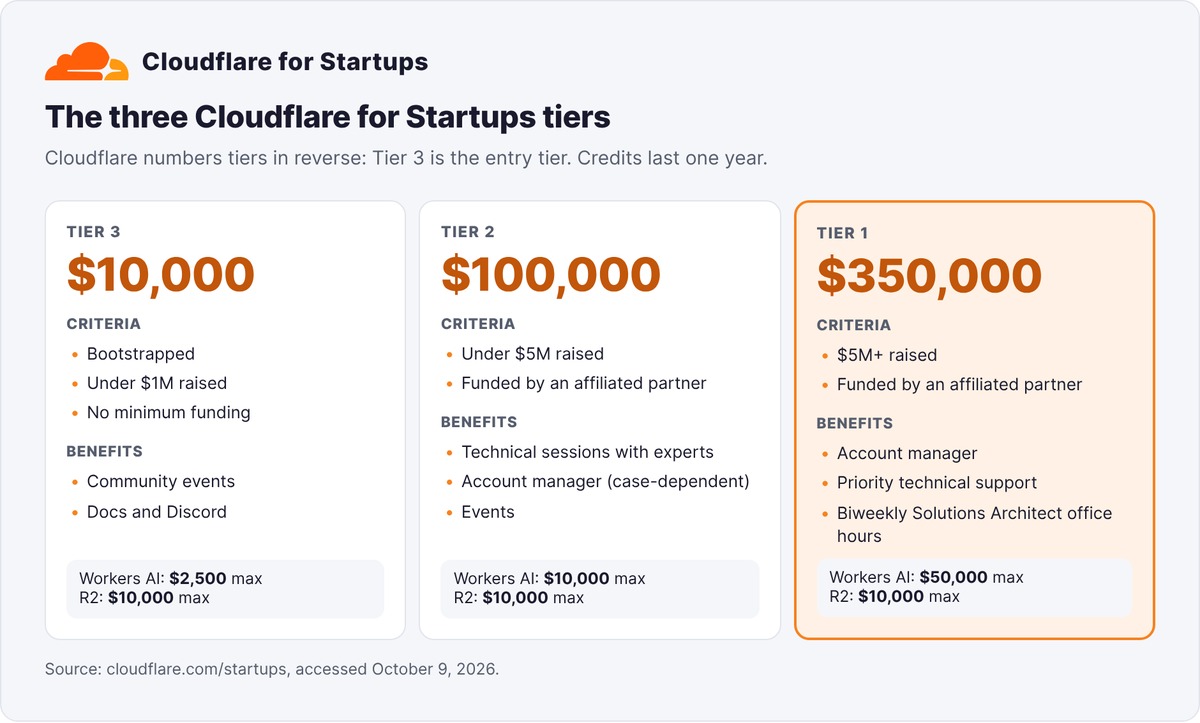
Cloudflare numbers its tiers in reverse: Tier 3 is the smallest, Tier 1 the largest.
Tier 3: $10,000 with no fundraising required
Tier 3 is for bootstrapped startups that have raised less than $1 million. Cloudflare sets no minimum funding amount. You get $10,000 in credits, access to community events, the developer documentation and the Discord server.
Workers AI is capped at $2,500 on this tier.
Tier 2: $100,000 with an affiliated partner
Tier 2 has two conditions: less than $5 million raised, and funding from a Cloudflare affiliated partner. You get $100,000 in credits, technical sessions with Cloudflare's experts and, depending on the case, an account manager. Workers AI goes up to $10,000.
Tier 1: $350,000 above $5 million raised
Tier 1 targets startups that have raised more than $5 million from an affiliated partner. This tier adds an account manager, priority technical support and biweekly office hours with a Solutions Architect. Workers AI goes up to $50,000.
Services covered by the credits
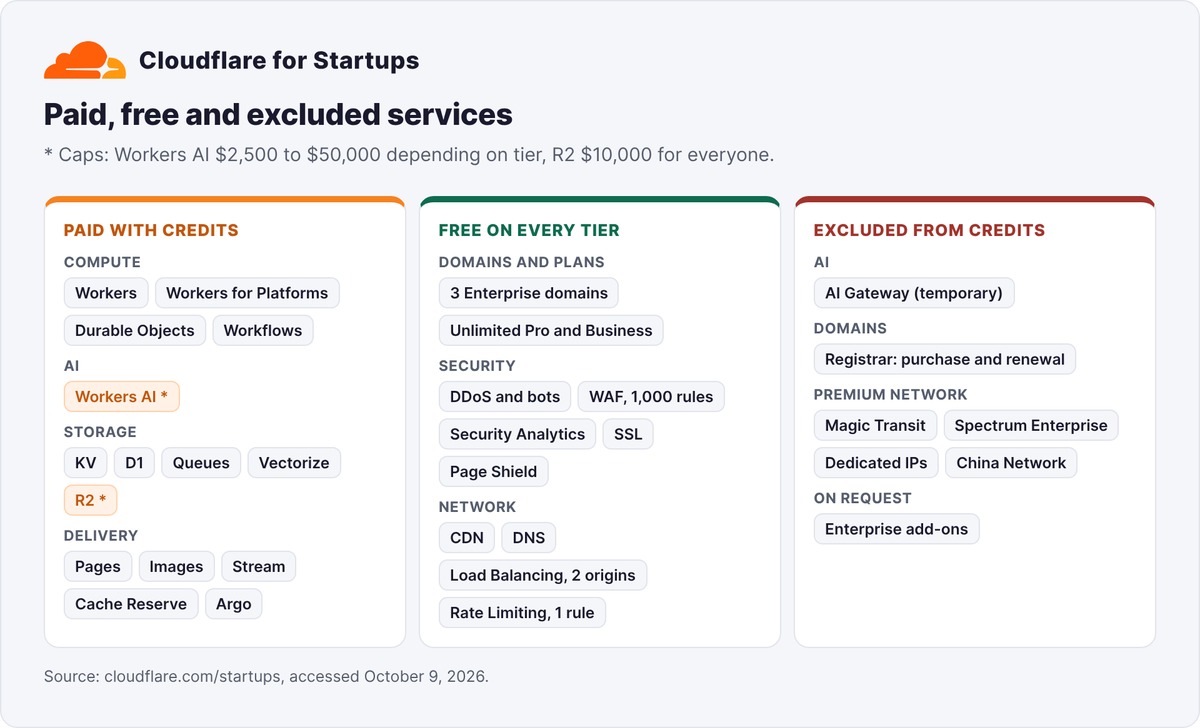
Cloudflare sorts its services into three categories: paid with credits, free on every tier, and excluded from the program.
Services paid with credits
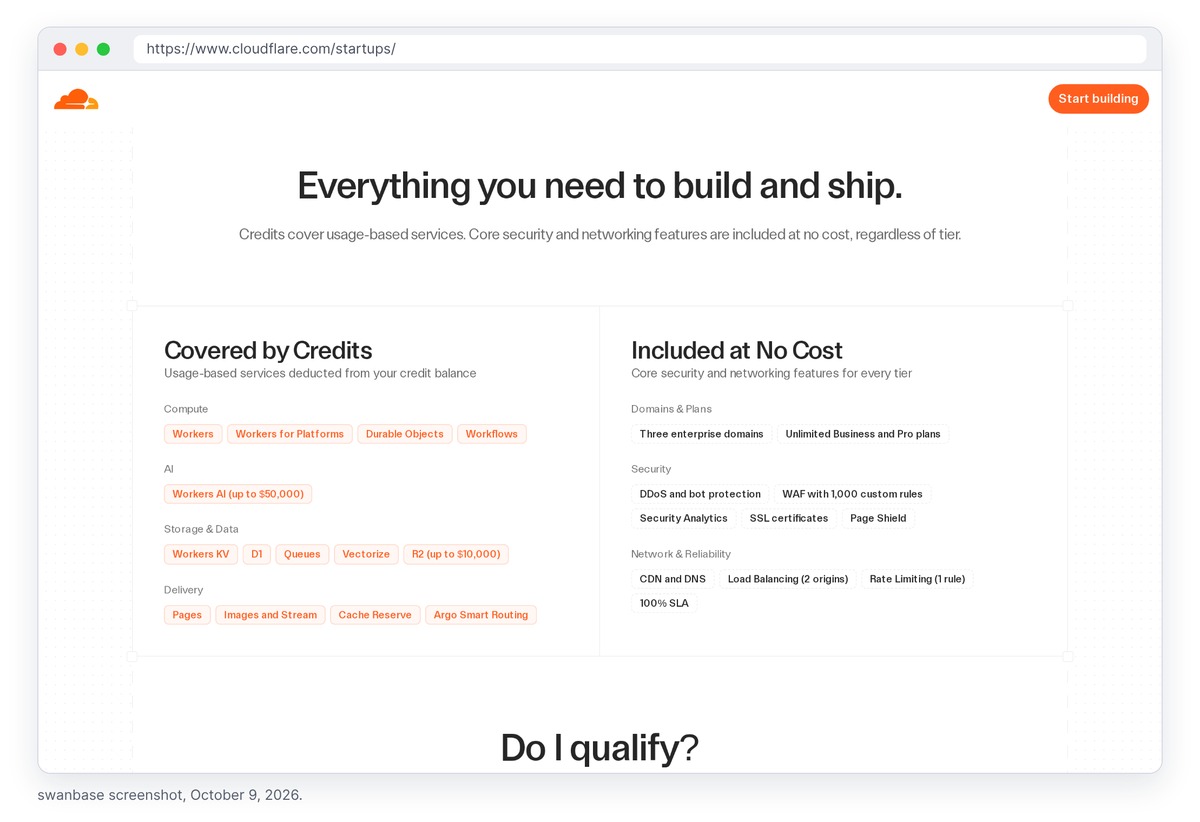
The credits cover usage-based services:
- Compute: Workers, Workers for Platforms, Durable Objects, Workflows.
- AI: Workers AI, capped at $2,500, $10,000 or $50,000 depending on the tier, at standard model pricing.
- Storage and data: Workers KV, D1, Queues, Vectorize, and R2 up to $10,000 on every tier.
- Delivery: Pages, Images, Stream, Cache Reserve, Argo Smart Routing.
Features free on every tier
Cloudflare also provides the following without touching your credits:
- three domains on the Enterprise plan, plus unlimited Pro and Business plans;
- DDoS and bot protection, a WAF with 1,000 custom rules, Security Analytics, SSL certificates and Page Shield;
- the CDN, DNS, Load Balancing across two origins and one Rate Limiting rule.
For a marketing site, these free features matter more than the credits. One founder on Reddit noticed this in February 2025: their server ran elsewhere, and they had no idea what to spend the credits on.
Exclusions
Cloudflare excludes the following from the credits:
- AI Gateway, temporarily, while the team makes it eligible;
- Registrar: you pay for domain purchases and renewals;
- Enterprise add-ons, available on request at [email protected];
- premium network services: Magic Transit, Spectrum Enterprise, dedicated IPs and China Network, which require a dedicated contract.
Some advanced features are only enabled on request. Email [email protected] for Advanced Certificate Manager, SSL for SaaS, Advanced Rate Limiting or extra Load Balancing origins. Open a support ticket for Bot Management, API Shield, Apex Proxying or additional Zero Trust seats.
Who can apply to Cloudflare for Startups?
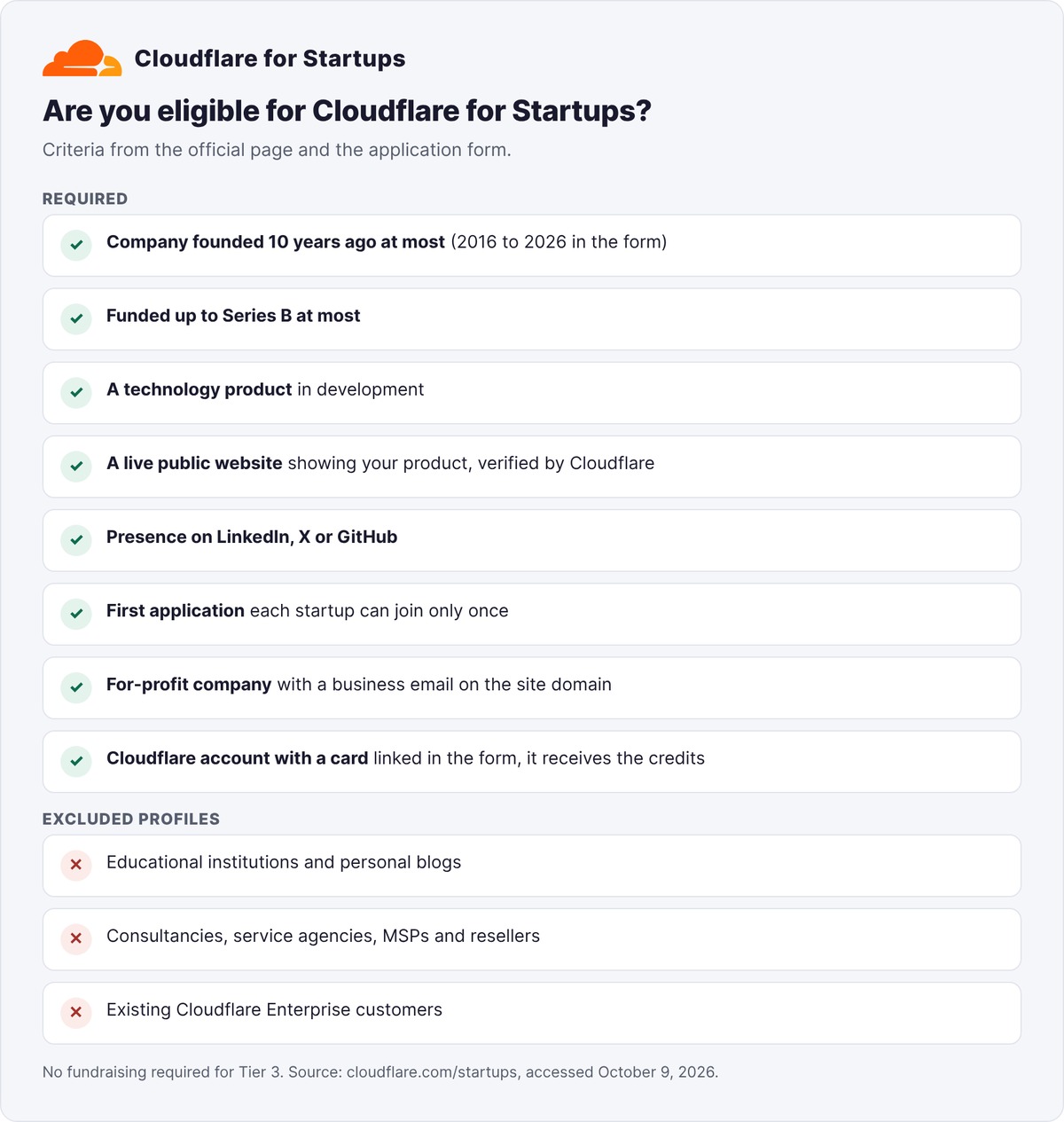
Your startup must meet the seven criteria published by Cloudflare.
The seven criteria
- Company founded no more than ten years ago. The form accepts years 2016 through 2026.
- Funded up to Series B at most. Under this criterion Cloudflare adds "funded within the last 12 months", without saying whether it applies to bootstrapped startups.
- A technology product in development.
- A public website the team can verify. The form asks for "a live website with your software product".
- A public presence on LinkedIn, X or GitHub.
- A first application: Cloudflare accepts each startup only once.
- A for-profit company, with a business email address on the website's domain.
A French SAS meets these criteria. The page mentions no geographic restrictions.
Excluded profiles
Cloudflare turns down educational institutions, personal blogs, consulting firms, service agencies, MSPs and resellers. The program also excludes existing Enterprise customers.
Civic projects and local governments go through other programs: Project Galileo for public-interest projects, and the Athenian Project for election websites.
The affiliated partner requirement for Tiers 2 and 1
To qualify for $100,000 or $350,000, your investor must be part of Cloudflare's partner network. A startup that raised $3 million from a fund outside the network stays on Tier 3.
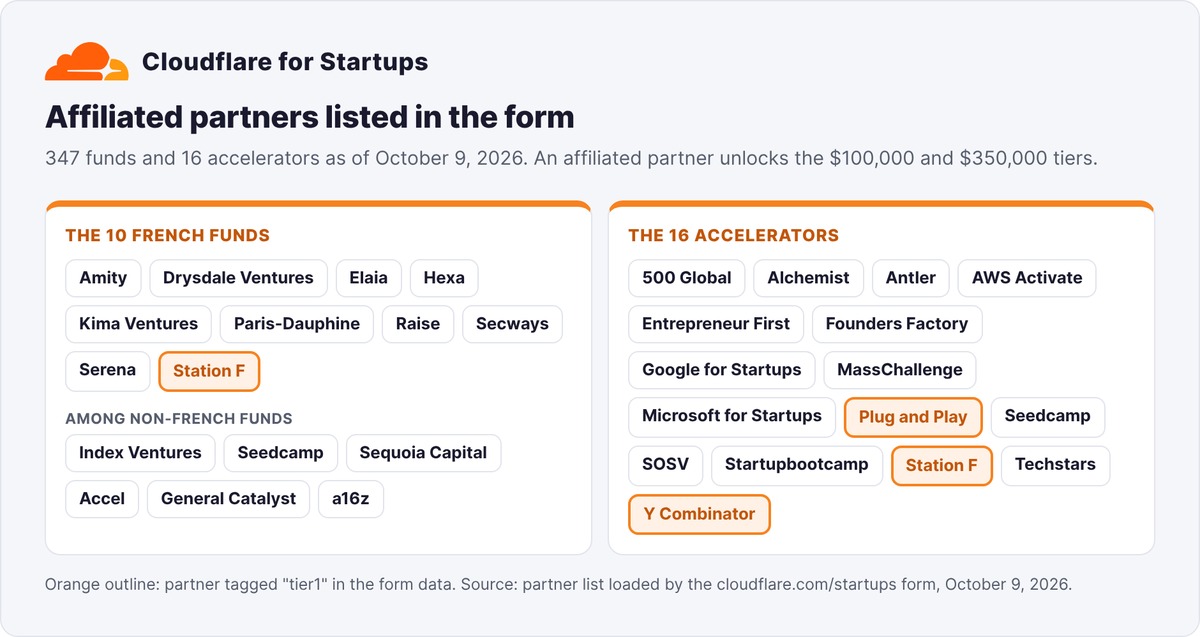
The form loads the partner list from Cloudflare's API. As of October 9, 2026, it includes 347 funds and 16 accelerators.
French funds in the network
Ten entries on the list are tagged France: Amity, Drysdale Ventures, Elaia, Hexa, Kima Ventures, Paris-Dauphine, Raise, Secways, Serena and Station F. The network also includes European funds with a presence in Paris, such as Index Ventures and Seedcamp, and the big US funds, including Sequoia Capital, Accel, General Catalyst and a16z.
The 16 accelerators
The recognized accelerators are 500 Global, Alchemist, Antler, Entrepreneur First, Founders Factory, MassChallenge, Plug and Play, Seedcamp, SOSV, Startupbootcamp, Station F, Techstars and Y Combinator. Three vendor programs round out the list: AWS Activate, Google for Startups and Microsoft for Startups.
Cloudflare tags twelve funds and three accelerators as "tier1", the accelerators being Station F, Y Combinator and Plug and Play. In 2025, Cloudflare reserved its top tier for startups in its "Tier 1 network". We don't know whether this tag still affects the tier awarded in 2026.
If you're at Station F or Y Combinator, select the program in the form and enter your batch. Our guides on getting into Station F and getting into Y Combinator cover both applications in detail.
If your fund isn't listed, choose "Other" and type its name. The form accepts manual entries.
How to apply to Cloudflare for Startups, step by step
The form opens in a pop-up window from the "Apply now!" button on the program page. Cloudflare says most applications take less than three minutes to fill in.
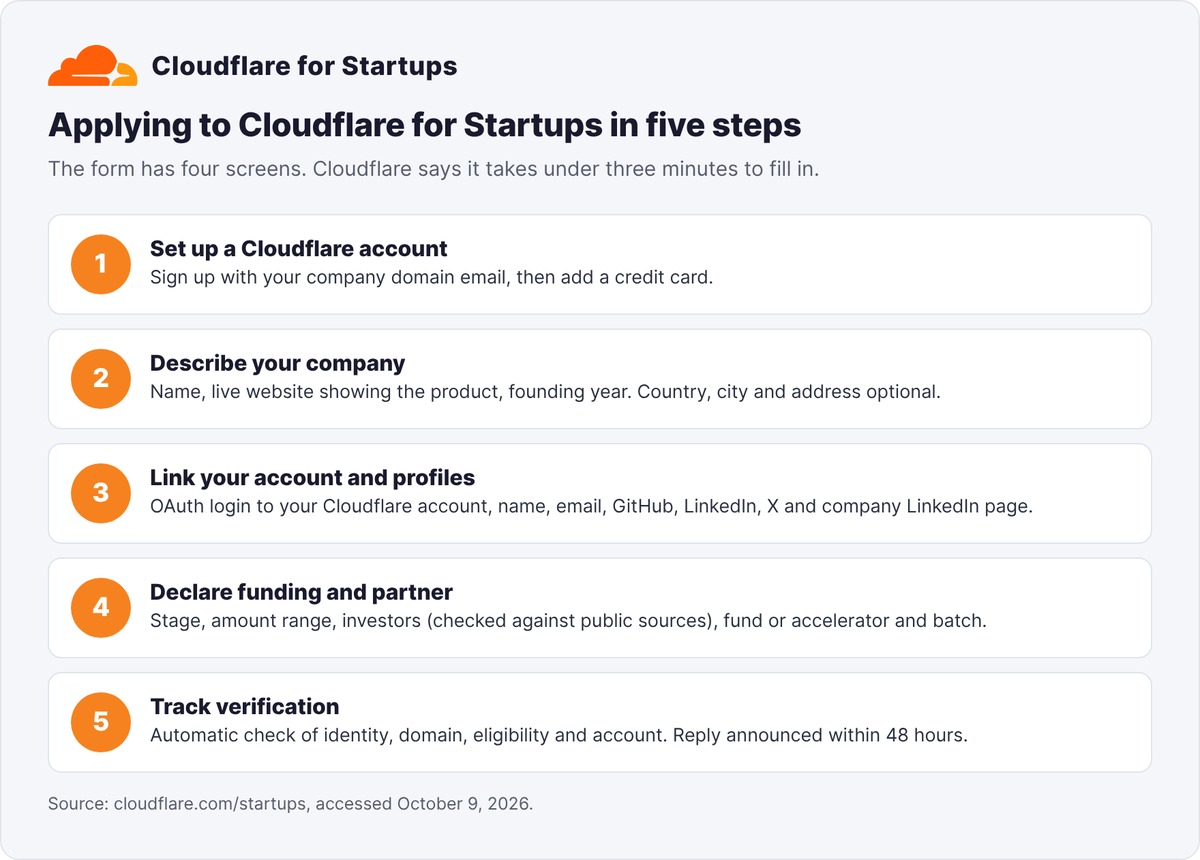
Step 1: set up a Cloudflare account with a payment method
Create an account on dash.cloudflare.com using your company domain email address, and add a credit card. The form links this account through an OAuth login, and Cloudflare applies the credits to it once you're accepted. The form asks for an account with a payment method attached.
Step 2: describe your company
The first step asks for the company name, website URL and founding year. Country, city and address are optional. Put a live website online that shows the product, because Cloudflare verifies the domain.
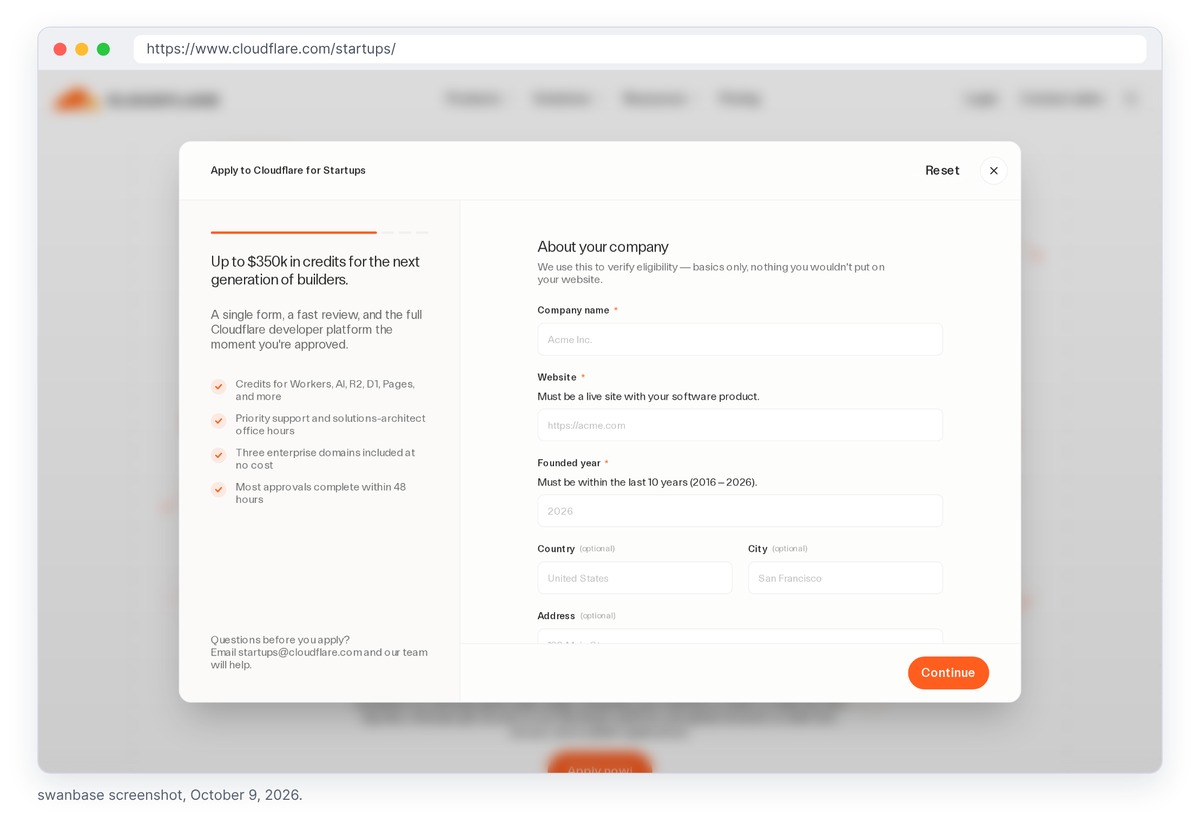
Step 3: link your account and profiles
The second step connects your Cloudflare account and asks for your name and email. You add your GitHub, your LinkedIn, your X account and the company LinkedIn page. Cloudflare labels these as optional, but they speed up verification, so fill them in.
Step 4: declare your funding and partner
The third step asks for your stage: Bootstrapped, Pre-Seed, Seed, Series A or Series B+. You then select the amount raised by range: under $1 million, $1 to $5 million, $5 to $10 million, or over $10 million. You also list your investors. Cloudflare warns that it checks this information against public sources, so declare the amounts you've announced.
The fourth step covers the affiliated partner. You search for your fund or accelerator in the list, enter your batch, and can name the person who referred you.
Step 5: track verification and the decision
After you submit, the form checks your identity, domain, eligibility and Cloudflare account. If automatic verification fails, the team promises to follow up within one business day.
Cloudflare says it usually reviews applications within 48 hours. Founder reports vary: one founder on Reddit waited about two weeks in May 2026, and another was still waiting in September. After a week without a reply, check your spam folder, then email [email protected]. If you're rejected, Cloudflare gives the reason and will review the application again if you provide supporting information.
Six traps to know before activating your credits
A credit card charged without warning
Cloudflare automatically bills any usage above the caps, for example beyond $10,000 on R2. When the credits expire, it charges the card on file unless you sign a prepaid contract. Set up billing alerts in the dashboard as soon as you activate.
Workers AI capped at $2,500 on Tier 3
The page shows "Workers AI (up to $50,000)" in the services table. That amount applies to Tier 1. On Tier 3, you get $2,500 for inference, and AI Gateway remains excluded.
The 100% SLA contradicted by the terms
The table of free features lists a "100% SLA". The program terms say the opposite: "The Startup Plan does not include a service level agreement". Don't promise your customers an uptime commitment based on the program.
No extensions
Credits expire after one year, even if you've used only 10% of them. Cloudflare grants no extensions. Startups that joined under the old $5,000 or $250,000 tiers can request a tier upgrade. The team decides case by case, and the one-year deadline stays the same.
Cloudflare can use your logo
By accepting the terms, you allow Cloudflare to display your company name and logo on its websites, presentations and reports, royalty-free. Let your co-founders and investors know.
One application only
Each startup can join the program only once, and credits can't be transferred between accounts. A founder running several separate companies can apply for each one, using separate accounts and email addresses. So pick your moment: apply once your product already consumes compute or storage.
After one year: leaving the program
Cloudflare sends three reminders before the program ends. You then have three options:
- switch to a self-serve plan from the dashboard, with pay-as-you-go billing;
- let your Enterprise domains automatically revert to the Free plan;
- negotiate an Enterprise contract with the sales team before the deadline.
For a small product, the bill stays low. The Workers Paid plan starts at $5 per month and includes 10 million requests. R2 charges $0.015 per GB per month for storage, with no egress fees. Run the numbers using your usage in month ten, rather than month one.
Our take on Cloudflare for Startups
For a bootstrapped French startup, Tier 3 is worth applying for if your product already runs on Cloudflare or you plan to deploy there. You submit the application in a few minutes, with no fundraising required, and you get $10,000 in credits, three Enterprise domains and the Pro and Business plans.
If you're building your MVP with Cursor or Claude Code, Workers and Pages are among your deployment options. Our guide to launching an MVP with vibe coding walks through getting to production.
We see two limitations. Your tier depends on your investor: without a fund from the network, a startup that has raised $3 million stays at $10,000. And the credits can only be spent on one platform: if your backend runs on AWS or Google Cloud, you'll use only a small share of them.
Combine Cloudflare for Startups with the AI vendors' programs. Claude for Startups (guide in French) offers a year of Claude Team and $1,000 in API credits, and our roundup of AI tools for startups lists other free offers.
Apply at cloudflare.com/startups as soon as your product is live and your Cloudflare account has a card on file.
FAQ
Is Cloudflare free for startups?
Yes, for one year and up to your credit limit. Cloudflare for Startups provides between $10,000 and $350,000 in credits on the developer platform, plus three Enterprise domains and the security features at no cost. After twelve months, Cloudflare bills at standard rates.
How many credits does Cloudflare for Startups give?
The amount depends on your stage. You get $10,000 if you're bootstrapped with less than $1 million raised. You get $100,000 with less than $5 million raised from an affiliated partner, and $350,000 with more than $5 million raised from an affiliated partner.
Do you need to have raised funds to apply?
No. Tier 3, at $10,000, accepts bootstrapped startups with no minimum funding. The $100,000 and $350,000 tiers require funding from a fund or accelerator in Cloudflare's network.
Can a French startup apply?
Yes. The program page mentions no geographic restrictions. Your company must be less than ten years old, with a technology product, a live website and an email address on that website's domain. Ten French funds appear on the partner list, including Kima Ventures, Elaia, Serena and Station F.
How long does it take to get a response?
Cloudflare says it reviews most applications within 48 hours and sends a confirmation email. Some founders have waited up to two weeks. After a week without news, email [email protected].
Do Cloudflare credits cover Workers AI?
Yes, with a cap per tier: $2,500 on Tier 3, $10,000 on Tier 2 and $50,000 on Tier 1. Cloudflare applies standard model pricing. AI Gateway isn't covered for now.
What happens when the credits run out?
Cloudflare sends three reminders before the deadline. After that, it charges the card on file for your usage, and your Enterprise domains revert to the Free plan unless you choose a paid plan. You can also negotiate an Enterprise contract before the program ends.