Hermes Agent is an open source, self-hosted AI agent released by Nous Research under the MIT license. You install it on your computer or on a server, connect it to the model of your choice, and it carries out multi-step tasks. It keeps memory from one session to the next, writes its own skills, runs scheduled tasks and replies from Telegram, Discord, Slack or WhatsApp. The software is free. You pay for the model and, if the agent runs around the clock, for the server.
Our short take: Hermes Agent suits founders who are willing to maintain a Linux server and want an agent they control end to end. At swanbase, version 0.20.5 runs on one of the team's Linux servers and we drive it from Discord. If you don't want to maintain anything, a hosted tool like ChatGPT Work will take less of your time.
The commands and prices below come from the official documentation and the NousResearch/hermes-agent GitHub repository, checked on October 26, 2026.
What is Hermes Agent?
Hermes Agent is a command-line program that turns a language model into an assistant that can act on your machine: it runs commands and edits files. It also searches the web and drives a browser. In its README, Nous Research calls it "the self-improving AI agent".
Local or server installation
You install Hermes Agent wherever you want it to work: a Mac, a Windows PC, a Linux server. The README mentions "a $5 VPS, a GPU cluster, or serverless infrastructure". According to the FAQ on the official site, your conversations and skills stay on that machine. When you stop the agent, you keep the data, but scheduled tasks stop running.
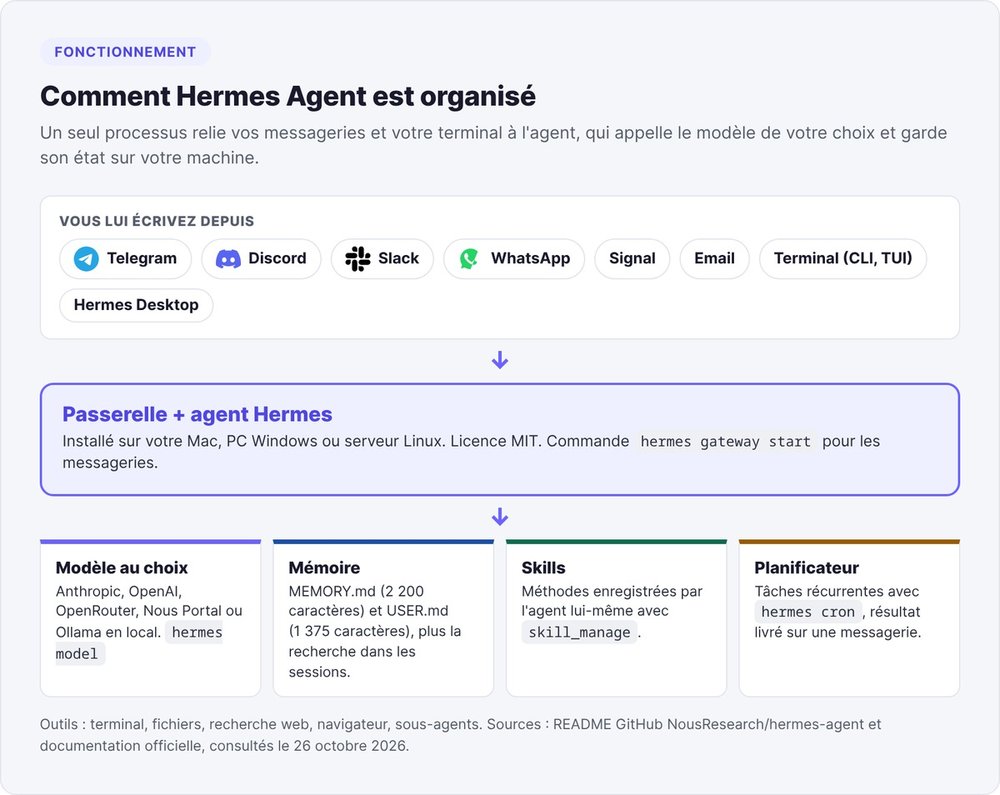
You pick the model with hermes model: Anthropic, OpenAI, OpenRouter, Nous Portal, or a local model through Ollama. According to the documentation, memory and skills carry over when you switch providers.
Who built Hermes Agent: Nous Research
The agent is published by Nous Research, which also releases the open source Hermes language models. The repository's LICENSE file reads "MIT License, Copyright (c) 2025 Nous Research".
On October 7, 2026, TechCrunch reported a $90 million Series B led by Robot Ventures, with Nvidia, Union Square Ventures, Menlo Ventures and Samsung participating. The round values the company at $1.5 billion and brings total funding to $158 million. According to the startup's own estimates cited by TechCrunch, developers have cloned Hermes Agent more than 24 million times.
Project numbers as of October 26, 2026
According to GitHub's public API, the repository has 257,311 stars and 56,367 forks. Nous Research created it on July 22, 2025. The team shipped 44 releases between March 12 and October 23, 2026, five of them between October 14 and 23. The latest, v0.22.5, came out on October 23. Expect frequent updates.
How Hermes Agent works
The official site sums up the agent in six functions: connect to messaging apps, remember, schedule, delegate to subagents, search, and experiment in a sandbox. Four mechanisms set it apart from a chatbot.
Persistent memory, with a cap
Hermes Agent keeps two memory files, according to the Memory page of the documentation. MEMORY.md holds the agent's notes about your environment and conventions, capped at 2,200 characters. USER.md describes your preferences, capped at 1,375 characters. Memory doesn't compact itself: as the cap approaches, the agent has to merge or delete entries.
The documentation puts MEMORY.md at 8 to 15 entries. So the agent retains durable facts, and it finds older conversations through a full-text search of its past sessions.
Skills the agent writes itself
A skill is a reusable instruction file. When Hermes Agent solves a complex task, it can save the method as a skill using the skill_manage tool, which the documentation calls its "procedural memory". You can require your approval before every write with the write_approval option. The format follows the agentskills.io open standard, close to Claude Code skills.
A built-in task scheduler
The hermes cron create command takes a schedule such as 30m, every 2h or a cron expression like 0 9 * * *, followed by an instruction. You get the result on Telegram, Discord, Signal or in a local file. With the --no-agent option, Hermes runs a script without calling a model, so a disk-space alert costs you zero tokens.
A gateway to Telegram, Discord, Slack and WhatsApp
A single process, the gateway, connects the agent to Telegram, Discord, Slack, WhatsApp, Signal and email. You configure it with hermes gateway setup and start it with hermes gateway start. From then on, you message the bot from your phone while the agent works on the server.
How much does Hermes Agent cost?
Hermes Agent is free, but a running agent costs money. On top of the software, you pay for two variable items: the model and the server.
The software: Hermes Agent is free under the MIT license
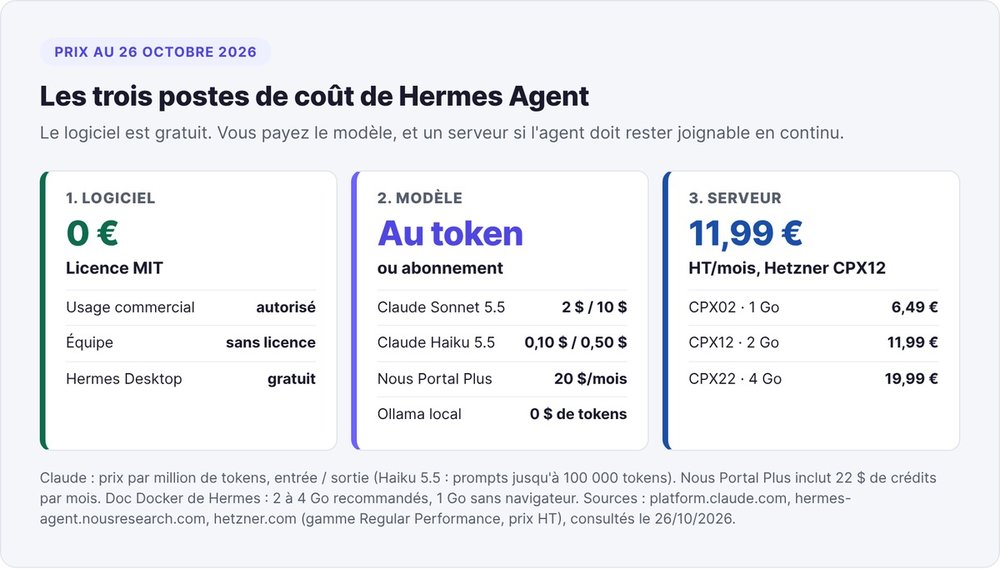
The MIT license allows commercial use, modification and redistribution. You pay no license fee, even for a team. The official site notes that model providers and optional hosted services set their own prices.
The model: API, Nous Portal subscription or local
You have three options for the model:
- An API key. You pay per token. On Anthropic's official price list, Claude Sonnet 5.5 costs $2 per million input tokens and $10 per million output tokens, Claude Opus 5.5 $4 and $20, and Claude Haiku 5.5 $0.10 and $0.50 (prompts up to 100,000 tokens).
- Nous Portal. Nous Research's subscription gives access to more than 200 models and to hosted tools. The Free tier costs $0 (free models only), Plus is $20 a month with $22 in credits, Super $100 with $110 in credits, and Ultra $200 with $220 in credits.
- A local model. With Ollama, you pay nothing in tokens, but you need the hardware (details below).
An agent burns through more tokens than a chat: on every turn, it sends the model its system prompt, its tool descriptions and the history. Run hermes insights to track your usage, and hermes -z "instruction" --usage-file report.json to get the estimated cost of a single request.
The server: which VPS for Hermes Agent
On your computer, the agent stops when you shut it down. For an agent you can reach 24 hours a day, you need a server. Hermes's Docker documentation recommends 2 to 4 GB of memory, with 1 GB as a minimum without the browser tools.
At the hosting provider Hetzner, prices excluding VAT in the Regular Performance line, checked on October 26, 2026, are €6.49 a month for 1 vCPU and 1 GB (CPX02), €11.99 for 1 vCPU and 2 GB (CPX12) and €19.99 for 2 vCPU and 4 GB (CPX22), with 20 TB of traffic included in Europe. The CPX12 is enough without a browser, and the CPX22 works with one. None of these machines can run a usable local model: on a small VPS, connect an API.
Hermes for Business, the team plan
Nous Research also sells Hermes for Business, a shared deployment for teams. According to the plan's page on the Nous Research portal, admins invite members by email and set per-person spending limits. Each team gets an isolated workspace on Nous's infrastructure. The Enterprise plan runs on your own infrastructure, with SSO and an SLA, on a custom quote. The page listed no prices as of October 26, 2026.
Installing Hermes Agent step by step
The official documentation lists as priority-supported: macOS on Apple silicon, Windows 10 and 11 natively, Linux, WSL2 and Docker. It declares macOS on Intel processors unsupported, along with installs via pip, brew or the AUR.
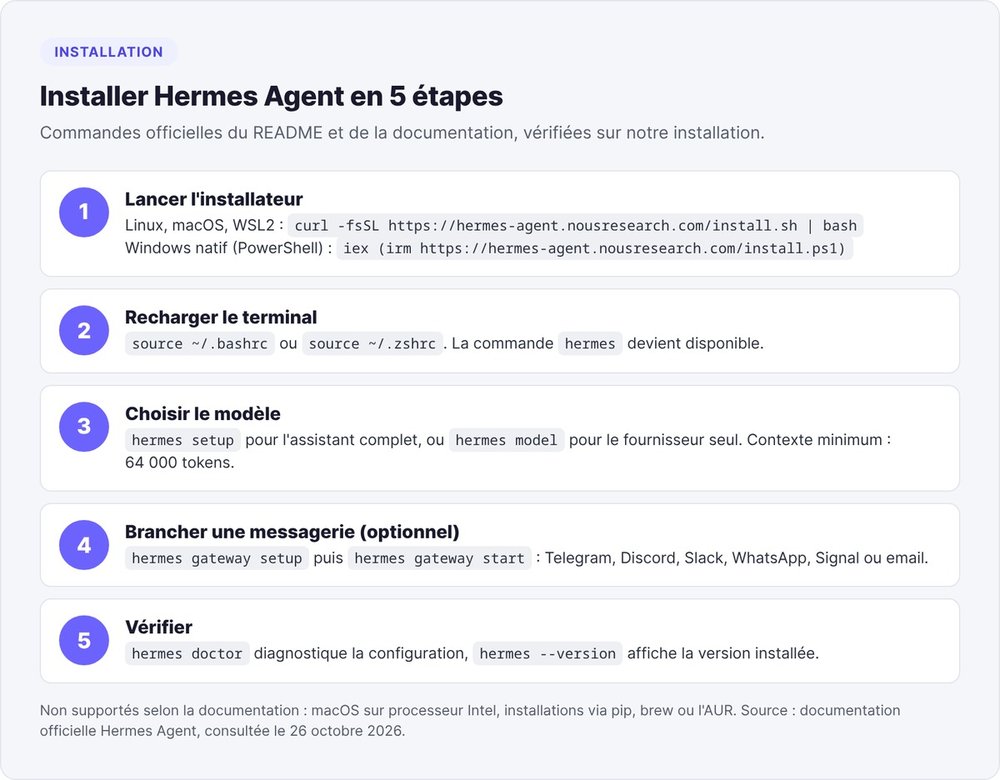
Linux, macOS and WSL2
According to the README, one command installs everything:
curl -fsSL https://hermes-agent.nousresearch.com/install.sh | bash
The installer fetches Python, Node.js, ripgrep and ffmpeg, clones the repository, and creates the virtual environment and the hermes command. Then:
source ~/.bashrc    # or ~/.zshrc
hermes setup        # full wizard: model, tools, messaging apps
hermes              # first conversation
As a regular user, everything lives in ~/.hermes/. If you run the install as root, the installer puts the code in /usr/local/lib/hermes-agent/.
Hermes Agent on Windows and Hermes Desktop
Hermes Agent runs natively on Windows, without WSL (some guides still claim otherwise). In PowerShell:
iex (irm https://hermes-agent.nousresearch.com/install.ps1)
You don't need admin rights: the install goes into %LOCALAPPDATA%\hermes. According to the Windows page of the documentation, only the dashboard's built-in terminal requires WSL2. For a graphical interface, download Hermes Desktop from the official site, for macOS 12 and later or Windows 10 and 11.
Commands to know after installation
| Command | Purpose |
|---|---|
hermes model |
Choose the provider and model |
hermes tools |
Enable or disable tools |
hermes gateway setup |
Connect Telegram, Discord, Slack or WhatsApp |
hermes cron list |
List scheduled tasks |
hermes skills list |
List installed skills |
hermes doctor |
Diagnose the configuration |
hermes security |
Audit dependencies (OSV.dev database) |
hermes backup |
Back up the data folder as a zip |
We checked each of these commands with hermes --help on our installation.
Migrating from OpenClaw or Claude Code
If you already use OpenClaw, hermes claw migrate imports your persona, memories, skills, command allowlist and messaging settings. Add --dry-run to preview. From Claude Code or Codex, hermes import-agent brings over CLAUDE.md or AGENTS.md, MCP servers, skills and memories. This command never carries over API keys.
Which model to choose for Hermes Agent
The documentation's "Choosing the Right Setup" table recommends OpenRouter or Nous Portal to get started, Ollama for simple local use, and a local model for maximum privacy.
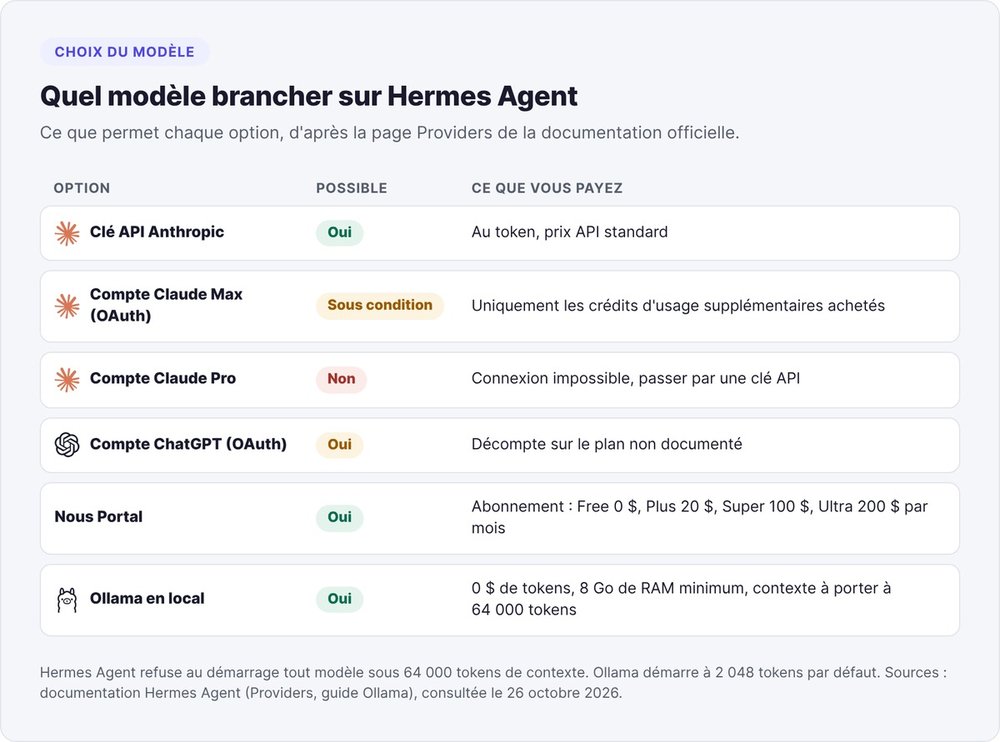
Hermes Agent with Claude: the Pro and Max rule
Check your Claude plan before connecting the agent. According to the Providers page of the documentation, signing in to your Claude account through OAuth only works with a Claude Max plan plus purchased extra usage credits. Hermes Agent draws on those extra credits and leaves your Max plan's base allowance untouched.
With a Claude Pro subscription ($20 a month), that sign-in isn't possible. The documentation suggests an ANTHROPIC_API_KEY instead, billed per token and independent of any Claude subscription. For ChatGPT, OAuth sign-in exists, but the documentation describes how usage counts against your plan limits as "not currently documented".
Hermes Agent with Ollama locally
In the official Ollama guide, Nous Research promises "no API keys, no subscriptions, no data leaving your machine". Plan on at least 8 GB of RAM for a 3-billion-parameter model, and 32 GB or more for a 27-billion-parameter model. A GPU is optional.
On CPU only, the documentation reports about 10 tokens per second for a 9B model on an 8-core CPU, and 2 to 5 tokens per second for a 31B, which works out to 30 to 120 seconds per response. A task that chains ten tool calls will then take several minutes.
The 64,000-token context minimum
Hermes Agent refuses to start with any model whose context window is under 64,000 tokens. Ollama defaults to 2,048 tokens. Create a Modelfile with the line PARAMETER num_ctx 64000, then run ollama create to get a usable variant. Without this setting, the agent won't start.
What to do with Hermes Agent in a startup
Our setup: an agent driven from Discord
At swanbase, Hermes Agent v0.20.5 (build of August 19, 2026) runs on one of the team's Linux servers. You can check your own version with hermes --version. We drive it from Discord: our bot launches one Hermes process per message, in single-query mode, and only sends back the final answer.
The install ships with 24 skill categories, including github, devops, research, productivity, social-media and media. On disk, the agent stores its state in five separate folders: memories, sessions, cron, skills, kanban. A backup of ~/.hermes is all you need to move the agent.
Our short video clip pipeline
We built a short-clip pipeline on top of Hermes Agent. We give it a long video and a goal. The agent suggests 10 to 15 clip ideas suited to that goal. We approve the ones we like, and the agent then renders only the approved clips in 9:16, captioned and in brand colors. Rendering runs on CPU, with no GPU.
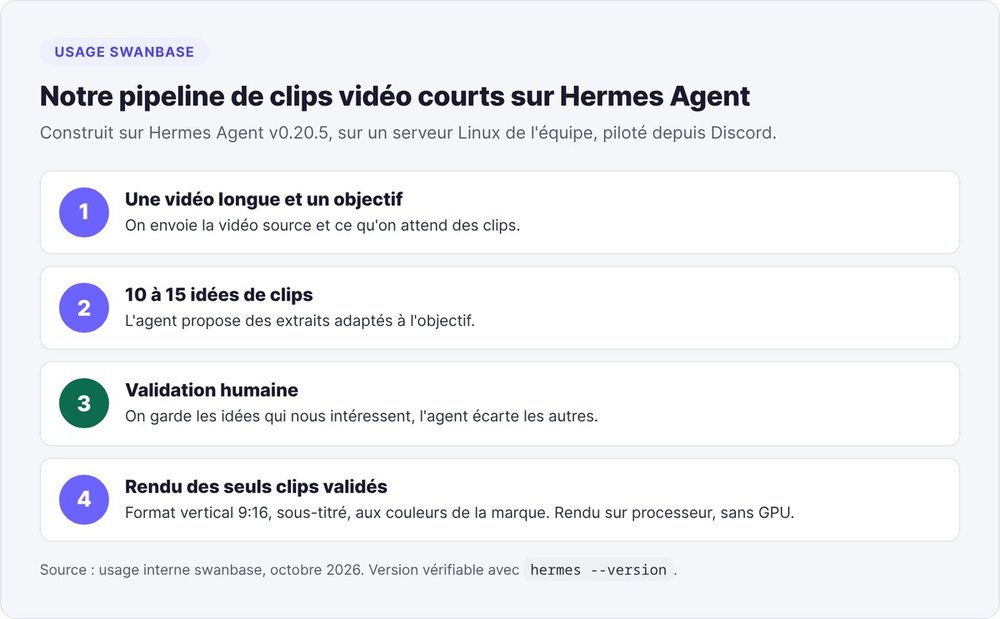
Thanks to this approval step, the agent only spends compute on the clips we keep.
Other documented business use cases
The README and the documentation describe uses that translate directly to a startup:
- a daily report sent to Telegram or Slack every morning via
hermes cron; - a weekly backup or audit scheduled in plain language;
- web monitoring that combines search and the browser;
- parallel work handed to isolated subagents, each with its own terminal;
- a team bot on Discord or Slack that shares the same memory as the terminal.
For a broader overview of tools to plug in, see our roundup of AI tools for startups in 2026.
Hermes Agent, OpenClaw, Claude Code or ChatGPT Work?
All four tools carry out multi-step tasks, but you manage them in different ways.
| Criterion | Hermes Agent | OpenClaw | Claude Code | ChatGPT Work |
|---|---|---|---|---|
| Publisher | Nous Research | Open source project | Anthropic | OpenAI |
| Code | MIT | MIT | Proprietary | Proprietary |
| Hosting | Your machine or server | Your machine or server | Your computer | OpenAI cloud |
| Model | Your choice, local included | Your choice | Claude | OpenAI models |
| Entry price | Free software, model paid separately | Free software, model paid separately | Included from Claude Pro ($20/month) | Included in ChatGPT plans, including Business |
| GitHub stars as of 10/26/2026 | 257,311 | 393,134 | N/A | N/A |
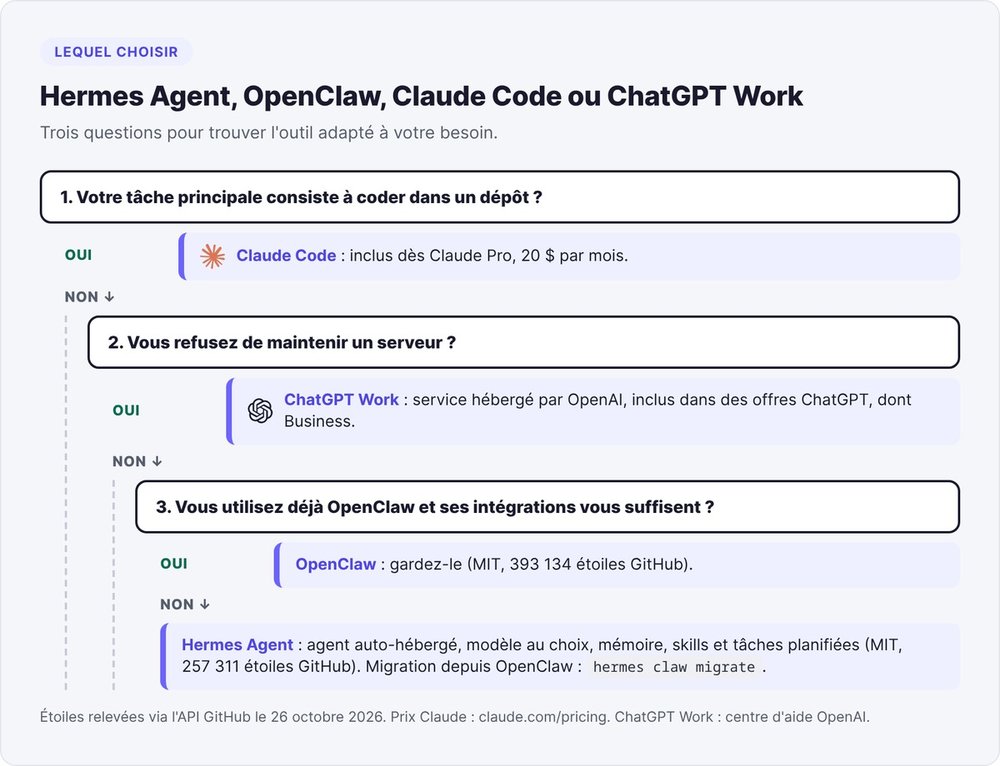
Choose Hermes Agent for an always-on agent you can reach from a messaging app, with the model of your choice. Choose Claude Code for coding in a repository. ChatGPT Work fits if you want to delegate office tasks without managing a server: our ChatGPT Work guide covers the plans.
If you're looking for an open source alternative to Hermes Agent, our comparison of OpenClaw alternatives reviews NanoClaw, Nanobot, n8n and others. For infrastructure managed by Anthropic, read our Claude Managed Agents guide.
Hermes Agent's limits to know about
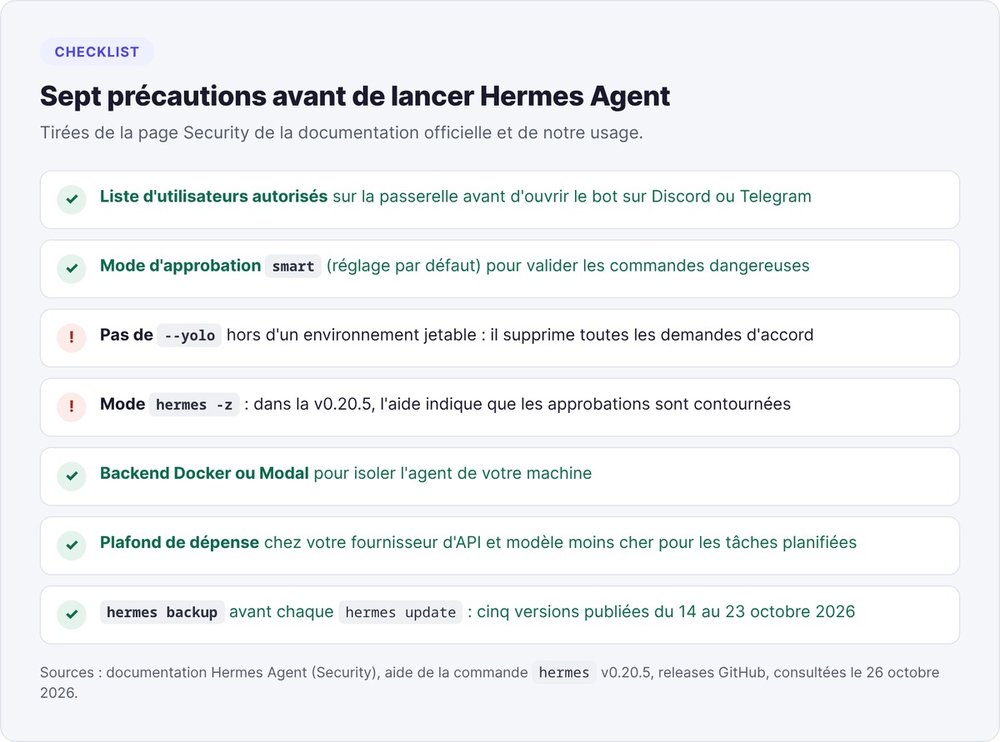
An agent that runs commands on your server needs guardrails. The documentation describes an eight-layer security model, from user authorization to isolation between sessions.
Command approvals and YOLO mode
By default, the agent asks for your approval before a dangerous command (smart mode). The --yolo flag or the /yolo command removes all of these prompts, except for a hard-coded blocklist. According to the documentation, the deny rules are designed for an honest agent that makes mistakes. Against a malicious process, it points you to an isolated backend: run the agent in Docker or Modal.
Single-query mode
We use hermes -z mode from Discord. It returns only the final answer. In version 0.20.5, the command's help text says of it: "approvals are auto-bypassed". If you connect Hermes Agent to a bot, restrict who can message it using the gateway's authorized user list, and run it under a system account with reduced permissions.
Maintenance and updates
With five releases in ten days in October 2026, any update can change a behavior. Test hermes update on a copy before touching the agent running in production, and run hermes backup before every update.
Token costs of an always-on agent
Every scheduled task and every message on the gateway triggers model calls. Set a spending cap with your API provider, and assign a cheaper model to scheduled tasks with hermes config set cron.model.
Our verdict on Hermes Agent
Hermes Agent is a very active project: 44 releases between March and October 2026, 257,311 GitHub stars, and a publisher that just raised $90 million. For a startup, its main use is running automations you control from a messaging app, with the model of your choice and your data on your own server.
In our use, Discord control and the bundled skills let us build a video clip pipeline without writing an interface. The hidden cost is maintenance: a server to monitor, frequent updates, and security settings you have to configure yourself.
Go with Hermes Agent if someone on the team can administer a Linux server. Otherwise, start with a hosted tool and come back to Hermes once your automations justify a dedicated server.
FAQ
What is Hermes Agent?
Hermes Agent is an open source, self-hosted AI agent released by Nous Research under the MIT license. It carries out multi-step tasks, keeps persistent memory, writes its own skills, schedules tasks and replies from Telegram, Discord, Slack, WhatsApp or the terminal.
Who created Hermes Agent?
Hermes Agent is published by Nous Research, which also releases the open source Hermes language models. The GitHub repository dates from July 22, 2025. On October 7, 2026, Nous Research raised a $90 million Series B, according to TechCrunch.
Is Hermes Agent free?
The software is free, under the MIT license. You pay for the model (per-token API, a Nous Portal subscription from $20 a month, or a free local model via Ollama) and, for an always-on agent, a server: €11.99 excl. VAT per month for a Hetzner CPX12 as of October 26, 2026.
Can you use Hermes Agent with Claude?
Yes, with an Anthropic API key billed per token. Signing in with a Claude account only works with a Max plan plus purchased extra usage credits. According to the official documentation, a Claude Pro subscription doesn't allow this sign-in.
Does Hermes Agent work on Windows?
Yes, natively on Windows 10 and 11, with the official PowerShell command or the Hermes Desktop app. Only the dashboard's built-in terminal requires WSL2.
Can you run Hermes Agent with Ollama?
Yes, with at least 8 GB of RAM for a small model. You also need to raise the context to 64,000 tokens, because Ollama starts at 2,048 tokens by default and Hermes Agent rejects smaller windows.
What can you do with Hermes Agent?
Daily reports sent to a messaging app, scheduled backups, web monitoring, parallel work handed to subagents, or a custom pipeline. At swanbase, we use it to suggest and then render short video clips from a long video.