You publish a polished post, you collect a handful of polite likes (your mum's included), and you conclude that LinkedIn doesn't work. That diagnosis is almost always wrong. Getting views on LinkedIn and finding clients aren't two separate problems: they're the same problem, solved in the right order. If your posts fall flat, it isn't that the algorithm hates you. It's that you're confusing visibility with selling, and tackling the problem from the wrong end.
This guide is built to stay open in a tab. It gathers the mechanics you need to understand, the hook templates to copy, the full post structures to reuse, and the handful of tactical moves that separate a dormant profile from one that generates conversations. Take what you need today, come back for the rest.
The method that works has six pieces: understanding how attention time works, turning your profile into a landing page, structuring your content as a funnel, writing hooks that stop the thumb, building the relationship before you pitch, and keeping it up over time. LinkedIn is still one of the rare places where a stranger with no ad budget can reach hundreds of targeted people with a simple block of text. The cost of entry is absurdly low. What most people who "can't make it work" are missing isn't luck or a network: it's an understanding of the mechanics. That's where we start.
Getting views on LinkedIn: the only thing the algorithm measures
Let's start with the only thing LinkedIn really measures: time.
The algorithm doesn't ask whether your post is good. It asks how long people stop on it. That attention time has a name, dwell time, and it's the whole game. Every post starts with a minimal reach: provided you have enough connections, LinkedIn first shows it to roughly 200 to 300 people in your network, watches what happens, then decides. If people stop, read, comment, and reply to comments, the content clears the first wave and spreads to a wider circle, on the order of 1,500 to 2,000 people. If the second wave performs too, the reach keeps growing, and the very best posts even get checked by human moderators before reaching massive audiences. Conversely, if people scroll past without slowing down, your post quickly stops spreading. Nobody censored it. It simply didn't hold attention long enough to earn the next wave.
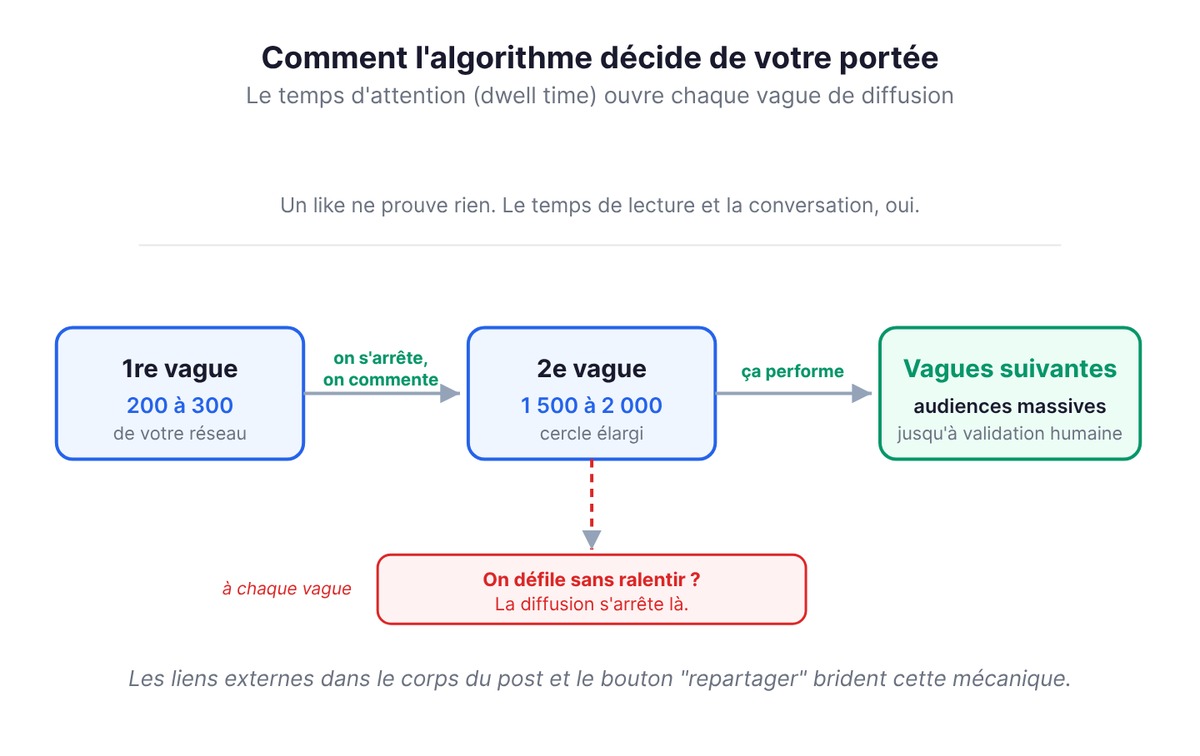
This wave mechanic has a consequence most people refuse to admit: likes aren't enough. A like takes no attention and proves nothing. What counts is reading time and, above all, conversation. A comment you reply to, which sparks another comment, keeps two people on your post for several minutes. In the eyes of the algorithm, that's gold. A post isn't a shop window to be looked at. It's the start of a discussion.
From this follow two mistakes that sabotage even good posts.
The first: the external link in the body of the text. You write a solid piece of thinking, and you end with "here's the link to the full article." You've just told LinkedIn: "this content sends people elsewhere." External links tend to throttle reach, since the platform has little interest in pushing content that empties its feed. The fix fits on one line: keep the link for the first comment, and let the post stand on its own.
The second: the "repost" button. A raw share of someone else's post adds almost no value of its own, and its reach is capped. Went to an event and want to spread the word? Don't click "repost." Rebuild your own post with the original photo, your take on it, and tag the organizer. You turn an invisible gesture into content that lives.
One last basic habit: readability. A dense wall of text drives people away. Open it up with frequent line breaks, one idea per line, and a well-placed emoji or two to guide the eye. People read LinkedIn by thumb, on the train, half distracted. Text that breathes holds attention longer than a dense block, and holding attention longer is exactly what the algorithm rewards.
Keep this principle in mind before going further: you're not trying to please, you're trying to hold attention.
Your profile isn't a résumé, it's a landing page
Imagine a post finally does its job. Someone stops, reads you, raises an eyebrow, and clicks on your name. What do they see?
Very often, they see a résumé. A hierarchical job title ("Associate Director at Whatever Corp"), a photo taken at a wedding, a default blue banner, an "About" section that's either empty or filled with corporate jargon. In the blink of an eye, the prospect who was just intrigued leaves. You had captured their attention, and you lost it on your own page.
A LinkedIn profile isn't an administrative document. It's a landing page, and a landing page has one goal: to convert a curious visitor into a contact. Every element has to work toward it.
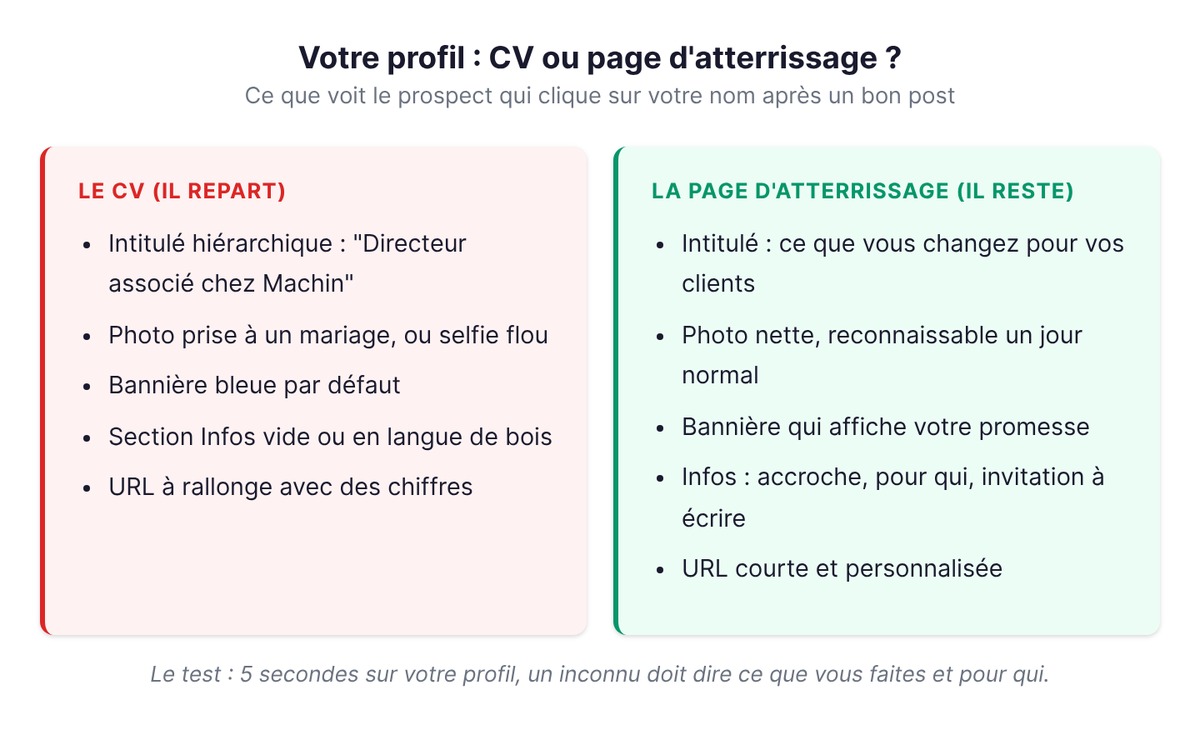
- The headline doesn't describe your rank, it describes what you bring. Not "Senior Consultant," but what you concretely change for the people you help.
- The photo is recognizable and looks like you on an ordinary day, not a blurry selfie or a cold logo.
- The banner restates your value proposition or key message, instead of letting the default blue occupy the best advertising space on your profile.
- The "About" section opens with a hook that makes people want to read on, follows with what you do and who you do it for, and ends with a clear invitation to get in touch.
- The URL is customized, short, and shareable without embarrassment.
The test is simple: show your profile to someone who doesn't know you, for five seconds, then ask them what you do and who you serve. If they hesitate, your landing page is leaking.
To take action right now, here's the checklist to tick off before your next post:
- Customized URL (linkedin.com/in/your-name), short and clean.
- Sharp photo, framed on the face, recognizable on an ordinary day.
- A banner that shows your promise, not the default blue.
- A headline that says what you change for your clients, not your rank.
- "About" section: a hook, what you do and who for, an invitation to message you.
- A contact link or a resource that's clearly visible.
Every ticked box is a leak sealed. A visitor intrigued by your post won't forgive a profile that leaves them in the dark.
The LinkedIn content strategy: the three-stage funnel
This is where most LinkedIn advice falls apart. You keep hearing "post value," as if "value" were a single, uniform category. It isn't. Content that gets you known and content that triggers a meeting look nothing alike, and confusing the two means writing posts that hit neither goal.
A serious content strategy is organized across three stages, borrowed from funnel logic.
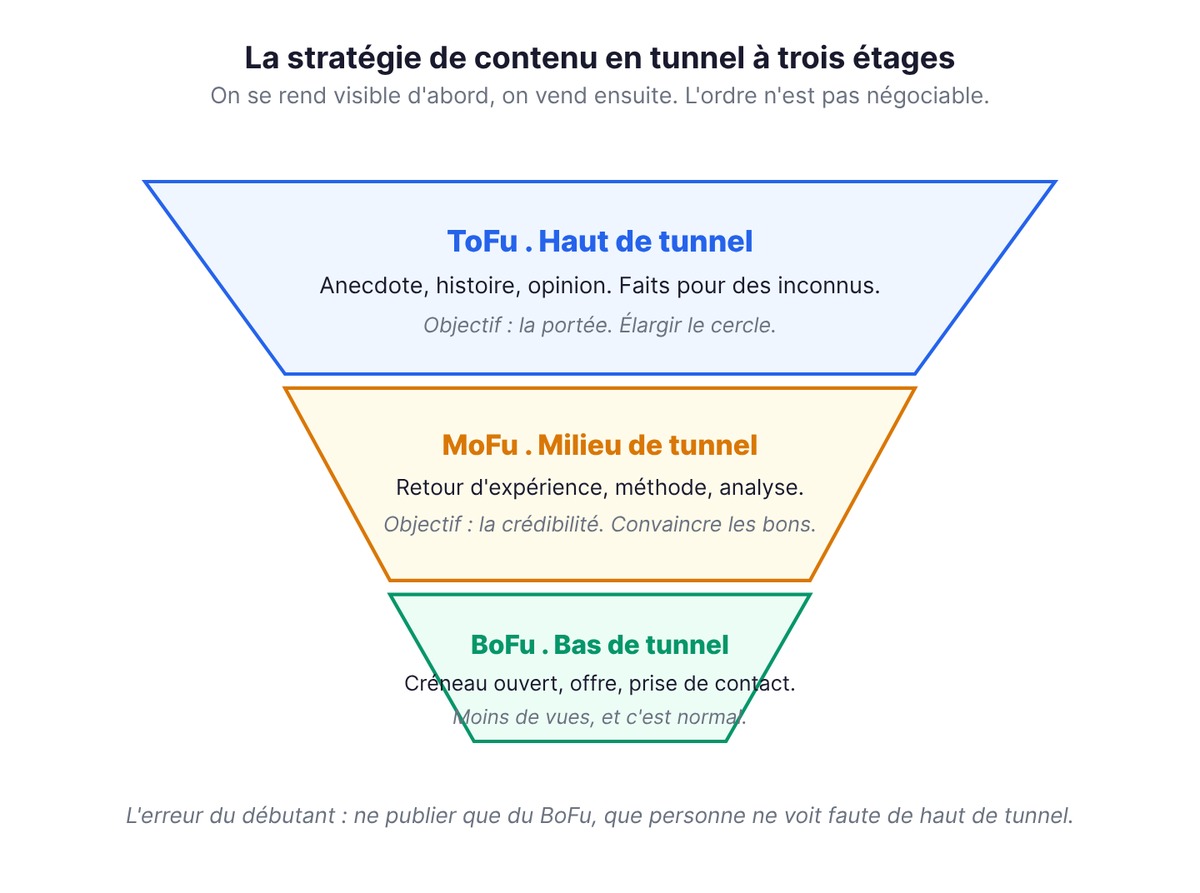
Top of the funnel (ToFu). Broad, accessible content, meant to be read by people who don't know you yet. An anecdote, a personal story, a win, an opinion that ruffles a few feathers. These posts don't sell anything. Their only job is reach: widening the circle of people who know you exist.
Middle of the funnel (MoFu). More specialized content, speaking to those already interested in your topic. A detailed case study, a method, an analysis. Here you're not trying to reach the largest number, but to convince the right ones. This is the content that establishes your credibility and makes you a go-to name on a specific problem.
Bottom of the funnel (BoFu). Action-oriented content. You open up a slot, you announce an offer, you invite people to get in touch. These posts often get fewer views, and that's normal: they only speak to those who are already well along in their thinking.
The beginner's mistake is to post only BoFu, because it's the only stage that "sells." The result: nobody sees it, because they never built the top of the funnel that feeds everything else. When you're starting out, you mostly write top-of-funnel content. You make yourself visible first, you sell second. That order isn't negotiable.
Hooks that stop the thumb: 7 templates to copy
Back to the mechanics of time. If everything comes down to attention, then the first line of your post decides its fate. It's the only one LinkedIn shows before the "see more." If it doesn't stop the thumb, the rest doesn't exist, however brilliant it may be.
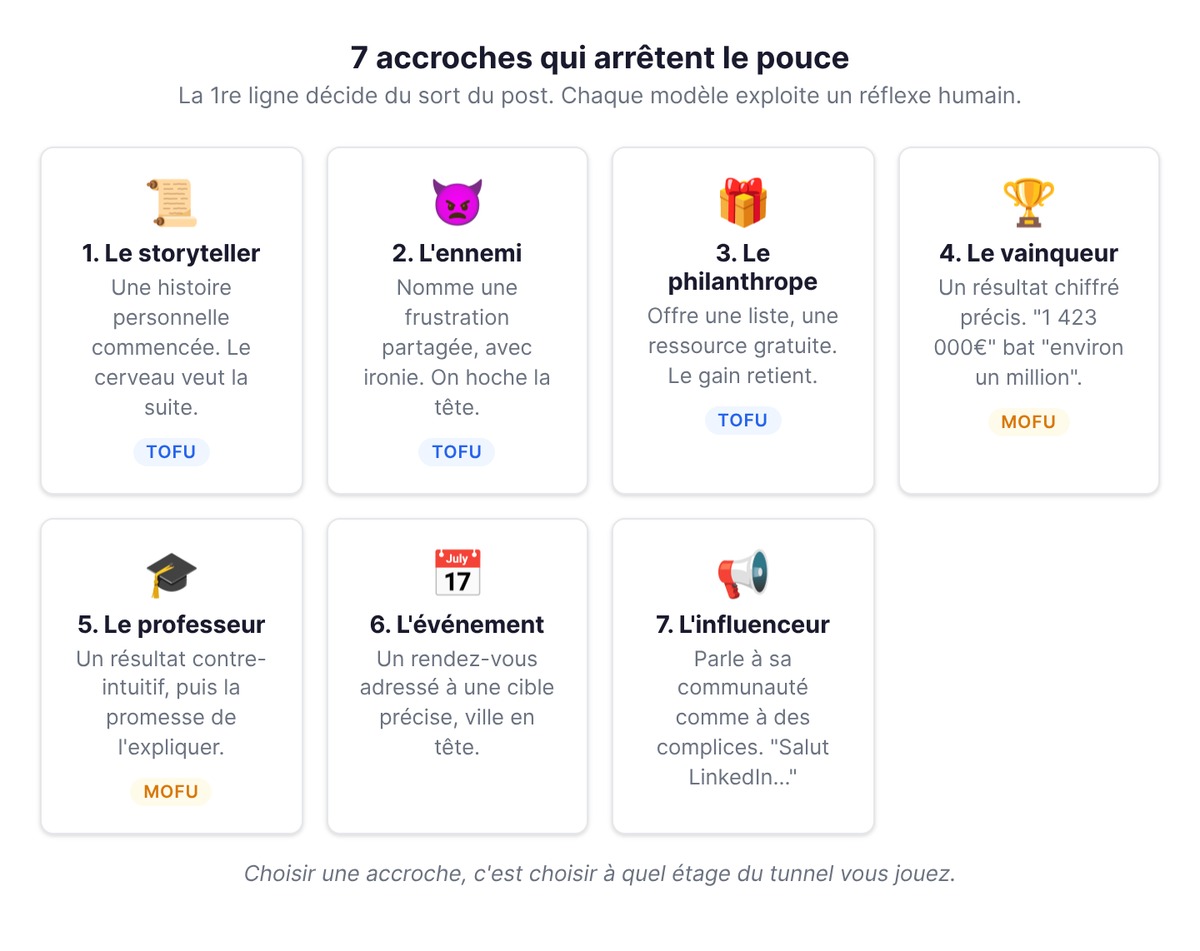
A good hook isn't a matter of talent. It's a matter of templates. Here are seven that work because each one taps into a human reflex. For each template, you get the structure to fill in, then a real example to see what it looks like once dressed up. Copy the frame, replace the brackets, keep the rhythm.
1. The storyteller tells a personal story. The brain always wants the rest of a story once it's started.
Template: "A few days ago, while [doing something], I came across [something curious]." Real example: "A few days ago, on my way to catch the tram, I came across this vandalized advertising poster."
Another frame in the same vein, even more effective with strangers: "I [did something bold] at [age]." Example: "I quit my job at 21." You want to know what happened next.
2. The enemy to take down names what annoys your audience, with a hint of irony. People always stop to nod along at a shared frustration.
Template: "[Common enemy]: "[ridiculous fake quote that caricatures them]"" Real example: "Recruiters: "Boo hoo, nobody answers job ads anymore, there's a shortage, do people just not want to work or what?? 😢""
3. The philanthropist gives something away. The promise of a free gain holds attention.
Template: "The best-known [tools / resources] aren't always the best. Here are [number] [cheaper] alternatives to famous [things] 👇" Real example: "Here are 12 cheaper alternatives to famous tools (and sometimes far better ones) 👇"
4. The winner has won and lets everyone know, with numbers to back it up, before lifting the hood.
Template: "Today I'm celebrating [big number] 💰 More precisely, [exact number]." Real example: "Today I'm celebrating 1 million euros 💰 More precisely, €1,423,000."
The precision of the exact figure creates credibility: "€1,423,000" holds attention better than "about a million." A method-oriented variant: "In [year], we [quantified result] for [target]. With only [constraint]. How did we do it?"
5. The teacher announces a counterintuitive result, then promises to explain it.
Template: "I just made [quantified result] in [time period], with [small constraint] on [lever]. One single action will let you multiply your [KPI], let me explain 👇" Real example: "I just made €5,800 in 2 days, with €76 on Facebook Ads. One single action will let you multiply your ROAS, let me explain 👇"
6. The event announces a gathering to your target audience.
Template: "[CITY - WORKSHOP] [objective] [under constraint]. Fellow [target], join me [date and time] for a hands-on workshop." Real example: "[MONTPELLIER - WORKSHOP] Hack your project in 48h with Lean Startup. Fellow founders, join me Tuesday from 9:30 to 11:30 for a hands-on workshop."
7. The LinkedIn influencer speaks directly to their community, like fellow insiders.
Template: "Hey LinkedIn, we've got [a concept] that's a little crazy." Real example: "Hey LinkedIn, we had a slightly crazy idea."
These hooks don't exist in a vacuum: they serve the funnel. The storyteller, the enemy, and the philanthropist pull toward the top of the funnel, where you're after reach among strangers. The teacher and the winner work the middle, where you build credibility with people already interested in your topic. Choosing a hook means first choosing which stage you're playing at.
What all these templates share: they create tension in the first line and resolve it in what follows. It's that small gap, between the question raised and the answer promised, that keeps the reader around long enough for the algorithm to reward you.
Calls to action that reignite the conversation
A post without a call to action ends in silence, and silence kills reach. Remember: what lifts a post is comments and replies, not likes. Your last line has one job, to open the discussion. Here's a small library of closers ready to paste under your posts.
- Grab the mic (get the audience to complete the list): "I've surely forgotten some, so I'll let you grow the list in the comments! Now's the time to share your favorite [tools / methods] 😁"
- What about you? (turn the question back to the reader): "Have you ever taken the time to [do this action]?" or, more lightly, "So, more of an [option A] or [option B] person?"
- Test the water (float an idea before launching it): "What if we [made this resource] for free? Give me a wave in the comments if you're interested 👋"
- Please click (send them to a resource, link in the comments): "If you want [objective], meet me at [the resource], the link is in the comments."
- The coach (end on a short, memorable lesson): "In short, [small win]. I'll say it again: [short lesson]."
The habit that changes everything: don't ask a rhetorical question, ask a real one people actually want to answer. And once the answers come in, don't settle for a "thanks." We'll come back to this in the toolbox, because that's where the second wave of distribution is won.
Four complete post structures to reuse
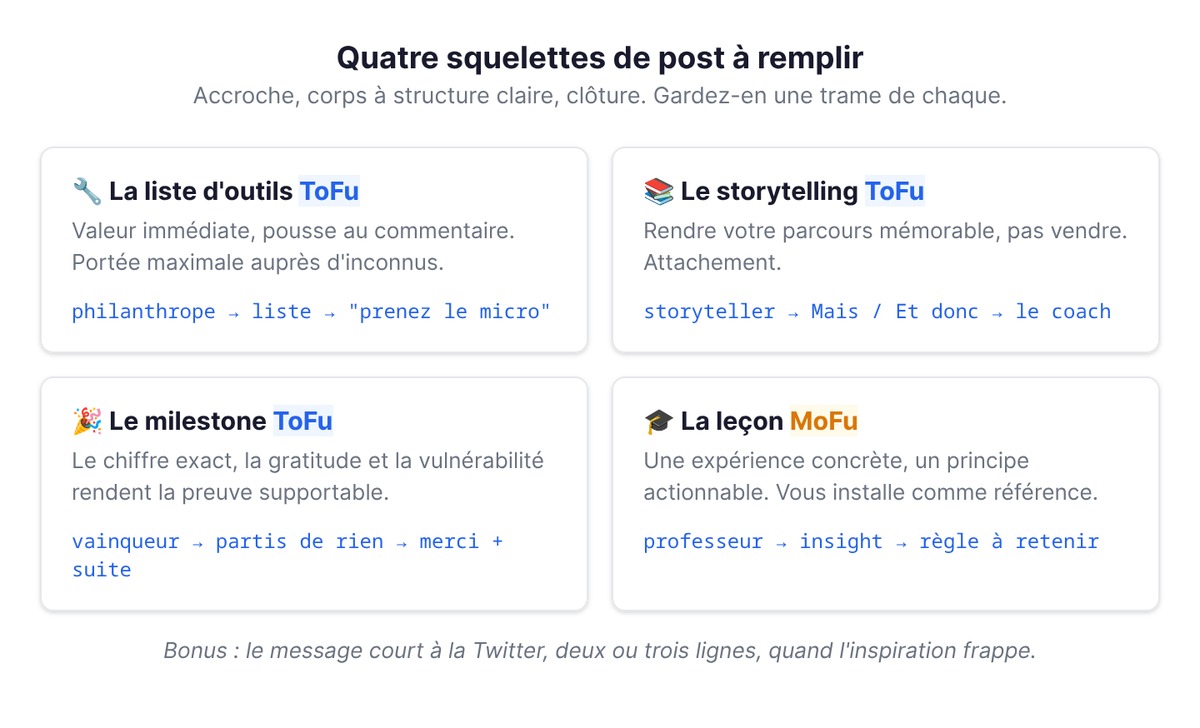
A hook and a call to action are the beginning and the end. That leaves the middle. Here are four complete, proven post skeletons you can fill in today. Each one combines a hook, a body with a clear structure, and a closer.
The tool list (top of funnel, maximum reach). A "philanthropist" hook, then a straightforward list, then a "grab the mic" call. It's an easy format to reach for when you want to widen your reach among strangers, because it offers immediate value and prompts comments. Example frame:
The best-known tools aren't always the best. Here are 12 cheaper alternatives 👇
- For slick forms: Typeform ➝ Tally
- For removing an image background: remove.bg ➝ erase.bg
- For automating processes: Zapier ➝ n8n
- For project management: Asana ➝ ClickUp (…) Do you use other alternatives? Share them in the comments!
Storytelling (top of funnel, connection). A "storyteller" hook, a body built on a "But / And so" structure (a situation, a turning point, a lesson), and a "coach" or "influencer" closer. You start from a specific moment ("I quit my job at 21"), unfold what changed, and end on an invitation to be bold. The goal isn't to sell, it's to make your journey memorable.
The milestone (top of funnel, proof). A "winner" hook with the exact figure, a body in "But / whereas / and so" (we started from nothing, it was hard, here's where we are), sincere thanks, and an opening toward what's next. Example skeleton: "Today I'm celebrating €1,423,000. That's what we generated for our clients this year. With just 2 of us. We started from almost nothing…" Gratitude and vulnerability make the number bearable rather than arrogant.
The lesson (middle of funnel, credibility). A "teacher" hook, then you take a concrete experience and draw an actionable principle from it. The template: a surprising result, the mistake or insight behind it, the rule to remember. Example angle: "If you're not yet [objective], it's probably because you [counterintuitive diagnosis]." This is the format that establishes you as a go-to name on a specific topic.
Bonus: the short, Twitter-style message. Two or three lines, one idea, a punchline. Perfect when inspiration strikes and you want to post on a whim. On LinkedIn, the cost of a text post is so low that these spontaneous flashes let you publish a simple idea without over-producing it, and they often do very well.
Keep one frame from each category in a document. On the day you're out of ideas, you don't face a blank page: you have a skeleton to fill in.
Finding clients on LinkedIn: social selling, step by step
Here's the part nobody wants to hear, and yet it's what makes all the difference between a profile that generates clients and one that generates polite emptiness.
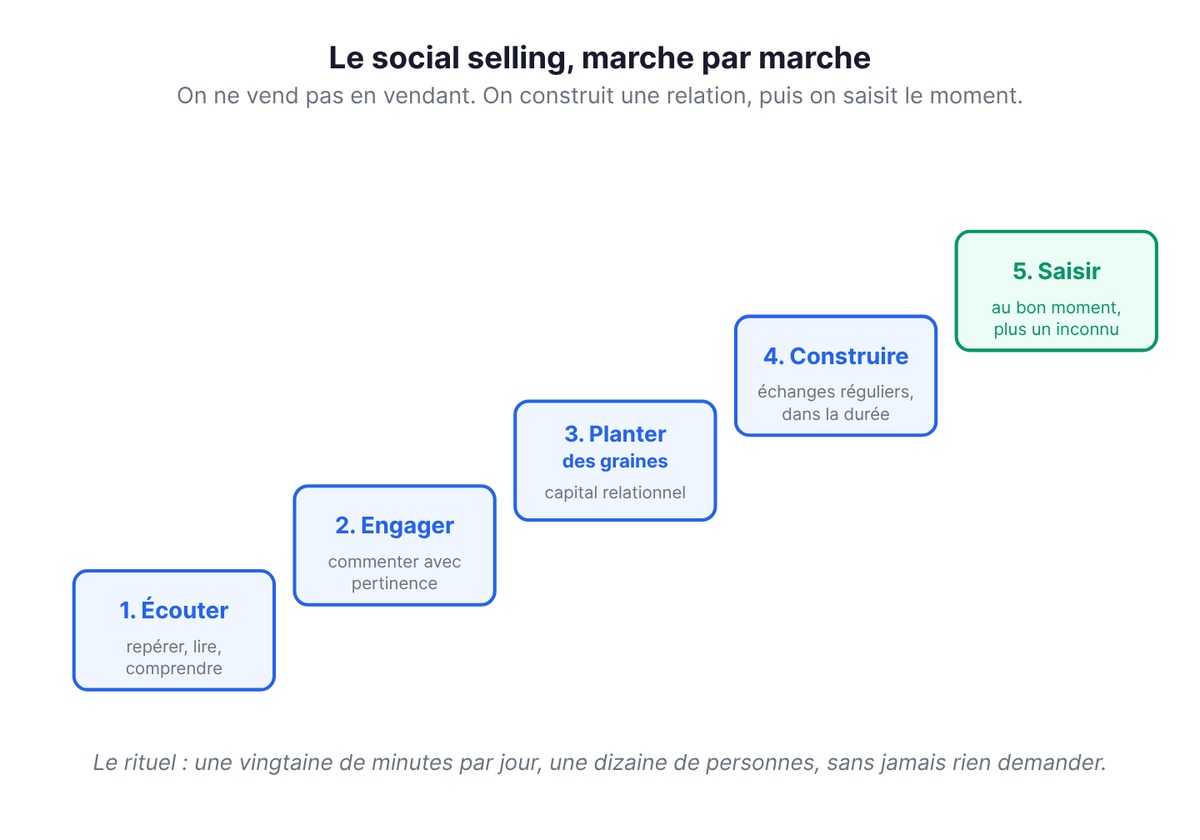
That's the whole principle of social selling: you don't sell on LinkedIn by selling, you sell by building a relationship, then seizing the right moment. It's slow, it's unspectacular, and it preserves trust where cold outreach burns it out. The approach comes in five steps, which apply just as much in B2B as in B2C.
- Listen. Spot the people who matter in your ecosystem: potential clients, peers, referrers. Read what they post. Understand their current priorities. You don't court someone whose concerns you know nothing about.
- Engage. Comment with substance, not with a "great post 👏." A comment that adds an idea makes you visible to the person and to their entire audience at once.
- Plant seeds. A word of encouragement, sincere congratulations on a success, a useful resource sent with no strings attached. These gestures build relationship capital, and relationship capital gets spent later. You can plant a seed years before you harvest it.
- Build. Keep up regular exchanges. Be available, responsive, kind. A relationship hardens through repetition, not through one perfect message sent a single time.
- Seize. When a window opens, a new job, a funding round, a launch, a problem you know how to solve, you make your pitch. And this time, you're not a stranger interrupting. You're someone the person already knows.
The concrete move that keeps this machine running, the way it's actually done: block out, say, twenty minutes a day to interact with a dozen or so people in your network, at a steady pace. A comment here, congratulations there, a useful reply somewhere else. This ritual keeps you in their field of view, among the first people who come to mind, without ever asking for anything. The day a need appears, you're the one they think of.
Cold outreach does the opposite: it strikes at step five without having climbed the first four. That's why it damages your reputation a little more with each message, especially when it's pushy. Trust can't be shortcut.
This is the shift we work to trigger in the founders we support at swanbase: a profile and content that do the first round of selling for them, so they no longer have to chase every prospect one by one.
The toolbox: the moves that boost your LinkedIn visibility
With the big principles in place, here are the specific tactics passed around among insiders. Each one is quick to put into action and reinforces your LinkedIn visibility.
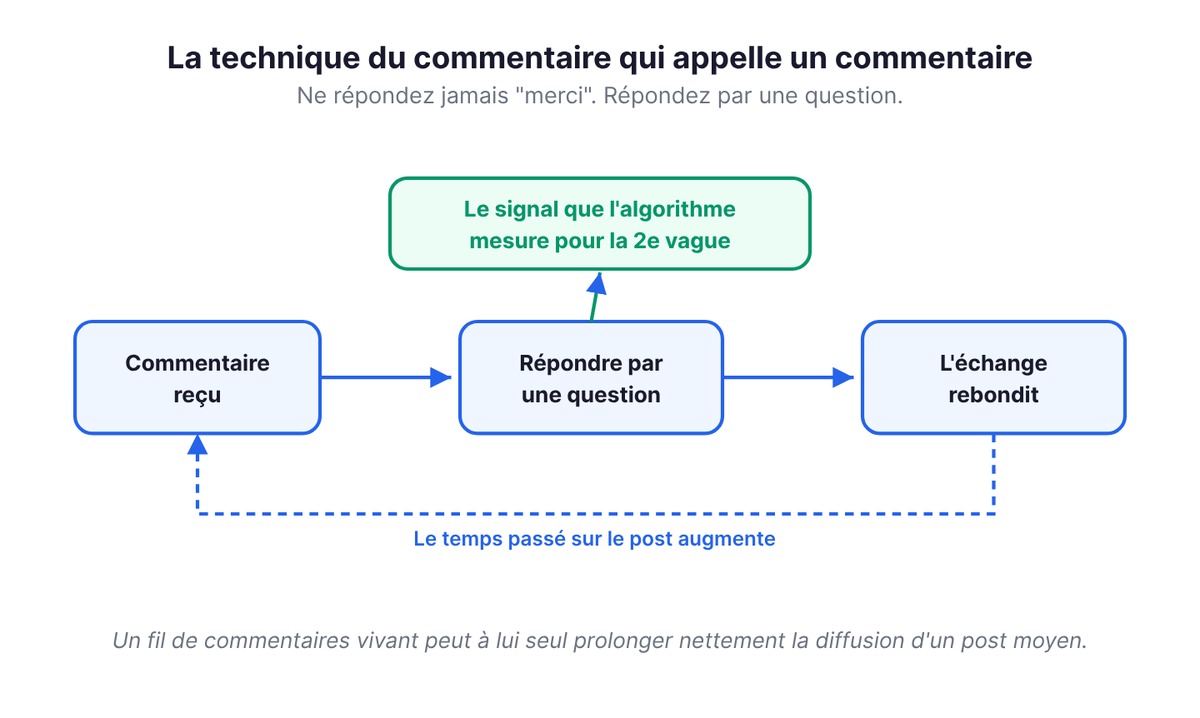
The comment-that-invites-a-comment technique. When someone comments on your post, don't reply with "thanks." Reply with a question. Every question restarts an exchange, every exchange lengthens the time spent on the post, and that time is exactly what the algorithm measures to decide on the second wave. A lively comment thread can, on its own, noticeably extend the reach of an average post.
The custom news feed (the URL trick). The default LinkedIn feed is a mess. You can build a tailored one that shows only the posts of your prospects or targets. The maneuver: run a search on a person, open the "Posts" tab, then in the URL of the results page, delete the keywords=… parameter (your search term) while keeping the member ID. Then add other people to the search to stack their IDs. You get a feed that displays only their posts. Bookmark this URL: you have a dedicated monitoring wall for your prospects, where commenting at the right moment becomes trivial. You can stack a good twenty or so people in a single feed before it breaks.
Video, multiplied across all your networks. Video captures attention time well, and above all it's recyclable everywhere: a single video can be recut for LinkedIn, Instagram, TikTok, YouTube, and the rest. For subtitles, which lift the read-through rate when the sound is off, tools like Captions generate the captions automatically in a few minutes. One stone, several networks.
Access your post analytics. LinkedIn tells you exactly what's working, but the information is tucked away. Under each of your posts, click "View analytics": you get impressions, members reached, and the audience breakdown. On a video, watch the hook rate and the total time spent watching. Read these numbers after each post and you'll know which format to double down on.
Document your journey so you never run out of ideas. Creative block comes from the false idea that you have to "produce content." In reality, your content is your daily life: a problem you ran into, a decision, a lesson, a behind-the-scenes moment. Keep a running backlog of ideas, turn them into drafts, and structure them when you have time. The topic isn't there to be invented, it's there to be noted down.
None of these tricks replaces strategy. But laid on top of a good strategy, they make the difference between a post that plateaus and one that takes off.
Rhythm, and the mistakes that kill a good strategy
A strategy is worth nothing without the habits that carry it. Consistency weighs more than perfection, and engagement more than volume.
A few habits hold up over the long run:
- Post regularly at a pace you can sustain over time, to stay present without flooding people. A reasonable starting benchmark is around two or three posts a week, provided you can keep it up.
- Vary the formats: text, image, carousel, video, because each one catches a different type of reader.
- Reply to every comment with care, ask questions, keep it going. You extend the life of the post and strengthen the relationship in the same move.
- Create rather than repost. A raw share doesn't belong to you. Original content around the same topic does.
And the traps, just as important to know, because they cancel out everything else:
- Posting at the wrong time, at hours when your audience is asleep.
- Neglecting interaction with others, especially at the start, when your visibility is still fragile and depends entirely on the network you feed.
- Ignoring the comments under your own posts. Nothing discourages a budding audience faster.
- Scattering yourself across ten topics with no editorial line, so nobody knows what to follow you for.
- Reaching for cold outreach and pushy messages, which burn in one shot the capital you patiently built.
These mistakes share a common denominator: they betray a lack of consistency or attention to the audience. Fixing them takes no special talent. Just discipline.
What to remember
Getting views on LinkedIn and finding clients there doesn't rest on a trick, a magic posting time, or an algorithm hack. It rests on a coherent ecosystem: a profile designed as a landing page, an understanding of how attention time works, a three-stage content strategy, a relationship-first logic that puts selling last, and the consistency to hold it all together over time. Good content thrown into the void stays invisible; average content carried by this system eventually finds its people.
Visibility isn't a reward you wait for. It's a consequence you build.
Frequently asked questions
How often should you post on LinkedIn each week? A good starting benchmark is around two or three posts a week, enough to stay present in the feed without overwhelming your audience. But consistency matters more than frequency: a few polished posts each week, sustained over time, beat a big burst followed by a long silence. The algorithm and your audience both reward steadiness, not fits and starts.
Should you put links in your LinkedIn posts? Not in the body of the post. An external link in the text sends readers off the platform, which LinkedIn penalizes by cutting reach. The good practice is to place the link in the first comment and let the post stand on its own. That way you keep your reach intact while still offering the resource to those who want it.
How long before you find clients through LinkedIn? There's no reliable timeline, because everything depends on the consistency and quality of the relationship you build. The logic is relational and gradual: you listen, you engage, you plant seeds, you build, then you seize the opportunity. The signal to watch isn't a date on the calendar but the appearance of qualified conversations in your inbox, once your profile and content have built trust.
Do you already need a large network to get views? No. Generally, LinkedIn first tests your content with an inner circle of your network, and it's the engagement it generates that decides what happens next, not your starting size. A small, highly engaged network often spreads content better than a large, passive one. Interacting with others, especially early on, remains the fastest lever for widening that base.
Does video work better than text on LinkedIn? Both have their role. Video captures attention time well and offers a decisive advantage: it can be recycled across all your other networks with a simple recut. Text, on the other hand, has almost no production cost, which lets you post often and on a whim, whereas video takes thought and editing. A good routine alternates regular text posts with more spaced-out videos, subtitled so they stay readable with the sound off.
Are LinkedIn groups still good for anything? In practice, not really anymore. Groups no longer bring meaningful visibility today. Your time is far better invested in posting on your own profile and interacting with the posts of the people you're targeting. To follow those people closely, build yourself a custom news feed instead, using the URL trick described above.
Can B2C work on LinkedIn, or is it just for B2B? B2C works, as long as you play the right register. LinkedIn is seen as a B2B platform, but consumer brands break through by leaning on branding, behind-the-scenes glimpses, and entrepreneurial stories rather than head-on product promotion. The relationship ladder and the content funnel apply in exactly the same way: you make yourself visible and likeable first, you convert second.
Should you schedule your posts in advance? Nothing stops you from scheduling. Many people, though, prefer to post on impulse, while the energy of the message is still intact. The best system stays hybrid: keep a backlog of ideas and drafts ready, then post the moment inspiration strikes. What matters isn't the exact time, it's consistency and the right tone. Don't go hunting for the universal "best time" either, because it doesn't exist; just make sure you don't post when your audience is asleep.