Go to market (GTM) is the plan that sets who a company sells its product to, at what price, through which channels and with which sales method. A go-to-market strategy answers one practical question: how do you get your product to paying customers, in a way you can repeat?
This page covers the definition, the five building blocks of a GTM, and four sales models illustrated by well-documented companies: Doctolib, Atlassian, HubSpot and Pennylane. It then compares GTM in B2B and B2C, and lays out a six-step plan for an early-stage startup. When you're ready to close your first deals, our guide to finding your first 10 customers picks up from there.
Go to market: definition
Software company Harvestr defines a go-to-market strategy as "a step-by-step plan created to launch a product on the market". You apply it to a new product, a new feature, or an existing product you're taking into a new segment or a new country.
A GTM fits on a few pages. It names the target customer, the promise that gets them to buy, the price, the channels that bring them to you and the person who closes the sale. Each choice depends on the others. If you sell software for a few euros a month, you can't afford a salesperson who visits every customer in person.
Go to market in French
In French, "go to market" translates as « mise sur le marché ». French teams usually keep the English term and shorten it to GTM. You'll also come across « stratégie d'entrée sur le marché » (market entry strategy). The go-to-market manager role, common at software companies, coordinates product, marketing and sales around a launch.
Go-to-market, marketing plan and business plan
A marketing plan covers communication and acquisition over a given period. A go-to-market plan also includes pricing, the sales motion and how the sales team is organized. A business plan models the entire company, and it draws on the revenue assumptions from your GTM.
Time to market and go-to-market
Time to market measures how long it takes to go from a product idea to its commercial launch, while go-to-market describes how you sell it once it's available.
The five building blocks of a go-to-market strategy
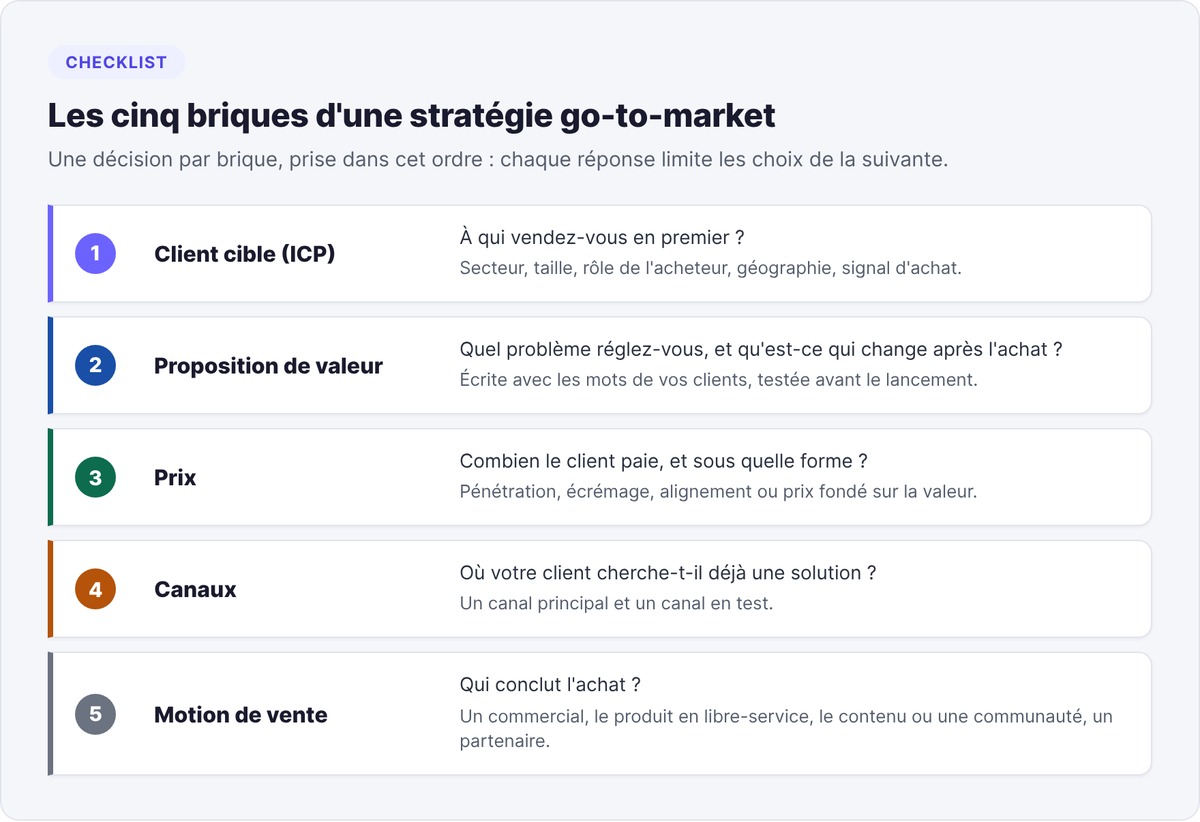
Every GTM strategy rests on five decisions. Make them in order, because each answer narrows your options for the next one.
1. The target customer (ICP)
Your ICP (ideal customer profile) describes the customer you go after first: industry, company size, buyer role, geography, and the signal that shows they have the problem today. In B2C, you describe a person and a usage situation. With a narrow ICP, you can list your prospects one by one. The lean canvas helps you pin down that customer and their problem on a single page.
2. The value proposition
Your value proposition states in one sentence what problem you solve, for whom, and what changes for the customer after they buy. Write it using the words your customers use in interviews. Then test two or three versions on a landing page, in a prospecting email or during a sales meeting, and keep the one that gets responses.
3. Pricing
Your price determines which sales method you can afford. A low subscription price means you rely on self-serve; a large annual contract lets you pay a salesperson for every deal. Marketing textbooks describe four pricing strategies:
- Penetration: you set a low price to win customers fast, then raise it.
- Skimming: you launch at a high price for the most eager customers, then lower it in steps.
- Competitive pricing: you stay close to competitors' prices and differentiate on something else.
- Value-based pricing: you set the price based on what the product earns or saves the customer.
Our guide to pricing for early-stage startups explains how to set and then test a first price.
4. Channels
Acquisition channels bring in prospects: SEO, content, ads, direct outreach, trade shows, communities. Distribution channels deliver the product: website, app stores, resellers, partners. At the start, pick one main channel, where your target customer already looks for a solution, and a single channel to test. Growth marketing then helps you improve each step of the funnel.
5. The sales motion
The sales motion describes who closes the purchase: a salesperson, the product itself through self-serve, content and community, or a partner. The next section covers these four models in detail.
Four go-to-market models and examples
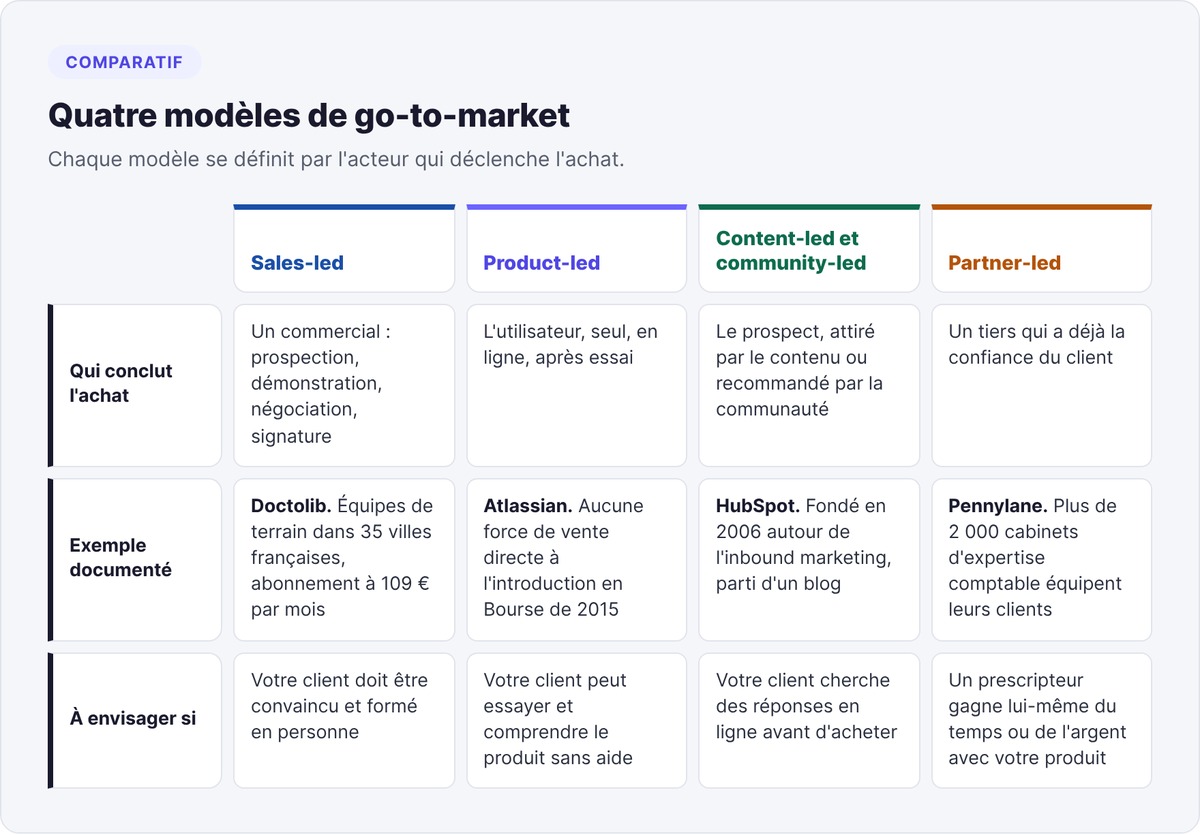
Each model is defined by who triggers the purchase. Most companies combine two, with one dominant model.
Sales-led: Doctolib and its field teams
In a sales-led model, salespeople run the sales cycle: prospecting, demo, negotiation, signature. Doctolib built its market this way. Stanislas Niox-Chateau, Ivan Schneider and Jessy Bernal founded the company in October 2013. It sold healthcare practitioners a single subscription at €109 a month with no commitment, according to Challenges.
The magazine described field teams based in 35 French cities, tasked with meeting current and future subscribers. At the time of the article, 17,000 practitioners used the service. Doctolib still hires field sales reps and account managers, according to its careers page.
Choose this model when your buyer needs to be convinced and trained in person, and when one customer brings in enough revenue to cover the cost of the salesperson who signs them.
Product-led: Atlassian without a direct sales force
In a product-led model, users try and then buy the product on their own, online. Atlassian, the company behind Jira and Confluence, is the most frequently cited example. In its 2015 IPO prospectus, the company wrote: "We do not have a direct salesforce and our sales model does not include traditional, quota-carrying sales personnel," as reported by Business Insider. Atlassian also listed this choice among the risks to its future growth.
Its 2025 annual report describes a model that has evolved. The website remains the main place where new customers buy, and Atlassian says it does not rely solely on a direct sales force "until a customer reaches a specific size". In other words, Atlassian acquires customers through the product and adds salespeople for the largest accounts. Our article on product-led growth breaks down how this model works.
Content-led and community-led: HubSpot and inbound marketing
In a content-led model, content attracts prospects: articles, free tools, newsletters, videos. In a community-led model, users recommend the product and answer newcomers' questions.
HubSpot built its GTM on content. According to its "Our Story" page, founders Brian Halligan and Dharmesh Shah noticed as early as 2004 that buyers wanted useful information rather than ads. They founded HubSpot in 2006 around inbound marketing. The episode of Sequoia's Crucible Moments podcast adds that the founders first tested their ideas on a blog they ran as a side project, and that Brian Halligan coined the term "inbound marketing".
At an early-stage startup, content-led often starts with the founder publishing under their own name. Our guide to founder-led content explains how to keep up that pace.
Partner-led: Pennylane and accounting firms
In a partner-led model, a third party that already has your customers' trust sells or recommends your product: a reseller, integrator, consulting firm or marketplace. Pennylane, accounting software launched in 2020, goes through accounting firms.
According to its Series C announcement, Pennylane charges firms for its accounting production tool. The company earns additional revenue when firms equip their clients with its business management tool, business account included. Pennylane credits adoption by more than 2,000 firms for a 40x increase in the number of small and mid-sized businesses on its platform over 24 months.
With this model, you convince the partner first, then the end customer. Your product therefore has to save the partner time or money.
To choose between self-serve and assisted sales based on your price and your target, see our comparison of product-led growth vs sales-led.
B2B go to market and B2C go to market
The five building blocks stay the same. The number of decision-makers and the size of the purchase change the motion and the channels.
| Criterion | B2B GTM | B2C GTM |
|---|---|---|
| Who decides | Several people: user, manager, buyer, finance team | One person |
| Target customer | A company and a role | A person and a usage situation |
| Sales cycle | Longer as contract value grows | Short, often same-day |
| Dominant motion | Sales-led or partner-led for large contracts, product-led for small ones | Product-led, content-led or community-led |
| Common channels | Direct outreach, LinkedIn, trade shows, partners, expert content | Social media, creators, SEO, app stores, ads |
| Metric to track | Annual contract value and sales cycle length | Customer acquisition cost and customer lifetime value |
GTM in B2B
In B2B, you sell to a group of people with different expectations. The user wants a practical tool, while the buyer compares prices and expected return. Your value proposition has to speak to each of them. For your first contracts, direct outreach is still the fastest channel to test: our guide to B2B cold email walks through the method.
GTM in B2C
In B2C, one person decides alone, often quickly, for a small amount. You can't pay a salesperson per customer, so the product, the brand and word of mouth drive acquisition. Track two numbers: what a customer costs you and what they bring in over their lifetime. Watch retention as closely as acquisition, because a customer who leaves quickly rarely pays back the ad that brought them in.
Building your go-to-market plan in six steps
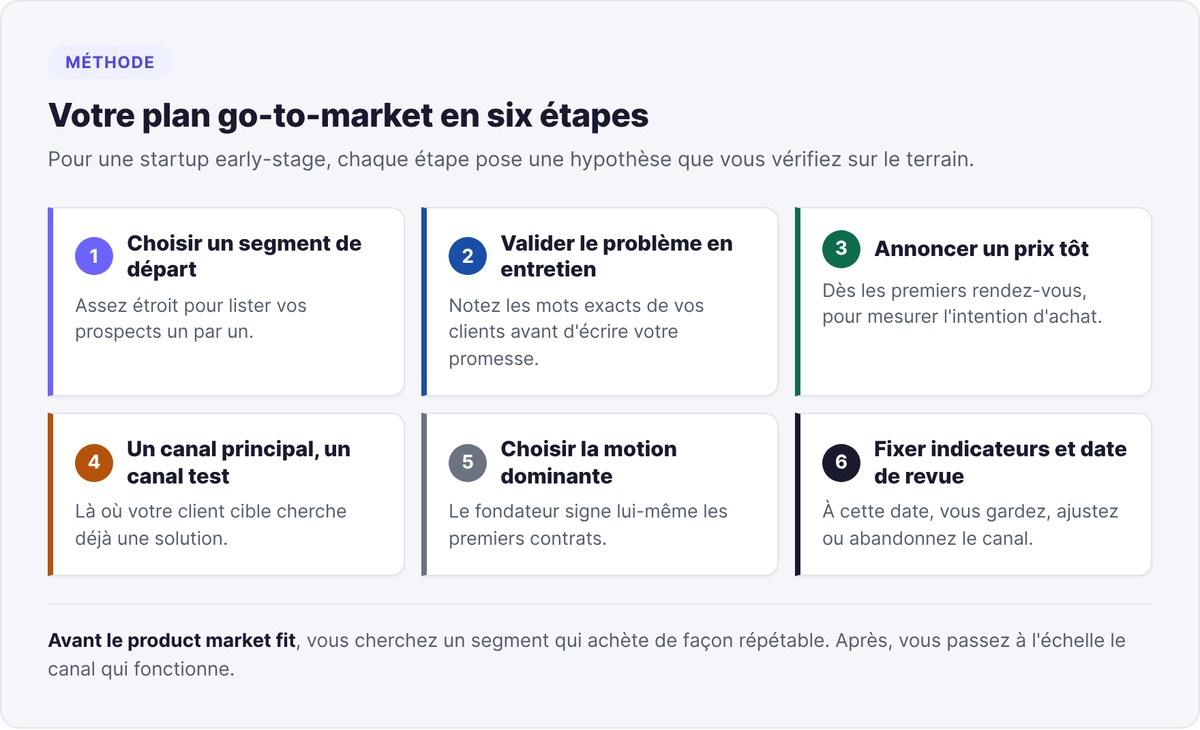
For an early-stage startup, the first GTM is a hypothesis. Before product market fit, you're looking for a segment that buys repeatedly. After it, you scale the channel that works.
1. Pick a starting segment
Choose a single segment, narrow enough that you can list your prospects one by one. You'll expand once you've won that first segment.
2. Validate the problem through interviews
Interview customers in the segment before you write your pitch. Note their exact words: you'll reuse them in your pages and emails.
3. Share a price early
Name a price from your very first meetings. A prospect who accepts that price gives you a more reliable signal than one who finds the idea interesting.
4. Pick one main channel and one test channel
Focus your effort on the channel where your target customer already looks for a solution. Keep a second channel in test mode, with a budget and a timeframe set in advance.
5. Choose your dominant motion
Whatever motion you're aiming for, sign the first contracts yourself. That way you learn the objections before you hire someone to handle them.
6. Set your metrics and a review date
Pick one metric per funnel stage: reply rate, meetings booked, conversion to paying customer, retention. Also set a date when you'll decide to keep, adjust or drop the channel.
Common early-stage go-to-market mistakes
- Targeting the whole market at launch. A message written for everyone convinces no buyer in particular.
- Opening every channel at once. With a small team, no channel gets enough effort for you to judge it.
- Copying a bigger company's motion. Atlassian could skip salespeople thanks to a self-serve product. If you sell to procurement teams at large corporations, plan for assisted sales.
- Putting off the pricing question. Months of free usage deprive you of the strongest proof there is: a paying customer.
- Handing off sales too early. If you hire a salesperson before you've signed customers yourself, you have no proven pitch to pass on.
- Freezing the plan. Revisit your GTM with every new target, new price or new country.
If you're working on your startup's go-to-market, swanbase supports early-stage founders over the long term, in Paris and remotely: €0, by application, and swanbase takes equity. Apply here.
FAQ
What is a go to market strategy?
A go to market strategy is the plan that sets who you sell a product to, with which value proposition, at what price, through which channels and with which sales method. You use it to launch a new product or to enter a new segment or a new country.
How do you say go to market in French?
The French translation is « mise sur le marché ». You'll also see « stratégie d'entrée sur le marché ». In practice, French teams usually keep the English term and its abbreviation, GTM.
What are the 4 pricing strategies?
Marketing textbooks distinguish penetration pricing (a low price to win customers fast), skimming (a high launch price, then reductions), competitive pricing aligned with competitors, and value-based pricing tied to the value delivered to the customer. Your choice determines which sales method you can afford.
What is the difference between time to market and go to market?
Time to market measures how long it takes to go from a product idea to its commercial launch. Go to market describes how you sell that product once it's available, from choosing the target to the sales motion.
Which go to market strategy examples are worth knowing?
Four well-documented examples cover the main models. Doctolib deployed field sales teams (sales-led). Atlassian sold without a direct sales force at the time of its IPO (product-led). HubSpot built its growth on inbound marketing (content-led). Pennylane goes through accounting firms (partner-led).