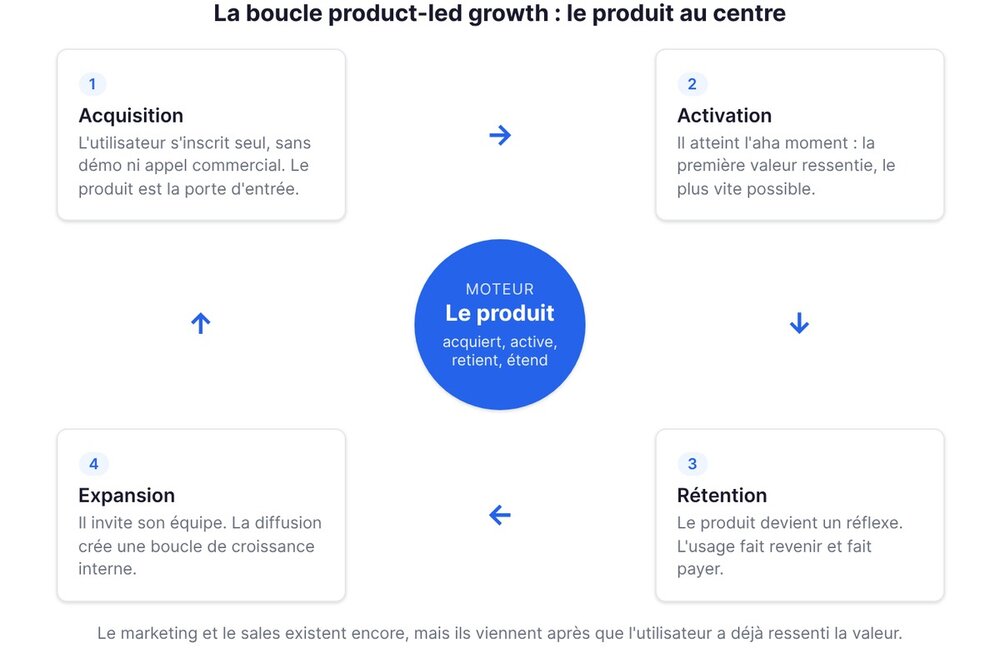
Product-led growth (PLG) is a growth strategy in which the product itself acquires, activates, and retains users before any sales involvement. A user signs up, tries it for free, feels the value, then converts. No mandatory demo, no sales call to get started. Slack, Notion, and Figma grew exactly this way. The term was coined at the fund OpenView in 2016, and by 2026 roughly 58% of B2B SaaS companies run a product-led motion. This article explains what PLG is, how it works, its key metrics, concrete examples (including French SaaS companies), and when it genuinely makes sense for an early-stage founder.
What is Product-Led Growth?
The one-sentence definition
Product-led growth is a go-to-market strategy in which the product is the primary engine for acquiring, converting, and expanding customers. That is the official definition laid down by OpenView, the fund that coined the term in 2016. In practical terms: instead of paying a marketing team to attract and a sales team to persuade, you let the product do the work. The user discovers, tests, and grasps the value on their own, then decides to pay because the product convinced them, not because a rep chased them five times.
The shift is simple to state and brutal to live through for companies used to the old model: the end user becomes the new decision-maker. It is no longer the head of procurement choosing the tool after a three-month sales cycle. It is the employee who signs up on a Tuesday evening, adopts the tool, and brings their team along.
PLG vs. marketing-led vs. sales-led (the positioning)
There are three ways to grow a SaaS business, and they differ by what drives acquisition:
- Sales-led: a sales team drives growth. Demos, negotiation, a long sales cycle. This is the classic enterprise software model.
- Marketing-led: marketing generates leads (content, advertising, SEO) that sales then converts.
- Product-led: the product itself acquires and converts. Marketing and sales still exist, but they come in after the user has already felt the value.
PLG is not the absence of marketing or sales. It is a shift in the center of gravity: the product leads, and everything else follows.
Why PLG is taking over SaaS
The new buyer: the user decides before the decision-maker
The software world has changed its gatekeeper. In the past, testing a professional tool meant going through a form, a demo, and a quote. Today, users expect the same thing from their work tools as from their personal apps: I sign up, I try it, I judge it in five minutes. Mixpanel, in its 2026 analytics report (12,000+ companies analyzed), goes so far as to name the product the new primary growth channel, ahead of the classic marketing channels.
This expectation has a mechanical effect: if your competitor lets people try for free and you require a demo, you lose before you have even spoken. Friction becomes a leak.
The advantages (lower CAC, velocity, expansion)
PLG appeals because it tackles three problems at once:
- Acquisition cost (CAC). A user who self-onboards does not cost a rep's salary. At scale, that changes a company's economics.
- Velocity. No three-month sales cycle: the user converts when the product has convinced them, sometimes within days.
- Expansion. A product that spreads from user to user (one person invites their team) creates an internal growth loop that sales alone never reaches.
The flip side, worth keeping in mind from the start: PLG demands a genuinely good product and value that is felt quickly. If your product needs to be explained to be understood, the model turns against you.
How a product-led strategy works
The product as an acquisition engine (freemium / free trial)
In practice, PLG rests on a frictionless front door. Two main forms:
- Freemium: a permanently free version with limited features. The user stays as long as they want and pays when they need more. Waalaxy, a French prospecting SaaS, offers a fully free plan with no time limit, for example.
- Free trial: full access, but time-limited. Lemlist, another French SaaS, offers a 14-day self-serve trial with access to personalization features, multichannel, and free credits, without going through a rep.
The choice between the two is not cosmetic: freemium maximizes entry volume but dilutes monetization (lots of free users who will never pay), while the free trial forces the decision faster but lets fewer people in. The right choice depends on your product and your time-to-value: if a user can draw lasting value from the free version without ever paying, freemium is expensive for you; if the value only reveals itself through heavy use, the time-limited trial pushes conversion at the right moment. It is an economic trade-off, not a matter of taste.
The aha moment and activation
The heart of PLG comes down to a single instant: the moment a new user feels the product's value for the first time. That is the aha moment. For Slack, it is when a team has exchanged enough messages that the tool becomes the default reflex. For an invoicing tool, it is the first invoice sent in thirty seconds.
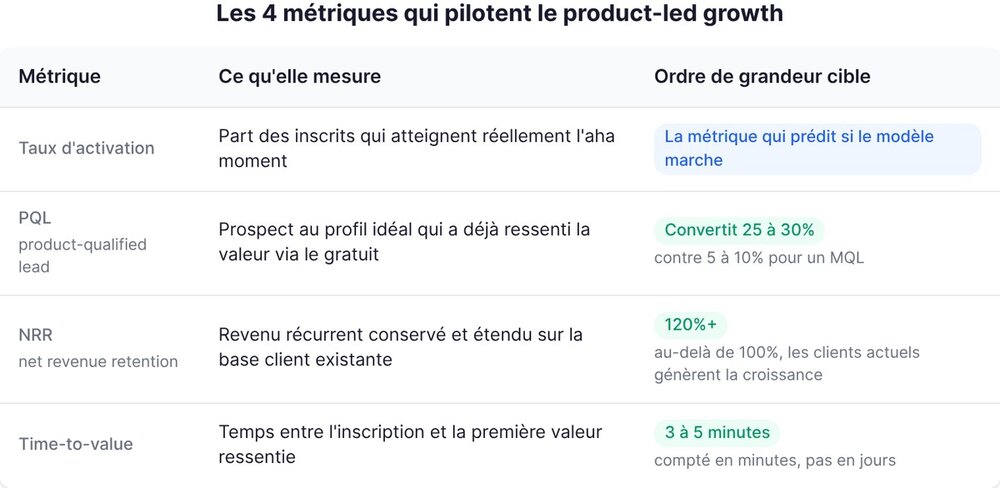
The entire product-led mechanic is about getting the user to that moment as fast as possible. We call it time-to-value, and the most refined PLG strategies count it in minutes, not days: a commonly cited target sits around 3 to 5 minutes between sign-up and the first felt value. Activation is the share of users who actually reach that moment. A poor activation rate, and everything else collapses: you are filling a leaky bucket. That is why onboarding is not a cosmetic detail in PLG, it is where growth is won or lost. Every setup step between sign-up and the aha moment is a place where the user can drop off, so every removed point of friction pays off directly in activation.
PLG metrics (activation, PQL, expansion, NRR)
PLG is not steered with sales-led metrics. Tracking sign-ups or page views is reassuring but says nothing. The real product-led metrics are behavioral:
- Activation rate: the share of sign-ups who reach the aha moment.
- PQL (product-qualified lead): a prospect who matches your ideal customer AND who has already felt the value through the free tier. This is the strongest signal in PLG, and it converts far better than a classic marketing lead: on the order of 25 to 30% for a PQL versus 5 to 10% for an MQL.
- NRR (net revenue retention): the recurring revenue retained and expanded within the existing base. Above 100%, your current customers generate growth all on their own. Mature PLG strategies aim for 120%+.
A stinging fact, measured across the 2026 market: ~58% of B2B SaaS companies say they do PLG and 91% plan to invest more in it, but only ~34% actually track activation. In other words, many claim the model and raise the budget without measuring the one metric that predicts whether it works.
PLG vs. sales-led: the difference in one table
Here are the two models side by side, no hedging. This is the summary; the full comparison and the "which one to choose" live in a dedicated article.
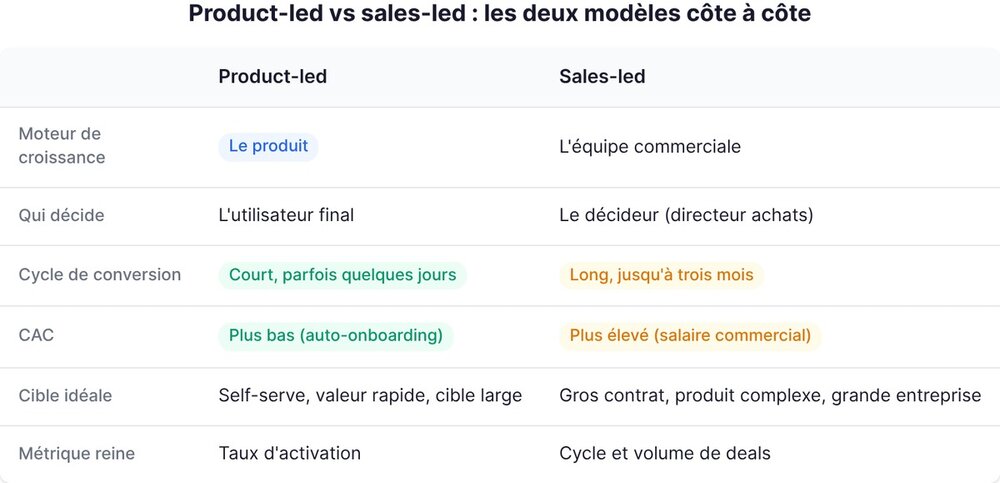
Product-led shines with self-serve products, fast value, and a broad target. Sales-led stays superior when the contract is large, the product complex, and the buyer a big enterprise. Most SaaS companies that scale end up blending the two anyway, which we come back to below.
PLG examples (including French SaaS)
The global references (Slack, Notion, Figma)
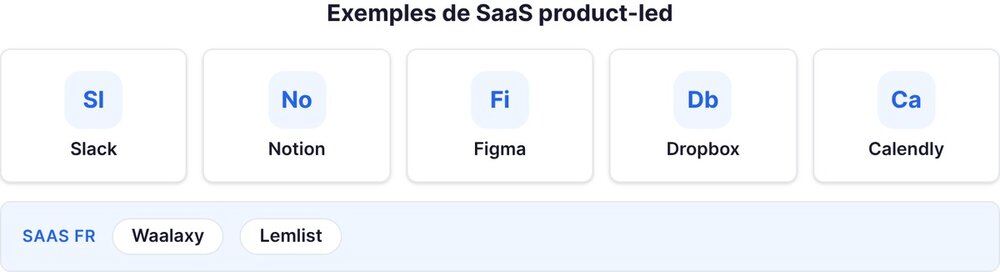
The textbook cases are well known: Slack, Notion, Figma, Dropbox, Calendly, Zoom, Stripe. All grew by letting the user come in on their own and leaning on viral spread. Slack, specifically, illustrates an important point: it is a hybrid model. The product attracts and converts via freemium through a team loop, but as soon as an organization gets big, a sales team takes over for the large accounts.
Even the publicly traded giants show it: Datadog, Atlassian, and Snowflake make most of their revenue on enterprise deals while keeping a self-serve door through which a user can sign up and start on their own. PLG does not exclude sales, it just brings it in later.
French SaaS examples
You do not have to look to the United States. Two French prospecting SaaS companies illustrate the mechanic well:
- Waalaxy: a fully free freemium plan with no time limit. You sign up, launch limited LinkedIn campaigns, and move up a tier when you need more. The product gets you in, usage gets you paying.
- Lemlist: a 14-day self-serve trial with access to the key features and no sales demo. The user tests the value (personalization, multichannel) before pulling out their card.
These two prove that a French SaaS company can be built product-led, in a B2B market, without an army of reps at the start.
PLG for an early-stage founder: when to adopt it (and when not to)
Here is the founder's read, the one no English-language guide writes for you.
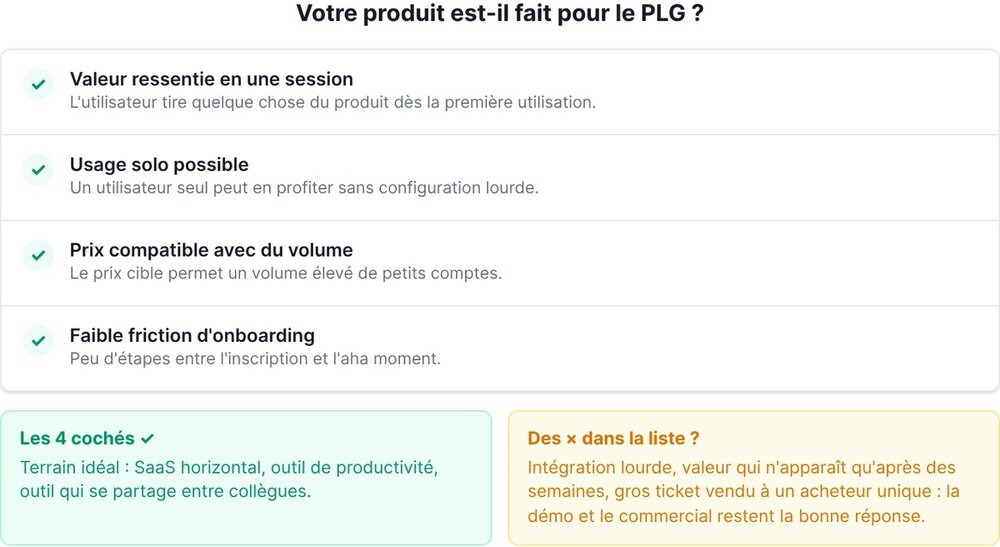
PLG makes sense for your startup if three conditions are met: your product delivers value that is felt quickly (ideally within one session), a single user can get something out of it without heavy setup, and your target price allows a high volume of small accounts. A productivity tool, a horizontal SaaS, a tool that gets shared between colleagues: ideal ground.
PLG is a bad bet if your product requires heavy technical integration before it serves any purpose, if your value only appears after weeks, or if you sell a large-ticket contract to a single enterprise buyer. In those cases, a demo and a rep are not an anachronism, they are the right answer.
The classic founder trap is opening a freemium tier because "everyone does PLG" when the product is not ready to sell itself. A freemium tier on a product that needs to be explained is not product-led: it just produces sign-ups who never come back. The model does not replace a good product, it amplifies one. If there is nothing to amplify, there is no PLG.
Going further
- Product-Led Growth vs Sales-Led
- Outils de prospection B2B : le guide founder
- Growth marketing pour startups : le guide
- Pricing d'une startup early-stage
- Waalaxy : avis, fonctionnalités et tarifs
FAQ
Is PLG a buzzword or a real strategy?
Both, and that is the trap. PLG is a real strategy, documented and adopted by the majority of B2B SaaS companies in 2026. But the word has become a badge that many slap on without respecting its discipline: opening a freemium tier is not enough. Real PLG is measured (activation, PQL, NRR) and built around a product that delivers fast. Without that, it is just the buzzword without the substance.
Does PLG work in B2B?
Yes, and that is exactly where it exploded. PLG is precisely about bringing a consumer-grade experience into enterprise software. Datadog, Atlassian, and Snowflake close huge enterprise deals while keeping a self-serve entry point. The key point in B2B: the user who signs up is not always the one who signs the check, so conversion often runs through a shift to an assisted model on the large accounts.
Are PLG and sales-led incompatible?
No. It is a false binary. Most SaaS companies that grow end up in a hybrid model: the product acquires and activates via self-serve, then a sales team steps in on the high-potential accounts. This is called product-led sales. The product does not replace sales, it qualifies for it: the PQL tells the rep who to call back, and why.