You're putting your deck together. Your lead investor asked for a Calendly link. Two hours before the call, they scrolled your LinkedIn. They found nothing.
Founder-led content: publishing as a founder, under your own name, telling the story of what you're building. In 2026, it's become the most effective organic acquisition channel for early-stage B2B startups, because it combines three levers that paid ads can't give you: trust (humans buy from humans, not from logos), free distribution (LinkedIn still pushes founder content beyond your network), and proof of execution that VCs scan before the first call. The timing rule: you start before you raise, not after. An audience compounds over 12 months, not in a 4-week sprint. In practice: master one platform (LinkedIn for B2B France, X for build-in-public, TikTok for B2C), post three times a week using seven proven formats, and run the capture-first system. That's founder-led content.
What founder-led content is (and why it's exploding in 2026)
Short definition: you publish as a founder, under your own name
Founder-led content is you speaking publicly about what you do. Not your startup's corporate account, but you personally: your observations, your mistakes, your decisions. LinkedIn, X, or TikTok depending on the audience you're targeting.
The confusion to avoid: many founders mix up "personal branding" and "founder-led content". Personal branding is an image built over the long run. Founder-led content is value distribution: you share what you're learning, what you're seeing in your market, what your customers told you this week. The image comes as a consequence, not as a goal.
3 reasons: trust, free distribution, recruiting + fundraising
Trust. Humans buy from humans. A founder who publishes builds credibility for their product before the prospect has even clicked through to the homepage. This is especially true in B2B, where the decision cycle is long and the perceived risk is high.
Distribution with no budget. LinkedIn has a structural bias toward individuals over company pages. A founder post that performs reaches thousands of people outside your direct network, with zero paid advertising.
Recruiting and fundraising. Engineers worth hiring can join any company they want. They join the founders whose convictions they'd been following long before the interview process. And VCs have changed how they source deals since 2023.
The 2024→2026 shift: VCs scroll LinkedIn before the first call
Three things have changed.
First, the explosion in inbound pitch volume. Funds now receive 3x to 5x more decks than they did three years ago, as no-code tools have gone mainstream. VCs pre-filter: they Google the founder, check their LinkedIn, and look at whether the person thinks out loud.
Next, the shift in the trust model. In 2021, solid traction and a well-structured deck were enough. In 2026, funds want to see that the founder understands their market better than anyone. A thread of posts about your ICP's pain points is worth more than a "Market Intelligence" slide produced by an agency.
Finally, founder-led content has become a sourcing channel for VCs themselves. Some funds follow active founders on LinkedIn to spot deals before they're formally in a process.
Why you should publish BEFORE raising (the real timing)
An audience is a compounding asset: 12 months for 5k useful followers
Here's the math nobody does: if you need 5,000 qualified followers before your raise, and your audience grows by 400 to 600 people a month at a pace of three posts a week, you need 9 to 12 months of consistent publishing. If you start posting the month you kick off your fundraise, it's too late.
The right analogy: an audience builds like compound interest, slowly and then all at once. The first three months are frustrating. The real flywheel kicks in around month 6, when people start citing you in conversations you weren't part of. That's when content becomes a channel.
Your deck gets 60 seconds. Your feed gets 12 months.
A deck is 15 slides. An experienced VC reads 50 of them a week. They give you 60 seconds of attention before deciding whether it's worth a call.
Your content feed has been talking to them for 12 months. They've seen how you analyze your market, how you react to criticism, how you adapt your thesis. By the time you call them, they already know you. That's an information asymmetry in your favor.
"Build in public" as proof of execution (for VCs and early customers)
Build in public is a specific form of founder-led content: you publish your metrics, your learnings, your decisions in real time. Pieter Levels (@levelsio) has been doing it for years: Nomad List clears more than $138,000 a month, with no marketing team. His distribution is himself.
For early-stage founders with no proven traction, build in public temporarily stands in for the numbers. No MRR to show yet? Show how you think, how you iterate, why you make a given decision. It's proof of execution that speaks to two audiences at once: VCs who want to see a founder navigating uncertainty, and early customers who want to know whether the company will hold up. See also how to find your first startup customers.
Which platform should you publish on? LinkedIn, X, TikTok
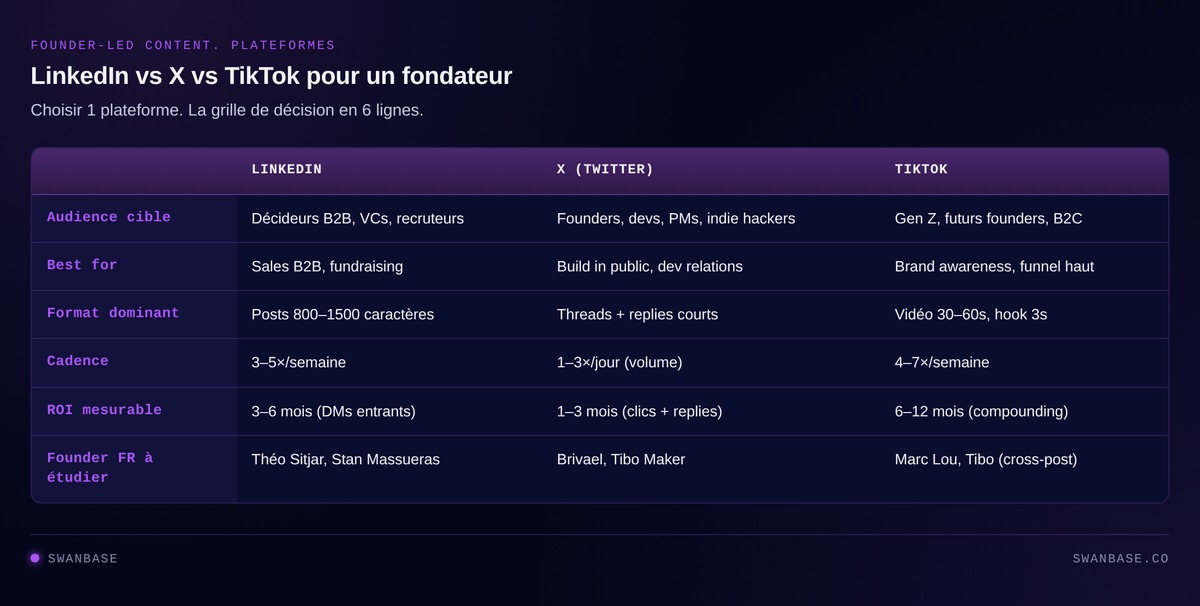
LinkedIn: the B2B France default (where VCs and buyers live)
LinkedIn remains the must-have platform for any B2B founder in France. It's where your buyers, your future employees, and your future investors all live. There's no debate to be had.
Two French founders worth studying to understand what "doing it well" looks like:
Stan Massueras (Lago). After six years at Intercom (where he was EMEA director), Stan co-founded Lago, the open-source billing platform. On LinkedIn, he mixes personal storytelling ("why I left Intercom"), B2B billing insights, and Lago's positioning against legacy solutions. He doesn't try to sound neutral; he owns his point of view, and that's what wins people over.
Jonathan Anguelov (Aircall). An Aircall co-founder, Jonathan publishes about leadership, scaling a team, and the reality of being a B2B SaaS founder in France. His best-performing posts are the most honest ones: what nearly went wrong, what he'd have done differently. The "honest admission" format is his natural register.
X / Twitter: for build in public + an English-speaking tech audience
X remains the go-to platform for build-in-public tech, the indie hacker community, and access to an English-speaking audience. If your market is international from day one, X is an essential complement to LinkedIn.
Pieter Levels (@levelsio). The textbook case. He publishes his revenue in real time, his product decisions, his experiments with AI tools. No comms team, just an audience. That audience has let him launch products without spending a euro on acquisition.
Marc Lou (@marc_louvion). 14 to 20 startups shipped solo, roughly $94,000 a month as of November 2025, and over a million dollars in annual revenue on his own. His X account is a running stream of updates on his products, his numbers, his learnings. He posts everything: revenue down to the cent, failures, new projects. The raw reality of a builder, not a manufactured brand image.
Brivael Le Pogam (@brivael, Argil/YC). The French founder of Argil (a YC cohort), Brivael publishes about the intersections of AI, tech policy, and French politics. His angle is more editorial than product-driven, but that's exactly what sets him apart. He builds authority over a territory of ideas, not just over his product.
TikTok: for B2C, creators, and early-adopter niches
TikTok makes sense if your product targets the general public, creators, or early-adopter digital niches. Tibo (Thibault Louis-Lucas, @tibo_maker) built a significant audience through short-form video before selling Tweet Hunter and Taplio to Lempire for more than $10 million in 2022. Now the founder of Revid.ai, he still uses content as his main distribution channel.
The TikTok case needs qualifying for pure B2B: short-form video takes more production, and the audience is still mostly B2C. For certain segments (creator tools, productivity, SaaS aimed at freelancers), B2C founders reach six-figure audiences and revenue in under six months through a single well-targeted TikTok channel.
The 1-2-3 rule: master one platform, test two, ignore three
The classic trap: opening accounts everywhere and keeping none of them going consistently.
The rule: one primary platform, 80% of the effort. One secondary platform actively tested (two to three posts a week, zero pressure on results). Three or more other platforms: ignored. Review every six months.
For a B2B France founder just starting out: LinkedIn is your primary. X is your secondary if you're targeting an international tech audience. TikTok can wait.
What should you post? The 7 formats that work
Tommy Clark (@tclarkmedia) has documented the founder-led content formats that generate pipeline in 2025-2026. Here are the seven that come up again and again:
1. Origin story. Why you started this company, the honest version (not the elevator pitch). What you saw, what you missed, what convinced you. Long format, 800 to 1,200 words on LinkedIn. Do it once, do it well, at the start of your account.
2. Monthly update. Three wins, three learnings from the past month. Short format, recurring. The easiest to keep up because it takes 20 minutes to write if you've been taking notes through the month.
3. New hire highlight. Just made a hire? Publish why. What that person did that convinced you, what they bring. Double effect: you show you're scaling, and you make it easier for them to plug into the network.
4. Customer conversation narrative. A customer told you something this week that changed how you see the product or the market. 300 words. Market intelligence published in real time.
5. ICP framework (savable). A structured framework on who your ideal customer is, how they decide, what they reject. People screenshot it. Long-lasting passive distribution.
6. Category hot take. You take a sharp stance on your industry. You'll scare off the non-buyers and attract the right ones. It's as much a filter as it is a magnet.
7. Trend-jacking. A piece of news in your sector, your reaction within 48 hours. Short, direct, grounded in what you know.
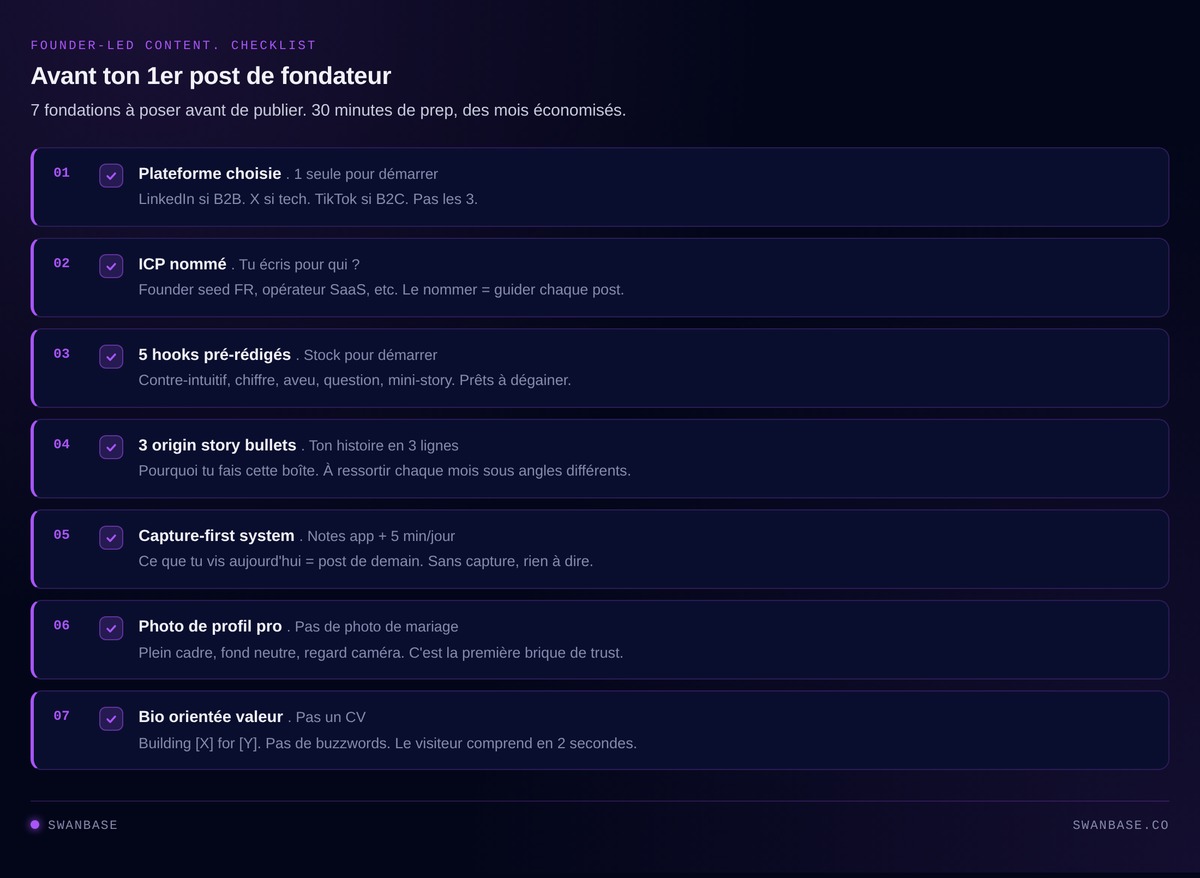
How much time it takes (and the 5-minutes-a-day system)
The "it takes 2 hours per post" myth: true for agencies, false for founders
Content agencies count in production hours because that's their billing model. A founder doesn't work that way. You don't write a post from scratch staring at a blank screen. You live it during your day and put it into words in five minutes in the evening.
Most founders who fail at content aren't short on ideas. They're missing a capture system.
Capture-first: you take notes during your day, you write in the evening
The simplest system: a note left permanently open on your phone. For every interesting observation, you jot down one line. A customer conversation that surprised you, a product decision you just made, a question from a VC you didn't see coming.
In the evening, you reopen your notes, pick the best observation, apply a hook, and write it in five minutes. You publish the next morning.
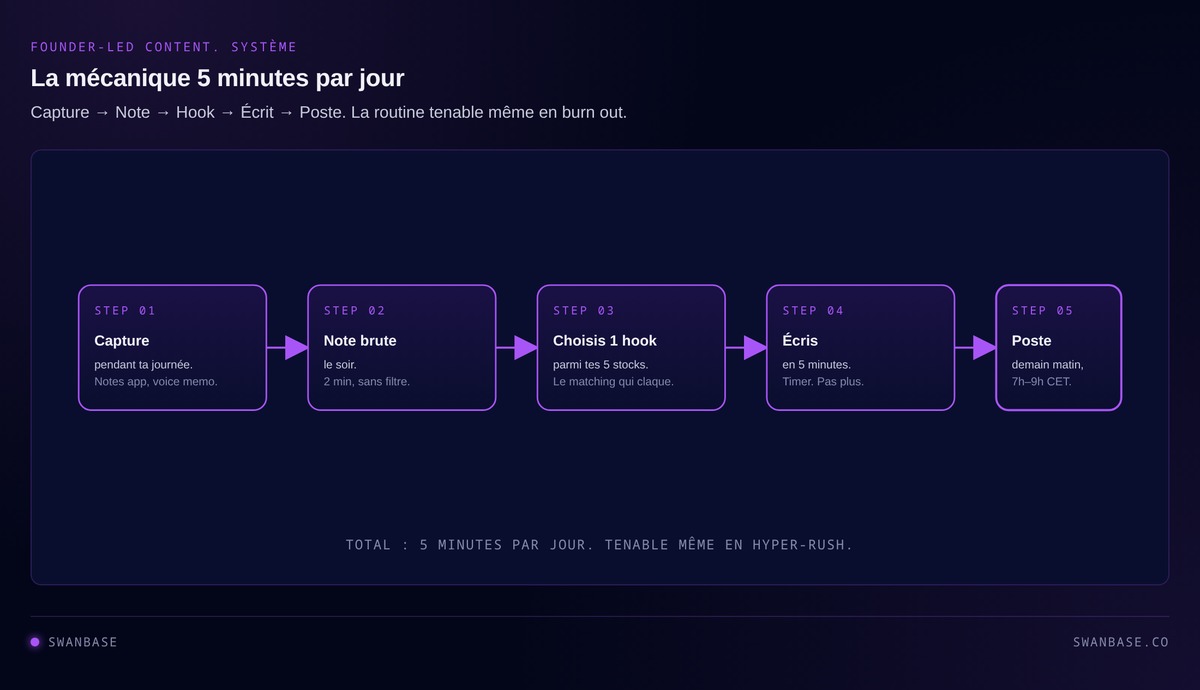
A realistic early-stage cadence: 3 posts/week on LinkedIn + 1 monthly recap
Three posts a week on LinkedIn. One monthly recap (the "3 wins / 3 learnings" format). That's the minimum viable to get the algorithm distributing you and to keep your followers from forgetting you.
If you have a rough week, you post anyway. Not out of moral obligation, but because consistency compounds. Three average posts across four weeks beat five excellent posts in one week followed by two months of silence.
When to delegate (ghostwriter, agency, never before 6 months)
Don't delegate before six months of publishing solo. A ghostwriter first has to learn to write like you, and for that they need to read at least six months of your real posts. Without that foundation, they deliver generic content under your name, and your followers will sense it immediately.
After six months, if you have the budget, a ghostwriter can help with wording and editing. The ideas always come from you.
The 4 hooks that open a post (tested formulas)
Tommy Clark (@tclarkmedia) has documented four types of hooks that drive opens on LinkedIn and X. Here they are, with examples grounded in the startup world:
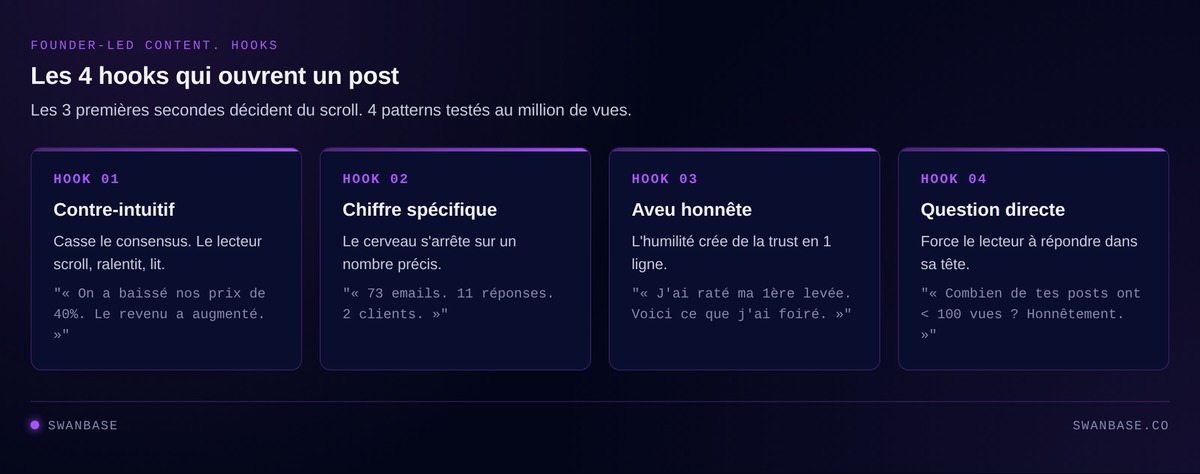
1. The counterintuitive line: "Most X founders are wrong about Y"
"Most early-stage founders think a raise legitimizes them. It's the opposite: it amplifies whatever existed before."
You assert a conviction that runs against the common wisdom in your industry. If your view holds up, the right readers will stop. The others will scroll past, and that's the point.
2. The specific number: "0 to 50 customers in 11 weeks, with no ads"
Precise numbers stop the scroll. "0 to 50 customers in 11 weeks" is more credible than "lots of customers fast". Marc Lou applies this mechanism systematically: he publishes his revenue to the cent, $94,799 in November 2025, not "around 100k". Precision is the proof.
3. The honest admission: "I almost killed this product 4 months ago"
The most shared format on LinkedIn in 2025-2026. Everyone pretends things are going great. You tell the truth. The recognition is immediate. Jonathan Anguelov naturally uses this register in his leadership posts: what nearly went wrong at Aircall, the decisions he regrets. That's exactly what gives them weight.
4. The direct question: "If you manage 10+ people, how do you do X?"
The direct question activates engagement because it involves the reader. It tells them: you're exactly the person I'm talking to, I need you in the comments. It's an audience-qualification mechanism as much as a hook.
How to measure the ROI of founder-led content
3 useful metrics: qualified DMs, founders/customers who cite you, calls booked "via LinkedIn"
Inbound qualified DMs. Each week, how many people from your ICP reached out to you directly referencing one of your posts? This is the strongest signal.
Out-of-network mentions. Someone you don't know references your post or your name in a conversation. You find out through a tag or a DM. It's a sign your content is circulating beyond your direct network.
Calls booked "via LinkedIn". When you onboard a customer or close a VC, ask them how they heard about you. If the answer is "I saw your posts", you have direct attribution. Keep a simple spreadsheet.
3 trap metrics: impressions, like count, raw follower count
Impressions measure distribution, not quality. A viral post outside your ICP is worth less than three qualified DMs from your exact segment.
Like count is vanity: people like without reading and read without liking. No correlation with pipeline.
Raw follower count is useful for tracking progress, not for value. 2,000 ultra-targeted followers in your ICP are worth more than 20,000 assorted ones.
The 6-month test: if after 6 months you don't have a single inbound lead, change your angle
Six months of consistent publishing with no qualified inbound lead means one of three things: your angle is wrong (you're not writing for your ICP), your platform is wrong (your ICP isn't there), or your formats don't drive action.
The fix isn't to publish more. It's to change your angle. Go back to the seven formats, back to the four hooks. Ask another founder to read your last 10 posts cold and tell you whether they understand who you're talking to.
If you're unsure about the diagnosis, that's exactly what we do in 1:1s at swanbase: read your posts, pinpoint the angle problem, propose three concrete directions. Sometimes 15 minutes of an outside read is all it takes.
FAQ: Founder-led content
Should you publish in French or in English?
It depends on your ICP, not your preference. If your target customers and investors are mostly French-speaking, publish in French. If you're addressing an international market or looking to raise from English-speaking funds, publish in English on X and in French on LinkedIn depending on the topic. Splitting by platform is more effective than mixing randomly from post to post.
Do you need a ghostwriter?
No, not before six months of publishing solo. A ghostwriter with no reference base produces generic content under your name. After six months of real posts, they can help with wording and cadence, but the ideas always come from you. Simple rule: if you can't brief the ghostwriter with 10 examples of posts you actually wrote, you're not ready to delegate yet.
How do you avoid the "corporate" tone?
Read your post out loud before publishing. If you wouldn't have said that sentence in a normal conversation, cut it. Markers to watch for: "Drawing on our expertise", "In a constantly evolving landscape", "We're thrilled to announce". Every time you write "we", ask yourself whether you could write "I". The founder tone is singular.
What if I have nothing to say?
You always have something to say. The problem isn't a lack of material, it's the absence of a capture system. A customer conversation this week, a product decision, a meeting that shifted your perspective: that's a post. Go back to the capture-first system: a note open on your phone, one line per observation through your day. The content is there. You just don't see it yet, because you haven't learned to look for it.
Does founder-led content work in B2B Enterprise?
Yes, but with a different angle. In Enterprise, the decision cycle involves several stakeholders. Your content doesn't convert directly: it builds credibility over time, so that when your name reaches the decision committee, it's already known. The most effective formats in Enterprise: the customer conversation narrative (you show you understand the problems of companies like your prospects') and the ICP framework (you segment use cases precisely). See also how to find your first B2B customers.