The difference between product-led growth and sales-led is simple: in product-led growth (PLG), the product does the acquiring and converting (free trial, self-service, no demo needed to get started); in sales-led, reps drive the sales cycle, from demo to signature. The right choice doesn't come down to fashion, but to three concrete things: your product's price, its complexity, and the size of your contracts. Below roughly $10,000 in annual contract value, product-led usually wins; above $25,000, sales-led takes the lead again. This article compares the two models, gives you a framework for deciding as a founder, and explains why most SaaS companies end up hybrid.
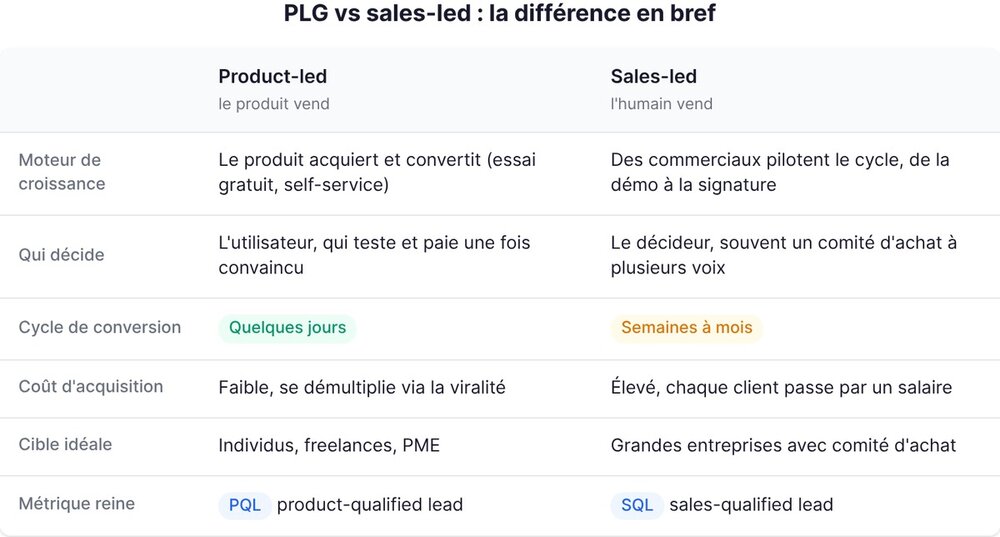
PLG vs sales-led: the difference in brief
A single criterion sums it all up: the moment your customer first encounters your product.
In product-led, they meet it right away. They sign up, test it, feel the value on their own, and pay once they're convinced. The product does the demo. In sales-led, they first meet a human: a rep gives them a demo, handles their objections, negotiates, and the product only shows up after the contract is signed.
That shift changes everything else. In product-led, the reigning metric is behavioral: the PQL (product-qualified lead), a user who has already felt the value through the free offering. In sales-led, it's the SQL (sales-qualified lead), a prospect qualified by a rep. The former converts far better: on the order of 25 to 30% for a PQL versus 5 to 10% for a classic marketing lead. But it only applies to products you can try on your own.
One useful clarification before we go further: in 2026, pitting the two models head to head is a bit dated. Product-led has become the majority motion (roughly 58% of B2B SaaS companies run it), but most companies that scale layer a sales function on top. So the real debate isn't "one or the other," it's "which one dominates in your case, and when do you add the other." We'll come back to that below with the hybrid model.
For the detail on how product-led works (freemium, activation, metrics), we have a dedicated article on what product-led growth is. Here, we're deciding between the two.
The sales-led model: strengths and limits
When sales-led wins (high ACV, complex product, enterprise target)
Sales-led isn't a relic. It's the right answer in specific cases, and a founder who ignores it is shooting themselves in the foot.
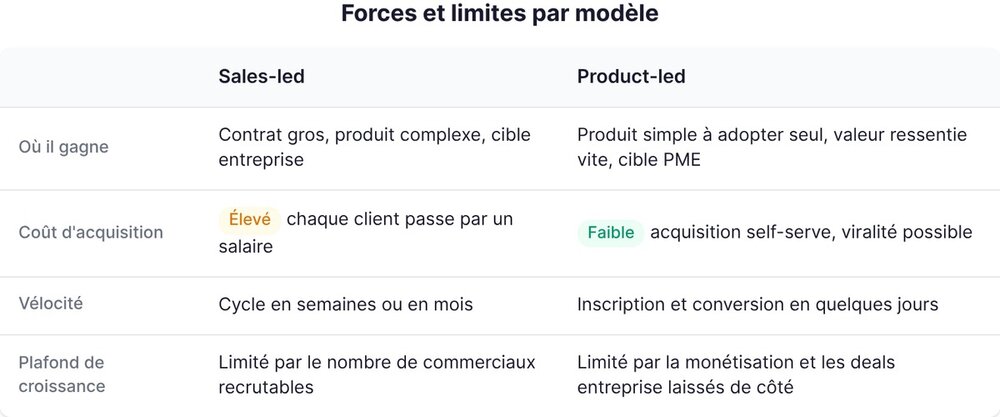
It wins when the contract is large. A commonly cited threshold: above $25,000 in annual contract value (ACV), with a buying committee of several decision-makers, sales-led is superior. The reason is mechanical: a purchase at that level involves several people, requires trust, and often a negotiation and an integration. No free trial replaces a human reassuring a director who's signing off on six figures.
It also wins when the product is complex: if it requires heavy configuration, a technical integration, or training before it's useful, the user can't reach the value alone. A rep and a pre-sales engineer become necessary, not optional.
A third case, often overlooked: when the buyer isn't the user. In a lot of enterprise software, the person who'll use the product day to day isn't the one signing the check. Sales-led exists precisely to speak to the decision-maker, the one who'll never touch the interface but who unlocks the budget. A free trial doesn't convince a CFO: a demonstrated return on investment does. That's why even technically simple products sometimes end up sales-led: it isn't the product that's complex, it's the buying decision.
Its limits (acquisition cost, velocity, team dependency)
The price of sales-led is its cost. A sales team is expensive, and at scale the economics tighten: in SaaS, companies spend on average $2 of sales and marketing for every $1 of new recurring revenue. Every new customer runs through a salary.
Second limit: velocity. A sales-led cycle is measured in weeks or months. Meanwhile, a product-led competitor lets its users sign up and convert in a matter of days. Third limit: dependency. Your growth is capped by the number of reps you can hire, onboard, and pay. You don't buy growth, you hire it.
The product-led model: strengths and limits
When product-led wins (self-serve, short time-to-value)
Product-led wins in the opposite situation. When the product is simple to adopt without training, when a lone user can get value from it, and when the price allows a high volume of small accounts. The symmetrical threshold: below $10,000 in ACV, with a product people grasp on their own, product-led is the most efficient.
The non-negotiable condition is a short time-to-value. If the user feels the value within one session (ideally within a few minutes), the product can sell itself. That's what made Slack, Notion, Figma, and Calendly. And it works even at the very top: Cursor, the AI code editor, crossed $500M in recurring revenue in mid-2025 and then $2 billion in February 2026, carried by massive self-serve adoption before any heavy sales effort.
Product-led has a second engine that sales-led lacks: viral spread. When a product shares naturally (you invite a colleague to Slack, a client to Figma, a prospect to Calendly), each user brings in others, and acquisition happens on its own at near-zero cost. No sales team reproduces that dynamic. This is where product-led crushes sales-led on economics: not only does acquisition not cost a salary, it also multiplies itself. The flip side is that this virality can't be decreed: it has to be designed into the product, and not every product lends itself to it.
Its limits (monetization, enterprise deals, support at scale)
Product-led has its own traps. The first: monetization. Letting everyone in for free dilutes revenue. The median free-to-paid conversion sits around 9% across all PLG models, and a poorly calibrated freemium can indefinitely host users who will never pay. The breakdown is instructive: freemium converts around 12% at the median, an opt-in free trial climbs to 18%, and a trial that asks for a credit card upfront exceeds 48%. In other words, the more you filter at the door, the more you convert, but the fewer people you let in. Choosing the type of free gate is a volume-versus-conversion trade-off, not a packaging detail.
The second: large accounts. A user who signs up alone isn't the one who signs an enterprise contract. Without a sales relay, you leave the value of big accounts on the table. The third: support at scale. Thousands of free users generate support requests that don't directly bring in anything. Product-led isn't free to operate, it just shifts the cost from sales to the product and support.
Which one to choose based on your product and market
The criteria: price, complexity, ACV, target
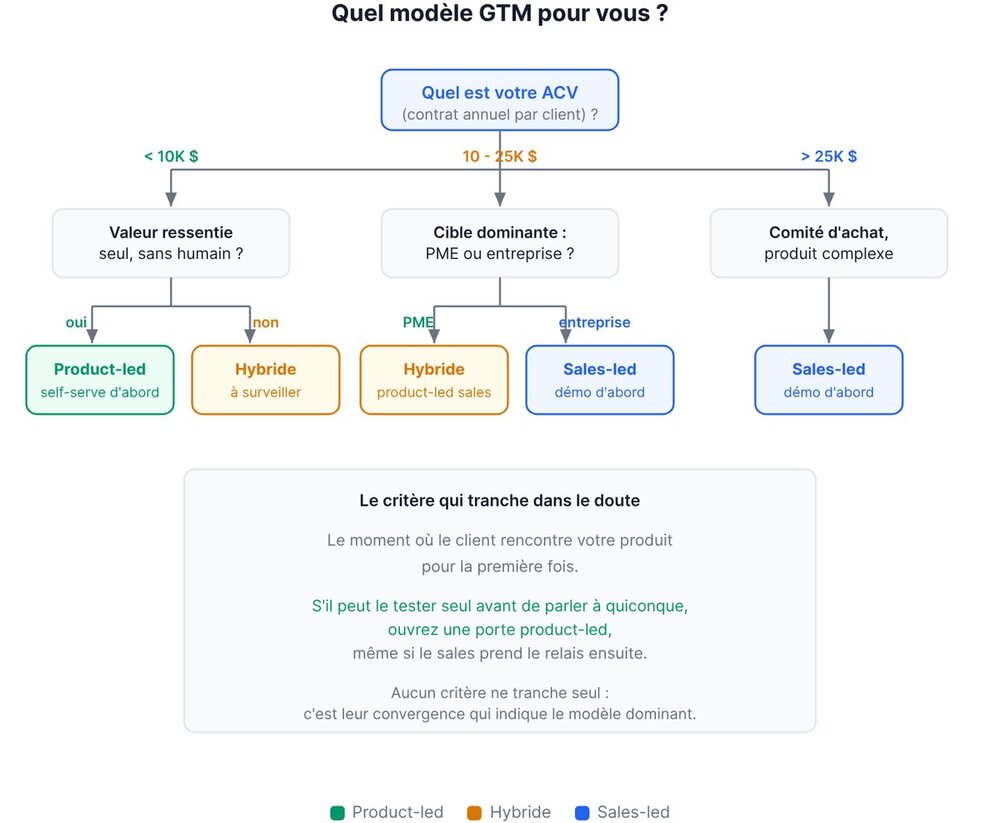
Here's the decision framework, no detours. Ask yourself four questions:
- Price / ACV: contract under $10,000/year → leans product-led. Above $25,000 → leans sales-led. In between → hybrid zone.
- Complexity: can a user get value on their own, without training or a heavy integration? Yes → product-led is possible. No → sales-led.
- Time-to-value: does the value appear within one session or after weeks? One session → product-led. Weeks → sales-led.
- Target: individuals, freelancers, SMBs → product-led. Large enterprises with a buying committee → sales-led.
None of these criteria decides on its own. It's their convergence that points to the dominant model. When they all point the same way (low price, simple product, immediate value, SMB target), the choice is obvious. When they contradict each other (simple product but large contracts, or complex product but a small target), you're in the hybrid zone, and the right move isn't to force a pure model but to decide which one drives acquisition and which one comes in as backup. The criterion that carries the most weight when in doubt remains the moment the customer meets the product: if they can test it on their own before talking to anyone, you have a product-led door to open, even if sales takes over afterward.
An early-stage founder's decision tree
In practice, when you're starting out, the shortcut is this. If your product is a horizontal, self-serve, low-price tool that a user can adopt alone and share with their team, start product-led: it's cheaper, faster, and you don't have to hire reps before you've proven the value. If your product is heavy, expensive business software sold to company leadership, start sales-led: a well-run demo beats a freemium nobody understands.
The founder's trap is choosing by ideology rather than by product. Opening a freemium "because PLG is the future" on a product that needs explaining doesn't create product-led: it creates sign-ups who never come back. The model follows the product, not the trend.
The hybrid model (product-led sales)
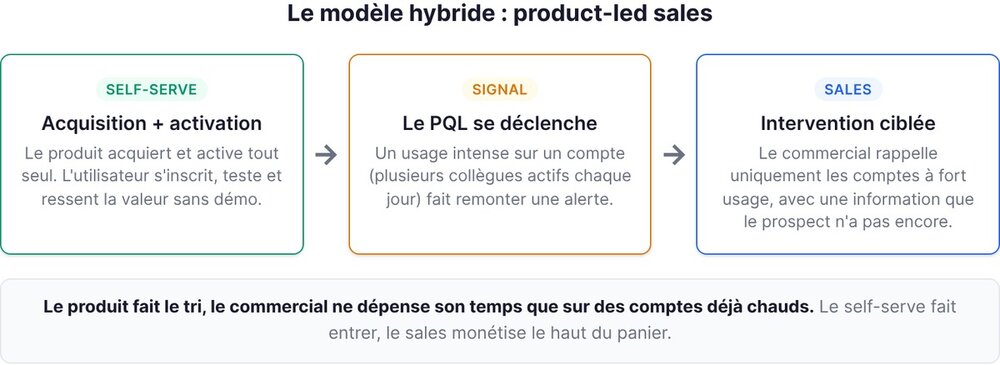
The truth in 2026 is that the "PLG or sales-led" question is a false binary. Most SaaS companies that scale do both, and it has a name: product-led sales (PLS). The principle: the product acquires and activates self-serve, then usage signals tell reps who to call back, and when. The PQL becomes the alert that triggers human intervention, but only on high-potential accounts.
This isn't theory: McKinsey has documented this shift from "product-led growth" to "product-led sales," observing that the best SaaS companies layer a sales function on top of product-led foundations to accelerate revenue and reduce CAC. Datadog, Atlassian, and Snowflake embody the model: most of their revenue comes from large enterprise deals, but a user can still sign up and get started alone. Self-serve brings people in, sales monetizes the top of the range.
Concretely, the difference between a hybrid that works and one that trips over itself is the signal. In a well-executed product-led sales motion, the rep doesn't prospect at random: they wait for a usage signal. For example, when five people from the same company have signed up for the free product and use it daily, that account is ripe for a sales conversation, and the rep arrives with information the prospect doesn't have yet: "your team is already using our tool, here's how we can roll it out across the company." The PQL becomes the alarm that triggers the human, instead of a human calling into the void. That's what makes the hybrid model more efficient than pure sales-led: the product does the sorting, and the rep only spends their time on accounts that are already warm.
Moving from one model to the other
The question every founder eventually asks: how do you add sales to a product-led model (or the reverse) without breaking everything?
The most common direction is product-led first, sales later. You start self-serve, you accumulate users and usage data, and when certain accounts show strong potential (lots of active users within a single company, intensive usage), you introduce a sales layer targeted at those accounts. Usage data becomes your best targeting: the rep no longer cold-prospects, they call back accounts that already use the product.
The reverse (sales-led to product-led) is harder, because it means rebuilding the product so it sells itself, which wasn't part of the plan to begin with. It's doable, but it touches the product, not just the go-to-market: you need a self-serve onboarding, value felt without hand-holding, a free door. Many sales-led companies break their teeth on it because they treat PLG as one more marketing channel, when it's actually an overhaul of the product experience.
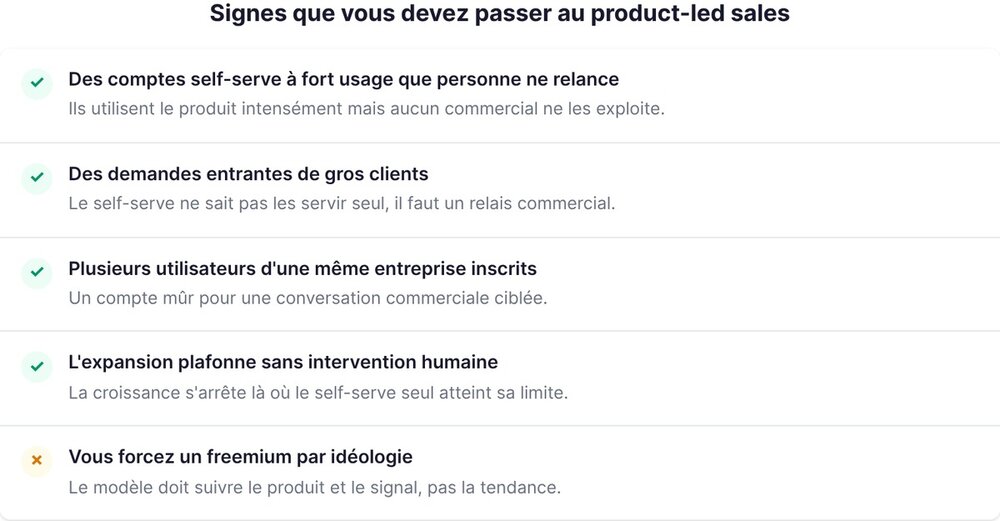
The principle that guides the transition in both directions: don't change models on principle, change because a signal tells you the current model has hit its ceiling. On the product-led side, the typical signal is high-usage self-serve accounts that nobody follows up with, or inbound requests from large customers that self-serve can't handle: that's the moment to add sales. On the sales-led side, it's a rising acquisition cost and a segment of small accounts your reps can't make profitable: that's the moment to open a self-serve door for them. The model isn't a religion, it's a response to the state of your product and market at a given moment.
Going further
- Product-Led Growth: definition and principles
- B2B prospecting tools: the founder's guide
- Growth marketing for startups: the guide
- Lemlist: review, features and pricing
- Clay: AI-powered B2B prospecting
FAQ
PLG or sales-led, which should you prefer?
Neither, in the absolute: it depends on your product. The short rule: a simple, self-serve, low-price product (ACV < $10,000) → product-led. A complex, expensive product sold to enterprises (ACV > $25,000) → sales-led. In between, or as soon as you scale, the answer is almost always a blend of the two. And when you're starting out, going product-led first costs less and tests faster, provided the product genuinely lends itself to it.
Can you do both at the same time?
Yes, and it's even the default model for SaaS companies growing in 2026. It's called product-led sales: the product acquires and activates self-serve, while a sales team steps in on high-potential accounts spotted through their usage. Product and sales don't compete, they take turns at different points in the journey.
How do you migrate a sales-led org to product-led?
It's the hardest transition, because it touches the product, not just the go-to-market. You have to make the product adoptable alone: self-serve onboarding, value felt quickly, a free entry point. Start with a simple segment (small accounts, new users) rather than flipping your whole customer base at once. The usage data you gather then becomes the fuel for a hybrid model.