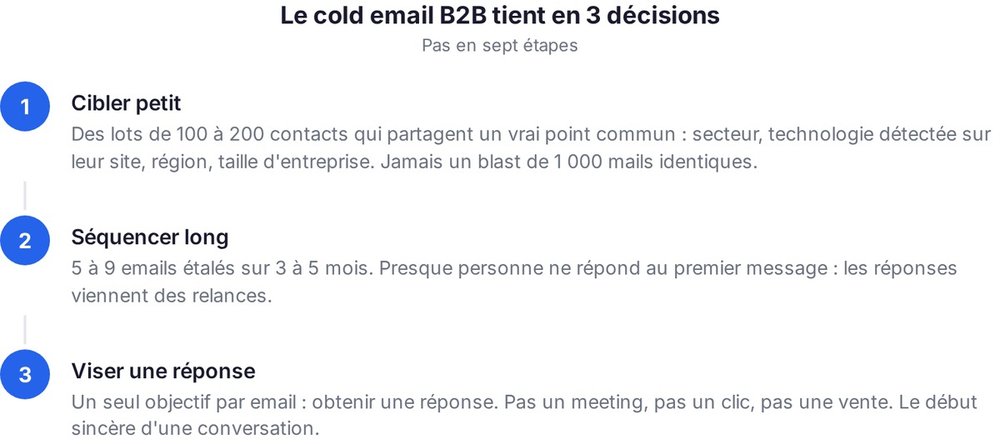
B2B cold email that works comes down to three decisions, not seven steps: target small (batches of 100 to 200 contacts who share a genuine common trait), sequence long (5 to 9 emails spread over 3 to 5 months), and give each message a single goal, getting a reply, never selling. It's the opposite of blasting 1,000 identical emails that land in spam. This method doesn't come from a white paper: it's run every day at roughly 500 emails a day, using a dedicated cold email tool (never a marketing tool like Brevo), with short, personalized messages and not a single attachment that would make them look like an ad. Everything else, the subject line, deliverability, follow-ups, GDPR, flows from those three decisions. We'll walk through all of it below, in the order you'll actually execute it.
Cold email: definition, and why it still works in 2026
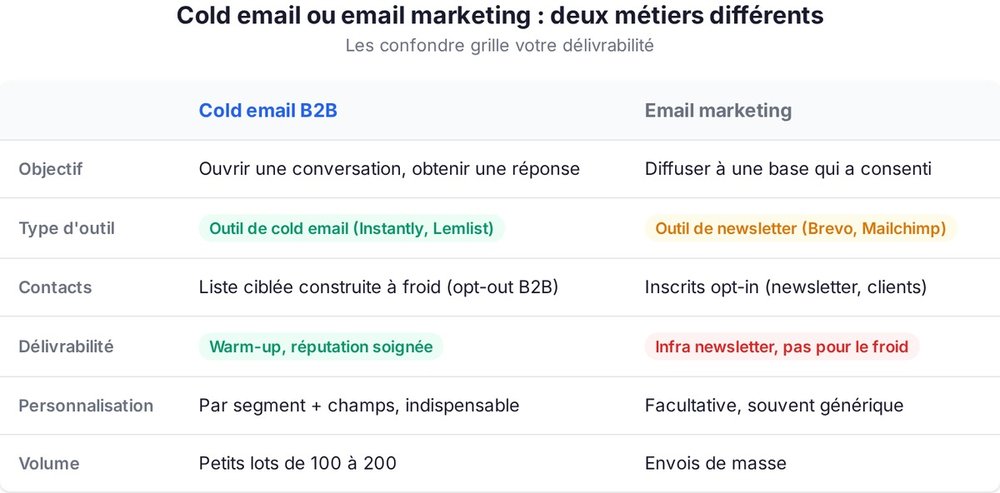
A cold email is a prospecting email sent cold: the person doesn't know you, hasn't asked you for anything, and never left their address with you. That's what sets it apart from email marketing, where you write to a base that has opted in (newsletter, customers, subscribers). The distinction isn't theoretical. It changes the tool you use, the tone of the message, and above all your deliverability.
Why does it still work when everyone keeps saying "email is dead"? Because it's the most direct channel for reaching a decision-maker without an intermediary, without paying for an ad auction, without waiting for an algorithm to decide to show you. A founder who's just starting out has no media budget and no reputation. They have an inbox and a list. Done well, that's enough to book the first meetings.
Cold email vs email marketing (Brevo, newsletter): the mix-up that kills deliverability
Here's the mistake that burns beginners before they even hit send: running a cold prospecting campaign out of Brevo, Mailchimp, or Mailjet. These tools are built to send newsletters to people who gave you their email. Their sending infrastructure, their IP addresses, their rules, all of it is calibrated for opt-in marketing. Send cold from there and you torch your sender reputation: your emails go to the promotions tab, then to spam, then nowhere.
Cold email is done with a cold email tool. These tools handle domain warm-up, inbox rotation, send spacing, and open tracking. They're two different jobs, with two different categories of tools. Mixing them sabotages the one thing that matters at the start: landing in the inbox.
The most direct acquisition channel when you're starting from zero
No subscriber list, no audience, no ad budget: that's the starting point for most founders. Cold email is the only channel that doesn't depend on any of those assets. All you need is an identifiable target and a legitimate reason to reach out. That's why, in 2026, it remains the first building block of go-to-market for a B2B startup that has to find its first customers.
The only goal of a cold email: get a reply, not a sale
Here's the principle that separates the people who book meetings from the people who talk into the void: every email has one goal and one goal only, getting a reply. Not a meeting. Not a click. Not a download, not a free trial, not a sign-up. A reply.
It sounds counterintuitive when you're selling something. In reality, it's mechanical. Cold email works when it reads like the sincere start of a conversation between two humans. The moment you try to close on the first message, you look like an automated sequence, and you get treated like one. You don't sell in a cold email. You open a door.
Mistake number one is the blast: segment into batches of 100-200
The most common error in B2B cold email is sending the same message to 1,000 people at once. It never works. A message that speaks to everyone speaks to no one, and an undifferentiated mass send destroys your deliverability just as surely as a bad tool does.
The opposite approach: slice your market into batches of 100 to 200 contacts who share a real common trait. The 2026 benchmarks confirm what the field has shown for a long time: small targeted lists consistently outperform large generic lists, and advanced personalization pushes reply rates well past the market average, which sits around 3%.
Why 1,000 identical emails never work
Three reasons. Deliverability first: an identical mass send trips the spam filters. Relevance next: a generic message hooks no one, because it doesn't speak to anyone's specific problem. Reputation last: a bad first send damages your domain for every send after it. The blast isn't just ineffective, it's destructive.
Build a segment around a real common trait
A good segment is built around a criterion that means something for your offer: an industry, a technology detected on the target's website, a region, a company size, a specific job title. The idea: everyone in a batch should be able to receive the same message and find it written for them. If your message holds up for "Paris web agencies of 5 to 20 people running WordPress," you have a segment. If you have to write "companies," you don't.
A sequence built per segment, not a generic message
Each segment deserves its own sequence, with its own examples, its own social proof, its own angle. This is where segmentation pays off: you're not writing 200 emails by hand, you're writing one excellent sequence for 200 people who resemble each other. The work is done once, the relevance multiplies.
Finding and enriching email addresses
Before you write, you need a list. The question "how do I find the email addresses" has as many answers as there are targets, but they fall into three families: scrape, buy niche data, enrich.
Targeted scraping: Google Maps, LinkedIn, PhantomBuster
To build a list from a public source (the restaurants in a city on Google Maps, the profiles in an industry on LinkedIn), a scraping tool like PhantomBuster automates the extraction: you give it a source, it hands you a clean file with name, company, link, often the email. The work happens server-side while you write your emails. It's list-building 101 in 2026.
Niche databases: the 1% of cases where buying a list makes sense
Buying email lists is a bad idea in 99% of cases: stale lists, non-consenting contacts, catastrophic deliverability. But there's one specific case where it's a gem: ultra-targeted databases for professions or sectors you can't find anywhere else. Need the emails of a specific licensed profession, or a niche type of industrial player that doesn't exist on LinkedIn? A specialized database delivers, for a few euros, what you'd never scrape. The rule: very targeted, very niche, very cheap, otherwise don't touch it.
Enrich and clean: Dropcontact, Pharow
A raw list is rarely usable as is: missing emails, duplicates, dirty data. Enrichment tools like Dropcontact or Pharow find and verify addresses, fill in the fields (job title, company, size), and clean the file. This is the step that turns a messy extraction into a base ready to sequence.
Verify emails to protect deliverability
One last verification pass is a must before sending: every invalid address that bounces damages your sender reputation. Cleaning the list means protecting the deliverability of every email that follows. You never skip this step.
Anatomy of a cold email that gets a reply
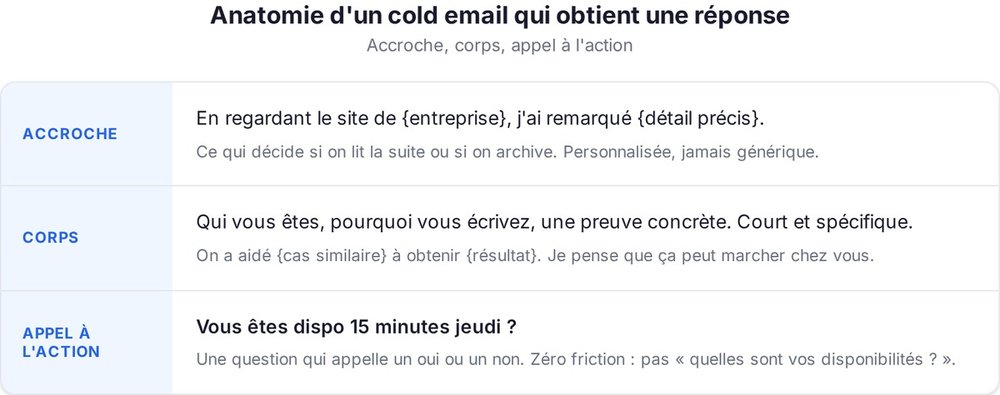
A prospecting message, whatever the platform, is made of three things: a hook, a body, a call to action. Exactly like a good TikTok, which has a hook in the first three seconds, then content, then a call to action at the end. A cold email follows the same grammar.
Hook, body, call to action
The hook is the first few words: what decides whether someone reads on or archives. The body says who you are and why you're writing, short and precise. The call to action asks the one question that matters, and it invites a yes-or-no answer. Three blocks, not one more.
Short, concise, personalized
A cold email has to be short. When I get a wall of text, I tell myself "I'll read it later," and later never comes. Concise means saying everything you need to and nothing more. Personalized means not sounding like a robot. A message that's obviously copy-pasted turns you into a spambot, and the filters sense it. Messages that are genuinely different from one recipient to the next land in the main inbox far more often.
The 4 rules: max personalization, zero friction in the CTA, specificity, incentive
Four rules make the difference between an email that gets a reply and a dead one:
- Personalize as much as possible, through segmentation first, then through the fields gathered at sourcing (first name, company, a detail specific to the target).
- Kill all friction in the call to action. The question has to be easy to answer. "Are you free for 15 minutes on Thursday?" invites a yes or a no. "What's your availability next week?" forces the person to pull out their calendar: they'll reply later, which means never.
- Be specific. Say exactly why you're writing and what you're asking for. Vagueness kills.
- Offer an incentive. A real reason to reply: value to gain, an idea to share, a concrete and short benefit.
The email you should never send
The counter-example that sums it all up: "Hi, I'm doing a study on cold email, could you share your view on what makes a good one different from a bad one? It'll help our research. Thanks, John." Why will this email get zero replies? No hook. No value for the recipient: you're asking for their time and offering nothing. No clear call to action: we don't even know what John wants. John wrote the worst possible email, and on top of that he's asking how to improve reply rates. Don't be John.
Subject line and deliverability: getting your emails opened
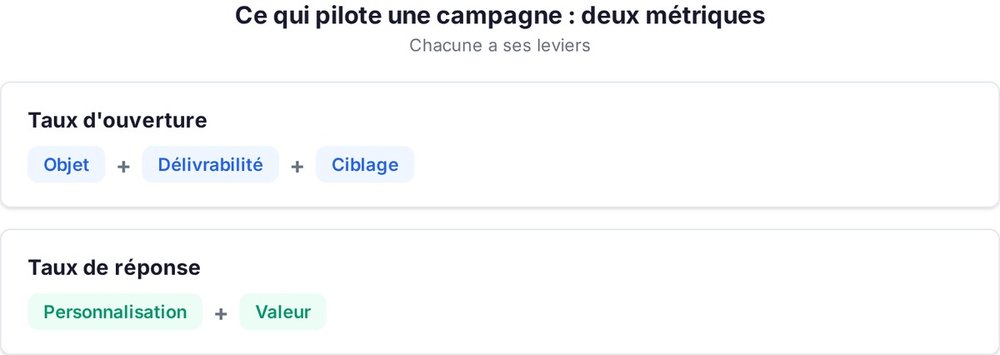
An unopened email doesn't exist. Before we talk about content, you have to get through the first door: the open. The open rate depends on three factors, and only one of them is obvious to beginners.
A subject line that triggers the open
The subject line is the number one factor in getting opened. A weak subject buries your email among the unopened, full stop. What works: personalizing the subject (the first name, a common point, "X suggested I reach out" when a shared connection introduced you), triggering curiosity with a precise question ("How do you handle your bookings?"), and getting the timing right. A good subject line sells nothing: it makes people want to open.
Warm-up and reputation: a cold email tool, never Brevo/Mailchimp
Second factor: deliverability. If your emails fall into spam, the subject line is useless. Deliverability is built through warm-up: you start small, you ramp the volume gradually, you don't send 500 emails on day one from a brand-new domain. And you use a cold email tool, never a newsletter tool. This is where solutions like Instantly or Lemlist do their job: warming up inboxes, regulating sends, protecting reputation.
Targeting, the 3rd open-rate factor people forget
Third factor, the most overlooked: targeting. It's the exact same variable that drives the success of an ad campaign or an influencer campaign. Send the best email in the world for restaurant software to a list of vets, and your open rate collapses. The right audience doesn't improve the message: it makes it possible. Subject line, deliverability, targeting: that's what gets your cold emails opened.
The sequence: 5 to 9 emails over 3 to 5 months
Here's where the consensus gets it wrong. You're told "send 2 or 3 follow-ups." In reality, a B2B cold email sequence that performs runs 5 to 9 emails, spread over 3 to 5 months. This isn't harassment: it's where the replies happen. The market data is unambiguous, follow-ups account for a majority share of the replies you get, and analyses of multi-touch sequences show that campaigns with several touchpoints clearly outperform a single send.
Why almost no one replies to the first email
The inconvenient truth: very few people reply to the first message. They reply to the follow-up. The first email is often read, set aside, then forgotten under 40 others. Without a follow-up, you lose nearly all of your potential replies. A cold email with no follow-up is a door you knock on once before walking away.
Split the value across several emails
"I don't have 5 emails to send the same person," that's the classic objection. It's a framing error. You don't have to repeat the same thing five times: you split what you wanted to say into several pieces, and each email brings new value. An angle, a proof point, a customer case, a different question. The people who fail send a single sprawling email, a kind of ebook, and wait. The people who succeed distribute the value over time.
The breakup email that unlocks replies
The last email in a sequence has a name: the breakup. The message is simple: "I see you haven't replied. If this isn't relevant to you, I'll stop following up. If it is relevant but you haven't had the time, reply to me today." This email unlocks a surprising volume of replies, because it lays out a clear choice and a deadline. Positive reply or negative, it doesn't matter: either way, you have your answer.
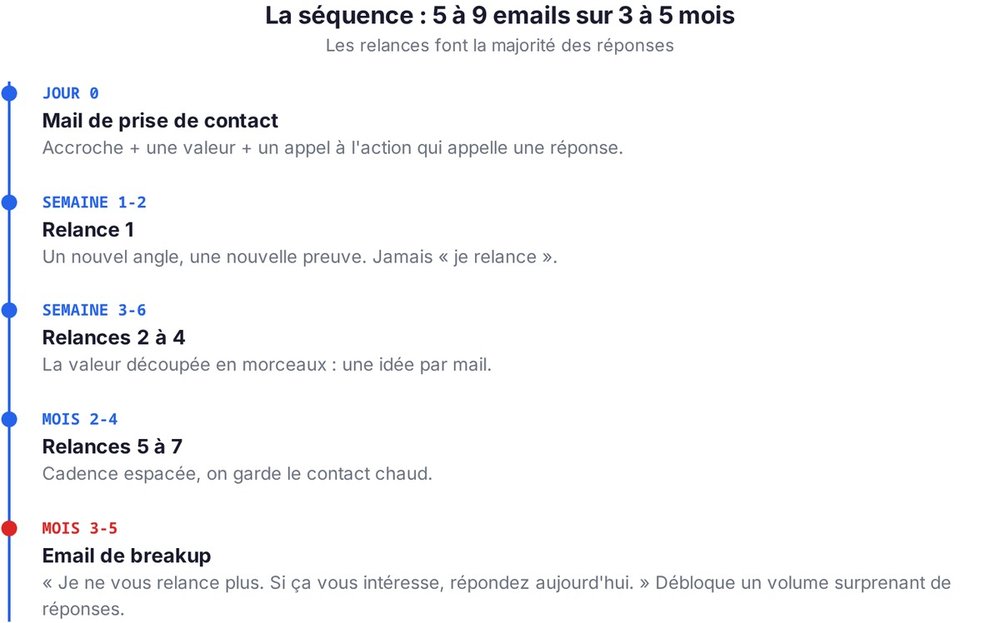
Cadence benchmark: FR 5-7, US 7-12
At the market level, French practice runs around 5 to 7 messages, American practice more like 7 to 12. The absolute minimum, whatever the market: an initial outreach email and at least one follow-up. Without those two, don't expect any reply.
Track opens and go multichannel
Tracking opens isn't vanity metrics. It's an intent signal you're going to use to move from one channel to another.
What open rate and reply rate actually tell you
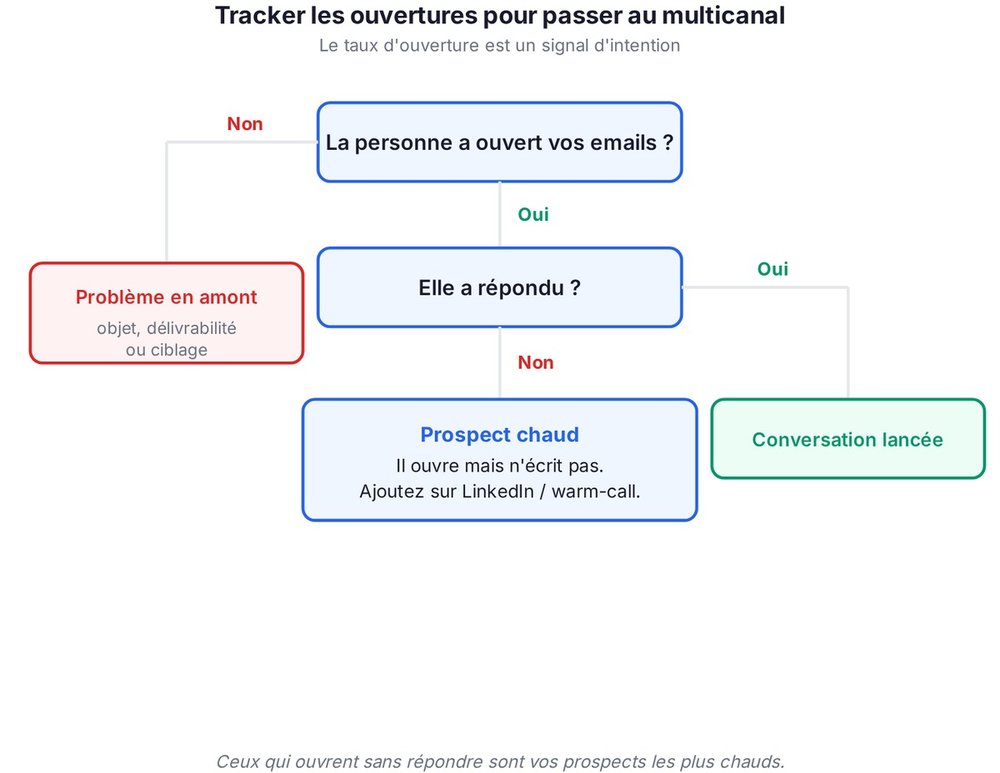
Two metrics steer a campaign. The open rate (subject line + deliverability + targeting) is the equivalent of an ad's click rate: it tells you whether your message reaches and intrigues. The reply rate (personalization + value) tells you whether your message convinces. When opens are good but replies are weak, your problem is the message. When opens are weak, your problem is upstream: subject line, deliverability, or target.
Add the people who open without replying on LinkedIn / warm-call them
This is the real lever. Track opens, then spot the people who open your emails several times but don't reply. These are your hottest prospects: they're interested, they're hesitating. Add them on LinkedIn, or make a call that's cold but warm. You no longer show up as a stranger: you show up as someone they've already read. Cold email becomes the radar, LinkedIn and the phone become the conversion.
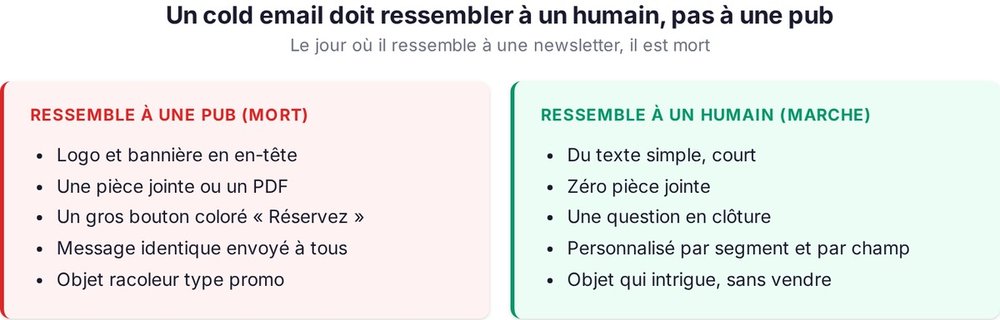
Zero attachments, logos, or ads: look like a human
One absolute rule: no documents, no images, no logos, nothing that looks like an ad. An email with a banner and a colored button screams "automated campaign," and it gets treated like spam. An effective prospecting email looks like an email one human would write to another: text, short, personal. The day your cold email looks like a newsletter, it's dead.
Cold email and GDPR in B2B: the essentials
B2B cold email is legal in France, as long as you respect a specific framework. No need to turn it into a lawyer's brief: here are the operational essentials.
Legitimate interest, opt-out, and mandatory disclosures
In B2B, email prospecting rests on legitimate interest (Article 6.1.f of the GDPR), not on prior consent as in B2C. It's an opt-out regime: you can contact a professional without their explicit agreement, under conditions. According to the CNIL on commercial prospecting by electronic means, the subject of the message must relate directly to the recipient's professional role, the sender must be clearly identifiable, every email must offer a simple and free way to unsubscribe, and the person must be informed about how their data is used. Respect those four points and you're compliant.
What changes compared to B2C
In B2C, it's the reverse: prior consent is mandatory (opt-in) before any send. The confusion between the two regimes is common and costly. Remember the line: professional acting in their role, opt-out; private individual, opt-in.
A practitioner's cold email stack
There's no single tool that does everything. A cold email stack combines three building blocks: find and enrich the data, send the sequences, track the replies.
Sending, enrichment, scraping: who does what
For sending and sequence tracking, tools like Instantly or Lemlist. For enrichment and data, Dropcontact, Pharow, or prospecting platforms like Clay. For scraping, PhantomBuster. Each block does one thing well; you assemble them based on your target and your budget.
To go further, the detailed reviews
We compared these tools one by one. To choose your stack, start with our guide to B2B prospecting tools, then dig in with the dedicated reviews: Lemlist for sending sequences, Waalaxy for LinkedIn outreach, and Clay for enrichment and AI-assisted prospecting.
FAQ, B2B cold email
How many cold emails should I send per day?
It all depends on how mature your sending domains are. You never start strong: warm-up requires ramping volume gradually to protect deliverability. Cold on a brand-new domain, a few dozen a day; a seasoned, warmed-up setup can climb to several hundred. Volume is never a goal in itself: 100 targeted emails beat 1,000 blasts that burn your reputation.
Is cold email legal in France?
Yes in B2B, under conditions. Professional email prospecting falls under legitimate interest (opt-out): a message related to the recipient's role, an identifiable sender, a simple and free unsubscribe, and information on how data is used. In B2C, prior consent (opt-in) is mandatory. The precise rules are detailed by the CNIL.
What reply rate can I expect in B2B cold email?
The market average sits around 3%, but the spread is huge: bad campaigns stay under 0.5%, the best ones exceed 8 to 12%. What makes the difference isn't magic: tight segmentation, real personalization, a sequence of several follow-ups, and a frictionless call to action. The rate follows the method.
Do I have to personalize each email by hand?
No, and it's actually a poor use of your time. Personalization comes first from segmentation (a message tailored to a batch of 100 to 200 similar contacts), then from the fields gathered at sourcing (first name, company, a specific detail). You write one excellent sequence per segment, not 200 emails by hand. It's repeatable and it still feels personal.
Cold email or LinkedIn: which should I choose?
Both, in sequence. Cold email is your volume and radar channel: it reaches wide and reveals who's interested via the opens. LinkedIn is your conversion channel for the hot prospects: the ones who open without replying. To go further on acquiring your first customers, see how to find your first customers. And if your target is investors rather than customers, the mechanics change: see the cold email to a VC.