The Lean Canvas is a one-page strategic template that lets startup founders capture their business assumptions in 20 minutes. Created by Ash Maurya in 2010 in his book Running Lean, it replaces the traditional business plan with 9 blocks, from the customer problem to the key metrics, all designed to be tested and iterated on quickly. According to CB Insights, 42% of startups fail because they build a product nobody needs. The Lean Canvas exists to prevent exactly that: to force you to think about the problem before you code the solution. This guide explains how to fill it out effectively, with a concrete French startup example and the mistakes that doom most canvases to remain purely theoretical exercises.
What is the Lean Canvas?
Definition and origin (Ash Maurya, 2010, Running Lean)
In 2010, an American entrepreneur named Ash Maurya found himself facing a problem every founder knows: the 50-page business plan that nobody reads. Not the investors (who want a pitch deck), not the team (who want to know what to build), and not the founder himself (who knows everything will change in three months).
Maurya took Alexander Osterwalder's Business Model Canvas and reworked it to fit the reality of startups. He removed the blocks that concern established companies (key partners, key activities, customer relationships, key resources) and replaced them with what actually matters when you're starting out: the problem, the solution, the key metrics, and the unfair advantage.
The result: a one-page tool you can fill out in 20 minutes, revise the next day, and throw in the bin if your assumption doesn't hold. It's the map before the expedition.
Lean Canvas vs Business Model Canvas: the real differences
People tell you the Lean Canvas and the Business Model Canvas are "pretty much the same thing." In reality, they serve opposite goals.
Osterwalder's BMC is designed to describe a business model that already works. It focuses on partners, resources, and customer relationships. In short, the infrastructure of an established company.
The Lean Canvas starts from a different premise: you know nothing. You have assumptions, not certainties. Here are the 4 blocks it replaces:
| Business Model Canvas | Lean Canvas | Why |
|---|---|---|
| Key partners | Problem | A startup solves a problem before forming partnerships |
| Key activities | Solution | What matters is the answer to the problem, not internal processes |
| Customer relationships | Unfair advantage | You don't have customers yet, but you need to know what makes you unique |
| Key resources | Key metrics | Measuring progress is worth more than listing assets you don't have |
Why the Lean Canvas is built for startups (not the BMC)
If you're an early-stage founder, the BMC will make you waste time on premature questions. Who are your key partners? You don't have any. What are your key resources? A laptop and some coffee.
The Lean Canvas asks you the right questions at the right time: what problem are you solving? For whom? How will you know it's working? It's a validation tool, not a planning tool.
The 9 blocks of the Lean Canvas explained
Each block answers a fundamental question. Here are all 9, in the order you should fill them out (not left to right, more on that below).
1. Problem (+ existing alternatives)
List the 3 main problems your future customers run into. Not 10, not 1: three. That number forces you to prioritize. For each problem, ask yourself: "Is this problem painful enough that someone would pay to solve it?" If the answer is no, it's not a problem, it's an inconvenience.
Below the block, note the existing alternatives: how your future customers handle this problem today. This is crucial. Your competitors aren't only other startups: they're also Excel, the intern, "we just do without," or the accountant who charges 80€/hour to deal with it. If nobody is actively trying to solve this problem, seriously question whether your market exists.
2. Customer segments (+ early adopters)
Who has this problem? Be specific. "French SMEs" isn't a segment, it's a statistical category from the INSEE. "Micro-businesses with fewer than 10 employees still invoicing on Excel" is one. You can find them, call them, and understand their day-to-day.
Below, identify your early adopters: the first customers willing to test an imperfect solution because their pain is strong enough. Early adopters represent roughly 13% of your market, but they're the ones who will make or break your launch. They tolerate bugs, give feedback, and recommend your product if you genuinely solve their problem.
3. Unique value proposition
One sentence. Not a paragraph. Not a marketing slogan. Why your solution is different from what already exists, phrased so your customer gets it in 5 seconds.
Steve Blank's formula works well: "We help [segment] to [solve problem] through [differentiator]." Geoff Moore's does too: "For [target customer] who [need], our [product] offers [key benefit]." The exercise is harder than it looks. If your UVP sounds like your competitors', you don't have one yet.
4. Solution
For each identified problem, describe the main feature that solves it. Three solutions for three problems. That's it.
The temptation to fill this block with a 200-line spec sheet is strong. Resist it. At this stage, you don't yet know whether the problem is real. There's no point designing the rocket before you've confirmed there's a destination. Describe the minimum features that prove your assumption holds, not the ones you're dreaming of for version 3.0.
5. Channels
How will your customers discover your product? SEO, paid ads, word of mouth, partnerships, cold outreach, content, events?
Focus on 1 or 2 channels at the start. You have neither the budget nor the team to manage more. The classic mistake: trying to be everywhere (LinkedIn, TikTok, Google Ads, trade shows, podcasts) and being effective nowhere. Choose the channel where your early adopters already spend time, test it seriously, then expand only once you've found an acquisition cost that's profitable.
6. Revenue streams
How you make money. Monthly subscription, per-transaction commission, one-time purchase, freemium, marketplace? Also state your target price and the logic behind it: cost-plus, competitive alignment, or perceived value.
If you don't yet know how much to charge, that's a signal. You don't understand the perceived value of your solution well enough. Go ask 10 prospects: "How much do you pay today to solve this problem?" The answer will give you your price anchor.
7. Cost structure
Your fixed costs (hosting, salaries, SaaS tools, rent) and variable costs (customer acquisition cost, support, infrastructure at scale). The goal here isn't a detailed business plan, it's to pin down two figures: your monthly burn rate and your approximate break-even point.
For an early-stage French startup, the main costs are usually development (developers or no-code), cloud hosting, and acquisition. Be honest about these numbers: underestimating your burn rate is one of the shortest paths to shutting down.
8. Key metrics (AARRR)
The metrics that prove your startup is moving in the right direction. Not the number of likes on LinkedIn, not your blog traffic: the metrics that measure the real value you create.
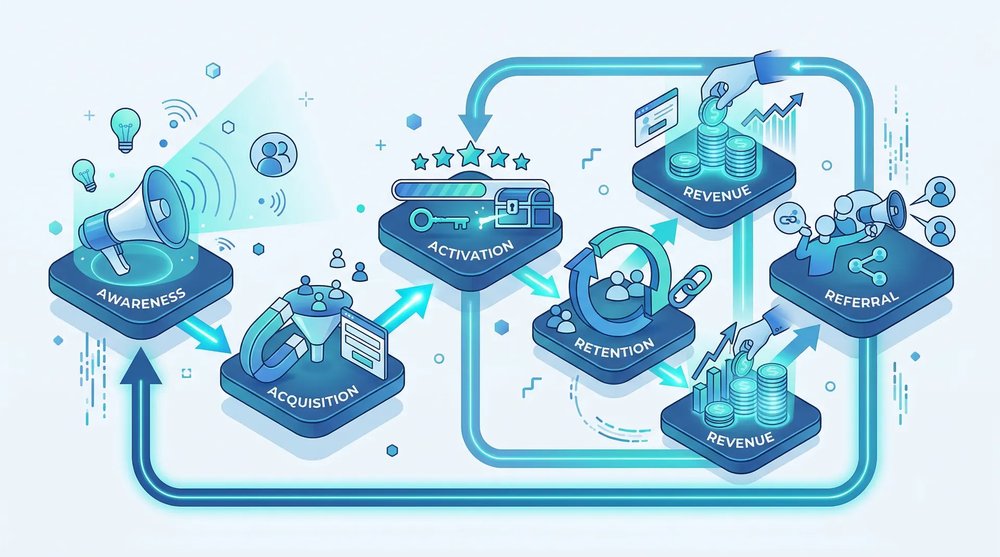
The AARRR (Pirate Metrics) framework, created by Dave McClure in 2007, gives you a proven structure: Acquisition (how users arrive), Activation (their first "aha moment"), Retention (do they come back?), Referral (do they talk about it?), and Revenue (do they pay?). At the start, focus on Activation and Retention: if people try your product and don't come back, no marketing budget will save you.
9. Unfair advantage
What your competitors can't easily copy. A patent, a network of experts, proprietary data, domain expertise, an active community, regulatory access. Ash Maurya calls this the "unfair advantage": something you have that can't be bought.
Watch out: "our team" or "our technology" are not durable competitive advantages (anyone can hire or code the same thing). If you don't have one yet, leave this block empty. Honesty beats illusion. Your unfair advantage is often built over time, as you accumulate data, users, and expertise.
How to fill out your Lean Canvas in 20 minutes
The optimal filling order (not linear)
Don't fill out the canvas from left to right. Maurya recommends starting with the problem/customer segment pair, because everything else flows from it. Here's the optimal order:
- Problem and Customer segments (both at once: a problem doesn't exist without someone experiencing it)
- Unique value proposition (your one-sentence answer)
- Solution (the minimum features)
- Channels (how to reach your early adopters)
- Revenue streams and Cost structure (the business model)
- Key metrics (how to measure success)
- Unfair advantage (often last, and that's normal)
Why this order? Because it forces you to validate the "why" before the "how." If your problem isn't real, your solution is useless, no matter how beautiful your value proposition is.
A complete example: a French SaaS startup
Let's take Factolib, a fictional but realistic startup: invoicing software for French micro-businesses.
| Block | Content |
|---|---|
| Problem | 1. Micro-businesses invoice on Excel/Word (errors, wasted time). 2. The 2026 e-invoicing compliance stresses them out. 3. Payment tracking is manual. |
| Existing alternatives | Excel, an accountant who handles everything, overly complex solutions (Sage) |
| Segments | French micro-businesses with 1-10 employees, tradespeople and independent professionals |
| Early adopters | Tech freelancers invoicing 5+ clients/month |
| Value proposition | "Invoice compliantly in 30 seconds, with no training" |
| Solution | 1. Create an invoice in 3 clicks. 2. Automatic e-invoicing compliance. 3. Automated payment reminders. |
| Channels | SEO ("micro-business invoicing software"), partnerships with chartered accountants |
| Revenue streams | Freemium (5 free invoices/month) + 19€/month subscription |
| Cost structure | Hosting (200€/month), developer (4000€/month), acquisition (500€/month) |
| Key metrics | Activation (first invoice created), M3 retention > 60%, MRR |
| Unfair advantage | Native integration with the Chorus Pro portal (French compliance) |
This canvas took 15 minutes. It isn't perfect, and that's exactly the point.
Notice what's missing: Factolib doesn't have any real data yet. The 19€/month is an assumption, not a validated price. The M3 retention > 60% is a target, not a measurement. The unfair advantage (Chorus Pro) is only relevant if micro-businesses know what it is (spoiler: most have never heard of it). Each of these cells is a sticky note to verify in the field.
That's precisely the strength of the Lean Canvas: it makes your blind spots visible. A 50-page business plan would have buried these uncertainties under 5-year financial projections. The canvas puts them front and center.
The mistakes that kill your Lean Canvas
Confusing problem and solution
The most common mistake, and the most destructive. You write "Micro-businesses need invoicing software" in the Problem block. No. That's your solution disguised as a problem.
The real problem is: "Micro-businesses lose 3 hours a week invoicing manually and risk penalties with the 2026 e-invoicing requirement." The problem describes a pain. The solution describes a remedy. The two don't go in the same block.
Why is this so dangerous? Because if you confuse the two, you never test the problem. You go straight to building a product, assuming the pain exists. That's exactly how 42% of startups end up discovering that nobody wanted what they built (CB Insights).
Targeting "everyone" as a segment
"Our target? Every French business." Congratulations, you're targeting no one.
A segment must be specific enough that you can find your first 10 customers this week. "Micro-businesses with fewer than 5 employees in construction in the Île-de-France region" is a segment. You can find them on LinkedIn, call them, ask them questions, understand whether your problem really exists. "Businesses" is an abstraction that gives you no direction to act on.
The fear behind the broad segment is "closing off options." In reality, it's the opposite: a narrow segment gives you permission to say no to everything else and concentrate your resources where they count. You'll expand later, once you've proven it works for the first ones.
Never updating it
A Lean Canvas filled out once and stashed in a drawer is about as useful as a 50-page business plan that nobody reads.
This document has to evolve. After every customer interview, after every test, after every pivot. Maurya recommends reviewing it at least every two weeks during the validation phase. Some founders in accelerators update it every week, noting what changed and why.
The canvas isn't a deliverable to hand to a jury. It's a logbook of your learnings. If your March canvas looks exactly like your January one, either you found product-market fit on the first try (unlikely), or you learned nothing in two months.
From Lean Canvas to MVP: what comes next
Validate the critical assumptions first
Your Lean Canvas contains assumptions, not truths. The next step isn't to build your product, it's to identify the riskiest assumption and test it.
Ask yourself this question: "If this assumption is wrong, does the whole project collapse?" If yes, test that one first. Not the second one, not the easiest one. The riskiest one.
For Factolib, the critical assumption would be: "Micro-businesses are willing to pay 19€/month for an invoicing tool when they use Excel for free." Before coding anything, go ask 20 micro-businesses whether they'd pay for it. Not "does this interest you?" (everyone says yes out of politeness). But: "Here's the pre-registration link, it's 19€/month, are you signing up?"
The difference between a founder who succeeds and one who burns out often comes down to this single reflex: testing the risky assumption before building. Startup Genome's data shows that premature scaling (building before validating) is present in 70% of startup failures.
From canvas to experimentation (the Lean Startup link)
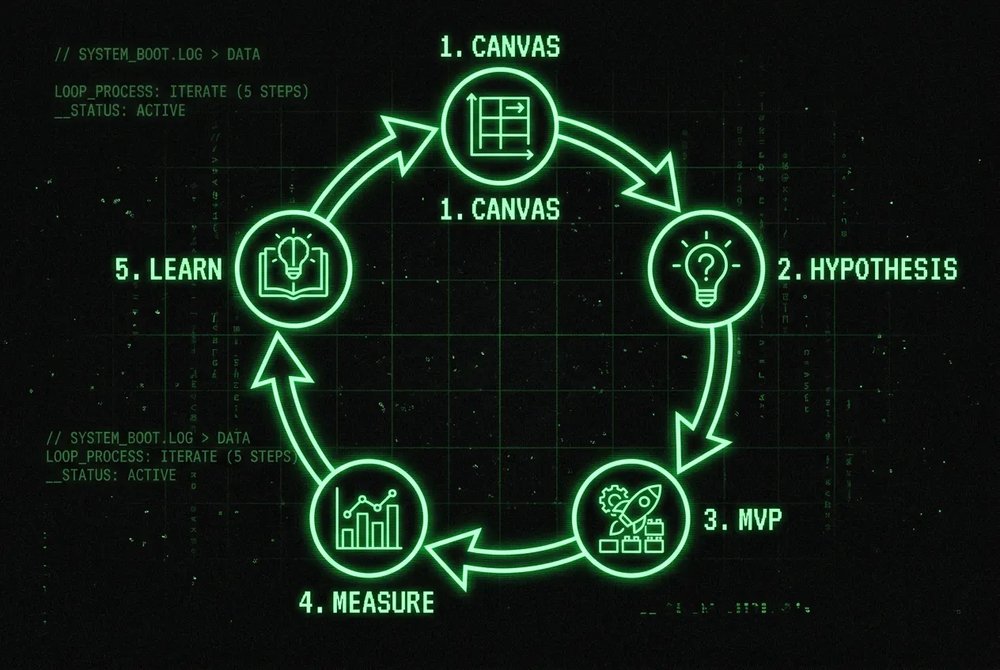
The Lean Canvas is the starting point for Eric Ries's Lean Startup loop: Build, Measure, Learn. Your canvas identifies the assumptions. The MVP tests them. The results update the canvas. And the cycle starts again.
Concretely, after your canvas:
- Identify your riskiest assumption
- Design the simplest experiment to test it (landing page, interviews, clickable prototype)
- Define the success criterion in advance ("if 5 out of 20 people pre-order, we continue")
- Execute, measure, decide: pivot or persevere
The canvas isn't the destination. It's the compass.
Each iteration brings you closer to product-market fit or convinces you to pivot. Both are wins. Discovering your assumption is wrong after 3 weeks of testing costs 0€. Discovering it after 6 months of development costs your runway.
If you're looking for a cofounder to kick off this process together, the Lean Canvas is also an excellent alignment tool: each of you fills it out separately, then you compare. The differences will reveal your disagreements before they turn into conflicts. A canvas that says "we don't agree on the problem" is better than a startup that blows up 6 months later because the founders didn't share the same vision.
FAQ
What is the Lean Canvas in one sentence?
The Lean Canvas is a one-page strategic template, created by Ash Maurya in 2010, that structures a startup's 9 key assumptions (from the customer problem to the unfair advantage) so you can test them quickly.
Lean Canvas or Business Model Canvas: which should you choose?
If you're in the creation or idea-validation phase, use the Lean Canvas: it focuses on the problem, the solution, and the risks. If you have an established company and are looking to optimize your model, Osterwalder's Business Model Canvas is a better fit: it covers partnerships, resources, and customer relationships.
How long does it take to fill out a Lean Canvas?
Between 15 and 20 minutes for a first version. But that first version is only the starting point. Plan to update it after every significant customer interaction, ideally every two weeks during the validation phase.
Can you use the Lean Canvas for an existing business?
Yes, especially to test a new product, explore a new market segment, or evaluate a pivot. The Lean Canvas works whenever you're facing uncertainty, whether your company is 6 months or 6 years old.