Finding your first 10 customers doesn't come down to a magic channel. It comes down to your business model, and therefore to your go-to-market strategy. A B2B SaaS prospects 100 accounts through LinkedIn outbound. A marketplace seeds one side by hand. A B2C product embeds itself in an existing niche community. A vertical SaaS locks down one specific profession, city by city. Every business model calls for its own go-to-market (GTM). This guide lays out the complete method for six business models, with examples from French startups (Doctolib, Qonto, Vinted, Lydia, Ledger) and the universal framework to apply before you start prospecting. If you're looking for "12 hacks to find customers," stop here. This article assumes you're the founder of an early-stage startup and you want an answer you can put to work, rather than a checklist.
Why 10 first customers, instead of 1 or 100?
The number 10 isn't arbitrary. It comes from a Y Combinator rule of thumb: below 10 customers who (actually) pay, what you have is a hunch rather than a startup.
A single customer can be a stroke of luck, a friend, or a cofounder's cousin. Five customers can share a hidden trait that you wrongly project onto the entire market. At 10 customers, patterns start to emerge. You see which persona converts, at what price, on which channel, and with which recurring objection. You're holding the first statistically usable signals of a possible product-market fit.
At the same time, 10 customers is far from a scaling threshold. Nobody raises a seed round on 10 logos. The goal of the first 10 is information, much more than revenue. 10 customers = 10 useful conversations, 10 feedback loops, 10 chances to discover that your product serves a different purpose than you thought.
The myth of the product that sells itself died with the 2010s. In 2026, in any competitive market, your first 10 customers are won with elbow grease rather than code.
The universal framework: 4 go-to-market questions to answer before prospecting
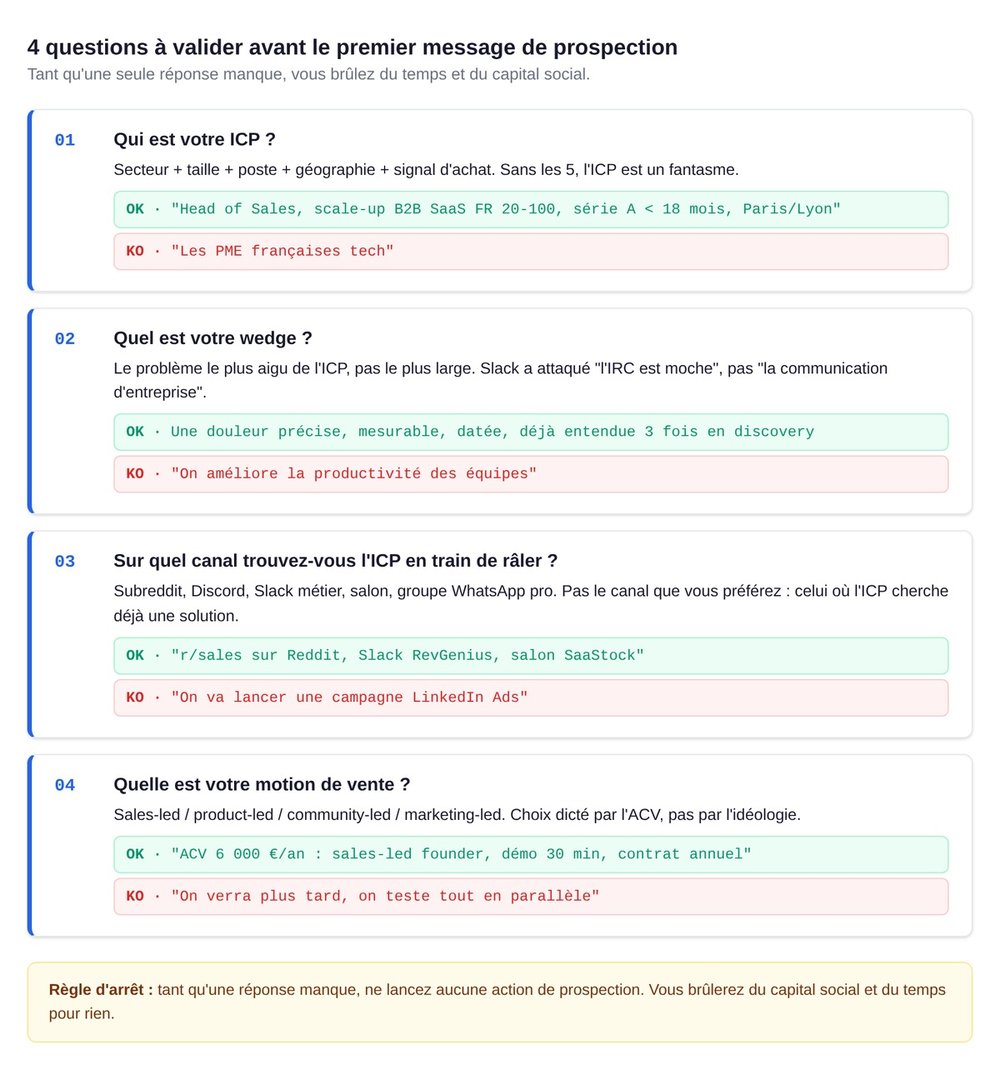
An early-stage go-to-market boils down to four questions. You need to answer all four, in this order, before you touch your first prospect.
1. Who is your ICP (Ideal Customer Profile)?
Answers like "French SMBs," "early-stage startups," or "CMOs at tech companies" are admissions of vagueness.
A usable ICP has an industry, a company size, a job title, a geography, and a buying signal. Example: "Head of Sales at a French B2B SaaS scale-up with 20 to 100 employees, based in Paris or Lyon, that raised a Series A in the last 18 months." With that level of precision, you can pull a list of 80 accounts on Sales Navigator in one afternoon. Without it, you'll never be able to prospect.
2. What's your wedge?
Your wedge is your ICP's sharpest problem, which is rarely its broadest one. Slack went after "IRC is ugly and our devs are fed up with it" long before it took on "workplace communication." Everything else came later.
3. Which channel does your ICP use to complain?
The right channel is the one where your ICP already spends time, ideally while looking for a solution to your wedge, whatever your own preferences are. Specific subreddits, Discord threads, industry WhatsApp groups, trade shows, community Slacks: if you don't know where your ICP hangs out, what you have is a fantasy rather than an ICP.
4. What's your sales motion?
There are four families: sales-led (a human closes the deal), product-led (the product closes the deal after a free trial), community-led (the community brings in customers), and marketing-led (content and SEO bring in customers). The choice comes down to your ACV (Annual Contract Value) rather than ideology: below €100/month, sales-led is too expensive. Above €10,000/year, product-led alone won't be enough.
Until these four questions have precise answers, hold off on any prospecting. Otherwise you'll burn social capital and time for nothing.
To pin down your target before prospecting, the lean canvas is still the fastest tool for aligning ICP, wedge, and channels on a single page.
Do things that don't scale (the founding principle)
In 2013, Paul Graham (cofounder of Y Combinator) wrote the essay Do Things That Don't Scale. It has become the go-to text on how startups land their first customers. His thesis fits in one sentence: what gets you from 0 to 10 customers won't get you from 1,000 to 10,000. And that's perfectly fine.
Four classic examples:
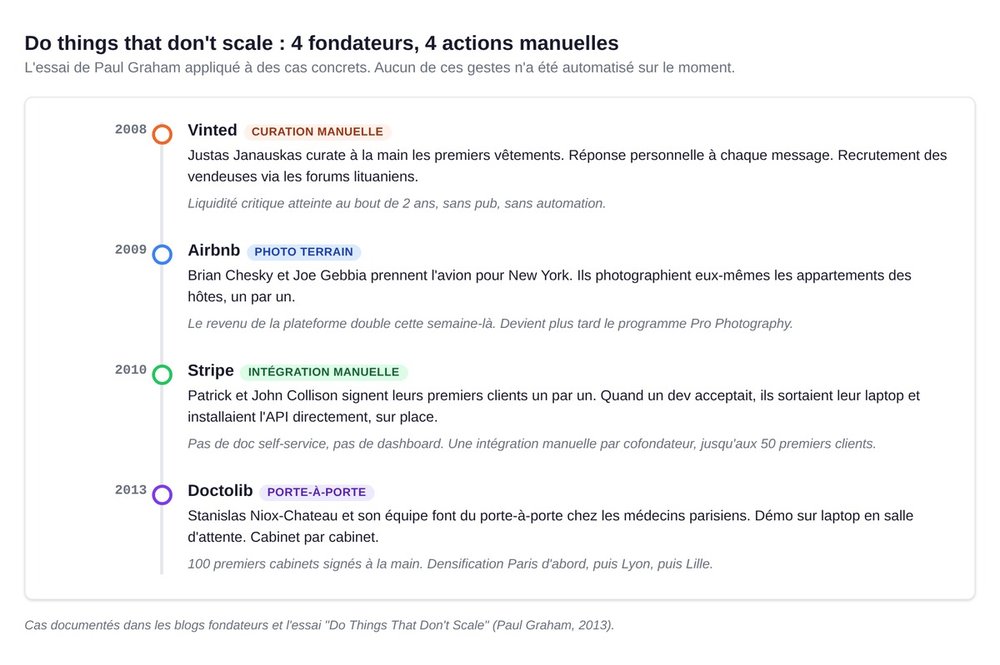
Airbnb (2009). Brian Chesky and Joe Gebbia realized their New York listings weren't converting. They got on a plane, flew to New York, and photographed the hosts' apartments themselves. The platform's revenue doubled that week. They didn't yet know it would become a product ("Pro Photography"), or that it would scale. They did it because it was the right thing to do that day.
Stripe (2010). Patrick and John Collison signed their first customers one by one. When a developer said "OK, I want to try it," the founders pulled out their laptop and set up the integration right there on the spot. Onboarding meant a cofounder doing the integration by hand, long before any docs or self-service dashboard existed.
Doctolib (2013). Stanislas Niox-Chateau and his team went door to door to doctors across Paris. They skipped webinars and cold emails entirely, going from practice to practice with flyers and a laptop demo in the waiting room. The first 100 practices were signed by hand.
Vinted (2008). Justas Janauskas (cofounder) curated the first clothing items by hand and brought in the first sellers through Lithuanian forums. Every message got a personal reply from a founder, with zero algorithms or growth automation involved.
The pattern is always the same: founders do what no employee would. It's the exact opposite of what most founders want to do early on (build a system, run ads, automate). And that's exactly why it works.
Go-to-market by business model: 6 playbooks for your first 10 customers
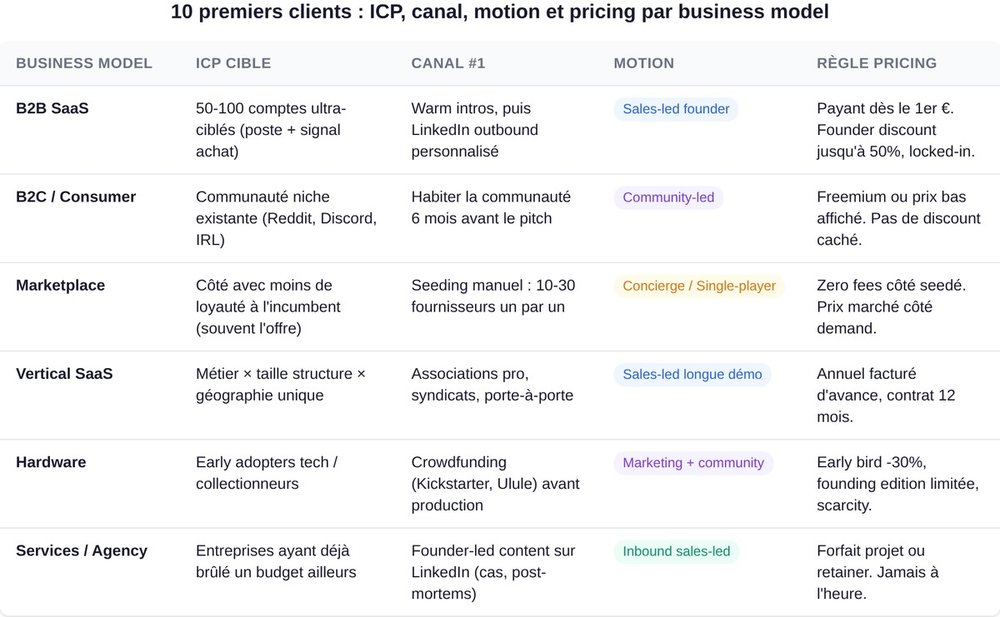
This is the heart of the article. The channel that works for a B2B SaaS fails for a marketplace. The pricing that works for B2C fails for vertical SaaS. Below are six go-to-market playbooks, one per business model, each with its ICP, its #1 channel, its motion, and its pricing rule.
B2B SaaS: founder-led sales + targeted outbound
You sell a software tool to businesses. Typical ACV falls between €100 and €10,000/month.
- ICP: a list of 50 to 100 highly targeted accounts, rather than 10,000.
- Channel #1: warm intros through your network. Channel #2: LinkedIn outbound that's genuinely personalized rather than templated. Channel #3: cold email, only once the first two are saturated.
- Motion: sales-led, founder-led. The founder takes every demo, with no SDR or salesperson in the loop. Until you've done 50 demos yourself, don't hire.
- Pricing: paid from the very first euro. A founder discount is fine (up to 50%), free never is. Locked-in price: early customers keep their rate for life.
French example: Qonto. Before their first sales hire, Alexandre Prot and Steve Anavi ran more than 200 founder-led demos to sign their first SMB customers. They handled support personally and shipped feedback within the week.
B2C / Consumer: community-led + a single organic channel
You sell a product or service to consumers. Prices are low, volume is high, and conversion is hard.
- ICP: an existing niche community, something far more specific than "French people aged 25 to 45." Think Reddit, Discord, Telegram, or IRL: associations, clubs, student communities.
- Channel #1: be inside the community before the product exists. Spend 6 months living and breathing the topic before offering anything, which will do more for you than any Instagram campaign.
- Motion: community-led or product-led freemium, with zero human salespeople.
- Pricing: freemium or a low price from the start. Skip hidden discounts. If it's free, it's free; if it's €9.99, it's €9.99.
French example: Lydia started with HEC students in 2013 with an ultra-niche product (paying a friend back for a coffee) before expanding. Backmarket built its presence on geek forums about refurbished devices before going after the mainstream market. The rule never changes: go deep on one segment before expanding.
Marketplace: seed one side by hand
You're building a two-sided platform (sellers/buyers, providers/clients, hosts/travelers).
- ICP: identify both sides, then go after them one at a time. The side to seed first is the one with the least loyalty to the incumbent (often supply).
- Channel #1: manual seeding. Recruit 10 to 30 suppliers by talking to each of them, one by one.
- Motion: three possible patterns. (1) Single-player mode: the seeded side gets value even without the other side (Airbnb worked as a listings site before it had travelers). (2) Concierge: you deliver the service by hand until you have inventory (Lyft paid its first drivers). (3) Geographic constraint: a single neighborhood or a single city, until you reach liquidity.
- Pricing: often zero fees at launch on the seeded side, to reduce signup friction. Market pricing on the demand side.
French example: Vinted seeded sellers first, by hand, in Lithuanian fashion forums and communities. It took two years of painstaking groundwork, without ads or an app store presence, to reach critical liquidity.
Vertical SaaS: lock down one profession, city by city
You sell a software tool to one specific profession (physical therapists, notaries, auto mechanics, restaurant owners).
- ICP: one profession × one practice size × one geography. Example: "independent physical therapists, 1-3 practitioners, central Paris," which is far narrower than "healthcare professionals."
- Channel #1: professional associations, unions, specialized trade shows, and door-to-door. Digital only starts working once the profession knows who you are.
- Motion: sales-led, annual contract, in-person demo or long video call (45 minutes minimum).
- Pricing: annual, billed upfront, with a 12-month contract rather than a cancellable monthly plan. You want cash and commitment from day 1.
French example: Doctolib locked down independent doctors in Paris first, going door to door. Once Paris was saturated, it moved on to Lyon, then Lille, then Germany. The logic was clear: build density in one segment before expanding, to benefit from a referral effect (doctors talk to their peers).
Hardware / Physical product: pre-orders + scarcity
You sell a physical object (gadget, electronics, design, consumer goods).
- ICP: tech early adopters or collectors, rather than the general public.
- Channel #1: crowdfunding platforms (Kickstarter, Indiegogo, Ulule) to validate demand before manufacturing. If you can't pre-sell €10,000, don't launch production.
- Motion: marketing-led + community-led. A structured pre-launch campaign, early bird tiers, and a newsletter that warms up your audience 3 months ahead.
- Pricing: early bird (-30%), a limited founding edition, visible scarcity. Avoid permanent discounts and "20% off for newsletter subscribers" offers.
French example: Ledger started with crypto early adopters on Bitcoin forums, well before Amazon. Withings negotiated distribution in the Apple Store as early as 2009 for 4 products. The pattern: an early distribution channel that carries strong credibility with the target segment.
Services / Agency / Done-for-you: one public case study, used everywhere
You sell your expertise (consulting, agency work, custom services, high-end freelancing).
- ICP: companies that have already tried an alternative and failed. Your best clients are the ones who have already burned a budget elsewhere.
- Channel #1: the founder's personal LinkedIn (founder-led content). You post case studies, post-mortems, and free tutorials. You demonstrate instead of selling.
- Motion: sales-led, but inbound. Leads come to you because they've been reading your posts for 6 months.
- Pricing: high and custom. Never hourly (clients pay for expertise rather than time). Per-project flat fee or monthly retainer.
French example: most AI and growth agencies scaling in 2026 follow the same playbook: a founder posting 5 times a week on LinkedIn, detailed case studies, and zero ads. Founder-led content is the most durable acquisition engine for this business model.
Pricing your first 10 customers
The question comes up in every session with a founder: "Should I charge my first 10 customers, or let them try it for free in exchange for feedback?"
The answer: charge them, every single time, even if the amount is small.
Three reasons:
1. A free customer is really just a user. And a user gives different feedback than a customer. A user tolerates bugs, leaves without a word, and doesn't invest in the relationship. A customer pays, which means they commit, which means they speak up.
2. Price is a signal. If you charge €0, your prospect concludes your product is worth €0. That's hard to fix later. If you charge €99/month with a founder discount at €49/month, you anchor the perceived value.
3. Founder discounts are fine, free is off the table. A 30 to 50% discount for early customers is acceptable, even recommended. One condition: the price is locked-in, meaning your first 10 keep that rate for life. The discount rewards commitment rather than signaling doubt.
The classic mistake is promising free access in exchange for feedback. Three months later, you have 10 users who have stopped answering your messages, zero revenue, and no credibility left when you try to charge them. To go deeper on early-stage pricing, read our guide on early-stage startup pricing.
The 5 mistakes that kill your first 10 customers
Mistake 1: wanting a scalable channel too early. You launch Google Ads before signing 5 customers by hand. You burn €3,000 in two weeks, maybe get 1 lead, and learn nothing because you never talked to anyone directly. The rule: hold off on scalable channels until you see the first PMF signal.
Mistake 2: running three ICPs in parallel. You test "industrial SMBs," "SaaS scale-ups," and "digital agencies" at the same time. Three personas × three channels = everything gets diluted, and none of them converts. Pick a single ICP for your first 10 customers. You can expand later.
Mistake 3: skipping qualification before the demo. You take 30 demos with anyone who asks, and 25 of them are nowhere near your ICP. That's your time going up in smoke. Set a minimum filter: company size, job title, and a buying signal (for example: "have you already tried an X solution?"). Every demo should come after that qualification step.
Mistake 4: hiring a salesperson before the founder has done 50 demos. Whoever you hire won't know how to sell your product until you've personally found the arguments that close deals. Selling a product that's still searching for PMF is a founder's job.
Mistake 5: confusing interest with a purchase. "Three super excited prospects told me they'd sign for sure" is a line we hear every week in our program. Three months later, none of them has signed. LOIs (letters of intent) aren't contracts. Until the money hits your account, you don't have a customer.
When should you go from 10 to 100 customers?
You've landed your first 10, congratulations. Next question: when do you stop doing founder-led sales and move to more scalable channels?
Three signals to watch:
Signal 1: retention. Your first 10 customers renew (or buy again). If you have 30% churn in the very first month, you don't have PMF. Stay founder-led, talk to every customer who churns, and understand why. For the right metrics to track, see our early-stage startup KPI guide.
Signal 2: organic pull. Prospects you never approached start reaching out. They heard about you from one of your customers, a post, or a conference. You've stopped being the only one pushing: the market is pulling.
Signal 3: your playbook is documented. You know what closes and what doesn't. You have a standard demo, a template email that works, and a repeatable answer to the main objection. As long as you're improvising every demo, scaling is impossible.
When all three signals are there, you can invest in scale (paid, content, hires). Before that, you'll burn capital without speeding anything up. This is also the moment your early-stage go-to-market stops being manual and becomes a system. To structure that transition, the growth marketing startup guide covers the channels that take over.
The most expensive mistake is scaling before you understand why things work. A startup with 50 customers that doesn't understand its funnel will hit a wall at 100 and be unable to unlock growth, because it automated too early.
FAQ
How long does it take to find 10 customers?
Between 2 and 9 months, depending on your business model. A founder-led B2B SaaS can reach 10 logos in 3-6 months if the ICP and wedge are sharp. A marketplace often takes longer, because you have to seed one side before liquidity becomes self-sustaining. If you pass 12 months without 10 paying customers, the problem is rarely the channel: it's the product, the wedge, or the ICP.
Do you need a website to find your first customers?
No. A one-page landing page is enough, or even a public Notion page or a Typeform. Your first 10 customers make their decision by talking to you, long before they read your website. A full website becomes useful once you want to generate SEO or inbound traffic, so somewhere between 10 and 100 customers. Before that, it's procrastination in disguise.
Cold email or LinkedIn: which should you choose?
For your first 10 B2B customers, LinkedIn outbound will beat cold email 80% of the time, because your prospects can see your profile, your activity, and your credibility. Cold email needs 500-1,000 sends to generate 5 qualified leads. LinkedIn lets you send 30 highly personalized messages and get a 30% response rate. Cold email has its place, but only once LinkedIn is saturated. On the tooling side, Waalaxy automates LinkedIn prospecting while Lemlist handles high-volume cold email; our guide to B2B prospecting tools breaks down the full stack.
How much should you spend on ads to get your first 10 customers?
Zero. Or very little (under €500/month) to test a channel, rather than to acquire your first customers. Paid ads are an amplifier: they amplify what already works. If nothing works yet, they amplify nothing. Your first 10 come from founder-led effort rather than Google Ads.
Do you need an MVP before prospecting?
Not necessarily. You can pre-sell a solution before it exists (concierge MVP). Stripe sold its integration by installing it by hand for its first customer. Plenty of B2B SaaS companies have signed paid LOIs based on slide decks. The question to ask is "can I deliver on my promise to a paying customer?" rather than "do I have a product?"
What is a go-to-market for an early-stage startup?
Go-to-market (GTM) is the strategy that defines how your startup sells, to whom, at what price, and through which channel. For an early-stage startup, it's the combination of a precise ICP, a clearly identified wedge, a #1 channel tested by hand, and a sales motion that fits your ACV, which is a far cry from a 30-page theoretical plan. A good early-stage go-to-market fits on one page and is dictated by your business model. That's exactly what this guide breaks down into six concrete GTM playbooks.
Does swanbase help you find your first customers?
It's a big part of what we do. The founders in our program get weekly reviews of their ICP, prospecting scripts, channels, and pricing. What sets swanbase apart: instead of theoretical lectures, we go through your prospect list and fix it with you. Our program costs €0, is application-based, takes equity, and supports you year-round.