The 10 vibe coding mistakes that actually cost you dearly in 2026 aren't technical. They're about decisions. You can write a bad prompt and the AI will eventually fix it. You can stack up hallucinations and the editor will eventually flag them. But an API key pushed to GitHub in plain text, a 12,000-line project nobody ever reviewed, total dependence on Lovable the day Lovable changes its pricing: none of that gets fixed with a single prompt. This article ranks the 10 traps by severity × probability, gives you the 4 security must-haves before production, and hands you the recovery checklist if your project has already drifted. Vibe coding works, for people who accept that writing the prompt is only 1% of the job. The rest is reading, validating, refactoring, securing. If you're jumping in without context, start with the canonical definition of vibe coding.
The "severity × probability" matrix of vibe coding mistakes
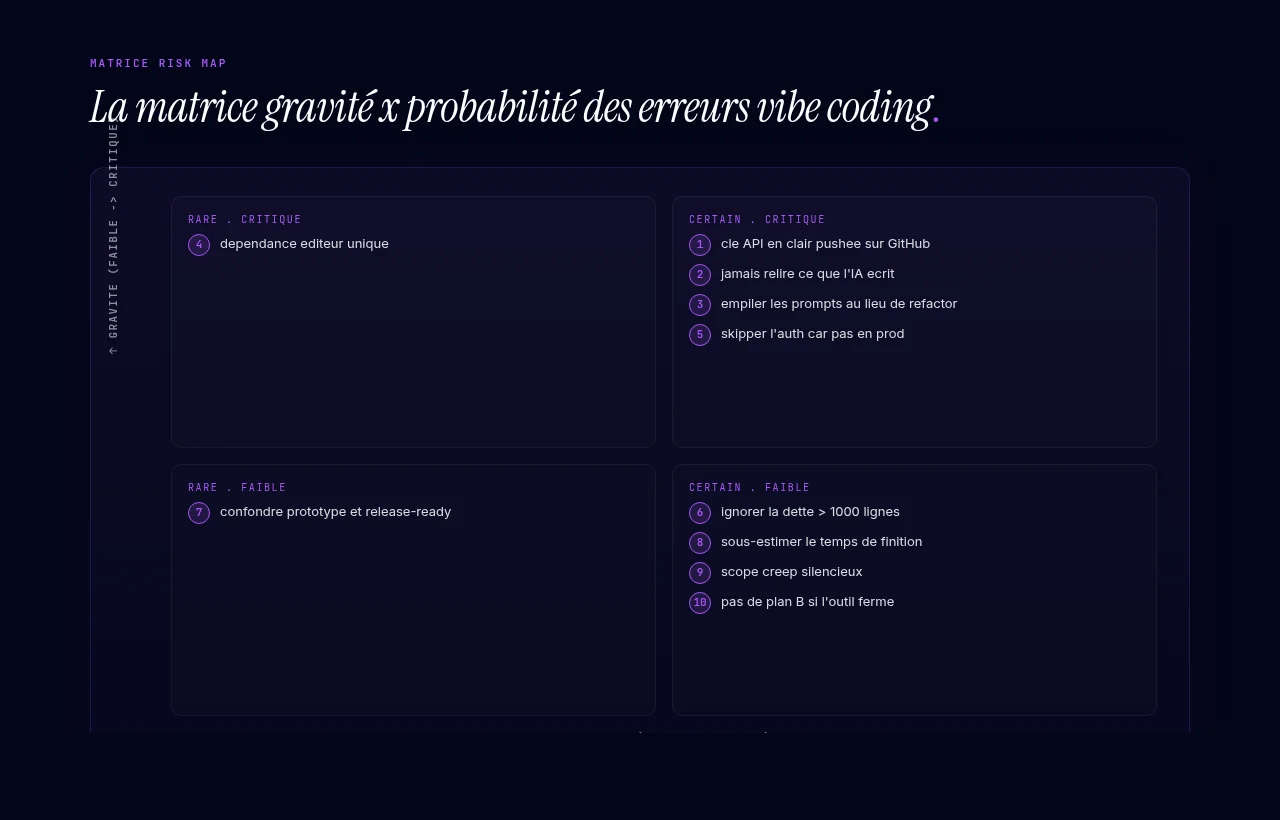
The most visible mistake isn't the most frequent one. The most frequent one isn't the most serious. It's the combination that ruins you. The list below is sorted by severity × probability, not by "what scares people in security blogs."
The 10 mistakes, ranked from most to least severe
1. Putting an API key in plain text in the generated code
This is mistake number one, the one you'll swear "won't happen to me." It happens. When you ask the AI to integrate OpenAI, Stripe, or Resend, it drops the key straight into the file, not into a .env. And your commit pushes everything to GitHub.
GitHub scans for it, and so do the bots. If your OpenAI key sits in a public repo for 20 minutes, it's being resold that same evening. The reflex: a git-ignored .env.local and gitleaks as a pre-commit hook.
2. Never reviewing what the AI wrote
You prompt, it works, you move on to the next feature. Three weeks later, 8,000 lines nobody has read. When a feature breaks, you have no idea why. Neither does the AI, since it lost the context between two sessions.
Audit rule: if your project has more than 1,000 generated lines you've never reviewed, it's already too late to do nothing. Set aside 2 hours, read it section by section, delete what you don't understand, and ask the AI to explain what's left.
3. Stacking prompts instead of refactoring
A feature doesn't work. You prompt a fix. The fix breaks something else. Thirty prompts later, your code is a sandwich where every layer cancels out the one before it. The AI has no memory of what you've stacked up.
Refactor isn't a dirty word. Every 10 features you add: ask the AI to rewrite the section from scratch, based only on the expected behavior. You throw out 60% of the generated code. That's the point.
4. Depending on a single editor (Lovable-only or Bolt-only)
You vibe-coded everything on Lovable. Tomorrow, Lovable triples its pricing or shuts down. You don't have the code, you don't have the hosting, you just have an account. Game over.
Lovable and Bolt both offer export. Export it by week 2, push it to your own GitHub, add Vercel or Netlify as an alternative deploy target. Keeping your stack portable is the real line of defense.
5. Skipping auth and basic security because "it's not in production"
"I'll handle it later." Nobody handles it later. The day you send the link to 5 testers, your MVP is in production. Without Supabase Auth or Clerk from week 1, you'll end up with 3 users holding "default" admin permissions you won't know how to revoke. The four must-haves (detailed below): secrets in environment variables, input validation, auth + permissions, and basic logging.
6. Ignoring the debt once the project passes 1,000 lines
At 300 lines, the AI holds the context. At 1,500 lines, it hallucinates on file 4. At 5,000, it's a lottery. Past a certain threshold, every feature costs twice what the last one did.
Tipping point observed across founder projects in 2025-2026: 1,000 to 1,500 lines. At that stage, split into modules, write a context README for the AI, and switch to Cursor or Claude Code (which see the whole codebase) instead of a cloud editor limited to one file at a time.
7. Confusing a prototype with "release-ready"
Your MVP works on your Mac. You send it to a VC for a demo. It crashes. Not because your code is bad, but because you forgot 12 edge cases: empty form, network timeout, refresh mid-flow, declined payment, double-click on submit.
A prototype works in the happy path. Release-ready means it doesn't crash on the 20 less glamorous paths. The difference is 30 to 40% of your total time.
8. Underestimating the finishing work (the last phase is the longest)
You shipped v1 in 5 days. You tell yourself "2 more days and it's clean." Three weeks later, you're still at it. The finishing work (UI polish, edge cases, mobile responsiveness, micro-bugs, copy, performance) consistently takes longer than the happy path.
Rule of thumb: 70% of the visible work gets done in 30% of the time. The remaining 30% will take 70%. Budget accordingly.
9. Silent scope creep (the AI accepts everything)
The AI never says "bad idea." An analytics dashboard in the middle of onboarding? It adds it. Dark mode the night before launch? It builds it. Three days later, you have a Frankenstein with 4 features started and zero finished.
Discipline: log every feature you add to the scope, one at a time, and finish it before the next. The AI is a yes-man with no apparent marginal cost. The cost is called "your project never ships."
10. Having no plan B if the tool changes its pricing or shuts down
Editors are raising at ten-figure valuations in 2026. They'll change their pricing, and some will shut down. Plan B from week 1: exported code, separate hosting, payments and auth handled by third-party services (Stripe, Supabase, Clerk) independent of the editor. If everything is tied to Lovable or Bolt, your product isn't yours.
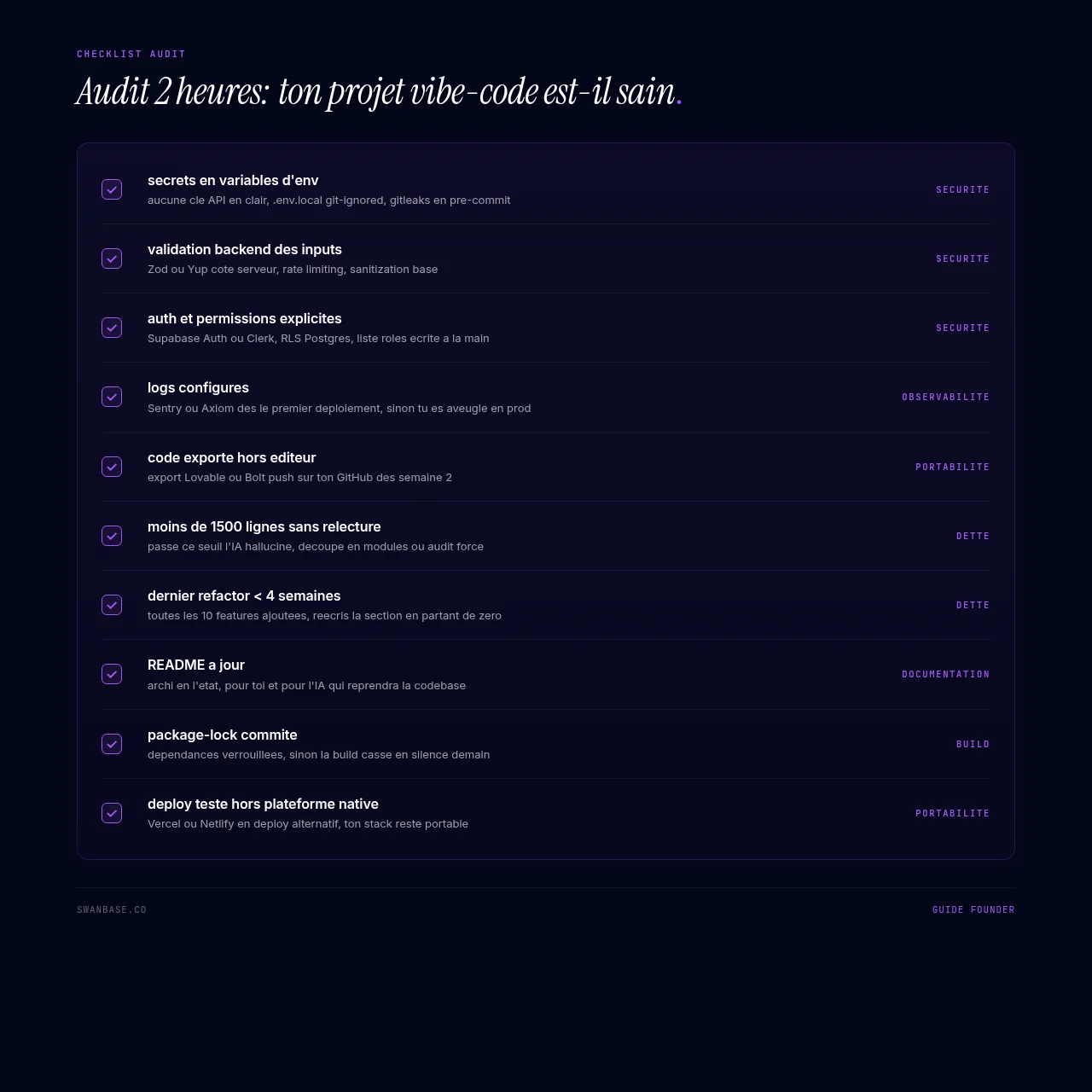
Security: the 4 must-haves before production
The SERP is saturated with "The flaws of vibe coding" articles. The summary fits in 4 lines.
Secrets and API keys
No key in plain text in the code. Ever. Use .env.local, .gitignore, and your host's secrets manager (Vercel, Railway, and Render expose this in 2 clicks). Add gitleaks as a pre-commit hook and turn on GitHub secret scanning.
Input validation
Every user input is hostile by default. The AI often validates only on the front end. Add: backend validation (Zod, Yup), rate limiting (Upstash, Vercel WAF), and sanitization of any input that touches the database.
Auth and permissions
User data means Row Level Security (Supabase, native Postgres) or mandatory auth middleware. The AI doesn't code it by default. Write your list of per-role permissions by hand, not roughly generated.
Logging and basic monitoring
Sentry or Axiom from your very first deploy. A vibe-coded project with no logs is blind: when a feature breaks in production, all you've got to tell you is an angry user's email.
Hallucinations: how to spot and fix them
Visual patterns of hallucination
Four signals tell you the AI is making things up. One: an import for a package that doesn't exist (check on npm or PyPI). Two: a function called on an object that doesn't expose it (like .toDateString() on a string). Three: API parameters that aren't in the official docs (the AI regularly invents Stripe fields). Four: code that "works" but does nothing you asked for, where the function is written but never called.
3 reflexes to build
When something breaks, don't re-prompt right away. Read the error, and look up the function or package in the official docs. If you don't have time, ask explicitly: "check that this code uses functions that actually exist in the docs for [X], and cite the source." The AI admits its hallucination about half the time.
Already hit the wall? The recovery checklist
This is the section the other guides don't give you. They tell you how to avoid it. Nobody tells you what to do afterward.
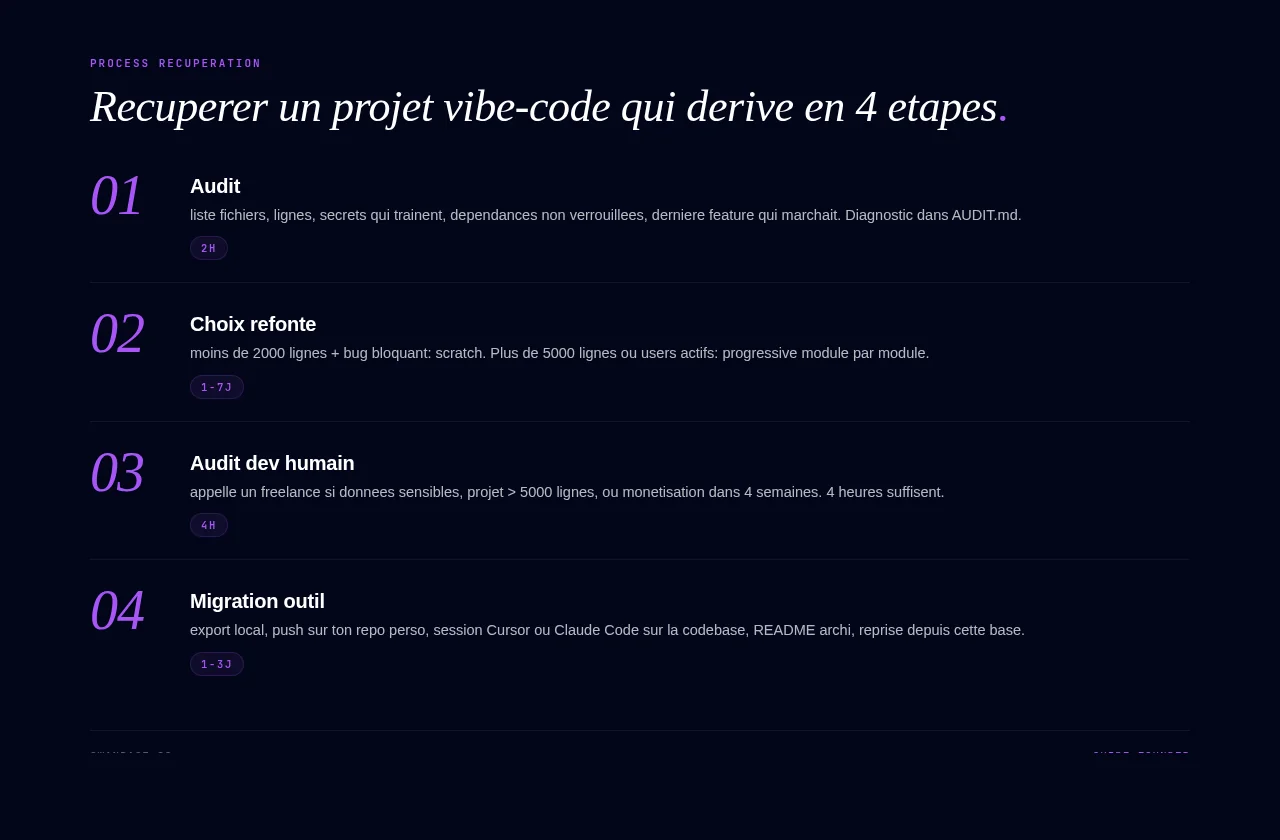
Quick audit (2 hours)
A 2-hour session. List it out: number of files, number of lines, stray secrets, unlocked dependencies, the last feature that actually worked. Write this diagnosis into AUDIT.md. It's your baseline snapshot before you intervene.
Progressive rebuild vs. rebuild from scratch
Under 2,000 lines with a blocking bug: rebuilding from scratch is faster. Go back to the original brief, generate a clean v2, and migrate the data. One week instead of two months.
Over 5,000 lines or with active users: rebuild progressively. Identify the rottenest module (often auth or checkout), rewrite it in isolation, and switch over once it's tested. No big bang.
When to call in a "human" dev to audit
Three signals. One: you're handling sensitive data (payment, health, professional) and you can't say what your code does with it. Two: your project passes 5,000 lines and your prompt spend exceeds a freelancer's hourly rate. Three: you're going to start charging for the product in under 4 weeks. The freelancer doesn't need to redo your code, just 4 hours to tell you what's shaky.
Migrating tools without breaking everything
Plan B activated: export the code locally, push it to your personal repo, run a Cursor or Claude Code session on the local codebase, ask the AI for a README describing the architecture as it stands, then pick back up from that base. 1 to 3 days depending on the size.
When vibe coding isn't the right answer
Critical real-time products
Algorithmic trading, live video telemedicine, synchronous multiplayer gaming, industrial control. A 200 ms latency is off-limits. AI-generated code, even excellent code, often carries hidden inefficiencies: redundant loops, N+1 queries, sequential calls where concurrency was called for. You need a dev who profiles and optimizes.
Strict regulatory compliance (GDPR, finance, health)
PCI-DSS (payments), HDS (health), sensitive GDPR data, AMF (finance): you have to produce audits, traceable logs, a documented chain of responsibility. Vibe coding doesn't generate these artifacts by default. A dev produces them naturally.
Scale beyond 10,000 active users
No vibe coding editor optimizes for performance at scale. 1,000 users without pain, 5,000 if the architecture is clean, beyond that you refactor seriously with a dev. That's not a flaw, it's the deal: the tool optimizes for time-to-market, not for operating cost at scale.
Outside these three cases, vibe coding is still the fastest way to validate your idea. Go back and read the full definition of vibe coding to frame where it helps.
FAQ
How long before a vibe-coded project becomes unmanageable?
Empirically, 6 to 12 weeks without a refactor, or 1,500 to 2,000 generated lines you've never reviewed. Beyond that, every feature costs twice what the last one did. Good habit: an audit every 4 weeks or every 800 lines added, with a partial refactor at each audit.
Do you always have to get your code audited by a human dev?
Not always. It's necessary if you're handling sensitive data, targeting more than 5,000 paying users, or if your product is part of a legal chain of responsibility. For an MVP that tests an idea on 200 users, a serious self-review is enough, backed up by a review from the AI itself.
Is vibe coding risky for an MVP shown to a VC?
No, as long as the MVP demos without crashing. A pre-seed VC looks at traction and the team, not code purity. Plenty of founders raised in 2026 with vibe-coded MVPs. The trap: claiming it's "real production code" when it isn't. Be honest, the VC doesn't care.
My project crashes after 2 months, is it all to be redone?
Very rarely. Most of the time, the project crashes because of 1 or 2 rotten modules: often auth, state management, or the payment integration. A 2-hour audit, then rewriting that single module from the original brief. 3 to 7 days depending on the complexity. The rest is salvageable.