Bringing in a vibe coding agency makes sense for three specific reasons: you want an MVP delivered without touching a single prompt, you have a fixed deadline (a raise, a trade show, an announced launch), or you don't have the founder bandwidth to get into it yourself. Otherwise, vibe coding it yourself stays more cost-effective. Here are the 2026 French market prices, based on the public rate cards of specialized agencies: €3K to €8K for a simple MVP, €8K to €25K for a mid-sized project, €25K and up for something more complex, excluding tool subscriptions, hosting, and design. Before you sign, check six red flags: no public portfolio, opaque pricing, subcontracting to another vibe coder, code that isn't delivered or documented, lock-in to a single platform, and confusing vibe coding with pure no-code. This guide gives you the full decision framework: solo, freelance vibe coder, agency, or hired CTO. (If you haven't read anything on the subject yet, start with our complete guide: what is vibe coding.)
What does a vibe coding agency actually do?
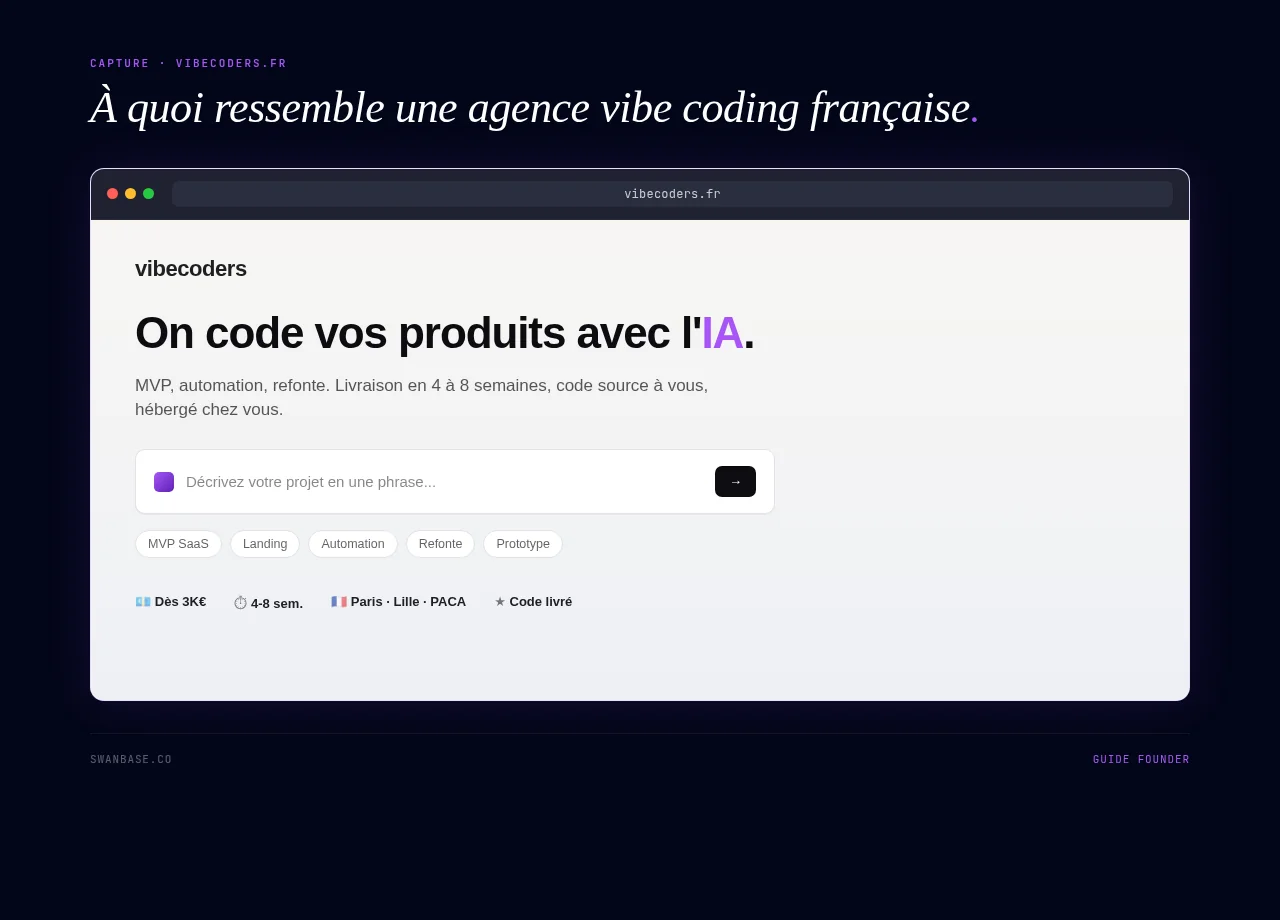
A vibe coding agency is a studio that produces software by steering AI code generators (Cursor, Claude Code, Lovable, Bolt) with one or more senior developers at the controls. It's not a no-code agency in disguise. It's not a traditional dev shop either. The deliverable is real source code, in your repo, hosted on your side.
4 typical deliverables
On the French market in 2026, projects almost always fall into one of four buckets.
- Validation MVP: a working app ready to show a VC or early users. Standardized stack (Next.js + Supabase + Stripe, or equivalent). Delivered in 4 to 8 weeks.
- Vibe-coded rebuild of an existing product: the landing page converting at 1.4% that needs rebuilding; the internal dashboard inherited from a freelancer who vanished.
- Internal automation: a business workflow (n8n, Make, custom scripts) that saves you two days a week. It's often a vibe coding agency's entry-level offer (€1,500 to €3,000).
- Prototype to pitch or test: a clickable demo before you even write production code. A few days, a few hundred euros. Useful for validating with users before paying more.
What a vibe coding agency does NOT do
An agency delivers. It doesn't run your product after delivery. Long-term maintenance, user support, product roadmap: that's not its job. If that's what you're expecting, you're looking for a CTO or an in-house team, not an agency.
It also won't hand you deep product knowledge of your market. It executes on a brief. The strategic vision stays on your side. If you're expecting someone to tell you what to build, you're going to be disappointed (and billed for the disappointment).
How much does a vibe coding agency cost in France in 2026?
The market is young, so it's opaque. Most agencies refuse to display their prices publicly. A few do (AskOptimize in the PACA region, Jud3v Digital in Lille). Cross-referencing published rate cards with the ranges seen on freelance projects, here's what you can expect.
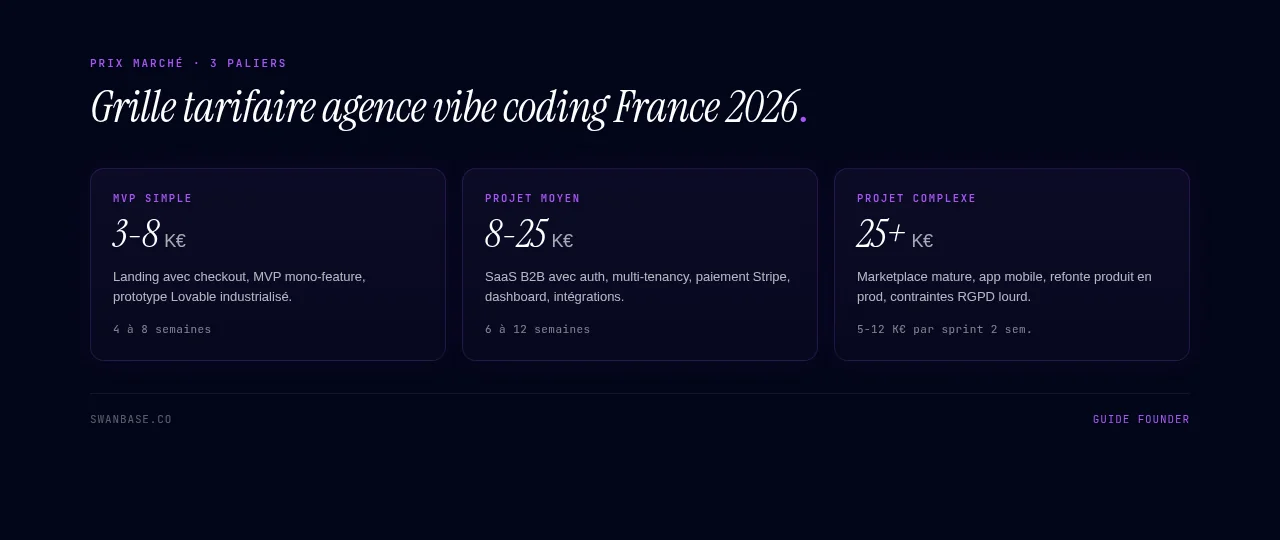
Simple MVP range: €3K to €8K
This is where landing pages with Stripe checkout, single-feature MVPs (a smart business form, a calculation tool, a basic internal dashboard), or an industrialized Lovable prototype fit. AskOptimize, for example, lists €3,500 for a high-conversion landing page and €8,000 and up for a SaaS MVP delivered in 4 to 8 weeks. Agencies that specialize in post-prototype industrialization (turning a Lovable demo into a real app) run around €3,000 to €15,000 according to Jud3v Digital. This is the zone where you're mostly paying for scoping time, prompt engineering, and finishing touches.
Mid-sized project range: €8K to €25K
A real B2B SaaS with auth, multi-tenancy, recurring Stripe Billing payments, a user dashboard, email and CRM integrations. A simple two-sided marketplace. An internal SME app with role management. Budget 6 to 12 weeks of work, often in two phases: an MVP sprint, then a polish and production-launch phase. This is the most common range in France in 2026, because it's where vibe coding agencies have their real price advantage over traditional dev shops (which often start at €40K for the same scope).
Complex project range: €25K and up
A mature marketplace, a native mobile app with a dedicated backend, a rebuild of an existing product already running in production, a project with compliance constraints (healthcare, finance, heavy GDPR). Here, vibe coding speeds things up, but it doesn't replace architecture work. Agencies positioned in this segment often bill by the sprint (€5K to €12K per two-week sprint) rather than a single fixed price.
What isn't in the price
Three blind spots that blow up a budget advertised as "all-inclusive".
- Tool subscriptions: Cursor Pro ($20/month), Lovable Pro ($25/month), Bolt Pro (~$20/month), Claude Code via API. These stay on you after delivery because you'll need them to iterate.
- Infrastructure: Supabase Pro ($25/month), Vercel ($20/month), domain, certificates, transactional emails (Resend, Postmark), Stripe (1.4% + €0.25 per transaction in the eurozone). Budget €80 to €200/month just to keep an MVP alive in production.
- Design: most vibe coding agencies ship a "decent by default" design based on shadcn or Tailwind UI. If you want a real visual identity, that's a separate quote (€1,800 to €5,000 for a simple B2B identity).
The "build or buy" framework
The real question isn't "agency or not." It's: which resource solves your current problem at the lowest total cost? Total cost includes money, but also your time, your future dependence, and your ownership of the code.
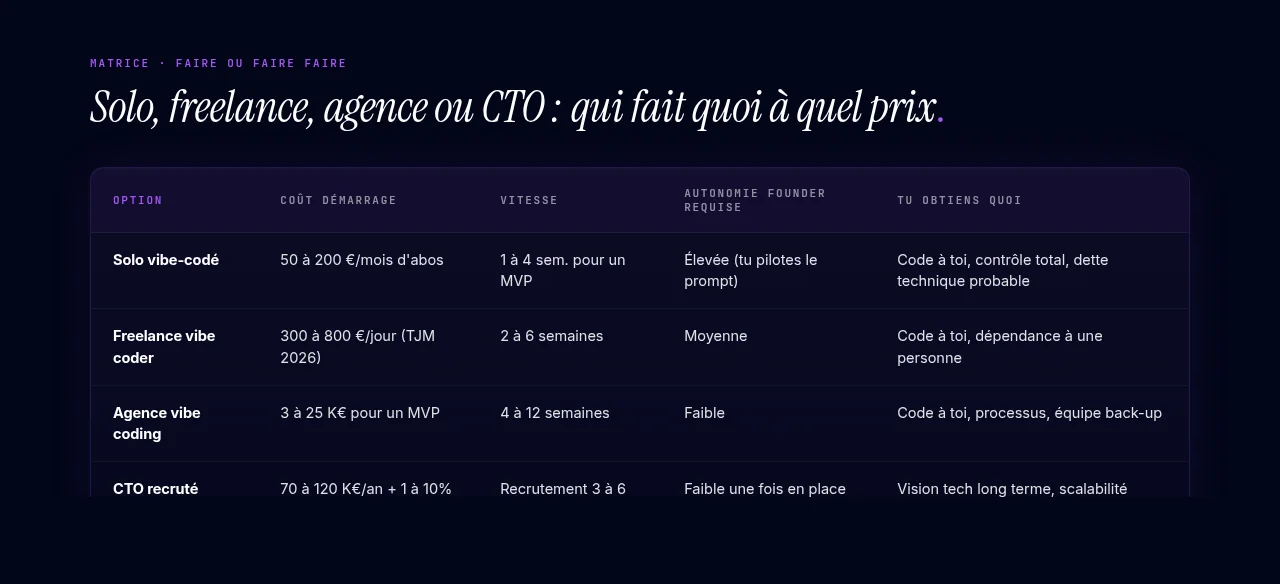
Solo, freelancer, agency, or CTO: who does what, at what price
| Option | Startup cost | Speed | Founder autonomy required | What you get |
|---|---|---|---|---|
| Solo vibe-coded | €50 to €200/month in subscriptions | 1 to 4 weeks for an MVP | High (you drive the prompt) | Your code, full control, likely technical debt |
| Freelance vibe coder | €300 to €800/day, 2026 French market day rate per Vibe Academy 1 | 2 to 6 weeks | Medium | Your code, dependence on one person |
| Vibe coding agency | €3K to €25K for an MVP | 4 to 12 weeks | Low | Your code, process, backup team |
| Hired CTO (employee) | €70K to €120K/year + 1 to 10% equity | Slower to start (3 to 6 months to hire) | Low once in place | Long-term technical vision, scalability |
The CTO isn't an option for the same question. You don't hire a CTO to deliver an MVP. You hire a CTO to steer your tech over 3 to 5 years, ideally after validating product-market fit. Confusing the two is expensive on both ends. If that's your angle, first read our guide on how to find a startup CTO.
4 questions to ask yourself before signing
- Is the urgency real? If your deadline is tied to a non-negotiable event (closing a round, a trade show, an investor demo in 4 weeks), an agency is justified even at a high cost. If your "urgency" is self-imposed pressure, vibe coding it yourself stays the healthier option.
- Do you want to learn or do you want to ship? Vibe coding it yourself is an investment. You pay for your learning in hours. An agency gets it shipped without you learning. Both choices are defensible, as long as you're aware of which one you're making.
- Will the code still serve you after the MVP? If so, get it in the contract that you receive the code, the credentials, and the deployment docs. No ambiguity.
- Do you have someone to take over afterward? An agency delivers. It doesn't maintain. If you have neither the skills nor a freelancer lined up behind it, your "delivered in 4 weeks" becomes "abandoned in 4 months."
When an agency is the right call
Three situations where signing with a vibe coding agency is rational.
You have a short window. A VC has scheduled a demo with you in 6 weeks. You're not going to learn Cursor in the meantime. You bring in an agency to deliver a solid demo, you pitch, and you decide afterward what you actually build.
You're a non-technical solo founder with budget but little time. You're raising a pre-seed, you have unique customer knowledge, and every hour you spend vibe coding is an hour not spent selling or hiring. The €8K you pay an agency buys you 4 weeks of sales focus. That pays off.
You have a high-stakes project that demands real architecture. A product with heavy GDPR compliance, a marketplace with multi-party payments, a critical integration with an existing IT system. A serious agency knows how to ask you the right scoping questions and avoid mistakes that would cost far more to fix later.
When you should vibe code it yourself
And it's simpler than you think. The 2026 tools (Lovable, Bolt, Cursor with Claude 4) let a non-technical founder ship a useful mini-project in an afternoon. If you've never tried, your intuition about "what I'm capable of" is probably 18 months out of date.
You should vibe code it yourself if:
- Your total budget is under €3,000.
- Your project is a validation MVP, not a finished product.
- You want to learn, because you'll be keeping your hands on the tech for a while.
- You haven't yet validated that people want your product. No point paying an agency to build what nobody's asking for.
If that's your case, start by learning vibe coding in an afternoon rather than signing a quote.
How to evaluate a vibe coding agency (2026 red flags)
The market is young, so it's full of opportunists who rebranded their no-code agency or their dev shop as a "vibe coding agency" in a matter of days. Here are the signals that should make you run.
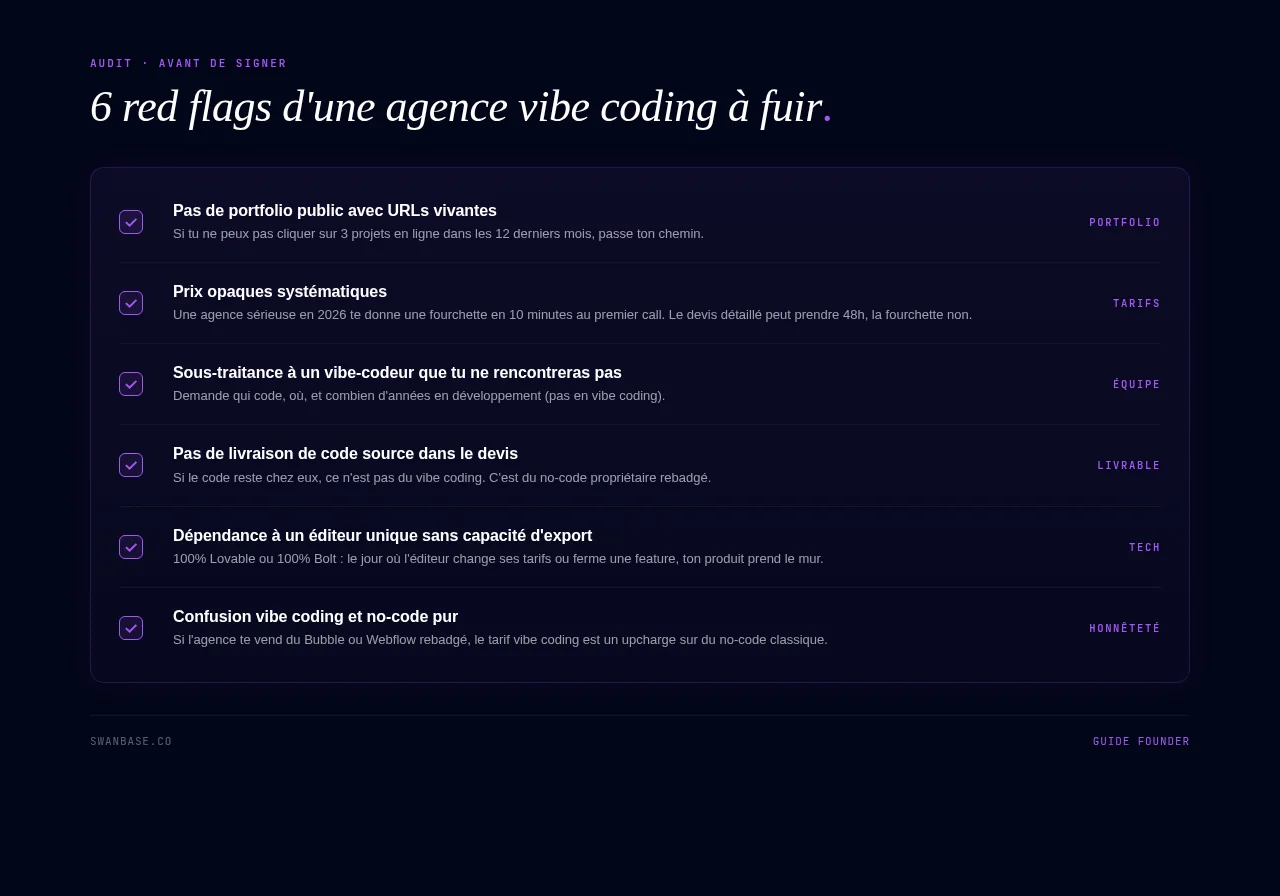
6 red flags to run from
- No public portfolio with live URLs. If you can't click through three online projects from their last 12 months, move on.
- Systematically opaque pricing ("we adapt to your project"). A serious agency in 2026 gives you a range in 10 minutes on the first call. The detailed quote can take 48 hours; the range can't.
- Subcontracting to another vibe coder you'll never meet. Ask who codes, where, and how many years of development experience (not "vibe coding") that person has.
- No source code delivery in the quote. If "the code stays with us," it's not vibe coding, it's proprietary no-code under another name.
- Lock-in to a single platform (100% Lovable, 100% Bolt) with no ability to export. The day the platform changes its pricing or kills a feature, your product hits the wall.
- Confusing vibe coding with pure no-code. If the agency is actually selling you rebranded Bubble or Webflow, the "vibe coding agency" rate is an upcharge on classic no-code. It's legal, and it's also a sign of opportunism.
4 trick questions to ask on the first call
- "What percentage of the delivered code is AI-generated, and who reviews it?" Honest answer: between 60% and 90%, reviewed by a senior dev. If they tell you 100% AI with no review, run. If they tell you 100% human, it's not a vibe coding agency.
- "Which main tool do you code with, and why?" The agency should defend its choice with a project-based argument, not a marketing one.
- "What happens if I want to move to another provider in 6 months?" A good agency tells you: you take the repo, here are the docs, here are the credentials, safe travels.
- "How many automated tests will the delivered code have?" Not a trap to catch you out, a question to gauge how serious they are. Zero tests on an MVP is defensible; zero tests on a €25K project isn't.
The limits of vibe coding (worth knowing before you sign)
Even with the best agency, vibe coding doesn't solve everything. On an MVP, technical debt stays tolerable. On a product in production with paying users, it becomes a concrete risk: untested generated code, hidden dependencies, prompts lost as teams turn over. If the core mechanics of vibe coding aren't familiar to you, go back to basics with our complete definition of vibe coding. For the detailed list of pitfalls (and the recovery checklist if you're already in one), see our guide to the 10 vibe coding mistakes.
A serious agency will warn you about these limits before signing. An agency that promises you "scalable, production-ready, debt-free" on a €5K MVP is lying to you. (And if your sales call runs 20 minutes without these limits coming up once, consider that a seventh red flag.)
FAQ
Agency vs freelance vibe coding: what's the real difference?
A freelance vibe coder charges between €300 and €800 a day (2026 day rate) and works alone 1. An agency charges you a fixed price (€3K to €25K and up), with a project manager, a dev who codes, and often a designer. The freelancer is faster and cheaper on a small scope. The agency is more solid when the project involves several disciplines or when you want continuity if the person gets sick.
Do I get clean code at the end?
You should receive the source code in your private GitHub repo, the credentials for every third-party service (Supabase, Stripe, hosting), minimal deployment docs, and the list of critical prompts used. If any of these four is missing from the quote, ask for it explicitly before signing. The word "clean" is fuzzier: on an MVP delivered in 4 weeks, "works and is readable" is the reasonable bar. Not "Google-grade production-ready."
Can the agency keep maintaining my product?
A few offer a monthly retainer after delivery (often €1,000 to €3,000/month for 1 to 3 days of availability). It's useful for the first weeks in production, when the bugs surface. Beyond 6 months, the total cost exceeds that of a dedicated freelancer or a first in-house hire. An agency retainer isn't a long-term tech strategy.
How many devs and AI agents work in a typical vibe coding agency?
An average French agency in 2026 runs with 2 to 5 experienced human developers, each steering 2 to 4 AI sessions in parallel (usually Cursor + Claude Code). The claimed productivity ratio ranges from 3x to 10x a traditional dev. In observed reality, count on 2x to 4x on production code, more if you include the prototyping and scoping phases. An agency that tells you "10x everywhere, all the time" is selling you marketing.