Built by mistral ai, this powerful tool runs on Devstral 2, an impressive 123-billion-parameter model that scores 72.2% on the SWE-bench Verified benchmark. The mistral vibe coding assistant can handle a very large context window of 256,000 tokens, which lets it take in monorepos and complex legacy applications. The results are remarkable too: 100% developer adoption across every client project and a code autocomplete accuracy of 90%, double that of previous solutions.
April 2026 update: Mistral AI released Mistral Vibe 2.0 on January 27, 2026, turning the experimental tool into a production platform. This new version introduces custom subagents, multiple-choice clarifications, slash skills, unified agent modes, and automatic updates. The CLI is now on version 2.9.x with continuous delivery, MCP support, and native VS Code, JetBrains, and Zed integrations.
In this article, you'll learn exactly what Mistral Vibe is, how to install it easily, and how to use it effectively to transform your development workflow. Whether you're new to programming or an expert, this tool could well become your best ally for boosting productivity.
An Overview of Mistral Vibe
What Is Mistral Vibe?
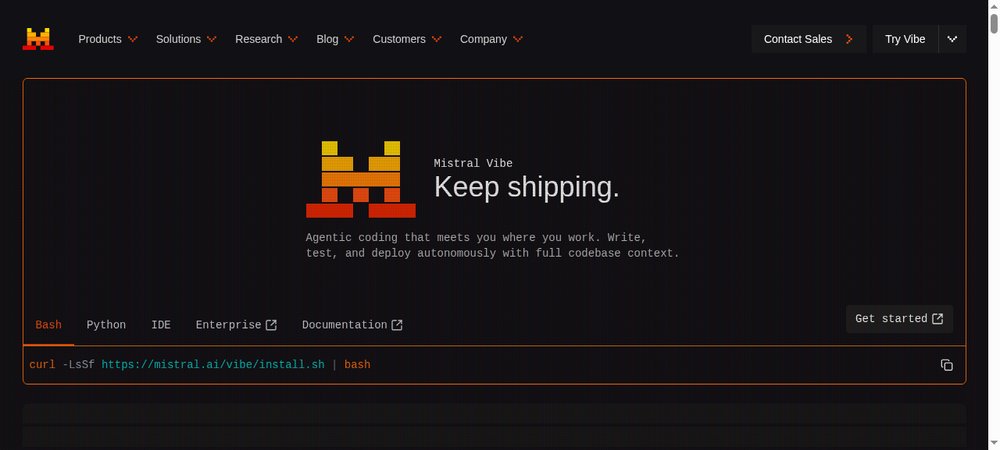
Mistral Vibe is a command-line coding assistant powered by Mistral AI's models. This innovative tool offers a conversational interface to your codebase, letting you use natural language to explore, edit, and interact with your projects through a set of powerful tools.
In practice, Mistral Vibe CLI is an open source assistant that runs directly in your terminal. It reads your codebase, understands the project structure, edits files, runs commands, and proposes changes from instructions written in natural language. All of the code is available on GitHub under the Apache 2.0 license.
The core features of Mistral Vibe 2.0 include:
- Project-aware context: it automatically analyzes your file structure and Git state to provide relevant context
- Smart references: autocompletions with @, shell command execution with !, and slash commands for configuration changes
- Multi-file orchestration: it understands your entire codebase, not just the file you're currently editing
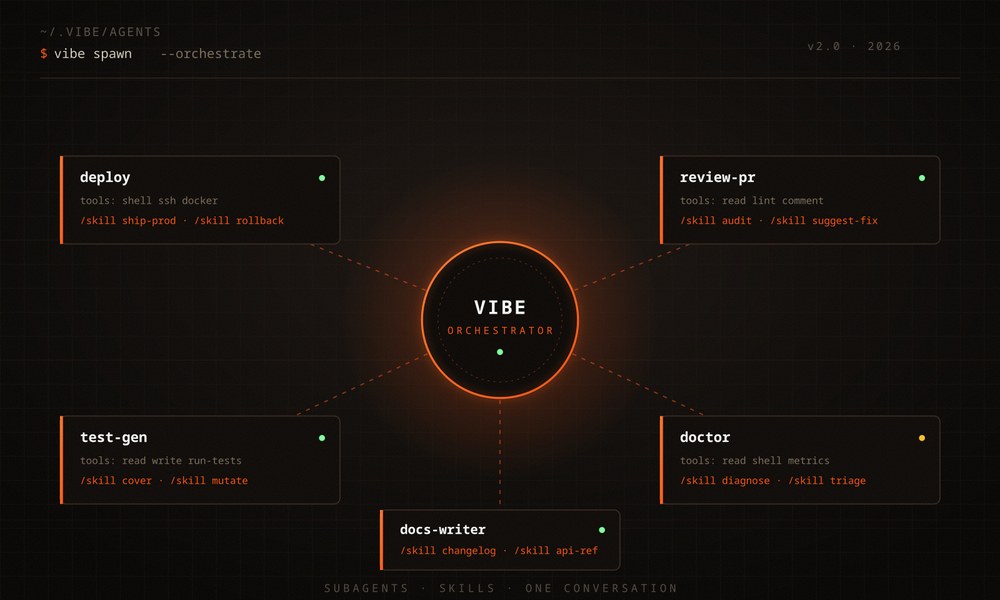
- Custom subagents for focused tasks (deployment, PR review, test generation) that can be invoked on demand
- Multiple-choice clarifications: Vibe asks before acting when your intent is ambiguous, rather than guessing
- Slash skills: preconfigured workflows loaded via
/for common tasks (lint, deploy, doc generation) - Unified agent modes that combine tools, permissions, and behaviors so you can switch context without switching tools
- Persistent history, autocomplete, and customizable themes
- Continuous automatic updates: fixes and improvements shipped without manual intervention
Why Was It Created?
Mistral Vibe was created to make "vibe coding" easier, an approach that means steering your development with natural-language instructions, as if you were briefing an experienced developer. Mistral Vibe goes further, though, by building in persistent memory and a deep awareness of context.
The main goal was to offer an open, credible alternative to proprietary code assistants while providing a tool that fits seamlessly into existing development workflows. So Mistral Vibe isn't just an IDE plugin or a chatbot, but a native, programmable, and free interface.
Its Ties to Mistral AI and Devstral 2
Mistral Vibe is closely tied to Mistral AI, being one of its flagship products in the field of AI application development. It was announced at the same time as Devstral 2, Mistral AI's new generation of open source code models.
Indeed, Mistral Vibe CLI is specifically designed to run on the Devstral 2 family, which serves as its underlying AI engine. The lineup comes in two sizes: Devstral 2 (123 billion parameters) for maximum performance, and Devstral 2 Small (24 billion parameters), which runs on consumer hardware. Vibe 2.0 also supports Codestral and Codestral Embed for specialized use cases. This dense architecture (rather than mixture-of-experts) was chosen to make deployment, monitoring, and reasoning easier.
Beyond that, the tool is part of Mistral AI's ambition to build a European technology foundation centered on software sovereignty. The open source nature of Vibe CLI reinforces Mistral AI's commitment to community-driven development and the advancement of open AI ecosystems, delivering a solution that combines power, flexibility, and full control over the development environment.
Pricing Plans and Deployment
Since Vibe 2.0, Mistral offers several access options:
- Le Chat Pro: $14.99/month (50% student discount)
- Le Chat Team: $24.99/seat/month with admin controls
- Devstral 2 API: $0.40/M input tokens, $2.00/M output tokens
- Devstral 2 Small API: $0.10/M input tokens, $0.30/M output tokens
- BYOK (Bring Your Own Key): use your own API key
- Self-hosted / on-premise: hosting on your own infrastructure for compliance requirements (finance, healthcare, defense)
This flexibility positions Vibe as a credible alternative to GitHub Copilot, Cursor, or Claude Code, especially for organizations that require data sovereignty.
Core Features of Mistral Vibe CLI
Exploring and Editing Code in Natural Language
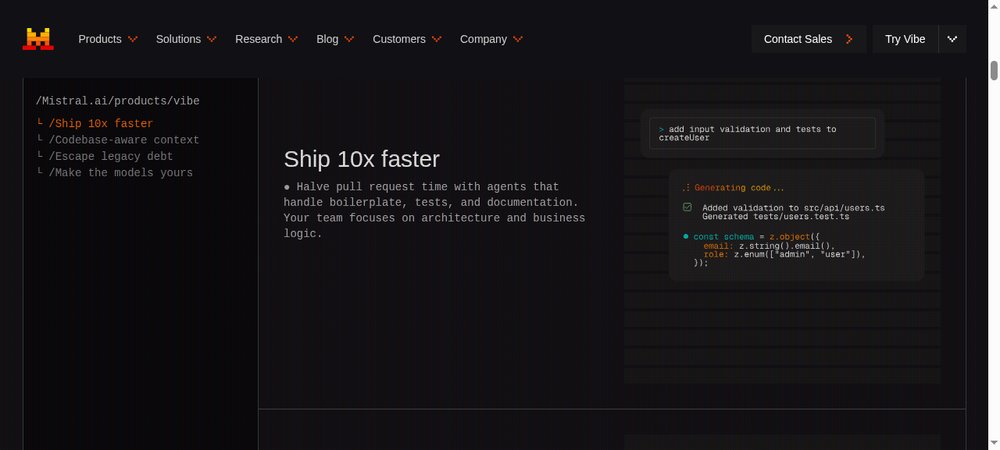
Mistral Vibe CLI turns your terminal into a true development partner. This assistant understands natural-language requests to edit, generate, and explore code. Thanks to its powerful built-in tools, you can read, write, and fix files (read_file, write_file, search_replace) directly from the conversational interface.
Running Shell Commands in the Terminal
To run shell commands without leaving the assistant, simply prefix your instructions with the ! symbol. For example, type !ls -l to list the files in your directory. This feature keeps your workflow uninterrupted and lets you interact with your development environment seamlessly.
Autocomplete and Command History
The Mistral Vibe interface offers:
- Smart autocomplete for slash commands (/) and file paths (@)
- A persistent history of your interactions
- Keyboard shortcuts like Ctrl+T to toggle the task view and Shift+Tab to change approval mode
Multi-File Support and Project Understanding
Mistral Vibe automatically analyzes the structure of your project and its Git state to provide relevant context. Unlike traditional assistants, it understands the overall architecture of your code, not just the active file, enabling high-level reasoning.
Git Integration and Context Management
The assistant integrates naturally with Git, analyzing the repository's state to build behavioral context. You can easily check status, review diffs, and even generate meaningful commit messages thanks to its deep understanding of your changes. Vibe 2.0 also supports OAuth connectors for GitHub, GitLab, and Jira via the /mcp menu, as well as MCP (Model Context Protocol) servers that open the assistant up to an ecosystem of third-party tools.
Custom Subagents and Hooks
With Vibe 2.0, you can create specialized subagents for repeatable workflows: a PR-review agent, a test-generation agent, a deployment agent. Each subagent can have its own tools, permissions, and instructions. The experimental hooks system (post-agent-turn) lets you trigger automatic actions at the end of a turn, and the scratchpad offers a temporary workspace shared between the main agent and its subagents.
Installing and Configuring Mistral Vibe
Installing Mistral Vibe is quick and works through several methods depending on your operating system.
Steps to Install Mistral Vibe CLI
To get started, make sure you have Python 3.12+ installed. Then choose one of the following options:
- Quick install (macOS/Linux):
curl -LsSf https://mistral.ai/vibe/install.sh | bash - Install via uv:
uv tool install mistral-vibe - Install via pip:
pip install mistral-vibe
While Mistral Vibe runs on Windows, it's mainly designed for UNIX environments.
The config.toml Configuration File
On first launch, Mistral Vibe automatically creates a configuration file at ~/.vibe/config.toml. This file lets you customize the interface, tool permissions, and the models used.
Customizing Models and Permissions
Set up your API key via vibe --setup or use one of the following methods:
- Interactive configuration on first launch
- Environment variables:
export MISTRAL_API_KEY="your_api_key" - A
.envfile in~/.vibe/
You can also create custom agent configurations in ~/.vibe/agents/ for specific use cases.
Using a Local Model or the Mistral API
By default, Mistral Vibe uses the Devstral 2 model through the Mistral API. That said, you can configure Vibe to use a local model by adding a provider configuration in your config.toml file and setting the active model to "local".
Advanced Usage and Use Cases
Creating and Managing Agents with Specific Skills
Customize your Mistral Vibe experience by creating specialized agents in the ~/.vibe/agents/ directory. Each agent can be configured with specific tools and permissions to meet particular needs such as web development, data analysis, or container management.
Automating Development Tasks
Mistral Vibe excels at automating repetitive tasks. Use it to generate unit tests, refactor code, or analyze databases. For example, ask "Generate tests for this service" and let Vibe handle the rest.
IDE Integrations: VS Code, JetBrains, Zed
Mistral Vibe remains CLI-first and editor-agnostic at its core, but it now integrates natively with VS Code, JetBrains (IntelliJ, PyCharm, WebStorm), and Zed. These extensions bring the assistant's features straight into the IDE while keeping the power of the terminal interface. It's a different position from Cursor (a custom editor) or GitHub Copilot (cloud-only): Vibe leaves you free to choose your environment.
Examples of Useful Commands
A few commands to try:
@filenameto quickly reference a file/helpto display the available commands/contextto view the current context!shell_commandto run a system command
Using It in a Team Environment
Mistral Vibe makes team collaboration easier thanks to its holistic understanding of projects. Share custom agent configurations, standardize development practices, and speed up onboarding for new members. On top of that, the text-based format of interactions makes it easy to document technical decisions and share them with the team.
Conclusion
Mistral Vibe marks a significant step forward in the world of coding assistants. This powerful tool genuinely turns your terminal into an intelligent development partner, capable of analyzing, editing, and generating code from simple natural-language instructions. The combination of the Devstral 2 model and the CLI interface creates a smooth experience that fits perfectly into your existing workflow.
With Vibe 2.0, the platform crosses a threshold: custom subagents, slash skills, unified agent modes, automatic updates, and MCP support make it a mature production tool, not just an experimental assistant. Organizations sensitive to data sovereignty (finance, healthcare, defense) will find here a credible European alternative to American solutions, with self-hosted deployment and fine-tuning on proprietary code.
Mistral Vibe's strength certainly lies in its versatility. Whether you want to quickly explore a complex codebase, automate repetitive tasks, or collaborate effectively with your team, this assistant delivers. Its simple installation, flexible configuration, and open source nature give you full control over your development environment.
As you use Mistral Vibe, you'll no doubt discover new ways to speed up your development process. Slash commands, file references with @, and shell command execution with ! will quickly become second nature in your daily practice.
Ultimately, Mistral Vibe is a perfect illustration of how development tools are evolving toward more intuitive, conversational interfaces. Unlike traditional assistants, it understands not only the file you're working on but also the overall architecture of your project. That contextual awareness, paired with the power of the Devstral 2 model, makes Mistral Vibe a valuable ally for any developer looking to improve productivity while keeping control of their code.
Try Mistral Vibe today and see for yourself how this assistant can transform the way you code, making development faster, more enjoyable, and more efficient.
Key Takeaways
Discover the essentials for mastering Mistral Vibe, the game-changing coding assistant that turns your terminal into an intelligent development partner.
• A powerful conversational assistant: Mistral Vibe uses natural language to explore, edit, and generate code directly in your terminal with 90% accuracy. • Vibe 2.0 is production-ready: Custom subagents, slash skills, unified agent modes, and automatic updates turn the experimental tool into a mature production platform. • Simple, fast installation: A single command (curl -LsSf https://mistral.ai/vibe/install.sh | bash) is all it takes to install this open source tool, compatible with all your projects. • Holistic project understanding: Unlike other assistants, it analyzes your code's full architecture, not just the current file, for context-aware suggestions. • Sovereignty and flexible deployment: Self-hosted, on-premise, Mistral Cloud, or BYOK. Devstral 2 (123B) or Devstral 2 Small (24B) depending on your hardware constraints. • Native IDE integrations: VS Code, JetBrains, and Zed on top of the terminal, with MCP support to connect third-party tools (GitHub, GitLab, Jira).
Mistral Vibe represents the future of AI-assisted development, offering a credible open source alternative to proprietary solutions while keeping full control over your development environment.
FAQs
Q1. What is Mistral Vibe and how does it work?
Mistral Vibe is a command-line coding assistant that uses artificial intelligence to explore, edit, and generate code from natural-language instructions. It runs directly in your terminal, analyzing your project structure and Git state to provide relevant context.
Q2. How do I install Mistral Vibe?
Installing Mistral Vibe is simple. Make sure you have Python 3.12+ installed, then run the following command in your terminal: curl -LsSf https://mistral.ai/vibe/install.sh | bash. Alternatively, you can install it via uv or pip.
Q3. What are the main features of Mistral Vibe 2.0?
Mistral Vibe 2.0 offers natural-language code exploration and editing, shell command execution in the terminal, multi-file support, and Git integration. Version 2.0 adds custom subagents (for deployment, PR review, test generation), multiple-choice clarifications, slash skills (preconfigured workflows), unified agent modes, and support for the Model Context Protocol (MCP).
Q4. What's the difference between Mistral Vibe 1.0 and 2.0?
Vibe 2.0, released on January 27, 2026, marks the shift from experimental status to production. The major additions are custom subagents, slash skills, unified agent modes, multiple-choice clarifications, and automatic updates. Version 2.0 also introduces pricing plans (Le Chat Pro at $14.99/month, Team at $24.99/seat/month) while keeping the open source self-hosted and BYOK options.
Q5. How do I customize Mistral Vibe for specific needs?
You can customize Mistral Vibe by creating specialized subagents in the ~/.vibe/agents/ directory. Each subagent can be configured with its own tools, permissions, and instructions to meet particular needs such as PR review, deployment, test generation, or data analysis. Unified agent modes then let you switch between these configurations without switching tools.
Q6. Can Mistral Vibe be used in a team environment?
Yes, Mistral Vibe makes team collaboration easier thanks to its holistic understanding of projects. The Le Chat Team plan ($24.99/seat/month) includes admin controls. You can share subagent and skill configurations, standardize development practices, and speed up onboarding for new members. For organizations with compliance requirements (finance, healthcare, defense), on-premise deployment ensures that code never leaves the internal infrastructure.