Finding a CTO for Your Startup: The Guide for Non-Technical Founders (2026)
You have a startup idea, a validated market, maybe your first customers. But you don't code. And the same question keeps you up at night: how do you find a CTO? The short answer: don't go looking for "a CTO." First, understand what you actually need. A cofounding CTO who takes 25% equity and builds the product with you is a very different thing from a freelancer at €600/day who ships an MVP in six weeks. This guide is written for you, the non-technical founder, who can't tell Python from JavaScript but knows your startup needs someone who can code. We cover it all: when to hire, where to look in France, how to evaluate without technical skills, and how to avoid getting burned.
Before you start looking: do you really need a CTO?
Most non-technical founders make the same mistake. They type "find startup CTO" into Google before asking themselves whether a CTO is really what they need.
Cofounding CTO vs. salaried CTO vs. lead dev vs. tech freelancer
Four technical profiles, four different realities:
- The cofounding CTO joins as a partner. Equity (15-35%), often no salary, co-decides on both the technical AND strategic direction. It's an entrepreneurial marriage.
- The salaried CTO comes on later, after a fundraise. Salary (€70-120k), some stock options, executes a technical vision. A senior employee, not a cofounder.
- The lead dev codes and manages a small team. They execute the tech strategy, they don't define it. This is what you need if your product is relatively simple.
- The tech freelancer delivers a scoped project, bills by the day (€400-800), then moves on to the next client. Zero long-term commitment, zero equity.
Confusing these profiles costs months of wasted searching. A founder looking for a "cofounding CTO" to build their MVP when what they need is a freelancer will spend six months trying to convince technical profiles to work for free. Conversely, someone who hires a freelancer when they need a real technical partner ends up with a delivered product but no one to maintain it or make it evolve.
The decision table: which profile for your stage
| Your situation | Right profile | Why |
|---|---|---|
| Unvalidated idea, no revenue | Freelancer or vibe coding | Validate the market before looking for a partner |
| Validated market, first customers | Cofounding CTO | You need a long-term commitment |
| Seed round closed, product in production | Salaried CTO or lead dev | You can pay a competitive salary |
| One-off project | Freelancer (Malt, platforms) | Scope the work, pay, move on |
The no-code / vibe coding option before you hire
Here's the insight that changes everything: most early-stage startups don't need a CTO. They need a good developer, or even no developer at all. With vibe coding and no-code tools (Bubble, Webflow, Make), a non-technical founder can build a working MVP in a few weeks.
Showing up in front of a potential CTO with a working prototype and 20 paying customers is radically different from showing up with a PowerPoint. In the first case, you have a project. In the second, a dream. Good technical profiles join projects, not dreams.
Build your lean canvas, validate your assumptions, get some traction. Then go find your CTO.
The CTO profile: 3 archetypes for early-stage startups
Behind the same title hide radically different profiles.
The technical lead CTO (hands-on, codes)
This CTO codes. Every day. They pick the stack, build the architecture, ship to production. They get their hands dirty, and that's exactly what you need when it's just the two of you in an apartment trying to ship an MVP. Typical profile: 5-10 years of experience, has already built products from scratch, prefers coding to managing. They don't want 15 developers reporting to them, they want a terminal and some peace and quiet.
Upside: you move fast. They code, you sell. The classic duo. Risk: some are excellent developers but poor communicators. If you don't understand what they're building and why, the technical/business gap widens fast.
The product-oriented CTO (strategy, not just code)
Rarer, more valuable. They code, but they think product first. They ask "do users actually need this?" before "what language do we build it in?". They join customer interviews and refuse to build useless features.
Upside: you build the right product, not just a well-coded one. Risk: they have opinions on everything (including your go-to-market strategy, which isn't necessarily a flaw).
The team builder CTO (avoid in early stage)
This profile comes from big companies. They know how to hire 50 developers, set up Agile processes, negotiate six-figure cloud contracts. The problem: you don't have 50 developers. You don't even have a product. The classic mistake: hiring a "desk CTO" who draws up theoretical architectures instead of shipping an MVP. They'll produce a beautiful roadmap on Notion. Your startup will be dead before they finish writing it.
This profile is excellent for a post-Series A startup. Not for you. Not now.
Which archetype for which startup?
- Pre-MVP, 0-2 people: technical lead CTO. Someone who codes and ships.
- MVP launched, first customers: product-oriented CTO. Someone who builds the right product.
- Post-fundraise, 10+ people: team builder CTO. Someone who hires and organizes.
A team builder at the pre-seed stage is like hiring a factory director before you have a prototype.
Where to find a CTO in France: 10 concrete sources
Theory is fine. Here's where to look concretely in 2026.
Founder communities (French Tech, Station F, Schoolab)
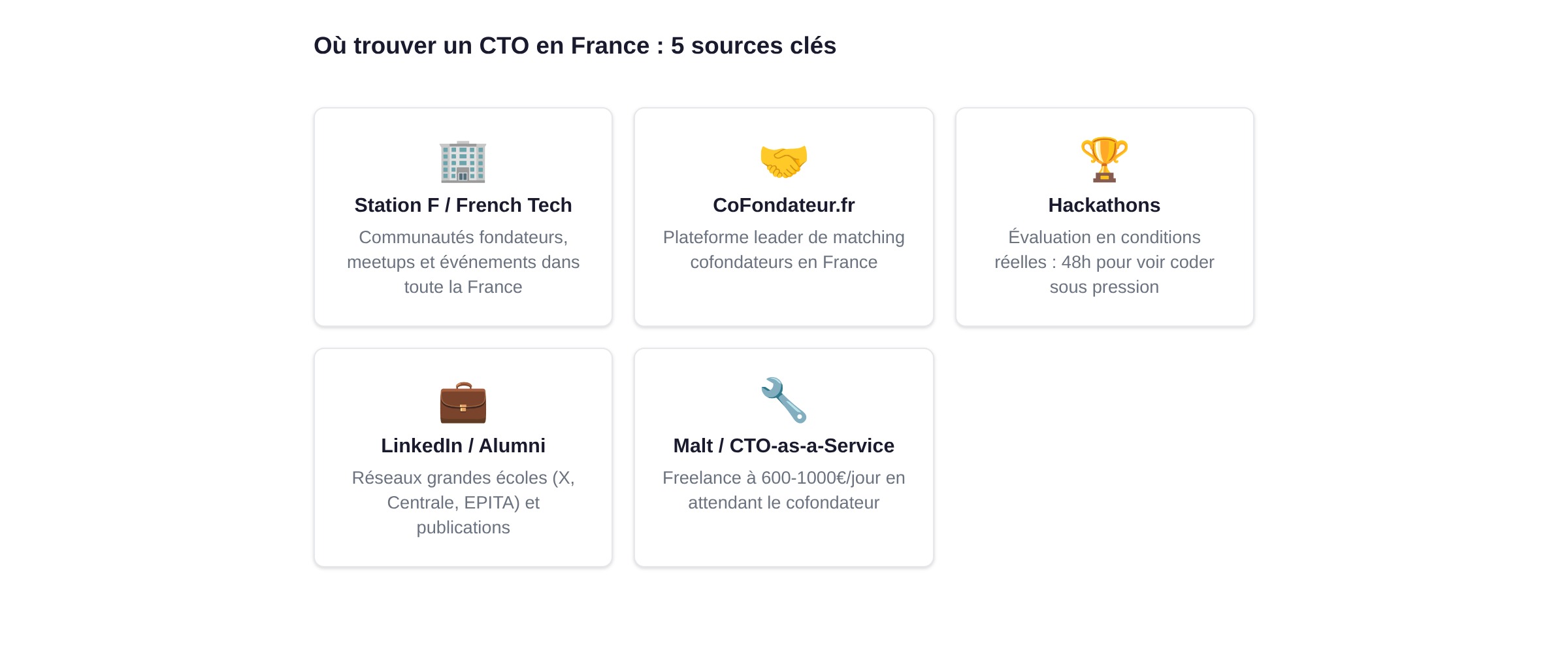
Station F is still the largest startup campus in the world. Its Fighters program welcomes non-technical founders and helps them connect with technical profiles. Upside: the people you meet there have already committed to the startup ecosystem.
French Tech runs events in every major city. Local communities (Bordeaux, Lyon, Toulouse, Nantes) host regular meetups between founders.
Schoolab and school incubators (HEC Incubateur, Polytechnique Drahi X-Novation, CentraleSupélec Excelerate) run cofounder matching events with engineering profiles who want to build a company.
Cofounder platforms (CoFondateur.fr, Cofounderslab, WeLoveFounders)
CoFondateur.fr is the leading platform in France for finding a partner. Verified profiles, skill-based matching, an equity split simulator. Be precise in your listing: describe your market, your traction, what you bring to the table. Vague listings ("looking for a passionate CTO for an innovative project") attract no one serious.
Cofounderslab is the international equivalent, useful if you're looking for a remote CTO. WeLoveFounders runs speed-dating events between founders: five minutes per meeting, 15-20 profiles in one evening.
cofondateurauchomage.fr connects project leaders with talent who are currently between jobs. Over 2,500 users, 10,000+ visits/month. The upside: technical profiles available immediately, ready to go all in. The Tinder-like format lets you filter by skill (Tech, Product, etc.) and match quickly.
Partner offer cofondateurauchomage x swanbase: looking for a cofounding CTO on cofondateurauchomage.fr? With the SWAN10 code from swanbase, get 10% off premium access to cofondateurauchomage.fr. Once you've found your CTO, you can apply to the swanbase program (2% equity, no fees) to structure and accelerate. Offer details →
Events and hackathons (Swanbase Cofounder Events, Station F, CES Paris)
Hackathons are the best proving ground. In 48 hours, you see how someone codes under pressure, communicates, and handles trade-offs. It's a real-world interview no résumé can replace.
Look for Startup Weekends (54 hours, a mix of tech and business profiles), school hackathons (42, EPITA, Epitech), and specialized meetups. Go even if you don't understand the technical talks. You're there for the coffee breaks.
LinkedIn and top engineering school alumni networks (Polytechnique, CentraleSupélec, EPITA)
LinkedIn works, but not by sending cold messages. Post about your project. Share your progress, your numbers. Technical profiles considering entrepreneurship watch you before reaching out.
The alumni networks of top engineering schools (Polytechnique, CentraleSupélec, Mines, EPITA, Télécom Paris) have internal directories and private LinkedIn groups. A well-crafted message in the "Entrepreneurship" group of the X-Alumni directory reaches 200 engineers in a day. Spell out your traction, not just your idea.
Malt and tech freelancers (CTO-as-a-Service while you wait for the cofounder)
The search takes 3-6 months on average. In the meantime, don't sit still. Malt, the leading freelance platform in France, offers "fractional CTOs": a senior expert works with you 2-3 days a week, defines the architecture, and helps you make the right technical decisions. Cost: €600-1000/day, but you keep 100% of your equity.
The hidden upside: a good CTO-as-a-Service can become your cofounding CTO, or recommend the right profile from their network.
How to evaluate a CTO when you can't code
You don't code. How do you evaluate someone whose job is to code? Here's the method.
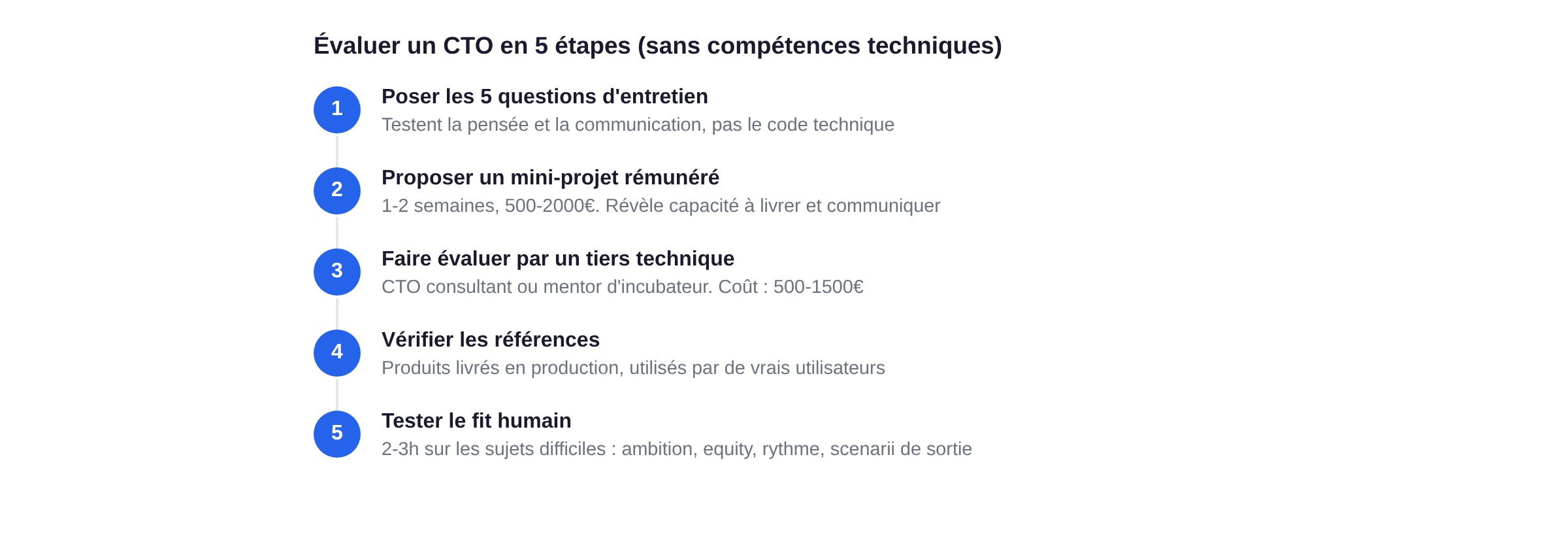
The 5 questions to ask in an interview (no tech knowledge needed)
You don't need to understand the code. You need to understand how they think:
-
"Explain how you'd build our product, as if I'd never seen a line of code." A good CTO can break things down simply. If they drown you in jargon, that's not skill, it's technical intimidation.
-
"What's the simplest product we could launch in four weeks?" A good CTO cuts scope. A bad CTO adds complexity. If the answer is "impossible, it'll take six months," run.
-
"Tell me about a project where you had to throw out code and start over." Every developer has made bad technical choices. Anyone who denies it has never built anything serious.
-
"How do you handle a disagreement with a non-technical founder?" A CTO who uses technical complexity as a shield to dodge the conversation will be impossible to work with.
-
"What would you do if we ran out of money in three months?" Look for "we cut the fat, we focus on what generates revenue" rather than "we raise funds."
The project test: propose a paid mini-project
Never partner up based on interviews alone. Propose a concrete, paid mini-project (€500-2000), over 1-2 weeks. For example: "Build a prototype of our main feature with the stack of your choice." This test reveals three essential things: the ability to deliver (do they hit deadlines?), the quality of communication (do they keep you posted on blockers?), and product vision (did they ask questions about users, or just execute the specs?).
Paying for the test is non-negotiable. A senior technical profile who agrees to work for free "just to see" is either desperate or not that senior. Good profiles value their time. Respect that.
Get a third-party technical assessment (outside opinion, consulting CTO)
If you can't evaluate the code yourself, have someone else do it. A consulting CTO, a senior developer friend, an incubator mentor. The cost of a technical audit (€500-1500) is trivial compared to the cost of a bad partnership. You'd hire an accountant to check the finances of a company you're buying. Same logic here.
The red flags to watch for
Some signals should set off alarm bells, even (especially) if you're not technical:
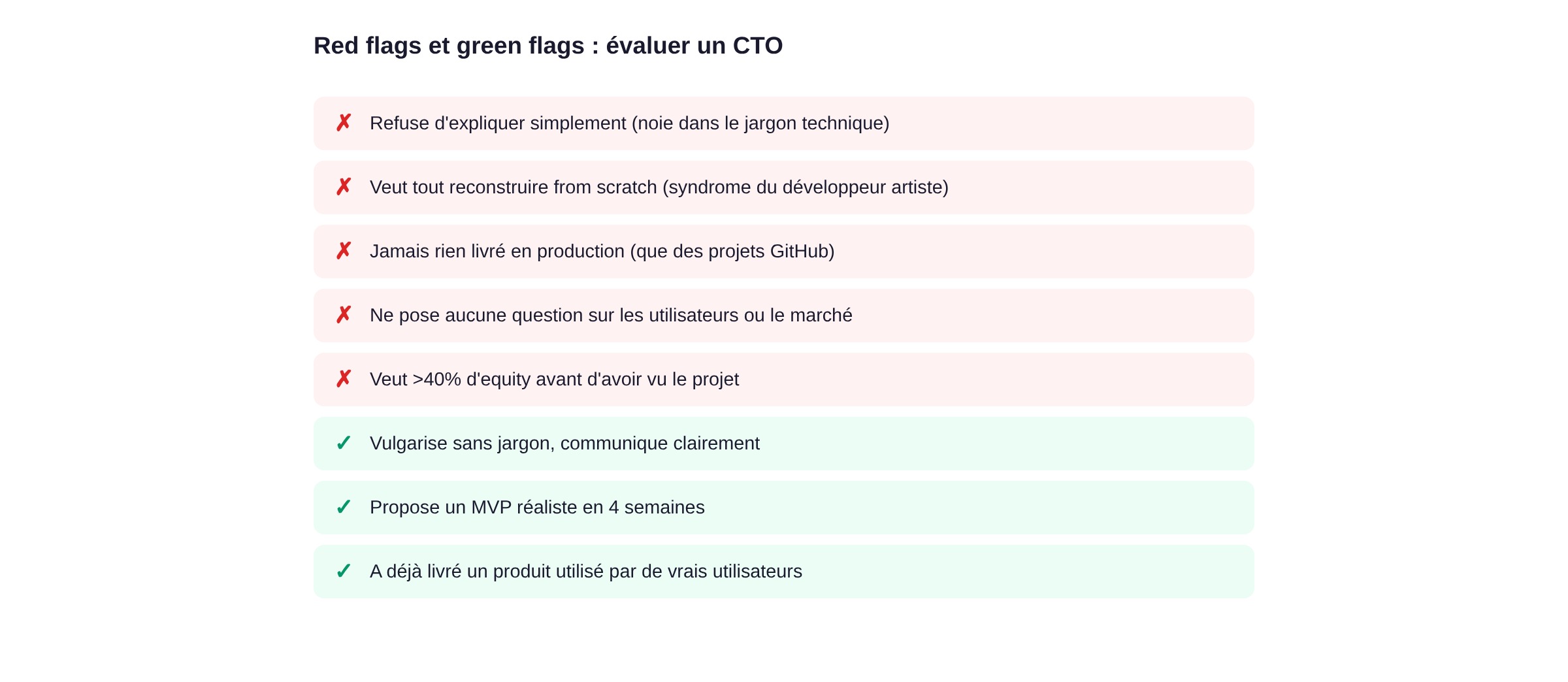
- They refuse to explain simply. 15 acronyms per answer isn't genius, it's an inability to communicate.
- They want to rebuild everything from scratch. The artist-developer syndrome. You need a pragmatist.
- They've never shipped anything to production. GitHub projects are nice. A product used by real users is better.
- They ask no questions about users. A CTO who never asks "who are the customers?" won't build the right product.
- They want too much equity too fast. A profile negotiating 40% before even seeing the project is an equity mercenary.
Winning them over and structuring the deal
You've found the right profile. They're interested. This is the part non-technical founders botch the most.
Cofounding CTO equity: realistic ranges by stage
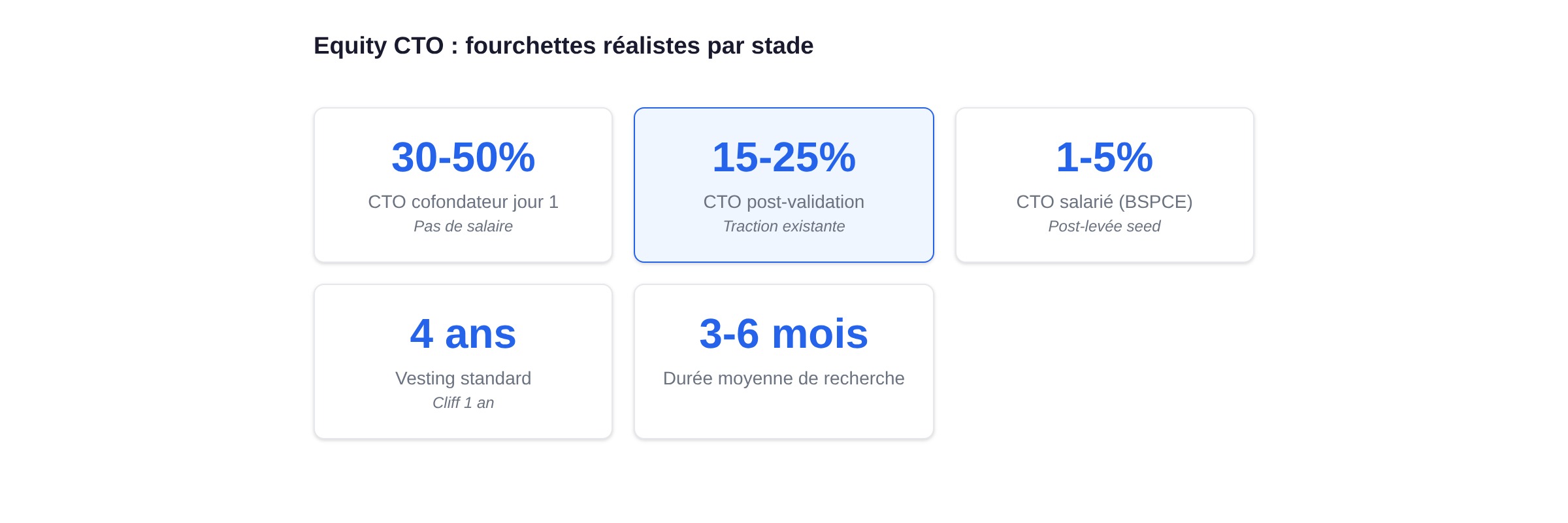
- Cofounding CTO from day 1, no salary: 30-50%. Y Combinator recommends near-equal splits for true cofounders.
- Cofounding CTO after the MVP, with existing traction: 15-25%. The risk is lower.
- Salaried CTO with equity: 1-5% in stock options. This is an employee, not a cofounder.
The classic mistake: offering 5% to someone taking on as much risk as you, then being surprised no one accepts. Your idea is worth nothing. Execution is worth everything. And a CTO who codes without a salary is executing at least as much as you.
The shareholder agreement and vesting (4 years with a 1-year cliff)
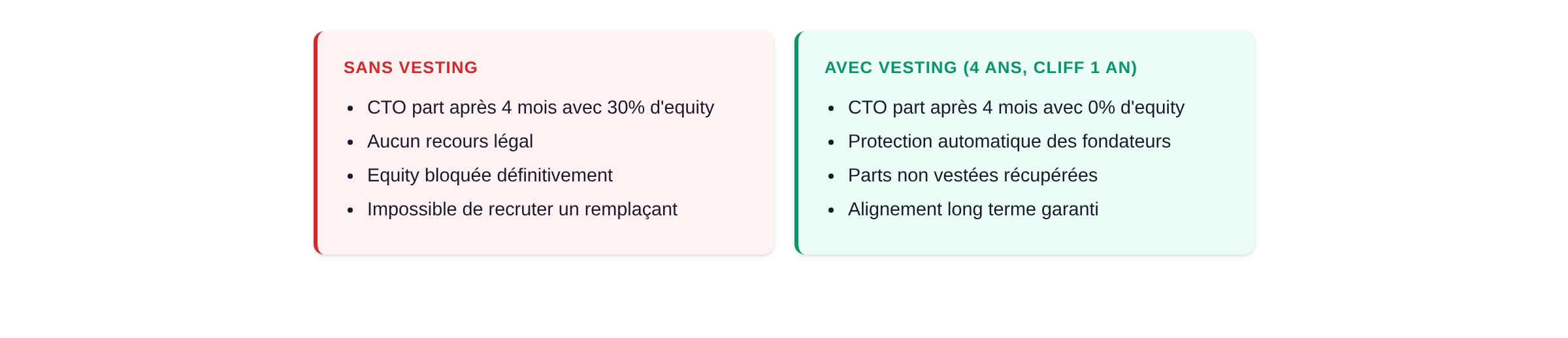
Vesting is your entrepreneurial life insurance. Standard mechanism: 4 years of vesting with a one-year cliff. If your cofounding CTO has 25% equity:
- Months 1-12: they own nothing. If they leave, they walk away with 0%.
- Month 12 (the cliff): they vest 25% of their shares (6.25% of the total).
- Months 13-48: linear vesting, every month.
Without vesting, a cofounder who leaves after six months walks away with their full equity allocation. That's a disaster.
Have the agreement drafted by a lawyer who specializes in startup law. Stock options (BSPCE in France), a tax mechanism reserved for SAS companies, let you issue options with a favorable tax regime. It's the standard tool for equity in France.
Salary vs. equity: the trade-offs
Pre-seed, no funds: no salary, significant equity (30-50%). Seed, first funds: small salary (€1500-3000/month) + equity (15-30%). Post-seed, revenue: decent salary + equity (10-20%).
The trap: a CTO who demands a market salary (€80-100k) AND 25% equity from the start. That's not a cofounder, that's someone who wants to have their cake and eat it too. On the flip side, €0 salary AND 5% equity attracts no one (and rightly so).
Align your visions before signing
Spend 2-3 hours on these topics before signing anything:
- Ambition: lifestyle business or unicorn? The top VCs in Paris expect global ambition. If your CTO wants a profitable niche project and you want to raise €10M, it won't work.
- Pace: 50 hours/week or 35? The early years demand intensity.
- Exit scenarios: what happens if one of you wants to leave? If an acquirer offers €5M?
These conversations are uncomfortable. That's exactly why you need to have them before signing.
The most common mistakes
The same mistakes, over and over.
Looking for a CTO too early (or too late)
Too early: you haven't validated your market, haven't talked to 30 prospects. You're looking for a CTO to code an idea with no proof of demand. You could have discovered there was no market in three weeks with a no-code prototype.
Too late: 50 customers, a no-code product held together with duct tape. Good CTOs don't want to take over a shaky project. They want to build. The longer you wait, the more the role becomes that of a firefighter. And firefighters cost more than architects.
The right timing: validated market, proven demand, a next step that's impossible without a product you can't build alone.
Confusing the best developer with the right CTO
The best developer in your network isn't necessarily the right CTO for your startup. An excellent developer codes fast and well. A good CTO codes, but also makes architecture decisions, prioritizes features, says no to useless ones, communicates with customers, and makes business calls.
The distinction is crucial for a non-technical founder: you need a translator between the technical world and the business world. Not a coding genius who lives in their terminal and only talks to you through pull requests. Test the communication, not just the skill.
Neglecting the cultural and human fit
You'll spend more time with your cofounding CTO than with your partner. That's not an exaggeration: in the early years of a startup, it's 10-12 hours a day together, under pressure, with high financial and emotional stakes. Ask yourself the real question: can you have a disagreement on Tuesday and get back to work together on Wednesday? Can you put up with their flaws (because they have some, and so do you)?
A technically brilliant CTO you can't communicate with will be worse than a decent CTO you collaborate smoothly with. Technical skill can be developed. Personality, much less so.
Underestimating the importance of vesting
Founders are still signing without vesting in 2026. Without vesting, your CTO can leave after four months with 30% of your company. Permanently. Legally. Standard vesting (4 years, 1-year cliff) isn't an option, it's a prerequisite. A cofounder who refuses vesting may be planning to leave quickly with the shares.
FAQ
How much equity should you give a cofounding CTO?
Between 15% and 50%, depending on the stage. CTO on day 1 with no salary: 30-50% (Y Combinator recommends near-equal splits). CTO post-validation: 15-25%. Always with 4-year vesting, 1-year cliff. Equity reflects the risk, not the value of the idea.
How do you find a CTO for free?
"For free" is the wrong phrase. You'll find them by paying in equity instead of salary. Free channels: CoFondateur.fr, hackathons (€50-100 entry), LinkedIn, Discord/Slack communities, alumni networks. What it costs is your time: expect 3-6 months of active searching.
Cofounding CTO vs. technical contractor: when to choose which?
Cofounding CTO when technology is at the heart of your value proposition and you can offer significant equity. Contractor when you need a specific deliverable, when tech isn't your competitive advantage, or when you haven't validated your market yet. Validate first, partner up second.
How do you evaluate a CTO's technical skills when you're not a developer?
Four methods: the 5 interview questions in this guide (they test thinking, not code), a paid 1-2 week mini-project, a third-party technical assessment (consulting CTO, incubator mentor), and reference checks. The most reliable signal: someone who has already shipped a product used by real users in production.