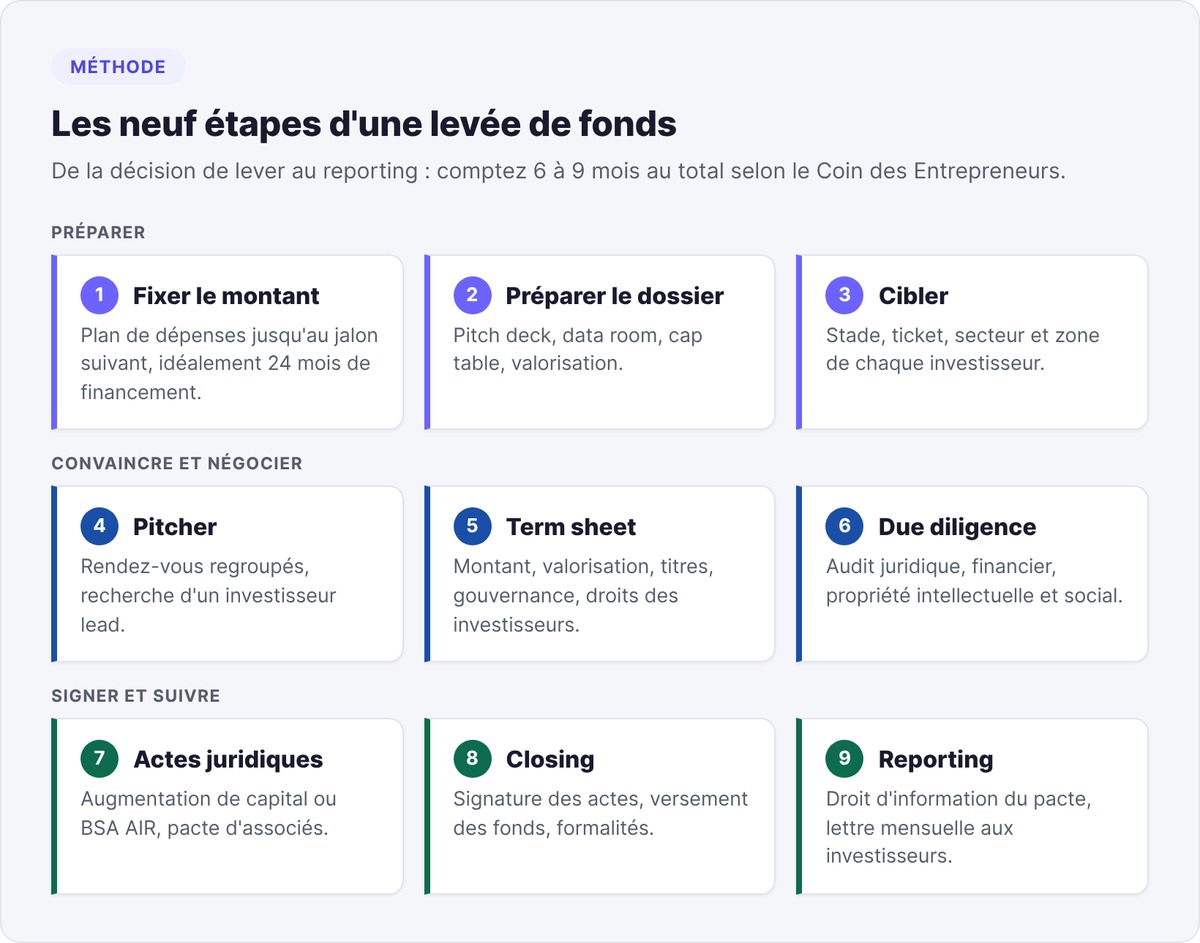
According to Bpifrance Création, fundraising "consists of seeking investors or institutions likely to invest in a company's capital, with predefined exit conditions." For a startup, the process follows nine steps: decide how much to raise, prepare your materials, target investors, pitch, sign a term sheet, go through due diligence, draft the legal documents, close, then report to your new shareholders.
Investors buy into your company's capital and receive shares in return. You get equity financing and give up part of the ownership. They hope to sell those shares at a higher price when they exit, for example through an acquisition.
The guide from Coin des Entrepreneurs suggests planning 6 to 9 months for the whole process. This guide walks through each step for a French startup raising pre-seed, seed or Series A.
Pre-seed, seed, Series A: the stages of a round
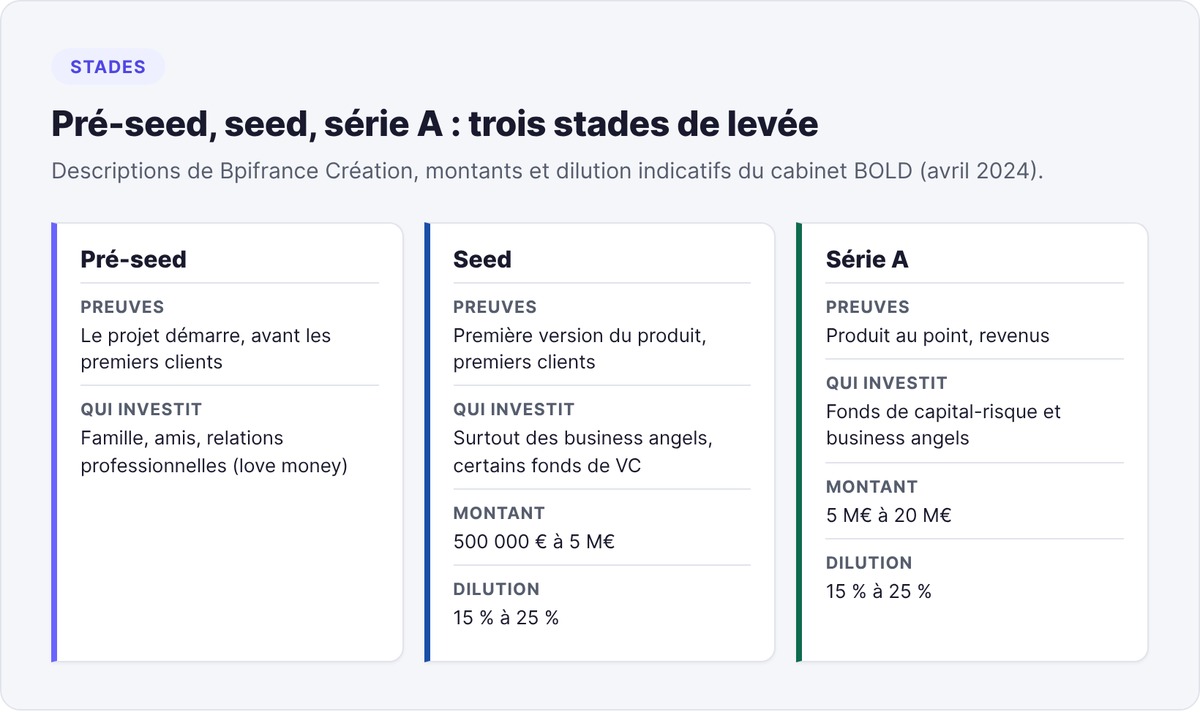
Your startup's stage determines the type of investor, the amount and the level of proof investors expect. Bpifrance Création describes three stages in its guide to finding investors.
- Pre-seed. You fund your early days through your personal network: family, friends, professional contacts. Bpifrance calls this "love money."
- Seed. A first version of the product exists and you have landed your first customers. Business angels invest mostly at this stage, alongside some venture capital funds.
- Series A. The business works, the product is mature and it generates revenue. Venture capital funds invest here alongside business angels.
Law firm BOLD gives ballpark figures in its fundraising timeline, published in April 2024: a seed round typically brings in €500,000 to €5 million, and a Series A €5 million to €20 million. In both cases, BOLD puts founder dilution at 15% to 25% per round.
Step 1: decide to raise and set the amount
A fundraise costs founders months of work and a share of the company. Raise when an equity injection lets you reach a milestone your revenue alone can't fund: hiring a head of sales, a commercial launch, a certification.
Calculating how much to raise
Start from your month-by-month spending plan up to the next milestone: salaries, product, customer acquisition. Coin des Entrepreneurs recommends seeking funding that ideally covers 24 months. Add a buffer for delays, since the next round will also take several months.
Choosing the right moment
Start while you still have cash in the bank. A founder who kicks off a raise with only a few months of runway negotiates from weakness, because the investor knows the deadline.
Step 2: prepare your materials
Preparation is the longest phase. BOLD estimates 3 to 6 months of preparation before the first investor offers come in.
The pitch deck
The deck covers the problem, the solution, the market, traction, the team, the amount you're raising and the use of funds. Prepare two versions: a reading version to send by email, and a presentation version for meetings. Our guide to building a winning pitch deck breaks down every slide.
The data room
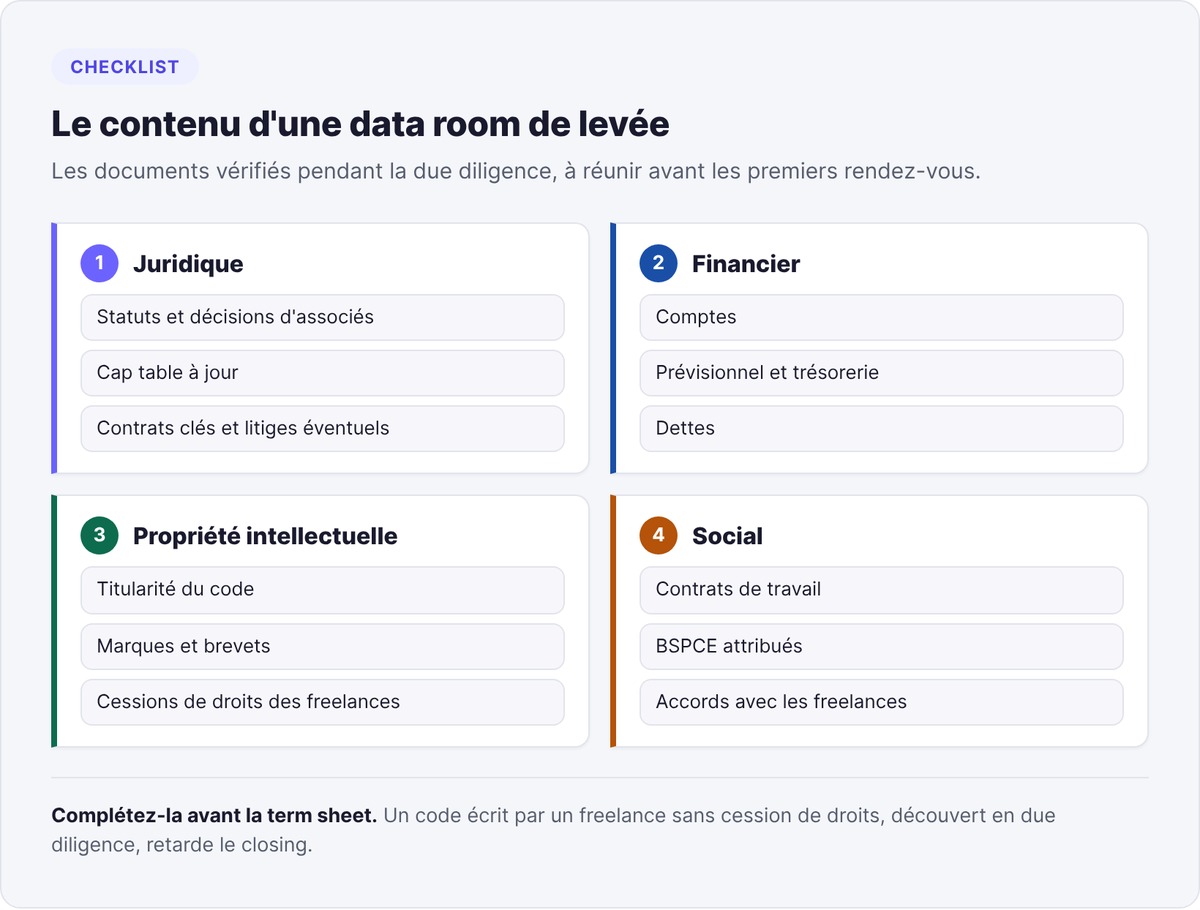
The data room is an online space holding the documents investors will review during due diligence. Set it up before your first meetings: it saves you weeks at step 6.
The cap table
The cap table lists your shareholders, their securities and their percentage of ownership, both current and fully diluted. Investors read it before proposing a price. Clean it up before launching your raise: our cap table guide walks through a worked example from incorporation to seed.
Valuation
Pre-money valuation is what your company is worth before the investment. Post-money adds the amount raised. The percentage you give up is the amount raised divided by the post-money valuation. Raise €1 million on a €4 million pre-money, and the post-money comes to €5 million, with investors owning 20%.
At pre-seed and seed, valuation is mostly negotiated based on the dilution founders can accept and the amount they need. Revenue-multiple methods take over once the company is billing customers.
Step 3: target investors
A short, focused list gets more meetings than a mass email blast. For each investor, check four criteria: stage, ticket size, sector and geography. Also look through their portfolio to spot any competitor they have already backed.
Business angels or VC funds
Business angels invest their own money, decide quickly and write smaller checks. VC funds manage money from limited partners and follow an investment committee process. Our VC vs. business angel comparison details the differences in ticket size and governance.
To build your list, see our guides to finding business angels and our roundup of the top VCs in France.
First contact
A warm intro from a portfolio founder or a mutual investor is still the most effective channel. If no intro is available, write a short email with your traction in the first line: our guide to cold emailing VCs offers a structure and examples.
Step 4: pitch and run your meetings
The first call is usually with an associate or a partner at the fund. If they're interested, the fund sets up further meetings, then a presentation to the full partnership.
Cluster your meetings within a few weeks. Two funds interested at the same time give you leverage on valuation and terms. Our guide to pitching a VC in France lists the questions to prepare for.
A first committed investor makes the rest easier. At pre-seed and seed, secure a "lead": the investor who sets the round's terms and whom the others follow.
Step 5: negotiate the term sheet
The term sheet, or letter of intent, summarizes the investment terms: amount, valuation, type of securities, governance, investor rights. It is largely non-binding, apart from its exclusivity and confidentiality clauses. Lawyers then carry its terms into every legal document.
Negotiate the clauses that matter at exit: liquidation preference, anti-dilution, founder vesting, veto rights. Our guide to the term sheet in France covers each clause and the points worth defending.
Step 6: due diligence
Once the term sheet is signed, the investor verifies the information in your materials. They usually hand this audit to a lawyer and, for the financials, to an accountant.
Due diligence generally covers four areas:
- Legal: articles of association, shareholder resolutions, cap table, key contracts, litigation.
- Financial: accounts, forecasts, cash position, debt.
- Intellectual property: ownership of the code, trademarks and patents.
- HR: employment contracts, BSPCE grants, agreements with freelancers.
A complete, up-to-date data room shortens this step. An issue found late, such as code written by a freelancer without an IP assignment, delays the closing or lowers the price.
Step 7: legal documentation
Lawyers on both sides turn the term sheet into binding documents. What those documents contain depends on how the round is structured.
Capital increase or BSA AIR
In a capital increase, the company issues new shares at a set price. Shareholders approve the transaction at a general meeting, and investors sign their subscription forms and wire the funds.
The BSA AIR (from the French for "quick investment agreement") defers the valuation. The investor wires the money right away and receives a warrant that converts into shares at the next priced round, with a discount or a valuation cap. Startups use it mainly at pre-seed or between rounds. Our complete guide to the BSA AIR explains how it works.
The shareholders' agreement
The shareholders' agreement governs the relationship between founders and investors: governance, information rights, tag-along and drag-along clauses, pre-emption. It supplements the articles of association and stays confidential. Our guide to the shareholders' agreement covers its main clauses.
Have your lawyer review these documents: the examples in this guide describe common practice and are no substitute for advice tailored to your situation.
Step 8: closing
Closing means signing all the documents and receiving the funds. Investors wire their subscriptions, the bank or notary issues the depositary certificate, and the company president formally records the completion of the capital increase.
After closing, you update the articles of association and the share transfer register, then file the change with France's one-stop business formalities portal (guichet unique).
Step 9: after closing, reporting
Your new shareholders expect regular updates. The shareholders' agreement often sets out their information rights: annual accounts, budget, KPI dashboard.
Beyond those obligations, a short monthly update keeps the relationship strong and sets up your next round, since your current investors may take part in it. Our guide to the monthly investor update includes a template.
The different ways to raise funds
A French startup can tap several sources of equity or quasi-equity financing.
| Type | Who provides the funds | Securities or consideration | Typical stage |
|---|---|---|---|
| Business angels | Individuals, often former entrepreneurs | Shares or BSA AIR | Pre-seed, seed |
| VC funds | Asset management firms, on behalf of limited partners | Shares, often preferred | Seed, Series A and beyond |
| BSA AIR | Business angels or funds | Warrants converted at the next round | Pre-seed, between rounds |
| Equity crowdfunding | Individuals via a licensed platform | Shares or bonds | Seed, growth |
| Honor loan (prêt d'honneur) | Entrepreneur support networks | Interest-free personal loan to the founder | Launch, pre-seed |
An honor loan funds the founder, who then invests it in the company. It strengthens equity without dilution and makes it easier to secure a bank loan. Crowdfunding platforms fall under EU Regulation 2020/1503, in force since November 10, 2021 according to the AMF, which licenses them in France.
How long does a fundraising round take
Coin des Entrepreneurs puts it at 6 to 9 months, from the decision to raise to receiving the funds. BOLD estimates 3 to 6 months of preparation before the first offers. After that come the term sheet negotiation, due diligence and drafting the legal documents.
Two factors stretch the timeline: an incomplete data room at due diligence and a round with no lead investor. A BSA AIR with business angels who are already on board usually closes faster than a capital increase with a fund.
The downsides of raising funds
Raising gives you resources and valuable partners. Weigh the costs too before you start.
- Dilution. Every round shrinks the founders' stake. After two or three rounds, founders can drop below a majority.
- Founder time. For several months, a founder spends much of the week on investors instead of customers.
- Commitments. The shareholders' agreement gives investors veto rights over certain decisions and preferences at exit.
- Growth pressure. A VC fund expects an exit at a high multiple. A profitable company with moderate growth fits that model poorly.
If your business can grow on its revenue, a bank loan or an honor loan, you keep your equity. Raising makes sense when speed matters more than the stake you hold.
Preparing a seed or Series A in France or Europe? swanbase invests €100,000 to €500,000 per startup: tell us about your startup.
FAQ
What are the steps of a fundraising round?
A fundraising round follows nine steps: set the amount, prepare your materials (deck, data room, cap table, valuation), target investors, pitch, negotiate the term sheet, go through due diligence, draft the legal documents, close, then report to your new shareholders.
What are the different ways to raise funds?
A startup can raise from business angels or VC funds, through a BSA AIR that converts at the next round, or through equity crowdfunding on an AMF-licensed platform. It can also top up its equity with an interest-free honor loan granted to the founder.
How long does a fundraising round take?
Plan for 6 to 9 months between the decision to raise and receiving the funds, according to Coin des Entrepreneurs. Preparing your materials takes 3 to 6 of those months according to law firm BOLD, before the term sheet, due diligence and legal drafting.
What are the downsides of raising funds?
Raising dilutes the founders, takes up much of their time for several months, gives investors veto rights and exit preferences, and imposes a fast-growth target compatible with a sale at a high multiple.
What is the difference between seed and Series A?
At seed, the startup has a first version of its product and its first customers, and business angels are the main investors. At Series A, the product is mature and generating revenue, and venture capital funds come in. BOLD puts seed rounds at €500,000 to €5 million and Series A at €5 million to €20 million.