A BSPCE (bon de souscription de parts de créateur d'entreprise, the French founder and employee equity warrant) gives an employee or executive the right to buy shares in their company at a price set on the day of the grant. The holder earns the difference between that price and the share value on the day they exercise their warrants, and then again on the day they sell their shares.
Article 163 bis G of the French General Tax Code (CGI) governs the scheme. The version in force since February 21, 2026 reflects two successive reforms: the 2025 Finance Act separated the taxation of the exercise gain from the taxation of the capital gain, and the 2026 Finance Act relaxed the issuance conditions.
This guide is written for founders who want to grant BSPCE to their first employees or to a CTO. It describes the law as it stands on September 26, 2026. For your specific situation, talk to a corporate lawyer or a chartered accountant.
BSPCE: definition and how they work
French lawmakers created BSPCE so that young companies could give their teams a stake in the business. A startup that pays below-market salaries makes up the difference with a share of its future value.
A right to buy shares at a fixed price
A BSPCE gives the holder no shares on the grant date. It gives them an option: to buy a set number of shares later, at the price fixed that day. If the share value rises, the holder buys below value. If it falls below the exercise price, they simply don't exercise and lose nothing.
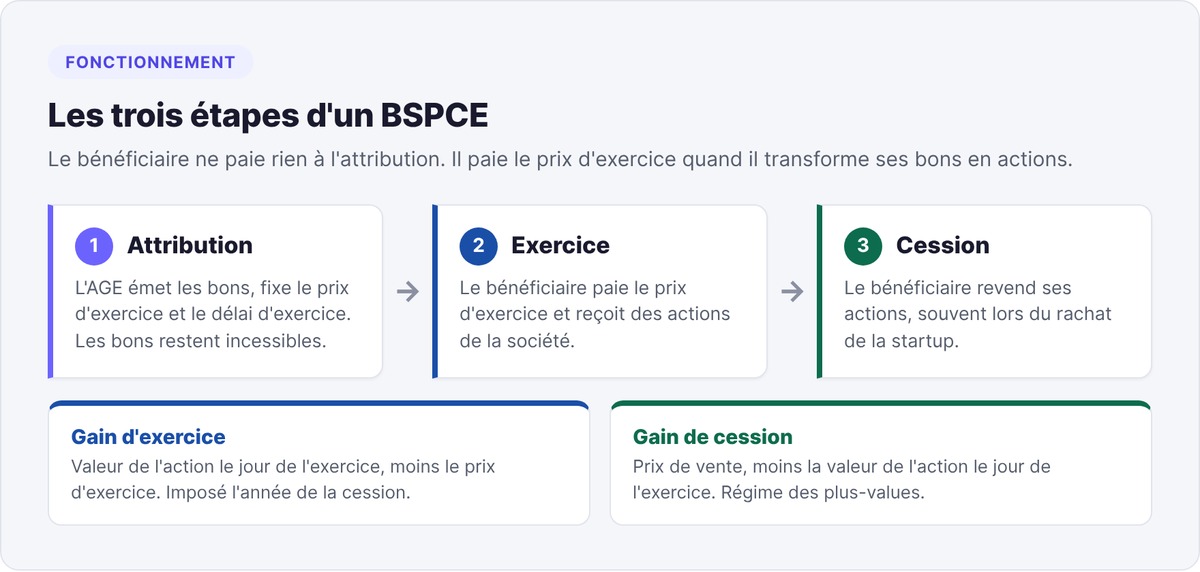
The holder pays nothing at grant. They pay the exercise price on the day they convert their warrants into shares.
Three stages: grant, exercise, sale
A BSPCE goes through three key dates.
- Grant. The extraordinary general meeting (EGM) issues the warrants and sets the exercise price and the period during which holders can exercise them.
- Exercise. The holder pays the exercise price and receives shares. The difference between the share value that day and the price paid is the exercise gain.
- Sale. The holder sells their shares, often when the startup is acquired. The difference between the sale price and the value on the exercise date is the sale gain.
Non-transferable warrants
According to Bpifrance Création, BSPCE are non-transferable. The holder can neither sell nor give them away: they either exercise them personally or let them expire. Only the shares obtained on exercise can be sold.
The conditions for issuing BSPCE
Not every company can issue BSPCE. Section II of Article 163 bis G sets out cumulative conditions, and the 2026 Finance Act relaxed one of them.
Conditions for the issuing company
Your company must meet all six of the following conditions on the grant date:
- A joint-stock company. Bpifrance Création lists the SA, SAS, SCA and SE. A SARL must first convert.
- Subject to corporate income tax. The company must be liable for corporate tax (IS) in France. Since January 1, 2020, a company based in the European Union and subject to an equivalent tax can also issue BSPCE, according to Bpifrance Création.
- Registered less than fifteen years ago.
- Not listed, or a market capitalization below €150 million.
- At least 15% of the capital held by individuals, directly and continuously, or by companies that are themselves at least 75% owned by individuals. The threshold was 25% before the 2026 Finance Act, according to Gide.
- A new business. The company must not result from a merger, restructuring, expansion or takeover of pre-existing activities, subject to the exceptions set out in the law.
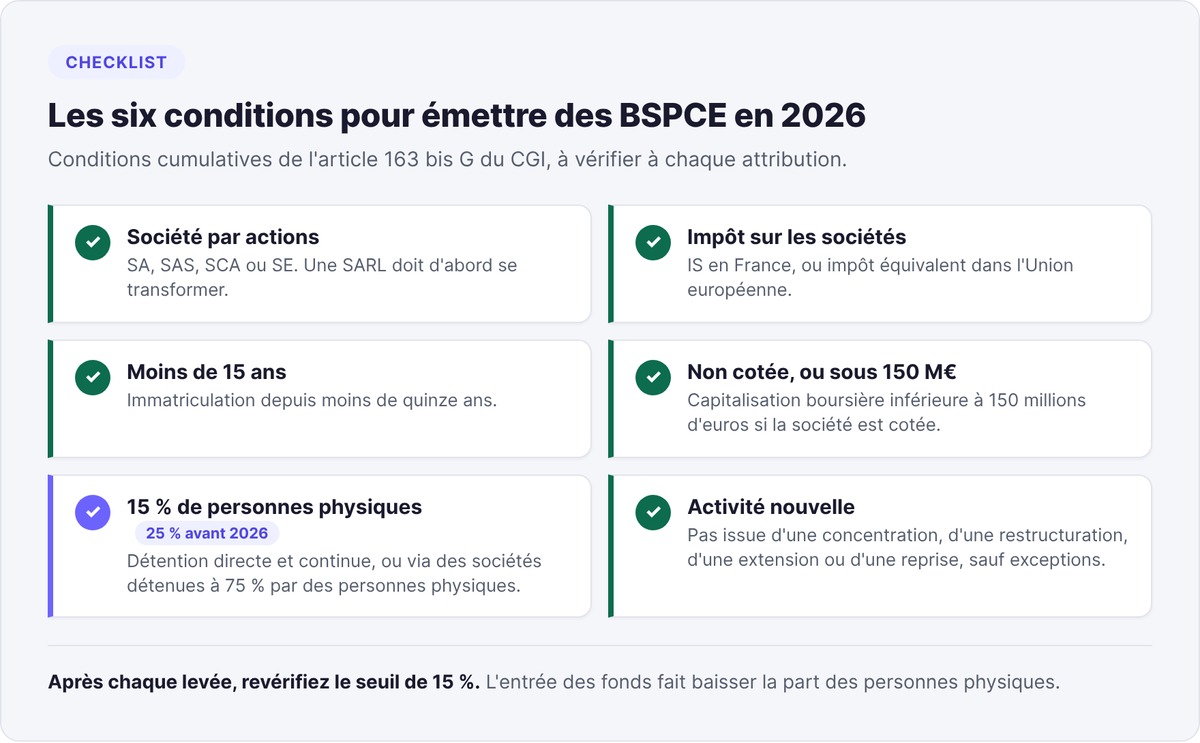
The 15% condition matters after every funding round. When funds come into the capital, the share held by individuals drops. Lowering the threshold from 25% to 15% lets more startups keep access to BSPCE after several rounds, Gide notes. Track this ratio in your cap table before each new grant.
Eligible recipients
The company can grant BSPCE to:
- its employees;
- its executives who are taxed like employees, such as a salaried SAS president;
- members of its board of directors, supervisory board or equivalent body;
- employees and executives of subsidiaries it owns at least 75%, and since the 2026 Finance Act, of second-tier subsidiaries when the product of the successive holdings reaches 75%.
Consultants, freelancers and advisors with neither an employment contract nor a corporate office fall outside the scheme. For them, startups generally use BSA, covered below.
The decision at an extraordinary general meeting
Shareholders vote on the issuance at an EGM. The meeting sets the exercise price and the exercise period. Section III of Article 163 bis G allows it to delegate the choice of recipients to the board of directors, or to the equivalent body in your SAS. In practice, the EGM votes a pool, then the delegated body grants warrants as hiring progresses.
The BSPCE exercise price
The exercise price determines the holder's entire gain. The lower it is relative to future value, the more the warrants are worth.
The general rule
The EGM sets the price on the grant date. According to Bpifrance Création, this price must reflect the real value of the share on that date. For an unlisted startup, that value is open to debate: a chartered accountant or valuation firm usually documents the method used.
After a funding round
If the company completed a capital increase in the six months before the grant, the exercise price must be at least equal to the issue price of the shares in that round. The law allows a discount reflecting any loss of economic value of the share since that issuance.
In concrete terms, a startup that just raised at €10 per share cannot set its BSPCE exercise price at €2 the following month unless it can justify the discount. Investors often hold preferred shares, with rights that employees' ordinary shares lack. These differences in rights are among the arguments for a discount, which a valuer should quantify.
BSPCE vesting and cliff
Article 163 bis G says nothing about vesting. The vesting schedule sits in the plan rules you have adopted alongside the issuance.
Vesting spreads the right to exercise the warrants over several years. The cliff sets an initial period during which the holder vests nothing. In its Rewarding Talent guide, Index Ventures describes the most common setup: four years of vesting with a one-year cliff. An employee who leaves after eight months keeps no warrants. After twelve months, they vest a quarter of their warrants, then the rest in regular installments.
The plan rules also cover what happens to the warrants when an employee leaves: the window to exercise vested warrants, forfeiture of unvested ones, and the treatment of dismissal or resignation. Test several departure scenarios in our vesting simulator before drafting the offer.
For a co-founding CTO, vesting usually applies to their shares through the shareholders' agreement. Our guide to finding a co-founder explains this mechanism along with good leaver and bad leaver clauses.
BSPCE taxation in 2026
Since the 2025 Finance Act, the tax rules distinguish between two gains. This regime applies to shares subscribed from January 1, 2025, regardless of when the warrants were granted.
The exercise gain
The exercise gain is the share value on the exercise date minus the exercise price paid. The tax authorities treat it as an employment benefit and tax it in the year the holder sells their shares, under Section I of Article 163 bis G. Exercising warrants therefore triggers no tax as long as the holder keeps their shares.
The rate depends on how long the holder has worked at the company on the sale date:
- Three years or more: a flat rate of 12.8%, or optionally the income tax scale applicable to salaries.
- Less than three years: a 30% rate, with no option for the scale.
Social security contributions are added on top of this tax. Since the 2026 Finance Act, time spent at an eligible subsidiary or second-tier subsidiary counts toward the three years, according to Gide.
The sale gain
The sale gain is the sale price of the shares minus their value on the exercise date. It falls under the capital gains regime for securities in Article 150-0 A of the CGI, with no length-of-service condition. According to Bpifrance Création, this gain is subject to the 12.8% flat tax, or optionally the progressive scale, plus 18.6% in social security contributions.
How to report BSPCE
The company gives the holder an individual statement summarizing their warrants, according to Bpifrance Création. The holder then reports their gains on the supplementary 2042 C return. The 2026 2042 C guide provides, for BSPCE exercised from January 1, 2025:
- box 3PC for an exercise gain taxed at 12.8% (at least three years at the company);
- box 3PE for an exercise gain taxed at 30% (less than three years at the company);
- box 1AY (1BY for the second filer) if a holder with more than three years opts to be taxed as salary.
The sale gain is reported with capital gains on securities. Box numbers change from year to year, so check the guide for the year of your sale.
A worked BSPCE example
The following calculation is illustrative, with figures chosen for readability. It describes no real case and does not replace a simulation by a chartered accountant.
Your startup grants 10,000 BSPCE to its first developer, with an exercise price of €1 per share, equal to the share value that day. Five years later, the share is worth €8. The developer exercises their warrants and pays €10,000. A year later, an acquirer buys the startup at €10 per share.
- Exercise gain: (€8 − €1) × 10,000 = €70,000. With more than three years at the company, tax at the 12.8% rate comes to €8,960, before social security contributions.
- Sale gain: (€10 − €8) × 10,000 = €20,000. At the 12.8% flat tax plus 18.6% in social security contributions, the total levy comes to €6,280.
With the same exercise gain and a sale before three years at the company, the 30% rate would have raised that tax to €21,000.
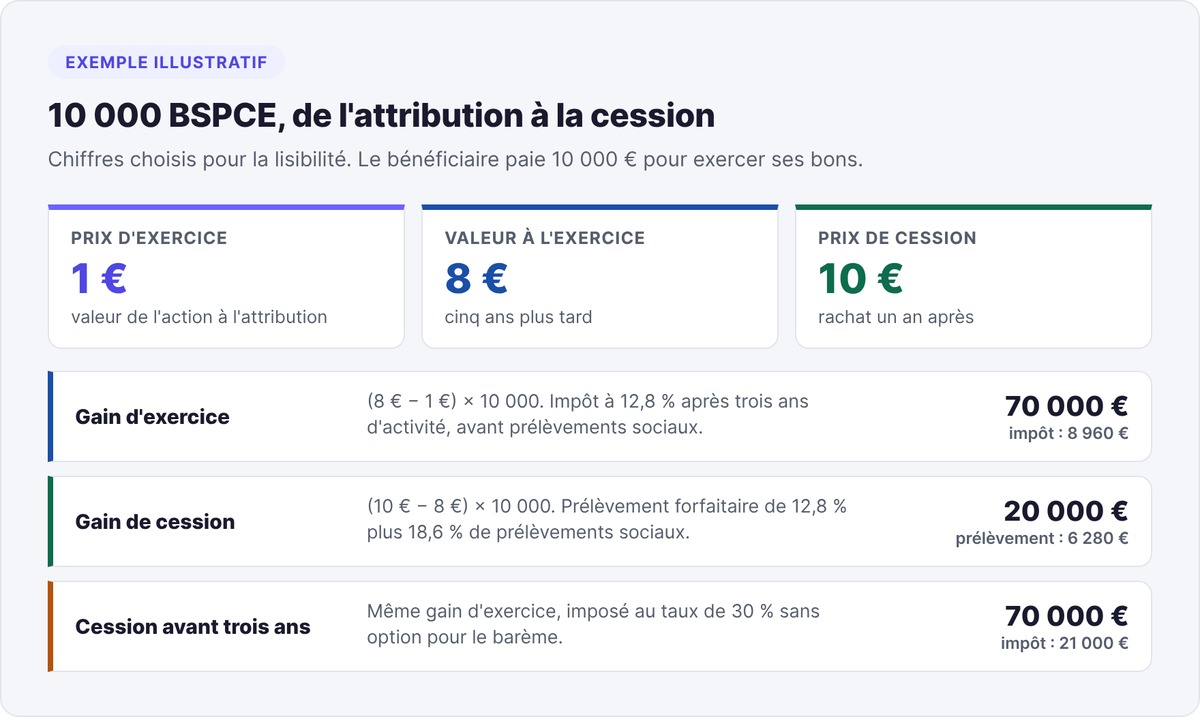
In many acquisitions, the holder exercises their warrants and sells their shares on the same day. The value at exercise then equals the sale price, and the entire gain counts as exercise gain. The holder also has to put up the exercise price on the day of the transaction. Our BSPCE simulator helps you show these amounts to a new hire.
BSPCE, BSA, AGA or stock options
Four instruments let you give someone a stake in the company. They differ in who can receive them, the entry cost and the tax treatment.
- BSPCE are for employees, executives taxed like employees, and board members. The holder pays nothing at grant and benefits from the Article 163 bis G regime. Only eligible companies can issue them.
- BSA (bons de souscription d'actions, share subscription warrants) are open to anyone: advisors, consultants, business angels. The holder usually buys the warrant at its value, then pays the exercise price. The Article 163 bis G regime does not apply. Don't confuse them with the BSA Air, a financing instrument that converts an investor's money into shares at the next round.
- AGA (actions gratuites attribuées, free share awards) grant shares with no exercise price after a vesting period. The employee pays nothing upfront, and the company pays an employer contribution.
- Stock options work like BSPCE, with an exercise price, but without the company age conditions or the Article 163 bis G tax regime. A company that is ineligible for BSPCE can use them.
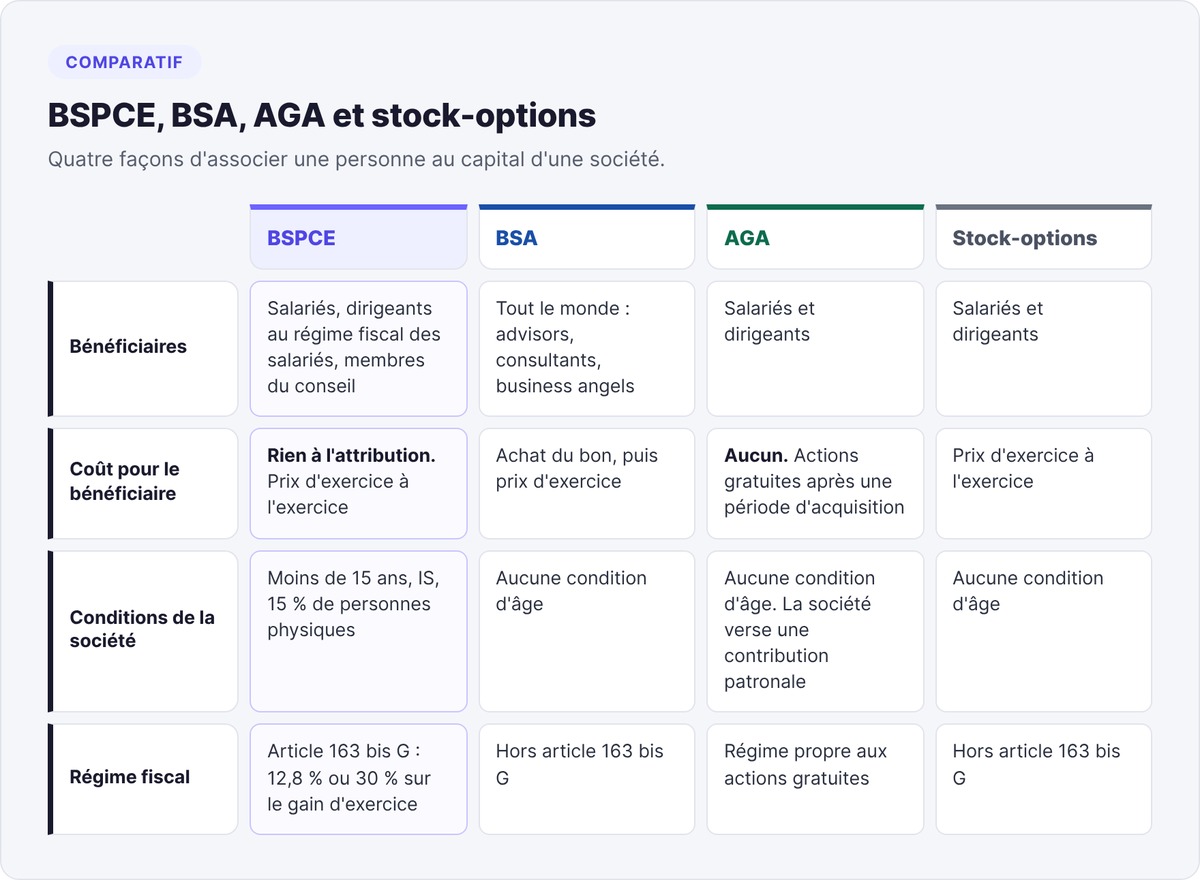
BSA complement BSPCE for people outside the salaried team.
Pros and cons of BSPCE
The pros
- No cost at grant for the holder, and a locked-in exercise price that lets them capture all the upside.
- A 12.8% rate on the exercise gain after three years at the company.
- A retention tool: with vesting and the three-year threshold, employees have a real reason to stay.
The cons
- The 30% rate for a holder who sells before three years at the company.
- The exercise price to put up at exercise, sometimes several thousand euros.
- Uncertain value: shares in an unlisted startup can usually only be sold in an acquisition or an IPO. If the value never exceeds the exercise price, the warrants are worth nothing.
- Dilution for founders and investors with every exercise.
- Paperwork: EGM, plan rules, price valuation, and individual statements for holders.
Common founder mistakes
Setting the exercise price below the last round price. Within six months of a capital increase, a lower price without a justified discount exposes both the company and the holder to a challenge of the tax regime. Document the valuation method.
Waiting for the round to grant. Early employees and a CTO hired before the seed get a low exercise price if they receive their warrants before the round. After the round, the price tracks what investors paid.
Losing track of the conditions after several rounds. At every round, check that individuals still hold 15% of the capital and that the company is under fifteen years old. A company that fails a condition can no longer issue BSPCE.
Overlooking the pool in the term sheet. Funds often ask you to create or expand a BSPCE pool before they come in, which dilutes the founders first. Our guide to term sheet clauses covers this negotiation.
Promising BSPCE without written plan rules. A verbal promise of "1% of the company" breeds misunderstandings. Put the number of warrants and the exercise price in the grant letter, with vesting and the treatment of warrants on departure set out in the plan rules.
Granting BSPCE to your first employees and your CTO
BSPCE come into play at two main moments in an early-stage startup's life. For your first hires, they top up a below-market salary and align the new hire with long-term value. For a salaried CTO hired after the MVP or after a round, they replace the equity stake reserved for a co-founder.
Before granting, check the company's eligibility, have the EGM vote the pool, set a documented exercise price, then draft plan rules with vesting and a cliff. Have a corporate lawyer review everything: a mistake on the price or a condition costs the holder dearly on the day of the sale.
Building your startup and getting ready for your first hires? swanbase supports early-stage founders over the long term, in Paris and remotely, at €0, by application; swanbase takes equity. Apply.
FAQ
What is a BSPCE?
A BSPCE is a warrant that gives an employee or executive the right to buy shares in their company at a price set on the grant date. The holder pays nothing at grant and benefits from the rise in share value between the grant and the sale.
What are the downsides of BSPCE?
The holder pays 30% tax on the exercise gain if they sell before three years at the company. They must also put up the exercise price, and their shares remain hard to sell before the startup is acquired. For the company, BSPCE require an EGM, plan rules and a documented exercise price.
What is the difference between BSPCE and BSA?
BSPCE are for employees, executives taxed like employees, and board members, with no cost at grant and the tax regime of Article 163 bis G of the CGI. BSA are also open to advisors and consultants. Their holders usually buy the warrant and do not benefit from that regime.
How do you report BSPCE on your tax return?
The company gives the holder an individual statement. On the 2026 2042 C return, the exercise gain goes in box 3PC if taxed at 12.8% and in box 3PE if taxed at 30%. The sale gain is reported with capital gains on securities. Check the box numbers in the guide for the year of the sale.
How are BSPCE taxed in 2026?
The exercise gain is taxed at 12.8% if the holder has worked at the company for at least three years on the sale date, and at 30% otherwise, plus social security contributions. The sale gain falls under the capital gains regime, taxed at 12.8% or the progressive scale, plus 18.6% in social security contributions.