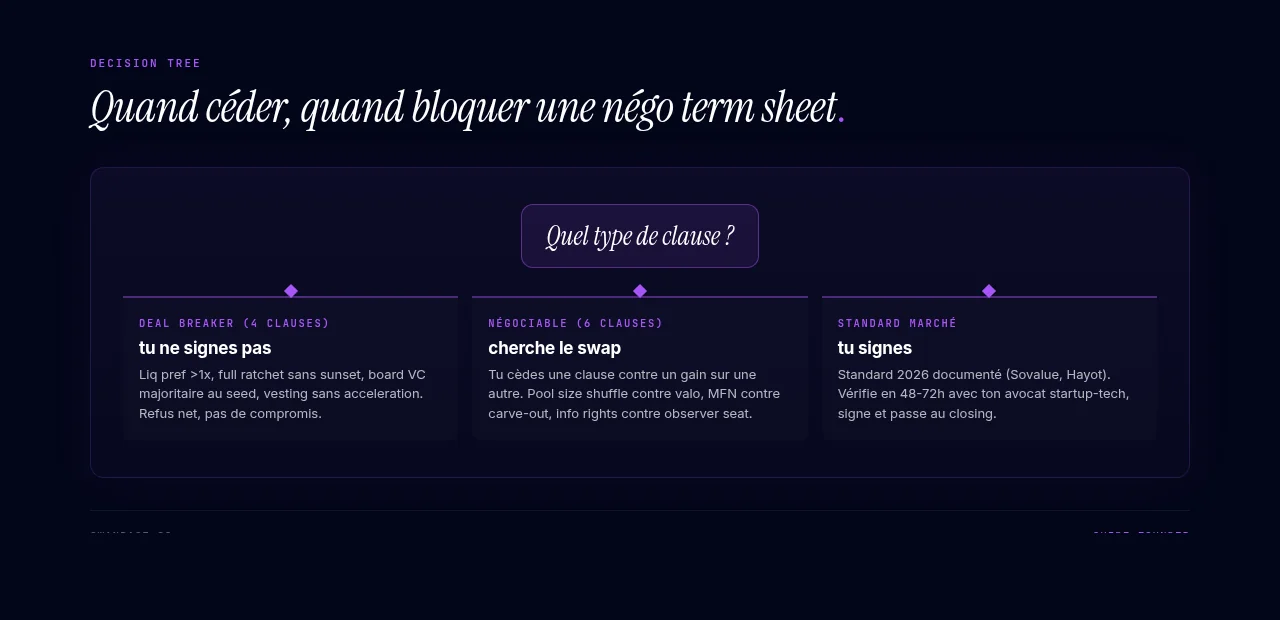
A French term sheet in 2026 contains around ten canonical clauses. Of those ten, four are deal breakers: a liquidation preference above 1x non-participating, full ratchet anti-dilution, an investor-majority board from pre-seed onward, and vesting with no acceleration clause. The other six can be negotiated or conceded depending on your leverage. The VC calls you on a Friday night, wants an answer by Tuesday noon, and in front of you sit six pages talking about "1x participating capped," "broad-based weighted average," and "drag-along 75% threshold." Golden rule: you're not a lawyer, so consult one before signing. But understanding the 2026 market value of each clause means walking into your lawyer's office with clear objectives, not a vague "I want less dilution."
What a term sheet is, in two sentences
A term sheet (or letter of intent) is the summary document, six to ten pages, in which a VC lays out the economic and legal terms of its investment. It is not legally binding, except for confidentiality, exclusivity of negotiation, and break-up fees1. What binds you is the shareholders' agreement signed at closing, six to twelve weeks later. But walking back a signed term sheet burns your reputation in the ecosystem. Sign a term sheet and you've essentially signed the bulk of the final deal.
What a typical French term sheet contains
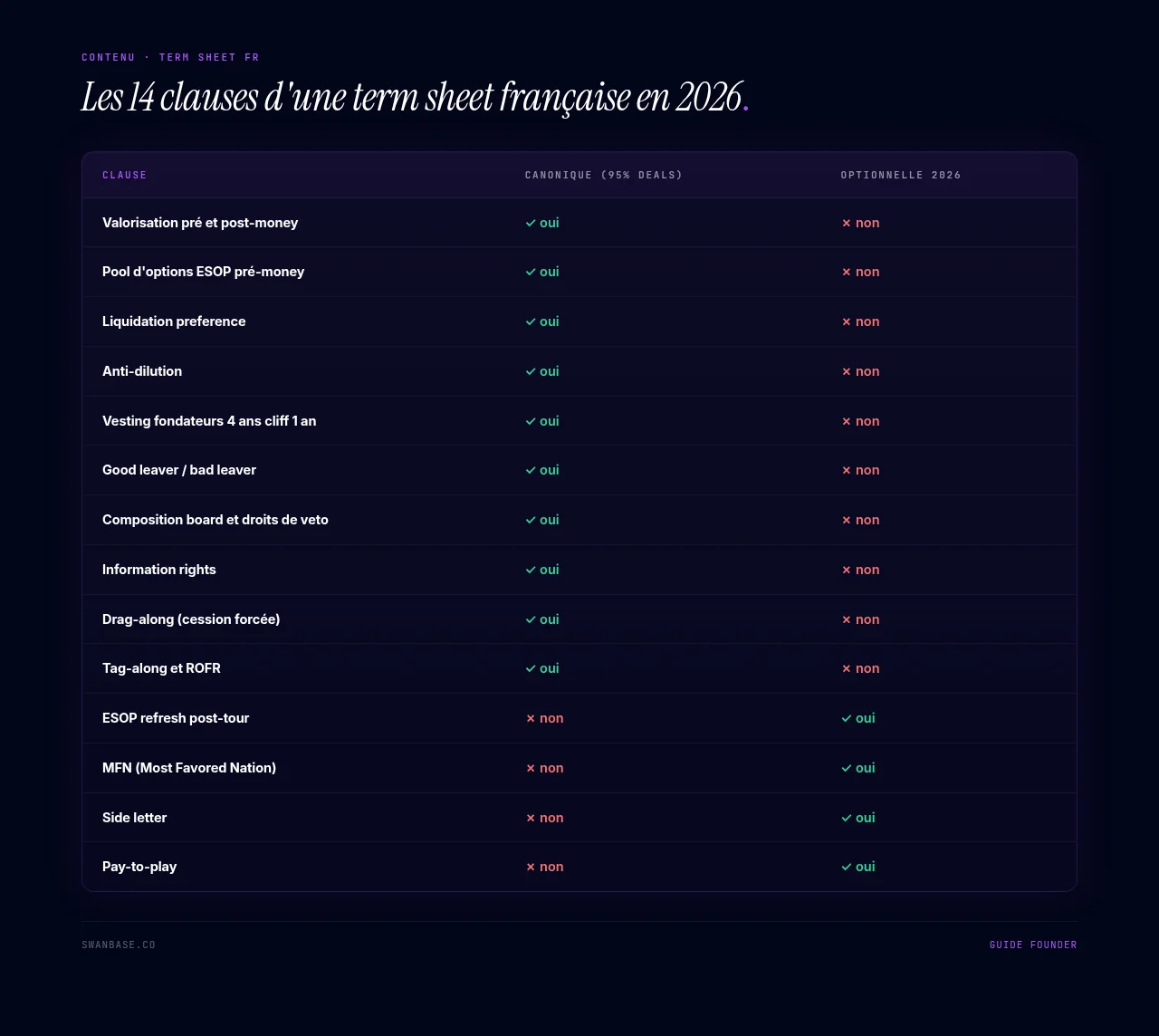
The ten canonical clauses
A French seed or Series A term sheet breaks into two blocks: the economics (who pays what on exit) and governance (who decides what).
The ten clauses you'll find in 95% of deals:
- Pre-money and post-money valuation
- Option pool (ESOP) sized pre-money
- Liquidation preference (1x non-participating in the vast majority of cases)
- Anti-dilution (usually broad-based weighted average)
- Founder vesting (4 years, 1-year cliff)
- Good leaver / bad leaver
- Board composition and veto rights
- Information rights (monthly or quarterly reporting)
- Drag-along (forced sale)
- Tag-along and right of first refusal (ROFR)
The three or four optional clauses seen in 2026
On top of those ten, depending on the maturity of the deal and the VC's profile:
- Post-round ESOP refresh: the investor requires the pool to be topped up before each subsequent round.
- MFN (Most Favored Nation): if you grant a more favorable clause to a later investor, it applies retroactively to the MFN investor.
- Side letter: an annex to the agreement giving a specific investor certain rights (enhanced info rights, observer seat, MFN). Very handy for closing a deal without amending the main agreement.
- Pay-to-play: a shareholder that doesn't participate in the next round loses its preferential rights. Increasingly seen in dilutive bridges.
Pre-money valuation: how to position yourself
2026 market ranges
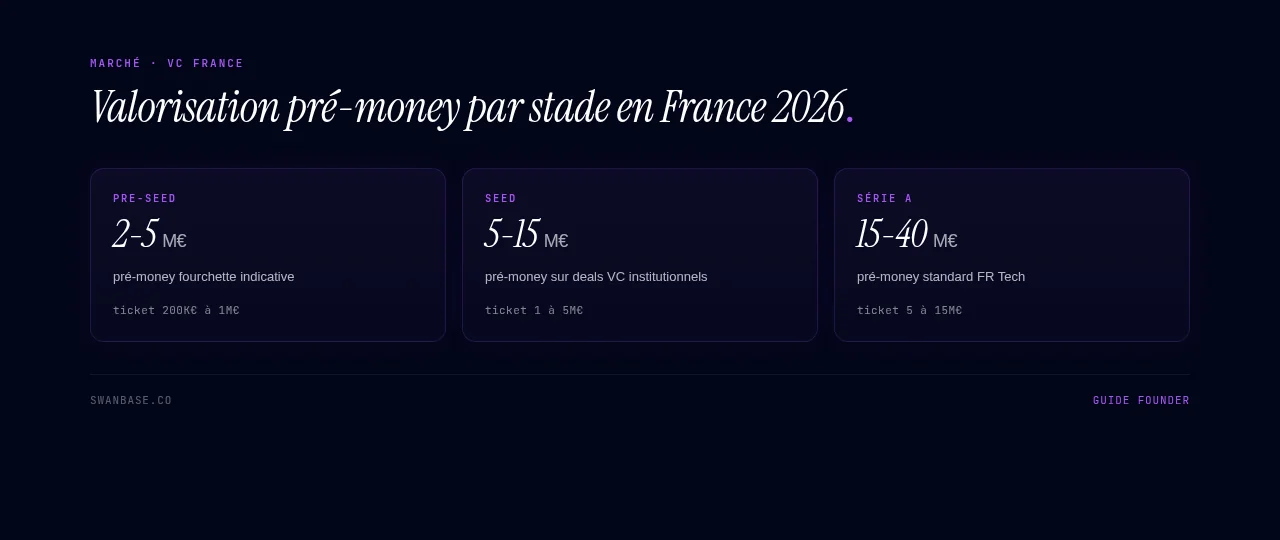
Here's what we observe in France in 2026, indicative ranges on institutional VC deals2:
- Pre-seed: €2M to €5M pre-money (€200K to €1M invested)
- Seed: €5M to €15M pre-money (€1M to €5M ticket)
- Series A: €15M to €40M pre-money (€5M to €15M ticket)
Above that, you're playing in the league of deep tech with a patent or serial founders. Below it, you're accepting heavy dilution relative to the market.
How to justify a valuation
Three methods:
- Revenue / ARR multiple based on comparable transactions (the VC knows its sector, so come with two or three comps you've dug into).
- DCF if you have financial visibility over 24-36 months (rare before Series A, valid for recurring SaaS).
- Benchmark of recent raises in your sector, stage, and geography. Often the most powerful lever: "Here are three comparable deals raised at €12M pre-money in 2025."
The VC also looks at projected cumulative dilution over the next three rounds. Valuation is never viewed in isolation.
Negotiation script if the VC comes in 30% low
The VC offers €7M pre-money when you were aiming for €10M. Four angles, in order:
- Facts. "We have three recent comps at €9-11M pre-money for startups at the same ARR ([X], [Y], [Z]). What are you basing your €7M on?"
- Mechanics. "At €7M, I'm diluting 30% at seed. You know as well as I do that I'll be under-incentivized at Series A if I drop below 50% founder ownership."
- Trade-off. "If the valuation won't move, what does move? A smaller pool? A bigger carve-out? A simplified liquidation pref?"
- Plan B. "I'm in talks with [another fund]. I'll get back to you Thursday."
Point 4 can't be bluffed. No other fund in reality, no bluff: this is a world of 200 people.
Liquidation preference: the clause that costs founders
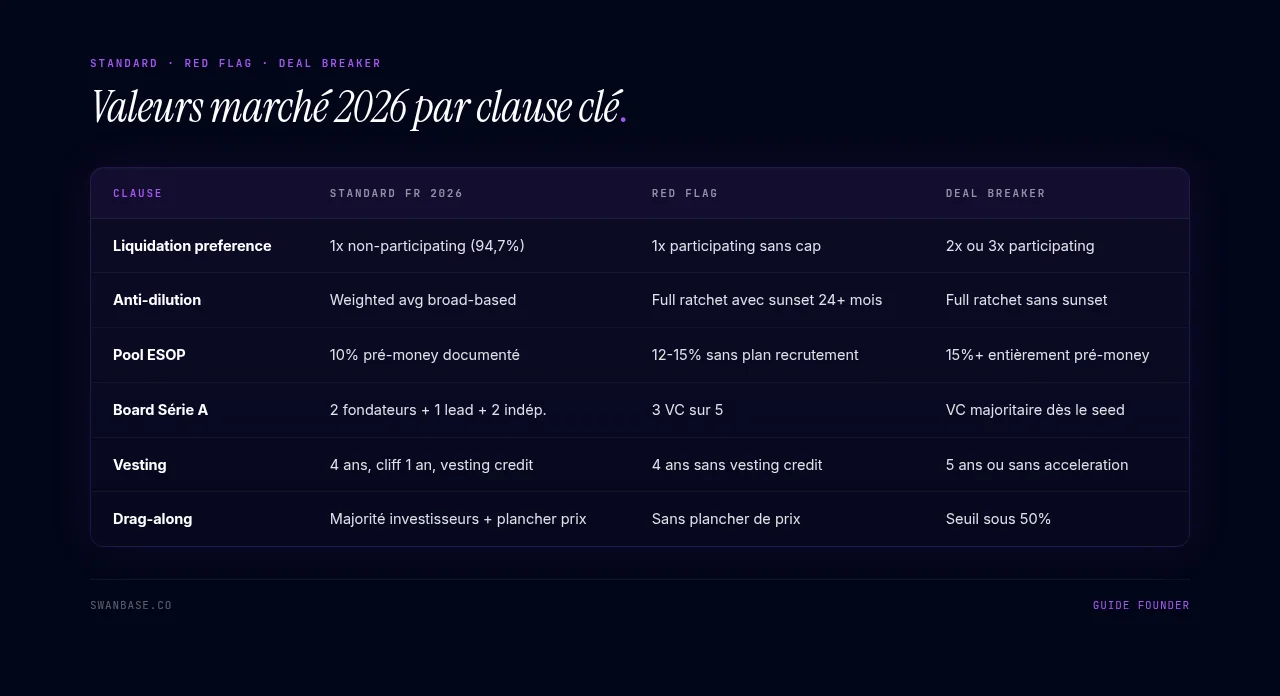
1x non-participating, the FR 2026 standard
According to the Sovalue 2026 report, based on 250+ FR Tech valuations, 94.7% of deals use non-participating liquidation preference, and the 1x multiple dominates by a wide margin (2x or 3x are marginal)3. In practice, on exit, the investor takes the higher of (i) its initial investment and (ii) its pro-rata share. It doesn't take both. That's the definition of "founder-friendly."
Example: a VC puts in €2M for 20% at seed. The company sells three years later for €8M. Pro-rata share: €1.6M. Investment: €2M. The VC takes €2M. That leaves €6M for the other shareholders.
1x participating, the tier-2/3 red flag
With participating, the investor takes back its investment first, then shares in the remainder pro-rata. On the same example: the VC takes €2M, then 20% of the remaining €6M (€1.2M), for €3.2M total. The others split €4.8M instead of €6M.
In 2026, you won't see participating from FR Tech tier-1 funds. At 5.3% of the market, it's negligible3. When a VC pitches participating "because that's standard for us," it's false, and it tells you something about the fund.
2x, 3x, and the distressed-deal clause
Anything beyond 1x (2x, 3x) signals a difficult deal: an inflated valuation, a fund that wants its minimum return at all costs, or a last-chance bridge. If you see "2x participating," step back and push on the valuation rather than signing.
How to negotiate toward 1x non-participating
Three levers:
- Cite the market data. "Sovalue 2026: 94.7% of the FR Tech market is 1x non-participating. Why are you asking me for the other 5%?"
- Propose a cap. If the investor insists on participating, negotiate a cap at 2x maximum. Beyond the cap, it flips to non-participating. That's an acceptable compromise, not ideal.
- Trade it for a carve-out. You accept a slightly tougher clause if the investor accepts a bigger management carve-out. 10% is the market reference (45% of the deals analyzed)3.
Anti-dilution: full ratchet vs weighted average
2026 standard: broad-based weighted average
Anti-dilution protects the investor in the event of a down round (a subsequent round at a lower valuation). Its purchase price is readjusted.
2026 standard in France: broad-based weighted average with BSPCE/AGA carve-outs and a sunset at Series C or IPO4. Proportional protection, weighted by the volume of the down round. It's the formula every standard Series A agreement uses.
Full ratchet: avoid it except in a rescue round
Full ratchet is the brutal version: on a down round, the previous investor's purchase price is dropped to the new round's price. Founder dilution can reach 5 to 15 points4. On a big valuation correction, it can take your founder stake from 35% to 22% over a weekend.
You see full ratchet when: a rescue round with no negotiating leverage, an opportunistic secondary investor, or a tier-2 fund replicating a 2018 American template. In all three cases, the answer is no. Or, at best, with a short sunset (12-18 months) and a massive carve-out.
Founder vesting: 4 years, 1-year cliff
FR standard: 4 years linear, 1-year cliff
Founders subject their shares to vesting: gradual acquisition over 4 years, with a 1-year cliff4. Leave before 12 months and you lose 100%. Between 12 and 48 months, you vest linearly (1/48 per month). At 4 years, you own it all.
If the company is already 18 months old when you sign, the 2026 standard provides for a vesting credit: you start with 18/48 already vested. Never sign a term sheet that resets you to zero when you've been building for three years.
Acceleration: single trigger or double trigger
If the company is acquired and you're let go right after, what happens to your unvested shares?
- Single trigger: a change of control is enough, and everything vests immediately. Very founder-favorable, rare in France.
- Double trigger: you need both a change of control AND termination for your vesting to accelerate. That's the 2026 standard4.
Without an acceleration clause, the acquirer can fire you the day after closing and you lose all your remaining vesting. Double trigger acceleration is non-negotiable. It's a deal breaker if it's missing.
Board, veto rights, info rights
Typical board composition by stage
In France, for an SAS, the "board" is a statutory strategic committee or supervisory board. Standard 2026 composition:
- Pre-seed: no formal board or a light board (2-3 seats, founder majority)
- Seed: 3 seats (2 founders + 1 lead investor)
- Series A: 5 seats (2 founders + 1 lead investor + 2 independents)4
The golden rule: founders never lose their board majority before Series B. If a Series A term sheet asks for 3 investor seats out of 5, the answer is no.
Reasonable vs abusive veto rights
The standard 2026 reserved matters (decisions requiring the investor's express consent):
- Amendment of the bylaws
- Capital increase or reduction
- Significant asset disposal (above a set threshold)
- Debt above a threshold
- Hiring or firing C-level executives
- Dividend payments
- Merger, acquisition, disposal4
What should make you push back: a veto right over operational decisions (non-C-level hires, commercial contracts, tooling choices). A VC that wants to block hiring a Head of Sales is a VC that wants to co-run the company. That's not its role.
Drag-along, ROFR, MFN: the less glamorous clauses that matter
Three clauses that get handled in five minutes and cost you dearly if they're poorly calibrated.
Drag-along. If a qualified majority of shareholders accepts a buyout offer, minority holders are forced to sell on the same terms4. 2026 standard: a threshold of "majority of investors + lead consent + sometimes one founder's consent." Negotiate a price floor (a multiple of the investment) below which the drag-along doesn't apply. Without a floor, a VC can force you into a sale at a loss.
Tag-along (co-sale right). If a majority shareholder sells, minority holders join the sale. The mirror image of drag-along, on the minority-protection side. Standard, rarely a source of friction.
Right of first refusal (ROFR). Before any sale to a third party, the seller must first offer to the other shareholders on the same terms. Standard. Little to negotiate, except the response window (15 days is reasonable, 60 days blocks any sale).
ESOP, vesting accelerator, side letters: the 2026 clauses to know
Pre-money ESOP sizing. The investor requires an option pool of 8% to 15% post-money, created before it comes in. The pool dilution is borne entirely by the founders, not shared4. The counter-move: the pool size shuffle. You document a costed hiring plan over 18-24 months. Only the pool needed for that plan is created pre-money. The rest goes post-money and is shared. Without documentation, the VC imposes 12% or 15%.
Side letters. Increasingly used to give a specific investor (often a tier-1 joining a syndicate) certain rights without amending the agreement: monthly info rights, an observer seat, MFN. Handy for closing a multi-investor deal. Watch for asymmetries that annoy the others in the next round.
Explicit vesting acceleration. Ask for double trigger directly in the term sheet, not just in the agreement.
The deal breakers vs concessions matrix
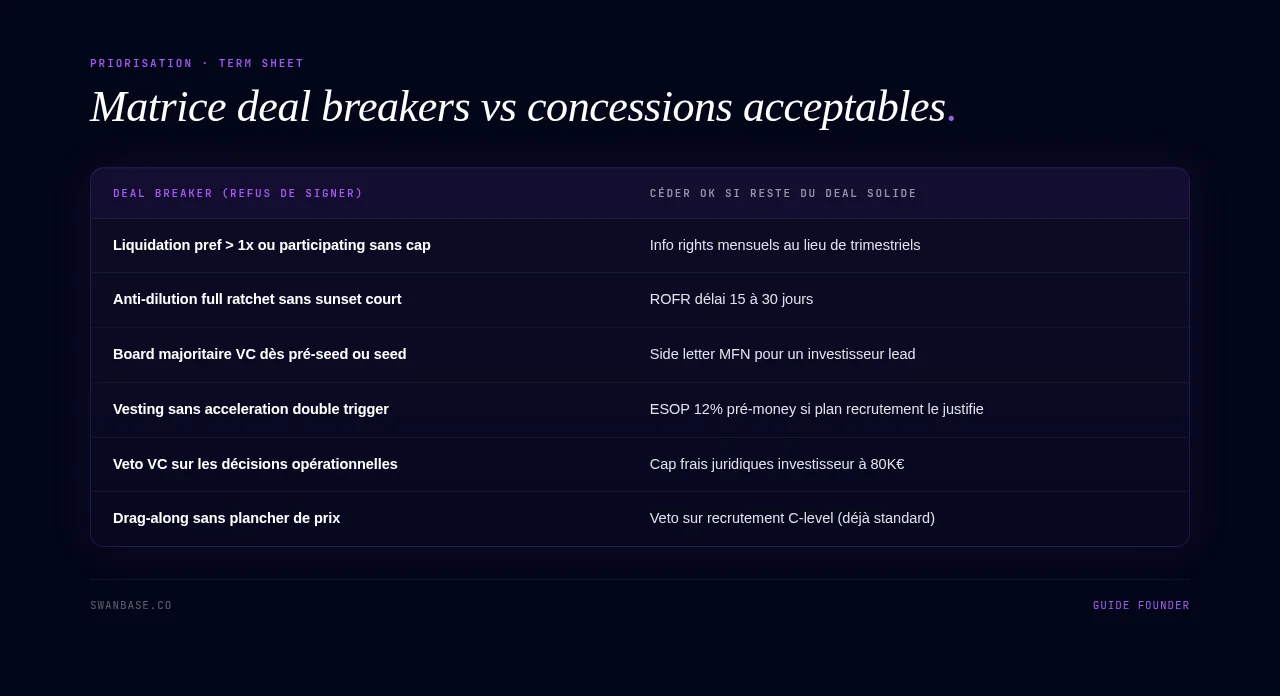
This is the table missing from 90% of articles on the French term sheet. Across 10 clauses, you can't negotiate everything at once. Here's how to prioritize.
Deal breakers (refuse = you don't sign)
- Liquidation preference > 1x or participating without a 2x cap.
- Full ratchet anti-dilution without a short sunset and a massive carve-out.
- VC-majority board from pre-seed or seed.
- Vesting without a double trigger acceleration clause.
- VC veto over operational decisions (non-C-level hires, commercial contracts).
- Drag-along without a price floor.
Fine to concede if the rest of the deal is solid
- Monthly info rights instead of quarterly.
- ROFR window of 15-30 days.
- Side letter MFN for a lead investor.
- ESOP at 12% pre-money (instead of 10%, if the hiring plan justifies it).
- Investor legal fee cap at €80K instead of €50K (typical Series A practice: €50K to €100K4).
- Veto over C-level hiring (already standard).
Tier-1 vs tier-2/3 VC: the clause differences
French tier-1 VCs (Kima, Daphni, Partech, Elaia, Breega, Iris, Korelya, Eurazeo, Serena) have well-oiled processes. Their term sheets converge on market standards: 1x non-participating, broad-based weighted average, 4-year vesting with a 1-year cliff, a balanced board. You negotiate at the margins.
Tier-2/3 funds (regional, sector-specific, family offices) vary more. You might come across:
- A term sheet that's more founder-friendly than a tier-1's (rare, on deals where the fund is desperate to enter a space).
- A term sheet with dated clauses (full ratchet by default, participating without a cap, 5-year vesting). Out of unfamiliarity or habit.
- An opportunistic term sheet on a strained deal (dilutive bridge, rescue). The VC pulls the blanket its way.
When you receive a term sheet, your first question: "for this fund, is this their tenth deal of the year or their third in five years?" Volume drives convergence toward the standard.
To dig into fund selection before the term sheet, see our guide on how a VC fund works and how to pitch a VC in France.
The lawyer's role and the cost
Startup-friendly firms in France
You don't want a generalist firm doing your term sheet between two corporate M&A files. You want a lawyer who has seen 50 term sheets this year. Three categories:
- Boutique startup-tech firms (3 to 15 lawyers), Paris, sometimes Lyon or Bordeaux. Widely used at pre-seed and seed.
- Mid-market firms with a tech practice (20 to 80 lawyers). Strong at Series A and beyond.
- International firms (Gibson Dunn, Latham, Cleary, Linklaters). From Series B onward. Expensive, US/UK standards.
The right lawyer gets back to you within 48 hours and tells you, in two pages, what's standard, negotiable, and unacceptable. If you get a 30-page memo stuffed with jargon, change firms.
Expected cost
2026 ranges, observed on the French market5:
- Love money: from €2,500 excl. tax (all-in flat fee)
- Pre-seed / seed with business angels or funds: from €3,500 excl. tax, up to €8,000 excl. tax depending on complexity
- Institutional Series A: €15,000 to €40,000 excl. tax on the company's side, sometimes more if the agreement is complex
On the investor side, the company reimburses the VC's legal fees up to a cap: €50K to €100K for a standard Series A4. That cap is negotiable.
FAQ
Should you sign the term sheet or just "acknowledge" it?
The term sheet is signed (or counter-signed). It's the moral commitment to proceed toward closing on the stated terms. Legally, only the confidentiality and exclusivity clauses are binding1. Socially, walking back on it burns your reputation in the ecosystem. Don't sign a term sheet you don't intend to honor.
Can you negotiate after signing the term sheet?
Yes, on legal details (agreement wording, unspecified numeric thresholds, the precise mechanics of clauses). No, on the main parameters: valuation, ticket, liquidation pref, anti-dilution, vesting, board. If you reopen those parameters after signing, you risk the VC pulling out. The negotiating window closes at signature.
How long between term sheet and closing?
For a standard Series A, 8 to 12 weeks. Sometimes up to 16 weeks if the due diligence is thorough (legal, financial, tech, HR)4. Beyond that, the risk of the fund disengaging rises. Preparing a data room in advance shortens the timeline significantly.
What to do if the VC pushes to sign in 48 hours?
If it's an unknown fund: don't sign. Time pressure is a negotiating tactic. Ask for 7 days to run it past your lawyer. If the VC refuses, it's trying to rush you past non-standard clauses. If it's a fund you know well after 6 months of discussion, 48 hours may be justified. Legitimate urgency is confirmed by the context of the preceding weeks, not by the tone of a Friday-night email.
A well-negotiated term sheet isn't a term sheet "won against the investor." It's a term sheet that aligns economic interests over 5 to 10 years and limits the friction points in an adverse scenario. You have two tools: market data (which tells you what's standard) and a lawyer who has seen a hundred term sheets. The rest is modeling.
To dig into how valuation is built upstream, see our complete BSA Air guide for startups and our VC France overview.
Footnotes
-
https://www.cofondateur.fr/blog/article/term-sheet-vc-en-france-7-clauses-a-bien-negocier-quand-on-leve-pour-la-premiere-fois ↩ ↩2
-
https://hayot-expertise.fr/en/blog/pre-seed-to-series-a-fundraising-france-2026 ↩
-
https://sovalue.co/en/rapport-2026-les-pratiques-de-liquidation-preferentielle-dans-la-french-tech ↩ ↩2 ↩3
-
https://hayot-expertise.fr/blog/term-sheet-startup-12-clauses-negociation-2026 ↩ ↩2 ↩3 ↩4 ↩5 ↩6 ↩7 ↩8 ↩9 ↩10 ↩11