A well-written cold email to a VC gets a 1 to 2% reply rate on average. That's low, but it's often the only channel available when you don't have a warm intro. What separates an ignored email from a booked call comes down to four concrete things: a specific subject line, a five-line body that proves traction, the right recipient (often an analyst, not the partner), and a clean follow-up. This guide breaks down the exact structure, annotated French templates (good vs bad), the D0/D4/D10/D21 follow-up cadence, and the method for aiming right at French funds. Realistic goal: land the first call that opens the conversation.
Does a cold email to a VC actually work?
Yes, as long as you put in the work. The "send 200 emails, one of them will say yes" version delivers almost nothing. A targeted, personalized email plays in a completely different reply-rate league, as the numbers below show.
The real numbers
A partner at an early-stage fund gets between 50 and 200 cold pitches a week. They read the subject line, then the first two sentences if the subject clears the filter. If those don't hold up, your email joins the 95% of cold emails that never get a reply, not a no, not even a "not right now."
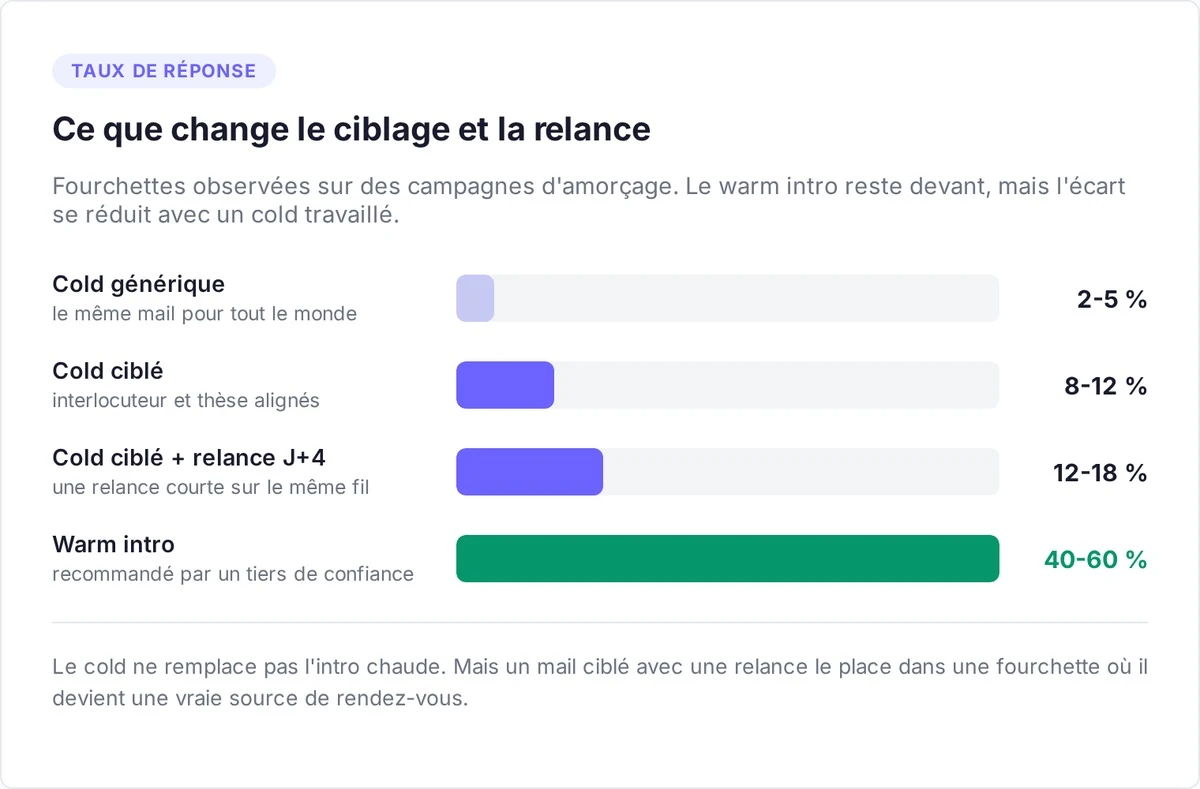
But that 1-2% is the rate for the generic email sent in bulk. As soon as it's targeted and personalized, the numbers change by an order of magnitude. The 2026 data aggregated by Round Funded shows: generic cold blast 2-5%, cold targeted at active investors 8-12%, cold targeted with a D4 follow-up between 12-18%. What kills your reply rate isn't the channel, it's the lack of targeting and the absence of a follow-up.
Cold vs warm intro: why the warm one weighs even more in France
One figure frames the debate: 68% of seed rounds in 2025 started with a warm introduction. A warm intro converts at 40-60% reply rate, versus 2-5% for generic cold, a ratio of 10 to 20 to 1.
In France, that weight is even more pronounced: a smaller, more concentrated, more relationship-driven ecosystem. In the United States, roughly 80% of the capital is held by about thirty funds, and the French market follows the same logic at a smaller scale. Partners know each other, pass deals around, and an email vouched for by a founder in their portfolio carries infinitely more weight than a stranger lost in the pile.
The cold email still remains your channel when you have no network, when you're starting from zero, when you're neither in Paris nor a YC alum. The warm intro takes 4 to 12 weeks to produce a result; the cold email produces meetings within the first week. The two complement each other. Converting the meeting once you've got it is another story, covered in how to pitch a VC in France.
Before writing: target the right fund and the right person
The first mistake happens before you write a single line: aiming at a fund that finances neither your stage nor your sector, or at a person with no decision-making power. No copywriting rescues bad targeting.
Analyst, associate or partner: who to target inside a French fund
Beginner's instinct: aim for the partner, the most senior person, the one who signs. That's usually a mistake.
The partner is saturated: they're the one getting 50 to 200 emails a week. The associate or the analyst, on the other hand, has a precise job: source deals, find the gems before everyone else. That's their mission, and their email is often more reachable. A well-crafted cold email that lands with a motivated associate moves up internally far faster than an email rotting in an overloaded partner's inbox.
The rule: address the person whose actual job is to source deals rather than the saturated decision-maker. To identify who does what inside Paris funds, top VC France 2026 and the VC funds in Paris map out the teams.
Do your homework: thesis, ticket, stage, recent deals
Budget two hours of research before writing, and apply four filters:
Stage. Pre-seed, seed, Series A. A fund that does seed at 2M€ won't read your 200k€ pre-seed request. Read the last ten deals.
Ticket. The amount you're asking for has to fall within the fund's usual range. Asking a fund whose average ticket is 300k€ for 1.5M€ doesn't work. Neither does the reverse.
Thesis. B2B SaaS, deeptech, marketplace, fintech. Every fund has a thesis. Kima Ventures does volume in generalist pre-seed, Daphni has its own thesis, Elaia leans more toward deeptech and B2B. Reading the thesis means knowing whether your email stands a chance before you even write it.
Recent deals. The last 10-20 deals on LinkedIn or Crunchbase reveal what the fund actually finances, not what its website claims to finance. For the inner workings of a fund, read how a VC fund works.
Finding the email when it isn't public
Many funds don't publish a direct address, just a form or a generic contact@. Three methods that work:
- The company pattern. Most use
[email protected]or[email protected]. Find a known address (often in a press release), infer the pattern, apply it. - Verification tools. Hunter, Clearbit or an SMTP verifier confirm whether the address exists before you send. An email that bounces is a wasted email.
- LinkedIn. A short, precise connection message can replace the email, with the same rigor as a cold email: no "I'd love to chat about my project."
The anatomy of a cold email that gets read
A VC doesn't read your email, they scan it: in a few seconds, diagonally, often on mobile between two meetings. Everything has to stay readable at that speed.
The subject line: short, specific, no superlatives
The subject line decides whether the email gets opened. Rule: under 60 characters, factual, zero superlatives.
What works: [Startup], [quantified traction] in [sector], seed [amount]. Example: "Lumen, 40k€ MRR in B2B fintech, seed 1M€". At a glance the VC knows who you are, where you stand, and what you want.
What doesn't work: "Unique investment opportunity", "Meeting request", "France's next unicorn". The first reeks of spam, the second says nothing, the third gets you archived instantly. The VC has already seen 10,000 "next unicorns" go by; none was won over by the adjective.
The body in 5 blocks (hook, traction, ask, deck, signature)
Five blocks, not one more. Aim for 120 words maximum in the body. The VC should be able to read the whole thing without scrolling.
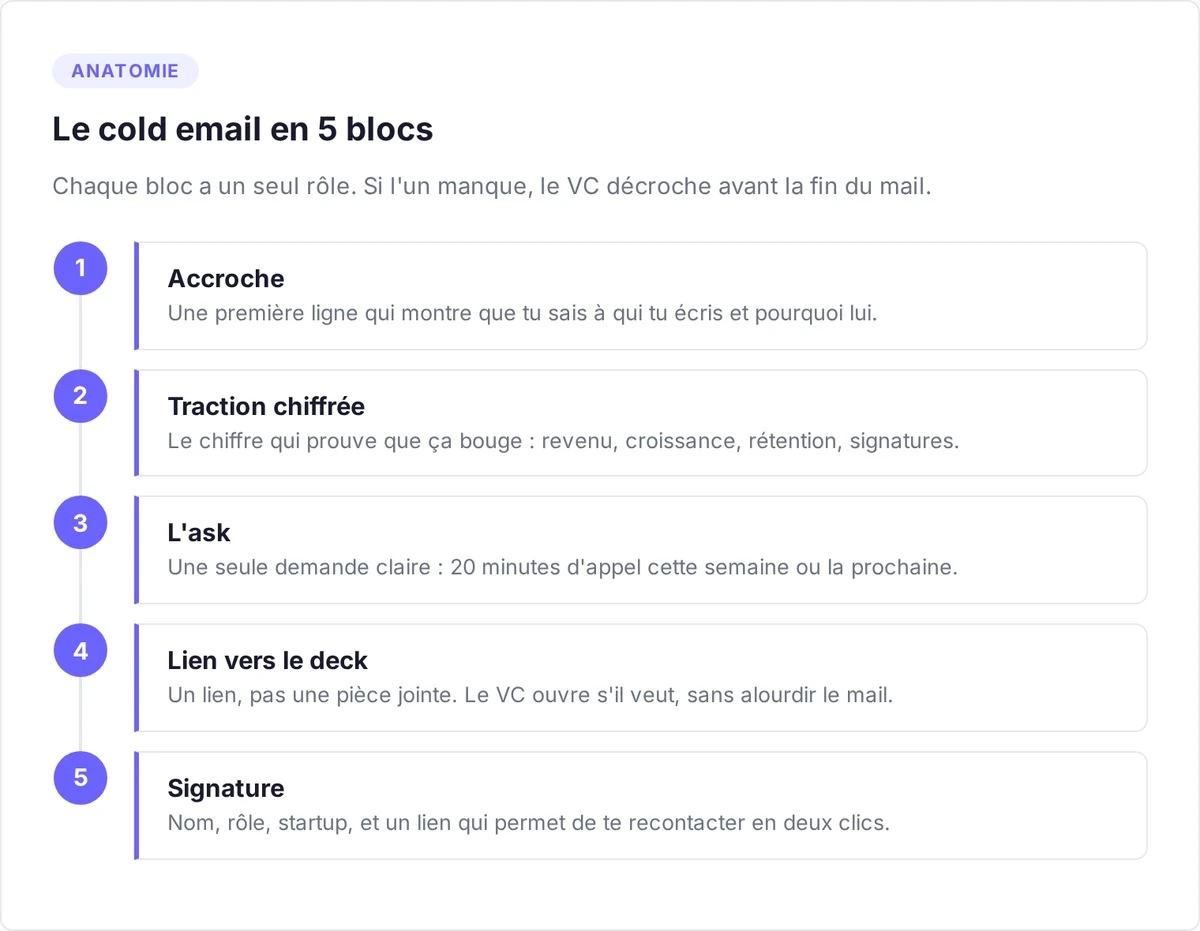
- Personalized hook (1 line). A concrete reason to write to this fund. "I saw you invested in X, we operate in the adjacent market." No hollow flattery.
- Quantified traction (2 lines). The most important block. Revenue, growth, users, retention. Numbers, not adjectives. "30k€ MRR, +25% per month over 4 months" beats "strong growth" a thousand times over.
- The ask (1 line). One request, clear. "Would you be open to a 20-minute call next week?" Not three requests, no "what do you think?".
- The deck (1 line). A link, not an attachment (see below).
- Signature (1 line). Name, role, link to the product. Short.
Should you attach the deck or a DocSend link?
A link, always. A heavy attachment trips the spam filters and weighs down an email that needs to stay light. More importantly, a DocSend or Pitch link gives you the analytics: who opened it, which slides held their attention, for how long. That's what lets you calibrate the follow-up: a VC who spends 90 seconds on your traction slide isn't followed up the same way as a VC who never opened it.
Illustrative templates: good vs bad (annotated)
Two emails for the same fictional startup and the same product: the first disappears, the second lands a call. These templates are built from best practices and the French context: they're teaching examples, not real sends.
Example ❌: the zero-effort generic email
Subject: Investment opportunity
Hello,
I'm reaching out because I think my project might interest you. We're building an innovative solution that revolutionizes the fintech market. Our team is passionate and we have an ambitious vision for the years ahead.
Would you be available to chat about our project? I remain at your disposal to present our vision in detail.
Best regards.
What's wrong: empty subject, no personalization, no numbers, "innovative solution that revolutionizes" (the VC has read that sentence 500 times this week), a vague ask, zero proof you know who you're writing to. This email tells the VC one thing: "I'm sending you the same message I sent 200 other funds," and it ends up archived with no reply.
Example ✅: the targeted email with traction
Subject: Lumen, 40k€ MRR in B2B fintech, seed 1M€
Hello [First name],
I saw your investment in [Portfolio startup]: we're going after the adjacent segment of B2B invoicing.
Lumen automates collections for SMBs. 40k€ in MRR, +25% per month for 4 months, 60 paying customers, 110% net retention.
We're raising 1M€ in seed to move from France to Southern Europe. Would you be open to a 20-minute call next week?
Deck (2 min): [DocSend link]
[First name Last name], CEO Lumen, lumen.io
What works: a factual, quantified subject, a hook that proves you did the research, dense traction in two lines, a single ask, a light link with analytics, a short signature. The VC knows in 15 seconds whether it's interesting.
The follow-up cadence without becoming a pest
Following up isn't harassing: it's half the job. Targeted cold without a follow-up caps out around 8-12%; with a D4 follow-up, it climbs to 12-18%.
Don't confuse following up on a cold email (a stranger who has never replied) with following up on a hot deal (a VC already in conversation). Here it's a spaced-out cadence, a light tone, and you stop cold after four attempts.
D0 / D4 / D10 / D21: what to say in each follow-up
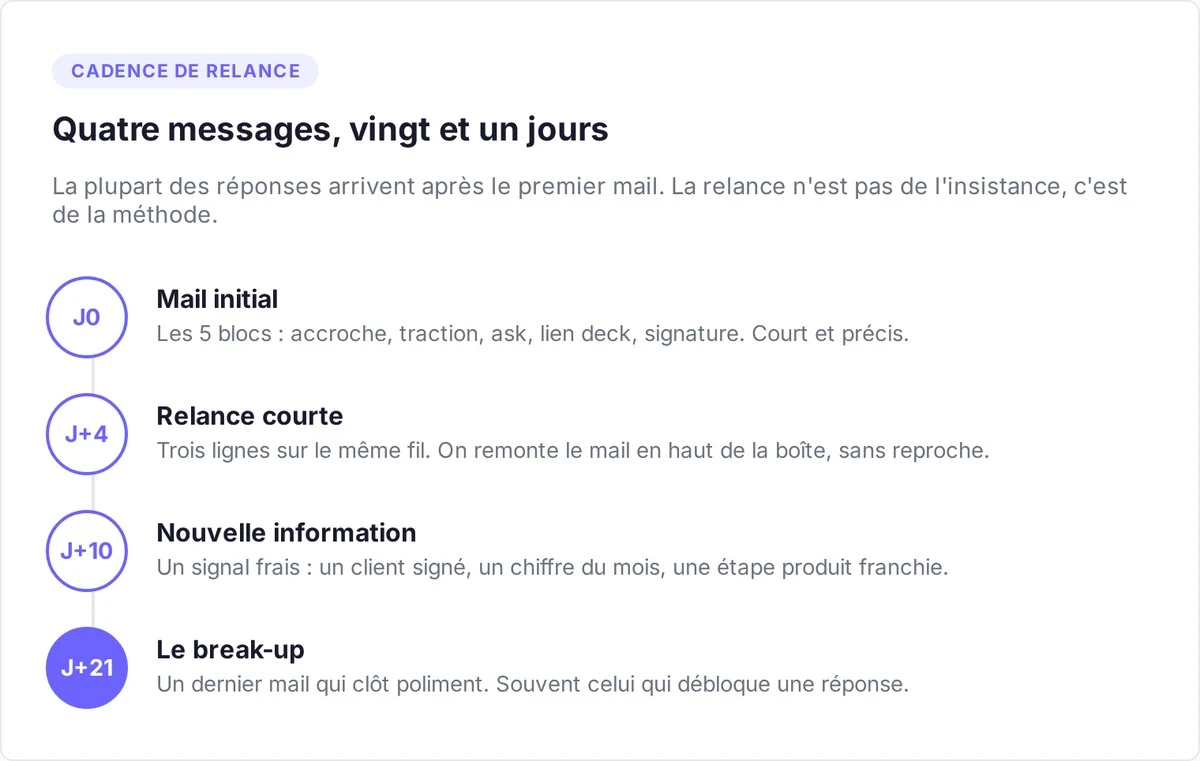
D0: The initial email. The 5 blocks above. Polished, short, targeted.
D4: The short follow-up. Three lines maximum, replying on the same thread. Add a new signal: a fresh number, a signed customer, a press mention. "Quick update: we just signed [customer], MRR at 45k€. Still up for 20 min?" The new signal justifies the follow-up.
D10: The new information. Not a plain "just following up." Bring a milestone, a round filling up ("the round is open, 40% committed"), social proof. You're showing momentum, not insistence.
D21: The break-up. The last email. "I won't push further, I understand the timing may not fit. I'll keep you posted on the next steps." Counterintuitively, it sometimes gets the reply: it removes the pressure and wakes up the fear of missing the train. After D21, you stop.
The mistakes that kill the email
Beyond the content, certain reflexes doom an email before it's even read:
- The wall-of-text email. 400 words of context. The VC won't read it. Cut it to 120.
- Superlatives. "Revolutionary", "disruptive", "unique". Every adjective undermines your credibility. Show with numbers, don't label with words.
- No traction. If you have no numbers, you're not ready for the cold email. Work on traction first, or go through a warm intro.
- The wrong recipient. Writing to the saturated partner instead of the associate who sources.
- The attachment. Anti-spam, heaviness, zero analytics.
- The visible copy-paste. "Hello [Fund name]" left unfilled. Instant death.
- No follow-up. The most common email that fails is the one that was never followed up.
Checklist: score your cold email before sending
Before hitting send, put the email through the wringer. One point per criterion met. Below 8/10, don't send it: rework it.
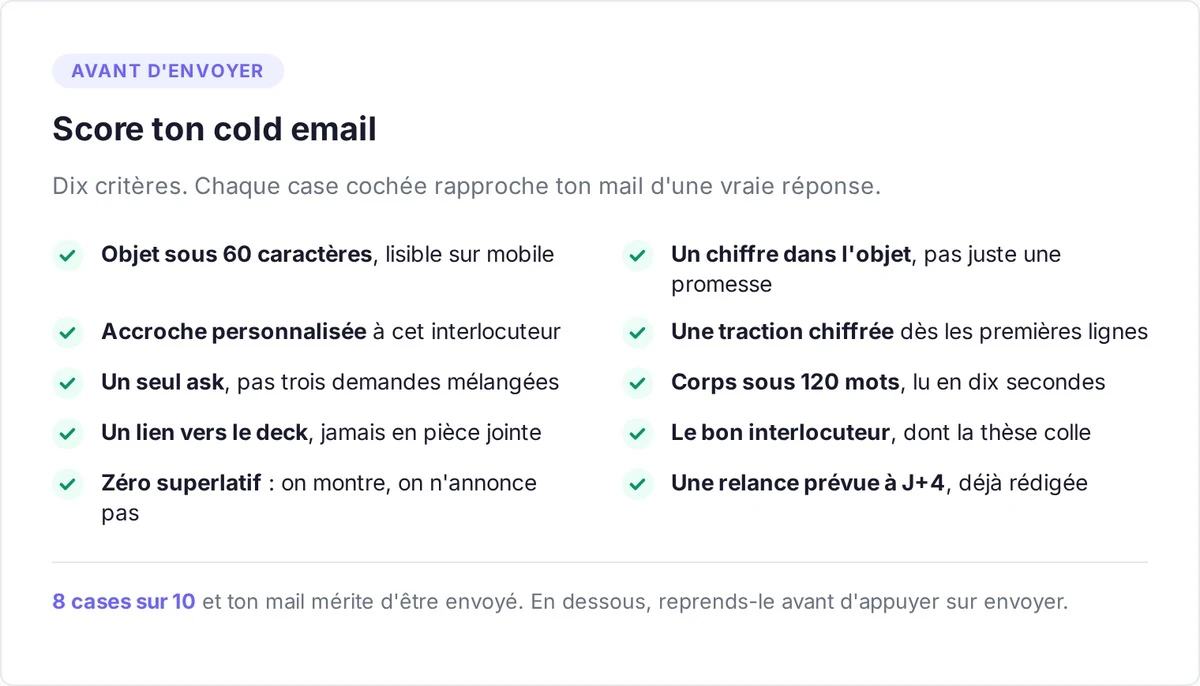
- Subject under 60 characters
- Subject contains a traction number
- Hook personalized to this specific fund
- At least one traction number in the body
- A single ask, clear and precise
- Body under 120 words
- Deck as a link, not an attachment
- Addressed to the right recipient (the associate/analyst who sources)
- Zero superlatives ("revolutionary", "unique", "disruptive")
- D4 follow-up already scheduled
Ten boxes. Below eight checked, your email joins the 95% with no reply; all checked, you're playing at the top of the range, 12-18%.
Sources
- Founders Capital: Cold emails to VCs have a 95% non-response rate
- Round Funded: warm intro vs cold email to VCs (2026)
FAQ
Do you absolutely need a warm intro to raise in France?
No, but it helps enormously. 68% of 2025 seed rounds started with a warm intro, and the French ecosystem, smaller and more relationship-driven, amplifies that weight. That said, the cold email remains a valid channel, especially if you have no network: a targeted, followed-up cold email converts between 12 and 18%. The right strategy is to do both in parallel, not to choose.
How many VCs should you cold email for a round?
As a rough order of magnitude, count on 100 to 200 targeted cold emails to land 10 to 20 first meetings, knowing you often need 30 to 50 meetings total to close a pre-seed. Targeted, not in bulk: 100 personalized emails beat 1,000 generic ones. The quality of the targeting matters more than the volume.
What do you do if the VC doesn't reply after the follow-ups?
You stop after the break-up email at D21. No fifth follow-up, ever. The lack of a reply isn't a personal failure: it's the statistical norm (95% silence). Focus your energy on the next funds and on your traction. A "no" today can become a "yes" in six months, with better numbers and an even sharper email.