A cap table, or capitalization table, is the document that lists a company's shareholders, the securities each one holds and the share of the capital those securities represent. It records the shares already issued. Its "fully diluted" version also counts every instrument that can turn into shares: BSPCE (French employee stock warrants), BSA (share subscription warrants) and BSA Air (the French equivalent of a SAFE).
You build it on the day you incorporate and update it after every transaction affecting the capital. The fund that leads your seed round reads it before proposing a price per share.
What a cap table contains
Equify, a shareholder management software company, sums up the minimum content in its capitalization table guide: the securities holders (executives, employees, investors), the type of securities each one holds, the amount invested, the number of securities and the percentage of capital. The law firm Fieloux Avocats adds options and subscription warrants as soon as the company issues them.
The columns of a cap table
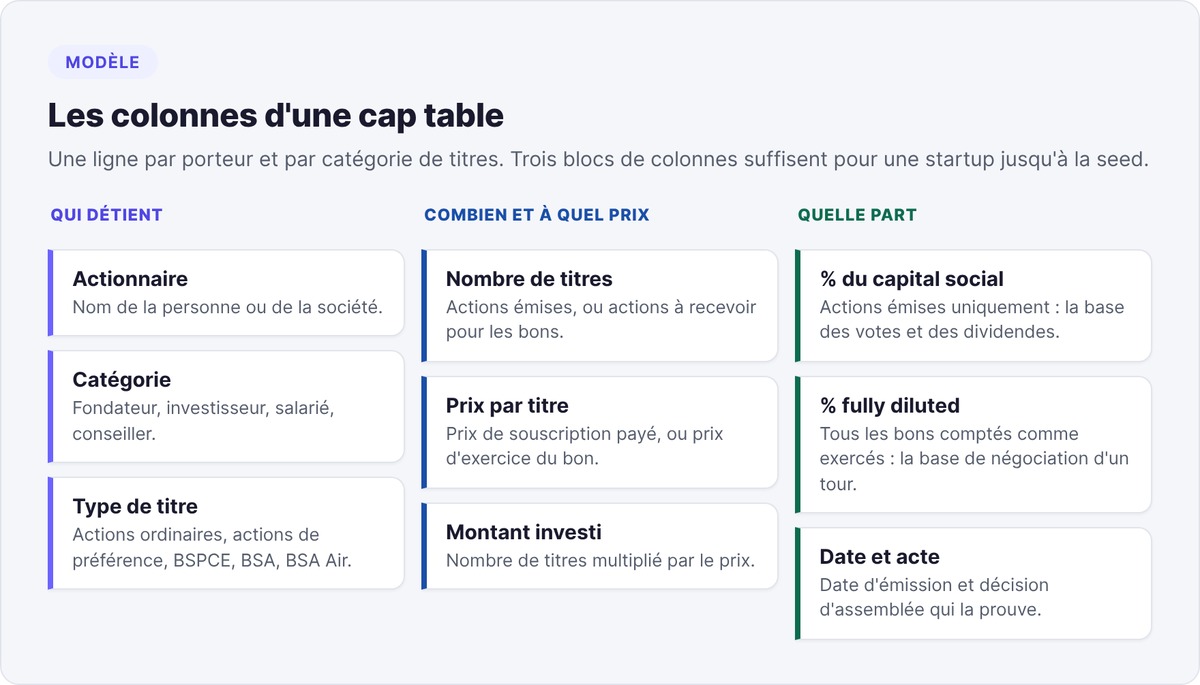
Use one row per holder and per class of security. The columns fall into three blocks:
- Who holds. Shareholder name, category (founder, investor, employee, advisor) and security type (ordinary shares, preferred shares, BSPCE, BSA, BSA Air).
- How much and at what price. Number of securities, subscription or exercise price per security, amount invested.
- What share. Percentage of share capital, fully diluted percentage, issue date and reference to the shareholders' resolution.
Add one tab per transaction (incorporation, funding round, BSPCE grant) to keep a history in case of an audit.
Categories of shareholders and securities
Founders usually hold ordinary shares. Investors in a round sometimes negotiate preferred shares, with special rights such as a liquidation preference. Employees receive BSPCE, and advisors receive BSA. A warrant carries no voting rights until it is exercised, but it counts in the fully diluted view.
Cap table vs share transfer register
The cap table is a management tool. In a French SAS, share ownership is proven by entry in the share transfer register kept by the company. Make the two documents match after every transaction: the fund's lawyer compares them during legal due diligence.
Cap table example from incorporation to seed
Let's follow a fictional company in four steps, from filing its articles of association to closing its seed round. All figures in this example are assumptions for the calculation, so swap in your own.
Step 1: incorporation
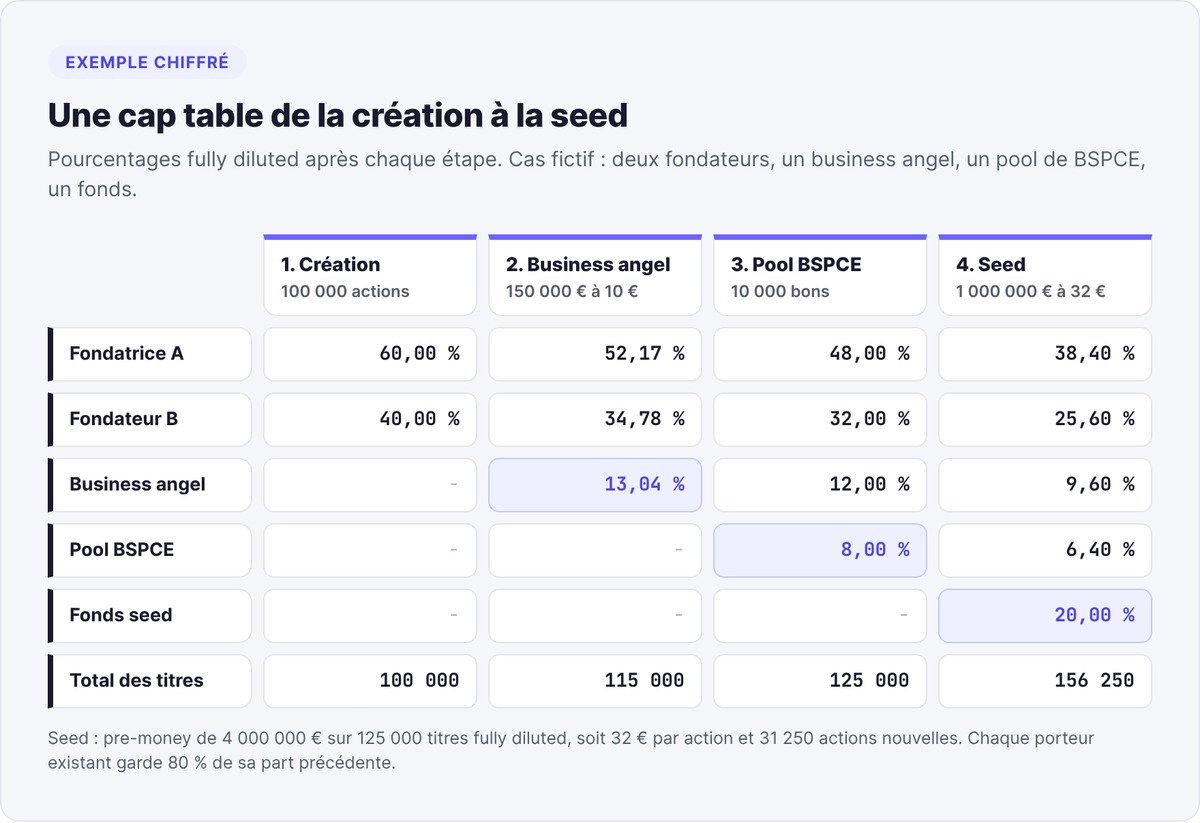
Two founders set up an SAS and split 100,000 ordinary shares. Founder A receives 60,000 shares (60%), Founder B 40,000 shares (40%). The cap table fits in two rows.
Step 2: a business angel invests
A business angel invests €150,000 at a €1,000,000 pre-money valuation. The price per share is €1,000,000 divided by 100,000 shares, or €10. The business angel receives 150,000 / 10 = 15,000 new shares.
The total rises to 115,000 shares. Founder A now holds 52.17%, Founder B 34.78% and the business angel 13.04%. Each founder keeps the same number of shares while their percentage drops. That drop is dilution.
If your business angel invests through a BSA Air rather than in shares, their securities only appear at conversion, in the next round. The full calculation is in our article on how a BSA Air affects your cap table, and typical discount and cap ranges are in our guide to negotiating a BSA Air.
Step 3: a BSPCE pool for the first employees
The shareholders' meeting authorizes a pool of 10,000 BSPCE, which the president then grants to the first employees. Share capital stays at 115,000 shares as long as nobody exercises their warrants. On a fully diluted basis, the total rises to 125,000 securities: A holds 48%, B 32%, the business angel 12% and the pool 8%.
BSPCE come with eligibility conditions (joint-stock company, age of the company, subject to corporate tax, capital ownership) set by article 163 bis G of the French Tax Code. Our BSPCE guide explains how they work and how they are taxed.
Step 4: the seed round
A fund invests €1,000,000 at a €4,000,000 pre-money valuation, calculated on the fully diluted base of 125,000 securities. The price per share is 4,000,000 / 125,000 = €32. The fund receives 1,000,000 / 32 = 31,250 shares, and the post-money valuation reaches €5,000,000.
After the seed, the fully diluted cap table totals 156,250 securities: A 38.40%, B 25.60%, the business angel 9.60%, the pool 6.40% and the fund 20%. Together, the two founders keep 64% of the diluted capital.
Share capital vs fully diluted
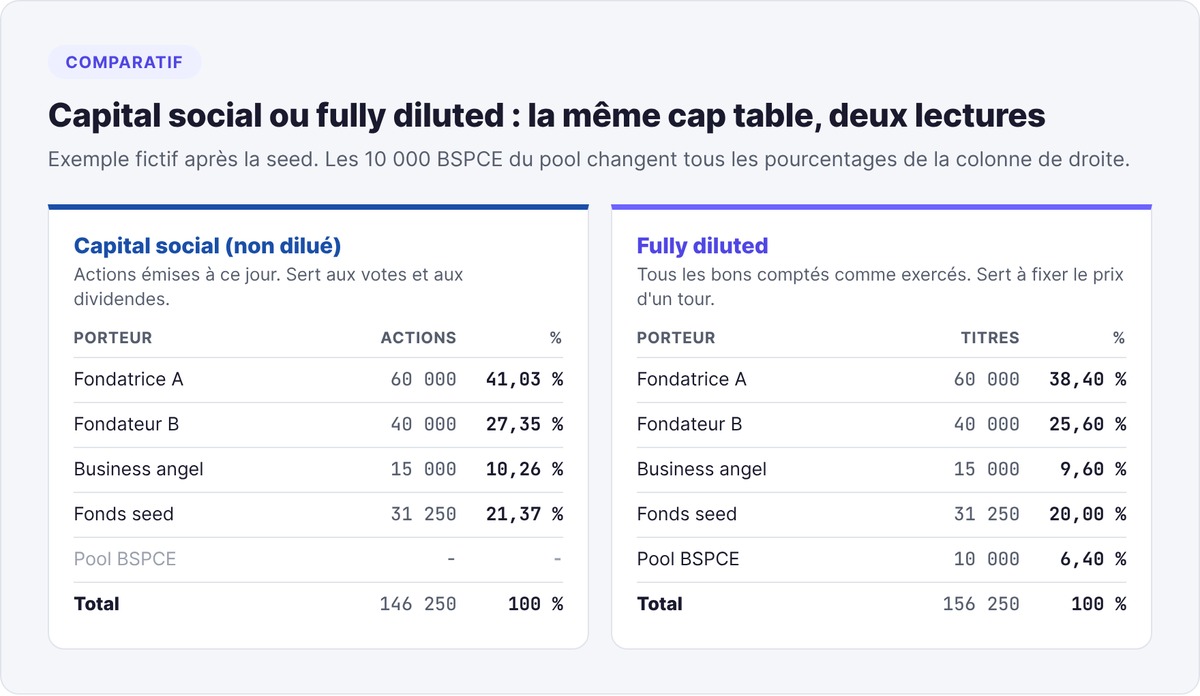
You can read the same cap table in two ways, and each reading answers a different question.
The share capital view
The undiluted base counts only the shares issued as of the table's date. In the example, after the seed, 146,250 shares exist: A holds 41.03%, B 27.35%, the business angel 10.26% and the fund 21.37%. This view determines voting rights at shareholders' meetings and how dividends are split.
The fully diluted view
The fully diluted base assumes holders have exercised or converted every instrument that gives access to the capital. Equify includes options, subscription warrants, BSPCE and free shares in this category. In the example, the pool's 10,000 BSPCE bring the total to 156,250 securities.
Funds negotiate a round's price on this basis, because it shows the maximum share each holder can lose. When a term sheet says "20% fully diluted", check which instruments go into the calculation: granted pool, ungranted pool, BSA Air still to convert. Our guide to term sheet clauses covers these negotiation points in detail.
Calculating dilution at each round
Dilution measures how much a shareholder's percentage drops when the company issues new securities. Their number of shares stays the same.
The formula
For a priced equity round:
- New percentage = previous percentage × (securities before the round / securities after the round).
- Round dilution = new shares / securities after the round.
In the example, the seed issues 31,250 shares for a total of 156,250 securities, a 20% dilution. Each existing holder keeps 80% of their previous stake: A goes from 48% to 38.40%.
A pool created before the round
The order of operations changes the split. In the example, the BSPCE pool exists before the seed, so its dilution falls on A, B and the business angel, and the fund then comes in at exactly 20%. If the term sheet asks you to create or top up the pool before the fund invests, existing shareholders bear that dilution alone. Model both orders in your spreadsheet before you sign.
A cap table template to rebuild in a spreadsheet
Google Sheets or Excel is enough up to the seed. Create a "Cap table" tab with the columns below, then one tab per transaction.
| Shareholder | Category | Security type | Issue date | Number of securities | Price per security (€) | Amount invested (€) | % share capital | % fully diluted |
|---|---|---|---|---|---|---|---|---|
| Founder A | Founder | Ordinary shares | Incorporation | 60,000 | 0.01 | 600 | 41.03% | 38.40% |
| Founder B | Founder | Ordinary shares | Incorporation | 40,000 | 0.01 | 400 | 27.35% | 25.60% |
| Business angel | Investor | Ordinary shares | BA round | 15,000 | 10 | 150,000 | 10.26% | 9.60% |
| Seed fund | Investor | Preferred shares | Seed | 31,250 | 32 | 1,000,000 | 21.37% | 20.00% |
| BSPCE pool | Employees | BSPCE | Pool | 10,000 | - | - | - | 6.40% |
| Total | 156,250 | 100% | 100% |
In this example, the founders subscribe their shares at a nominal value of €0.01, giving an initial share capital of €1,000.
The formulas to set up
- % share capital: the holder's number of shares divided by total shares issued (146,250 in the example, excluding the pool).
- % fully diluted: the holder's number of securities divided by the total of all securities, warrants included (156,250).
- Amount invested: number of securities multiplied by the price per security.
Add a check row that compares total shares issued with the share capital stated in the current articles of association. Any gap points to a missing transaction.
A modeling tab
Duplicate the main tab to model the next round: amount raised, pre-money valuation, pool size. The spreadsheet recalculates the price per share and the percentages, so you walk into meetings knowing the dilution in each scenario.
Tools for managing a cap table
A spreadsheet works fine while the company has few shareholders. The accounting firm wilhow recommends Excel and Google Sheets to start, then specialized software such as Capboard, Equify or Ledgy.
- Spreadsheet. Free and flexible. You control every formula, and you alone carry the risk of data entry errors.
- Equify. Shareholder management software. Its pricing page, checked on September 26, 2026, lists a Starter plan at €500 per year for up to 20 active shareholders; higher tiers are quote-based.
- SeedLegals. Every plan includes cap table management. The pricing page checked on September 26, 2026 lists the Standard subscription at €675 per year excl. VAT. Our SeedLegals review compares the other plans.
- Carta. US-based equity management platform. Check its pricing page for current prices.
Switch to software when you grant BSPCE to several employees or when your investors ask for read access.
Cap table mistakes to fix before a fundraise
A fund reads the cap table from the first conversations, and some setups slow down or kill a round.
Dead equity
Picture a co-founder who leaves the company after a year and keeps 30% of the capital. The fund sees a large stake held by someone who no longer works on the project and who still votes at shareholders' meetings. From incorporation, set up vesting on founder shares and leaver clauses (good leaver, bad leaver) in the shareholders' agreement.
Too many shareholders
Every shareholder votes at meetings and signs the round documents. With twenty small holders from the founders' friends and family, you need twenty signatures before closing. Keep the number of direct shareholders low from the earliest rounds.
The forgotten pool
A BSPCE pool created after the seed dilutes the fund, which anticipates this in its negotiation. The fund then asks for the pool to be created before it invests, at the existing shareholders' expense. Size the pool from your hiring plan before you open the round.
Founders diluted too much, too early
Equify recommends that founders keep at least 50% of the capital between them for a balanced structure. If founders give up 35% at pre-seed, little room is left for the seed and Series A.
An inaccurate cap table
A total that doesn't add up to 100%, an issuance without board minutes or a BSA Air missing from the fully diluted view will delay closing. Have your lawyer or accountant review the cap table before you open the data room: only they can advise you on your specific situation.
Other meanings of "table de capitalisation"
In French personal injury law, lawyers also use "table de capitalisation" for a scale that converts an annuity into a lump sum to compensate a victim. In English, the full term for the startup document is "capitalization table".
If you're preparing a seed or Series A round in France or Europe, swanbase invests €100,000 to €500,000 per startup: tell us about your startup.
FAQ
What is a capitalization table?
A capitalization table, or cap table, is the document that lists a company's shareholders, the type and number of securities each one holds, and the share of the capital they represent. It records the shares issued and, in its fully diluted version, the warrants that can become shares (BSPCE, BSA, BSA Air).
What is a company's share capital?
Share capital is the total of the contributions made by shareholders, in cash or in kind, as stated in the articles of association. In an SAS, it is divided into shares; in a SARL, into membership units. The cap table allocates this capital among the shareholders.
What does fully diluted mean in a cap table?
Fully diluted refers to a calculation that assumes every instrument giving access to the capital has been exercised or converted: BSPCE, BSA, BSA Air, free shares. Funds negotiate a round's price on this basis. Share capital, by contrast, counts only shares already issued.
What is a company's cap?
In fundraising, the cap is the valuation ceiling of a BSA Air. It sets the maximum price at which the warrants convert into shares in the next round, and it protects the investor if the valuation rises sharply in the meantime.
Which tool should I use to manage my cap table?
A Google Sheets or Excel spreadsheet is enough up to the seed. Beyond that, software such as Equify, SeedLegals, Capboard, Ledgy or Carta keeps the cap table up to date. On September 26, 2026, Equify listed a Starter plan at €500 per year and SeedLegals a Standard subscription at €675 per year excl. VAT.
When should I update my cap table?
After every transaction affecting the capital: capital increase, share transfer, BSPCE grant or exercise, BSA Air conversion. Also update it before opening a fundraise, so the data room matches the share transfer register.