You have an MVP, two or three early adopters, and a coffee with a VC in ten days. On LinkedIn, a former founder from your batch offers you €50,000 out of his own pocket. You hesitate. The real question isn't "VC or business angel," it's: what stage you're at, in which sector, and what your cap table will look like in 18 months. In France in 2026, a business angel invests €10,000 to €20,000 per deal, up to €300-500K when a network co-invests, typically taking < 20%1. A pre-seed VC puts in €200K to €1M for 15-20% dilution2. A seed VC invests €2.4M on average3. Same orders of magnitude, radically different governance and cap-table consequences. This guide gives you the decision tree, worked numbers, and the five criteria for spotting "smart money" angels.
Fundamental differences: BA vs VC (in one table)
The operational parameters you'll live with every day, not the textbook definitions.
A business angel invests their own money, on their own conviction1. A VC is a team (General Partners) investing other people's money (Limited Partners: pension funds, family offices, BPI), with management fees of ~2% and carried interest of ~20% above a 5-8% hurdle rate4. Everything else follows from that: an angel trusts their gut, a VC defends every line item to their LPs.
Direct consequences:
- Check size: BA €10K to €100K per head, pre-seed VC €200K to €1M, seed VC €1.5M to €3M123.
- Speed: an angel signs in 48 hours (Kima Ventures, halfway between a syndicated angel and a fund, signs in 48-72h4). A tier-2 VC takes 3 to 6 months.
- Support: an operator angel intros a customer with a single WhatsApp. A VC routes you through a "platform team."
- Governance: an angel rarely takes a board seat (sometimes an observer). A VC takes a seat, often with veto rights.
- Dilution: for the same cash, an angel takes 2 to 4 points more than a VC, because they value more conservatively.
- Horizon: an angel can wait 8 years. A VC is on a 10-year fund whose LPs want their cash back.
- Risk tolerance: an angel backs idea + team. A VC wants idea + team + traction + a market >€1B.
How much each invests (France 2026 check sizes)
BA: €10-100K typical, up to €200K for super-angels
According to BPI Création, a French business angel invests €10,000 to €20,000 per deal, and up to €300,000-500,000 when a network co-invests on the same deal1. Operational ceiling: €1M for a 100% angel round, beyond that the cap table becomes unmanageable. "Super-angels" (exited former founders, senior operators) go up to €100-200K per check. In 2024, French business angels injected €98.6M into startups, mostly at pre-seed and seed5.
Pre-seed VC: €200-800K
Pre-seed France 2026: €200K to €1M, pre-money valuation €2-5M, target dilution 15-20%2. Typical players: Kima Ventures (fixed check ~€150K), Breega, and a dozen pre-seed micro-VCs.
Seed VC: €800K - €3M
The average seed check in France 2026 sits around €2.4M according to FundTrack, in a €1.5-3M range3. At this stage, the VC takes a board seat and requires monthly reporting.
Mix: business angels + pre-seed VC in the same round
The most common pattern in 2026: a pre-seed VC leads with €500K-1M, topped up by 2-4 business angels following at €50-150K each. The lead VC structures the round (term sheet, governance), the angels bring the network. It's also the cleanest for the cap table heading into a future Series A.
The decision tree: BA, VC, or mix?
Your stage × your sector = a single recommended vehicle.
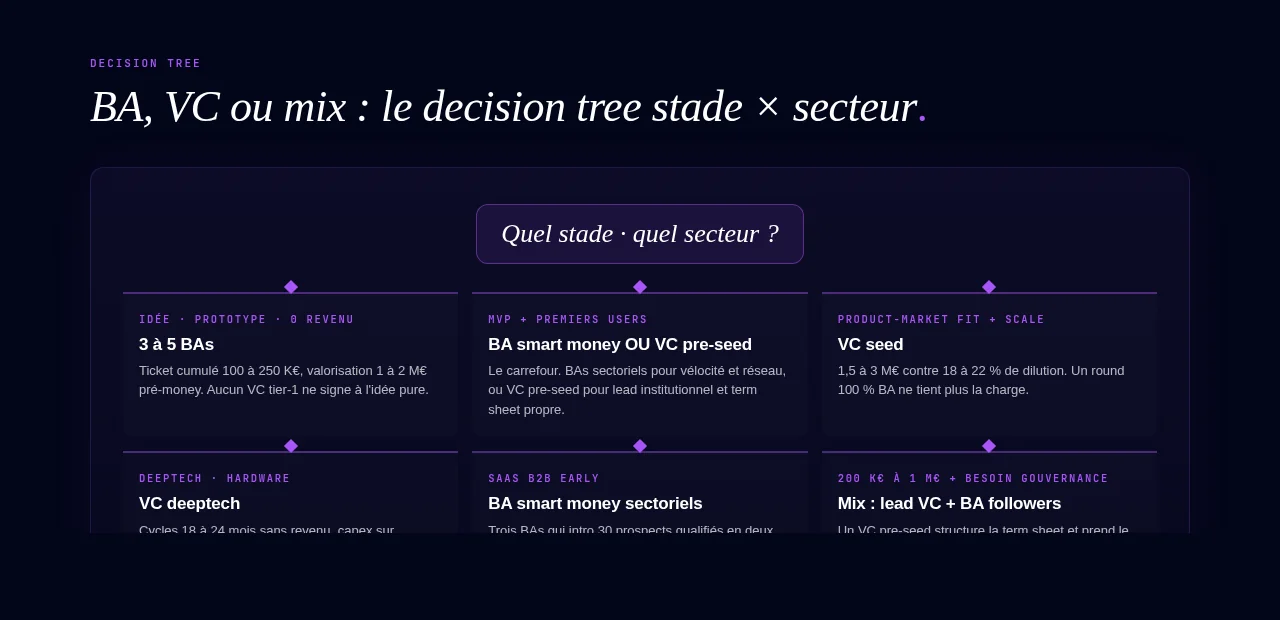
If stage = idea / prototype / zero revenue → BA (almost) always
No tier-1 VC signs on a pure idea (unless you're a serial entrepreneur who's already exited twice). Your only option: 3 to 5 business angels, €100-250K combined, €1-2M pre-money valuation. If you insist on a VC at this stage, you'll land tier-3 money with aggressive terms and regret it at Series A.
If stage = MVP with first users + traction → "smart money" BA or pre-seed VC
The crossroads. Two viable options. Sector "smart money" angels if you want velocity and an operational network, accepting 2-4 extra points of dilution. A pre-seed VC if you want an institutional lead that locks in a clean term sheet for what comes next.
If stage = proven product/market fit + need to scale → seed VC
Past €1M ARR or equivalent traction, you need serious ammunition (hiring, marketing at scale, expansion). A 100% angel round can't carry that load anymore. Head for a seed VC: €1.5 to €3M for 18-22% dilution3.
Sector deeptech / hardware → leans VC (capex)
Hardware burns cash on prototypes, certifications, first inventory. Angels won't follow through 18-24 month cycles with no revenue. Head for a deeptech VC (Elaia, Supernova Invest, BPI deeptech funds).
Sector early B2B SaaS → sector "smart money" angels are often better
In early B2B SaaS, an operator angel's customer network counts for more than the check. Three angels who intro you 30 qualified prospects in two weeks beat a pre-seed VC who knows nobody in your vertical.
Cap table impact in numbers: 1 VC vs 5 angels for the same amount
The French SERP skips this comparison. Yet it's what determines your life as a founder 24 months from now. Two scenarios for raising €200,000.
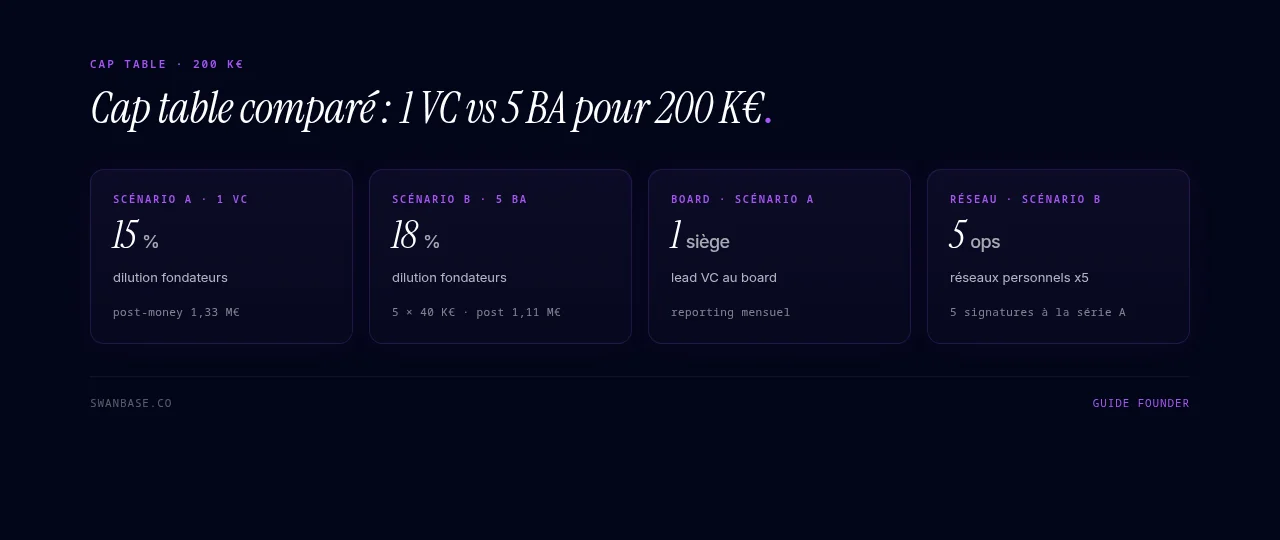
Scenario A: 1 VC puts in €200K for 15% (post-money €1.33M)
You keep 85% across two founders before ESOP. One counterpart, one board seat, one signature for sensitive decisions. Monthly reporting, traction pressure, operational support via a platform team. For a future Series A, a readable cap table: 1 investor line, 2 founder lines.
Scenario B: 5 angels put in €40K each (€200K total) for 18% (post-money €1.11M)
You keep 82% across two founders before ESOP. Five counterparts, five emails per update, five signatures at the next raise if you haven't negotiated simplified powers6. Operational network x5 if the angels are smart money. But a crowded cap table: Series A will require cleanup (drag-along, share buyback).
Comparison: dilution, governance, decision velocity, support
| Criterion | 1 VC (€200K) | 5 BA (€40K × 5) |
|---|---|---|
| Dilution to founders | 15% | 18% |
| Board seats | 1 | 0 (sometimes 1 observer) |
| Decision velocity | Slow (board) | Fast or blocked |
| Operational network | 1 platform team | 5 personal networks |
| Readability for Series A | Very good | Average |
| Performance pressure | Strong | Varies by angel |
When each scenario wins
Scenario A if you're aiming for an institutional Series A in 18-24 months and the traction will get there. Scenario B if your sector rewards network over check, or if no VC wants to lead you.
Smart money vs dumb money: 5 criteria to assess an angel
A "dumb money" angel who takes 8% of your equity without bringing anything can poison your cap table for the rounds that follow. Five criteria to filter before you sign.
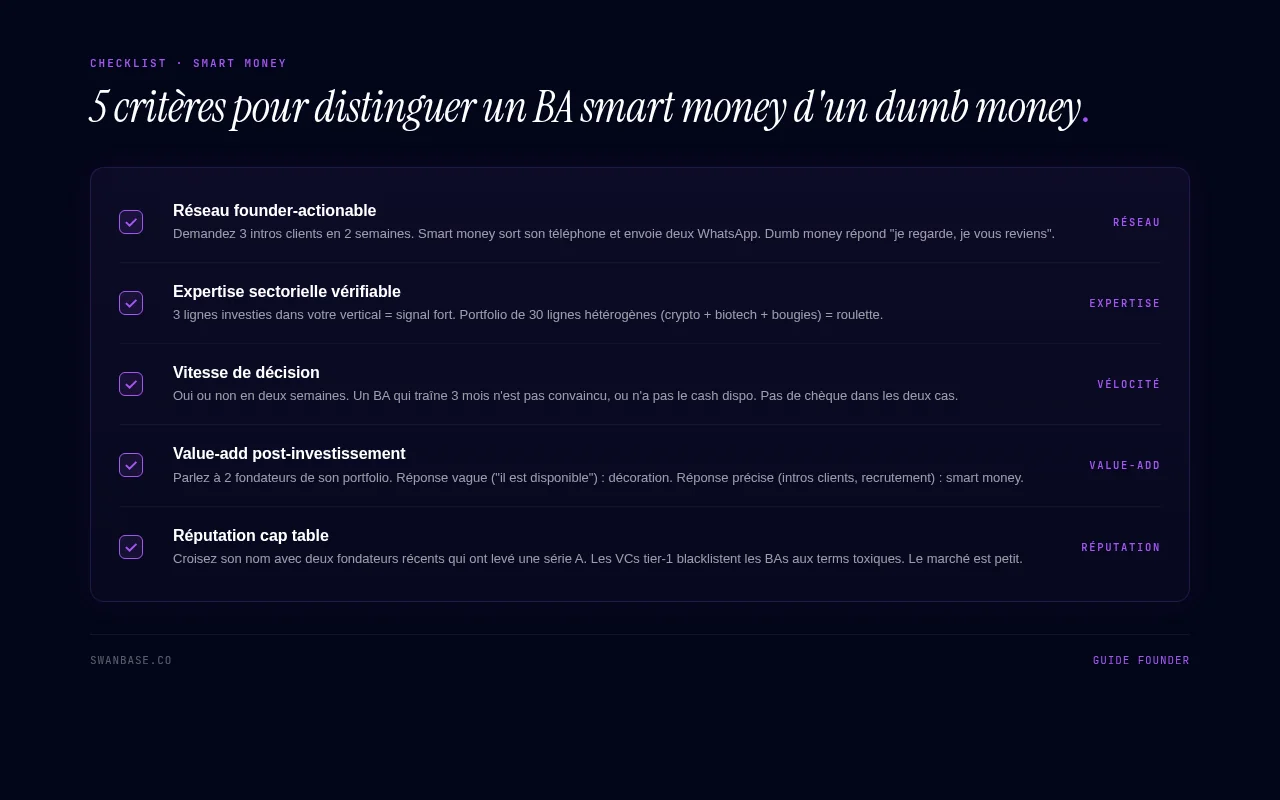
Founder-actionable network
Ask: "Can you introduce me to three potential customers in the next two weeks?" Smart money pulls out their phone and fires off two WhatsApps. Dumb money says "I'll look into it and get back to you."
Sector expertise (verifiable via portfolio)
Look at their investment list (LinkedIn, Crunchbase, or just ask). If they've backed 3 B2B HR SaaS startups and you do B2B HR SaaS, that's a very strong signal. A portfolio of 30 scattered lines (crypto + biotech + candle e-commerce): they're playing roulette.
Decision speed (a fast no > a 3-month "let me think")
A serious angel says yes or no within two weeks. An angel who drags it out for 3 months isn't convinced (and won't dare say so) or doesn't have the cash on hand. Both cases end the same way: no check, your time wasted.
Post-investment value-add (customer intros, hires)
Talk to one or two founders from their portfolio: "what did they actually bring you after the wire?" A vague answer ("he's available"): decoration. A precise answer ("he sourced my head of sales and intro'd 5 major accounts"): smart money.
Cap table reputation (doesn't break a future VC raise)
Some angels have a rotten reputation among tier-1 Paris VCs (aggressive terms, toxic behavior). Before signing, cross-check their name with two recent founders who've raised a Series A. It's a small market, and VCs blacklist.
When to mix BA + VC in the same round
The mix isn't a compromise: it's often the optimal setup. Three dominant patterns.
The "lead VC + BA followers" pattern
A pre-seed VC leads with €500K-1M, structures the term sheet, takes the board seat. Three or four sector angels follow at €50-150K each on the same terms (no side letter). Best of both worlds: clean governance + operational network.
The "BA seed + VC Series A" pattern
You raise €200-400K in pure angel money to go from MVP → first revenue, then you load up a VC at seed or Series A 12 months later. This pattern works if your VC pitch deck holds up at T+12 months and traction has moved seriously.
The cap table traps to avoid
No more than 6-7 angels on a single round without a pooling vehicle (SPV, dedicated holding). Otherwise the cap table becomes unreadable, and every future raise needs 7 signatures. Also avoid angels who demand favored terms (custom liquidation preference, full-ratchet anti-dilution): it pollutes the round for everyone.
Transition BA → VC: when and how
If you raised 100% from angels at pre-seed, the shift to a VC at seed/Series A is a delicate step. Played badly, it dilutes your angels beyond reason and damages the relationship.
Signals it's time to pitch a VC after an angel round
Three converging signals: ARR > €500K with growth > 15% MoM, a verifiable market > €1B TAM, a team that holds without a bottleneck. With all three in place, you're VC-pitchable. If just one is missing, wait 3-6 months.
How to keep your angels in the cap table (anti-dilution, pro-rata)
From pre-seed, negotiate a pro-rata right for your angels: they can reinvest pro rata to their stake at the next round so they aren't diluted beyond the natural amount. It keeps them loyal and sends a positive signal to the lead VC.
Common mistakes
Too many small angels = a broken cap table for a future VC raise
10 angels at €10K each is €100K of cash and 10 lines on the cap table. No tier-1 VC will sign afterward without a major cleanup (share buyback, merger via SPV). Doable but costly. Solution: group your angels into a single SPV from the start.
A "dumb money" angel as lead = a negative signal for tier-1 VCs
If your lead angel is a retired doctor with no sector expertise who values your company at €3M pre-money on an MVP, the tier-1 VC you pitch 12 months later will see the valuation, raise an eyebrow, and move on. The round's lead carries a signal.
Pre-seed VC with aggressive terms (tier-2/3 red flag)
A pre-seed VC demanding 25-30% dilution on a €300K check, a 2x non-participating liquidation preference, and full-ratchet anti-dilution is a tier-2/3 protecting itself because it didn't see the deal first. Turn it down and find better, even if it takes 3 more months.
FAQ
Can you raise 100% from angels without a VC?
Yes, up to roughly €1M combined via a business angel syndicate1. Beyond that, the number of investors becomes unmanageable on the cap table and Series A will require cleanup. Most startups move to a VC by seed (€1.5-3M).
What's the max number of angels you can have on a cap table?
In practice, 6 to 8 individual angels max on a round, otherwise the cap table becomes unreadable. Beyond that, group them into an SPV (Special Purpose Vehicle) or a dedicated holding that shows up as a single line. Standard structure in France via a dedicated SAS.
Do you have to declare your angels to the tax authorities?
Business angels who invest in your startup's capital qualify for the IR-PME (Madelin) or IFI-PME income-tax reduction, provided the company meets the EU SME criteria. You have to provide them with an annual tax certificate. Check with your accountant.
How do you find sector "smart money" angels?
Three sources: (1) structured networks like France Angels, Paris Business Angels or Angelsquare; (2) exited founders from your vertical (LinkedIn search "founder ex-acquired" + your sector); (3) senior operators present at your vertical's conferences. Avoid open "call for angels" platforms that mostly attract dumb money.
Choosing between a business angel and a VC isn't a prestige call. It's a choice of referee. The right referee for your stage, your sector, and tomorrow's cap table.
Footnotes
-
https://bpifrance-creation.fr/encyclopedie/financements/recours-a-investisseurs/business-angels ↩ ↩2 ↩3 ↩4 ↩5
-
https://hayot-expertise.fr/en/blog/pre-seed-to-series-a-fundraising-france-2026 ↩ ↩2 ↩3
-
https://fundtrackplus.com/startup-funding-france/levees-fonds-seed-series-a ↩ ↩2 ↩3 ↩4
-
https://eldorado.co/blog/2021/11/15/comment-fonctionne-un-fonds-de-venture-capital ↩ ↩2
-
https://stripe.com/fr/resources/more/angel-investors-in-france ↩