A good investor update fits in a monthly letter of 400 to 700 words, readable in three minutes, sent on the same day every month. Six sections are enough: a one-sentence headline, 3 to 5 highlights, a KPI table (actual, previous month, target), 2 or 3 challenges with the actions underway, 1 to 3 specific requests (your "asks"), and your runway. You don't need a €200-a-month software tool or a forty-slide deck. An email will do. What matters isn't the layout, it's the consistency: an investor who receives your letter every month trusts you before you even open your next round. This guide gives you the complete template, a ready-to-copy written example, and the cadence to keep based on your stage.
Why a Monthly Letter Transforms Your Investor Relationship
Most founders share news when things are going well, or when they need something. You should do the opposite.
An investor who hasn't heard from you in four months assumes the worst. In a startup, silence never reads as "all good" but as "they have a problem they don't dare mention." A letter that lands every month, rain or shine, builds what nothing else can: trust through consistency.
And that trust pays off. Founders who communicate continuously close their follow-on rounds faster, because the relationship is already warm the day they ask for a check: the investor has followed the story, knows your numbers, and has seen how you handle setbacks. Monthly reporting isn't admin work, it's your next round being prepared twelve months ahead.
A second, subtler effect: the letter forces you to look your own numbers in the eye every thirty days. Many founders discover their real runway the day they write the "cash" section. It's a steering tool before it's a relationship tool.
The 6-Section Template (Copy It)
Here's the structure you'll find in every good investor update. You can paste it straight into an email and fill it out in thirty minutes.

1. The One-Sentence Headline
A single sentence, at the top of the email, that sums up the month. "Record month on revenue (+22%), but rising churn that we're tackling as a priority." The investor should understand where you stand before scrolling. If you can't sum up your month in one sentence, you don't yet know what matters.
2. The 3 to 5 Highlights of the Month
Three to five points, no more. The genuine milestones: a client signed, a feature shipped, a key hire, a revenue milestone crossed. If you list eight, none stands out. Telegraphic format, one line per point.
3. The KPI Table (Actual, Previous Month, Target)
The heart of the letter. Four to six metrics in a table, three columns: this month's actual, previous month, target. The trio tells a story a single number can't: you're progressing, plateauing, or slipping.

4. The 2 to 3 Challenges + Actions
The section founders are tempted to skip. Don't skip it. Two or three real challenges, and above all what you're doing to fix them. An investor doesn't expect perfection: they want to see that you spot problems and act on them. A challenge without an action is a complaint. With a plan, it's leadership.
5. The "Asks": 1 to 3 Specific Requests
This is the section that separates a letter that's useful from one that merely informs, and it's precisely the one nobody fills out properly. Your investors have a network, portfolios, experience. Ask, but ask specifically. Not "if you know any interesting people," but rather "an intro to a CFO at a Series B SaaS scale-up" or "feedback from someone who has handled enterprise churn on usage-based pricing." Three asks maximum: beyond that, nothing is actionable anymore. A specific ask lands far better than a vague request.
6. Runway and Outlook
Two to four sentences: how many months of cash you have left, and what you're aiming for next month. Runway is simple to calculate, your cash divided by your monthly burn. Putting it in black and white every month is the strongest signal of maturity you can send. It says: I know exactly where I stand.
Which KPIs to Track Based on Your Model
The table in section 3 isn't filled out at random. There's a base set that works for almost every startup, then metrics that depend on your model.
The base set, whatever your business:
- MRR / ARR (monthly or annual recurring revenue), with its change from the previous month. The number everyone looks at first.
- Net new MRR: the breakdown of what makes up your revenue growth (new customers, expansion, contraction, churn). Two startups with the same MRR but opposite net new figures are in completely different health.
- Net burn: what you actually burn each month, after revenue.
- Runway: your remaining months of cash. The number that determines when you need to raise.
- Headcount: your team size, because it's often your biggest cost line.
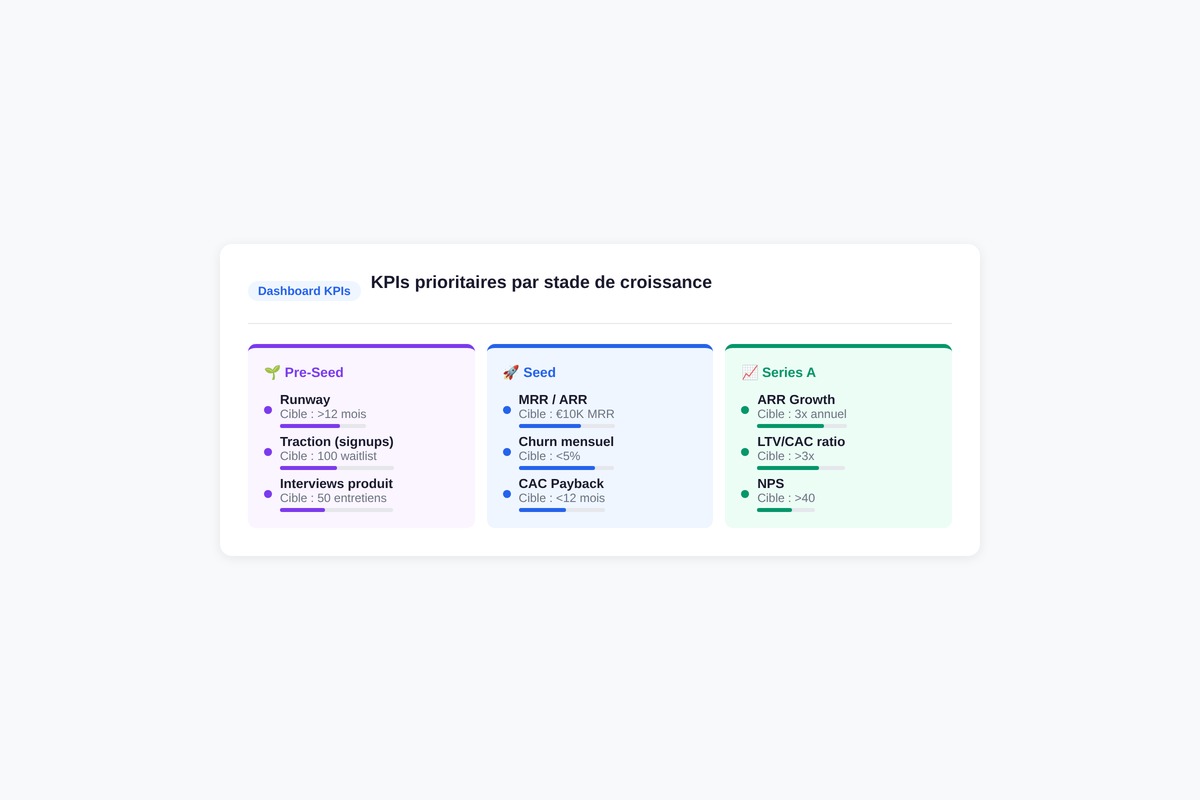
Depending on your model, add churn (the rate at which customers leave) if you're SaaS, CAC and its payback from Series A onward, NRR (net revenue retention) if you sell B2B, or GMV if you're a marketplace. The principle: 4 to 6 numbers, the ones that actually run your business. Not twenty. A report that lines up fifteen KPIs steers nothing, it drowns.
If you want the details of which metrics to track stage by stage, we have a dedicated guide: Startup KPIs: the essential metrics by stage.
How Often and How Long?
The short answer: monthly, as long as you're early-stage. Consistency outweighs everything else.

The breakdown by stage:
- Pre-seed: monthly, 300 to 500 words, informal tone, a few light metrics. At this stage, you're mainly building the habit.
- Seed: monthly, 400 to 600 words, with the KPI table. This is where you lock in the template for good.
- Series A: monthly, 500 to 700 words, full KPI table. The board complements the letter, but doesn't replace it.
- Series B and beyond: monthly or quarterly. Quarterly becomes acceptable once board reporting takes over, but monthly remains preferred.
On length, stick to the three-minute rule. An investor reads your letter between two meetings, on their phone. If they have to download an attachment or scroll through ten screens, they set it aside "for later," and later never comes. Everything in the body of the email, short and dense.
And always send on the same day: first Monday of the month, the 5th, last Friday, whatever works. A fixed date turns a good intention into a ritual.
A Fully Written Monthly Letter Example
Here's what it looks like, concretely, for a fictional seed-stage SaaS startup.

Subject: [Nimbus] May 2026 Update: record month (+22% MRR), churn to watch
Hi everyone,
Headline: best month on revenue since launch (+22% MRR), but a rise in enterprise churn that we're tackling as a priority.
Highlights
- Signed our biggest contract to date (Acme, €1,400/month).
- Shipped v2 of the export module, requested by 60% of active accounts.
- Hired our first Head of Customer Success (starting June 2).
KPIs
Metric Actual Prev. month Target MRR €18,200 €14,900 €17,000 Net new MRR +€3,300 +€1,800 +€2,100 Net burn €41,000 €38,000 €40,000 Runway 9 months 10 months n/a Churn 3.1% 1.9% <2% Challenges and actions
- Churn rose from 1.9% to 3.1%, driven by two enterprise accounts. Action: we're launching quarterly check-ins, the first priority for the new CS hire.
- The B2B sales cycle is lengthening (45 days on average). Action: we're testing a free 14-day POC in the mid-market segment.
Our asks this month
- An intro to a CFO at a Series B SaaS scale-up (a target for our enterprise offering).
- Feedback from anyone who has built a CS team from scratch.
Runway and next steps We have 9 months of cash left. June goal: bring churn below 2.5% and cross €20K MRR. We're aiming to open a round in the fall.
Thanks, and feel free to reply.
You can copy this skeleton this very month. Swap in your numbers, keep the structure.
The Mistakes That Scare Off an Investor
A few traps that cancel out all the benefit of reporting, even when you take the time to write it.
Hiding bad news. An investor who discovers a problem you hid for three months loses trust all at once, and for good. Being transparent about your challenges isn't an admission of weakness: it's what makes you credible when you announce a win. Share bad news early, with your action plan alongside it.
Dressing up the numbers. Picking whichever metric flatters you each month, changing definitions from one report to the next, playing up cumulative revenue to hide a stagnating MRR. A seasoned investor spots these moves in ten seconds, and concludes you're not reliable on the rest. Same KPIs, same definitions, every month.
Drowning the reader. A 2,000-word letter with fifteen charts isn't more serious, it just goes unread. The discipline of concision is a signal of maturity.
Forgetting the asks. Asking for nothing, month after month, wastes the most valuable resource on your cap table: a network that wants to help you but doesn't know how. Give them a concrete entry point in every letter.
FAQ
How often should you send an update to your investors?
Monthly while you're early-stage, from seed to Series A. Quarterly becomes acceptable from Series B onward, when board reporting takes over, but monthly remains the preferred norm. Consistency matters more than absolute frequency: a short letter every month beats a detailed report every six months.
What should you put in an investor update?
Six sections: a one-sentence headline, 3 to 5 highlights, a table of 4 to 6 KPIs (actual, previous month, target), 2 or 3 challenges with the actions underway, 1 to 3 specific requests to your investors, and your runway with the outlook for the following month. All in the body of an email, readable in three minutes.
Which metrics should you track in a startup update?
The universal base: MRR/ARR with its change, net new MRR, net burn, runway, and headcount. Depending on your model, add churn (SaaS), CAC and its payback (from Series A onward), NRR (B2B), or GMV (marketplace). Aim for 4 to 6 metrics maximum, the ones that actually run your business.
Should you tell your investors about bad news?
Yes, and early. An investor who discovers a hidden problem loses far more trust than one informed of a challenge you own up to. Present every piece of bad news with the action plan you're putting in place to address it: that's what turns a problem into proof of leadership.
How long should an investor letter be?
400 to 700 words, readable in under three minutes, entirely in the body of the email. At pre-seed, 300 to 500 words is enough. The goal isn't completeness but density: every line should deliver useful information.