A shareholders' agreement (pacte d'associés) is a confidential contract that some or all of a company's shareholders sign alongside the articles of association. It governs their relationships, the company's governance and any transfer of shares. Bpifrance Création calls it an "optional agreement between shareholders" in its page on the shareholders' agreement, updated in June 2026.
In a startup set up as a SAS, you usually sign one twice. The cofounders draft the first version when they incorporate, to cover departures and commitments. At the first funding round, the investors have it rewritten with their own clauses. This guide covers both stages: how the agreement differs from the articles, the key clauses, a typical clause-by-clause structure, the cost, the duration and the penalties for breach.
Shareholders' agreement: definition and legal status
The shareholders' agreement is optional. No law requires shareholders of a SAS to sign one, and no registry accepts it for filing. Signatories use it to set custom rules that the articles leave out, or that they would rather keep confidential.
A contract between its signatories
The agreement binds only the people who signed it. Bpifrance Création grounds its binding force in articles 1103 and 1104 of the French Civil Code: contracts are law for those who made them, and they must be negotiated, formed and performed in good faith. Every shareholder can sign it, or only some of them. Two cofounders can therefore sign an agreement between themselves and leave out the business angel who came in with a small ticket.
Pacte d'associés or pacte d'actionnaires
In French, both terms refer to the same kind of contract, and both translate as shareholders' agreement. In a SAS or an SA, the capital is divided into shares (actions), so people tend to say pacte d'actionnaires. In a SARL, members hold parts sociales, hence pacte d'associés. SCIs can have one too, but this guide focuses on the startup SAS, the most common legal form among founders who raise money.
Shareholders' agreement vs articles of association: the differences
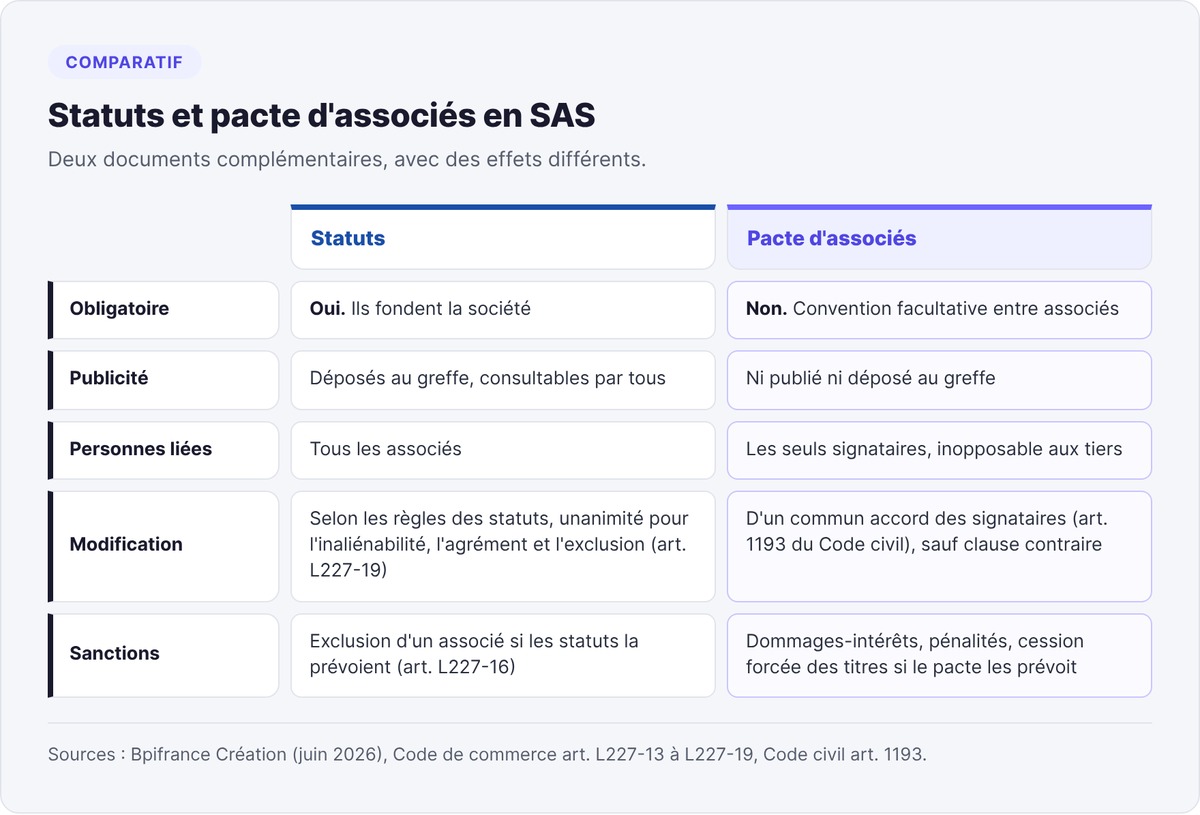
The articles of association establish the company: name, corporate purpose, share capital, registered office, decision-making rules. The agreement adds to them on the topics the shareholders want to settle among themselves.
Confidentiality and enforceability against third parties
You file the articles with the commercial court registry, and anyone can look them up. The agreement, by contrast, "is neither published nor filed with the registry," Bpifrance Création notes. Signatories therefore use it for what they would rather keep private: the buyback price for a departing founder, an investor's special rights, internal voting rules.
The trade-off is enforceability. The articles bind every shareholder. The agreement binds only its signatories, and Bpifrance Création stresses that it "cannot be enforced against third parties." A new shareholder who has not signed the agreement is bound by none of its clauses.
Clauses that belong in the articles
Some protections work better in the SAS's articles precisely because they then bind everyone. The French Commercial Code provides three statutory clauses that are useful to founders:
- Lock-up (inaliénabilité). Article L227-13 of the Commercial Code allows the articles to prohibit share transfers for up to ten years.
- Approval (agrément). Article L227-14 allows any transfer to require the company's prior approval.
- Exclusion. Article L227-16 allows a shareholder to be excluded under the conditions set in the articles.
Shareholders adopt or amend these clauses unanimously, under article L227-19. In practice, startup lawyers combine the two documents: an approval clause in the articles, and the detailed exit and departure mechanisms in the agreement.
Key clauses in a startup shareholders' agreement
Bpifrance Création lists the main clauses as pre-emption, approval, shareholding caps, tag-along, lock-up and non-compete. A startup agreement adds clauses on founder departures and, after a round, on investor rights.
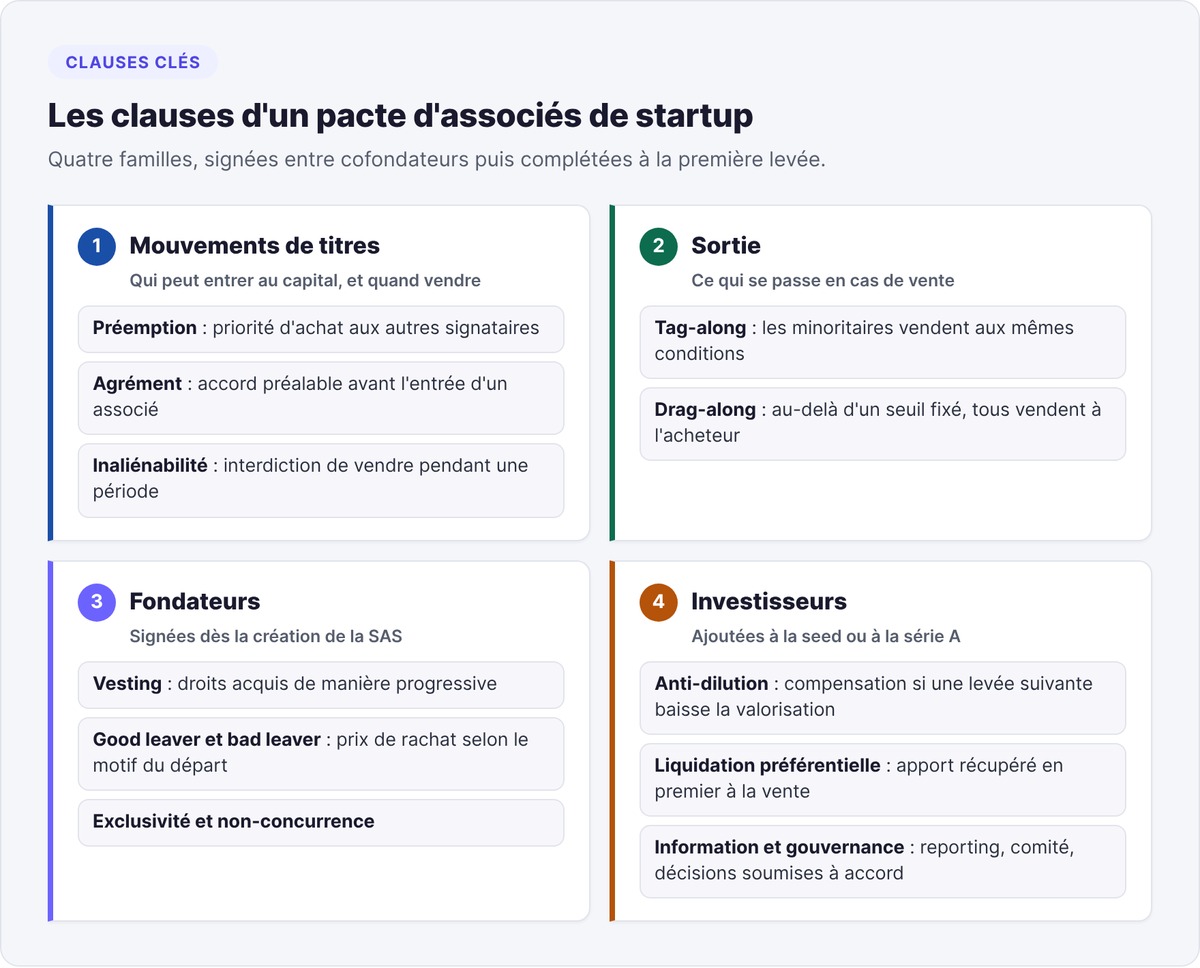
Share transfer clauses
- Pre-emption. A shareholder who wants to sell must first offer the shares to the other signatories, at the price the buyer offered or according to a formula set in the agreement.
- Approval. A new shareholder can only come in with the consent of the signatories or of a company body.
- Lock-up. Signatories agree not to sell their shares for a set period. Founders often accept one until the next round, and investors see it as a guarantee that the team will stay.
Exit clauses: tag-along and drag-along
- Tag-along. If one shareholder sells, the others can sell their shares to the same buyer on the same terms. This clause protects minority shareholders, who are not left alone with a new majority owner.
- Drag-along. When shareholders holding a threshold set in the agreement accept an offer for the whole company, the others must sell too. The buyer thus gets 100% of the capital.
The drag-along threshold is renegotiated at every round. Our guide to the term sheet covers market positions on this point.
Founder clauses: vesting, leaver and non-compete
- Vesting. The founder earns their rights gradually. In France, the agreement often implements this through a promise to sell their shares at a price that depends on when they leave. In its Rewarding Talent guide, Index Ventures describes the most common schedule for employees: four years of vesting with a one-year cliff.
- Good leaver and bad leaver. The agreement classifies departures. Leaving because of illness or without fault counts as good leaver, and the founder sells their shares back at a price close to their value. Leaving for misconduct counts as bad leaver, with a lower buyback price.
- Non-compete and exclusivity. The founder commits to working exclusively on the startup and to not launching a competing venture. To hold up in court, the clause must be limited in time, in geography and to the company's actual business.
The same mechanisms apply to a cofounding CTO. For employees, vesting usually runs through the rules of a BSPCE plan.
Investor clauses
At the first priced equity round, the fund brings its own clauses:
- Anti-dilution. If the startup later raises at a lower valuation, the investor receives additional shares to offset part of the drop.
- Liquidation preference. If the company is sold, the investor recovers some or all of its investment before the rest is distributed.
- Information rights. The company sends reporting on a fixed schedule: financial statements, cash position, key metrics.
- Governance. A strategic committee brings founders and investors together, and certain decisions require the investor's consent: a new round, the annual budget, hiring a senior executive.
The term sheet sets these parameters, and the agreement signed at closing spells them out in detail.
Shareholders' agreement example: the structure clause by clause
A startup agreement follows a fairly standard outline. The framework below shows the usual order of the articles and what they contain. Use it to review a lawyer's draft or to prepare a negotiation; it is not a legal template. Bpifrance Création also publishes a free SAS shareholders' agreement template.
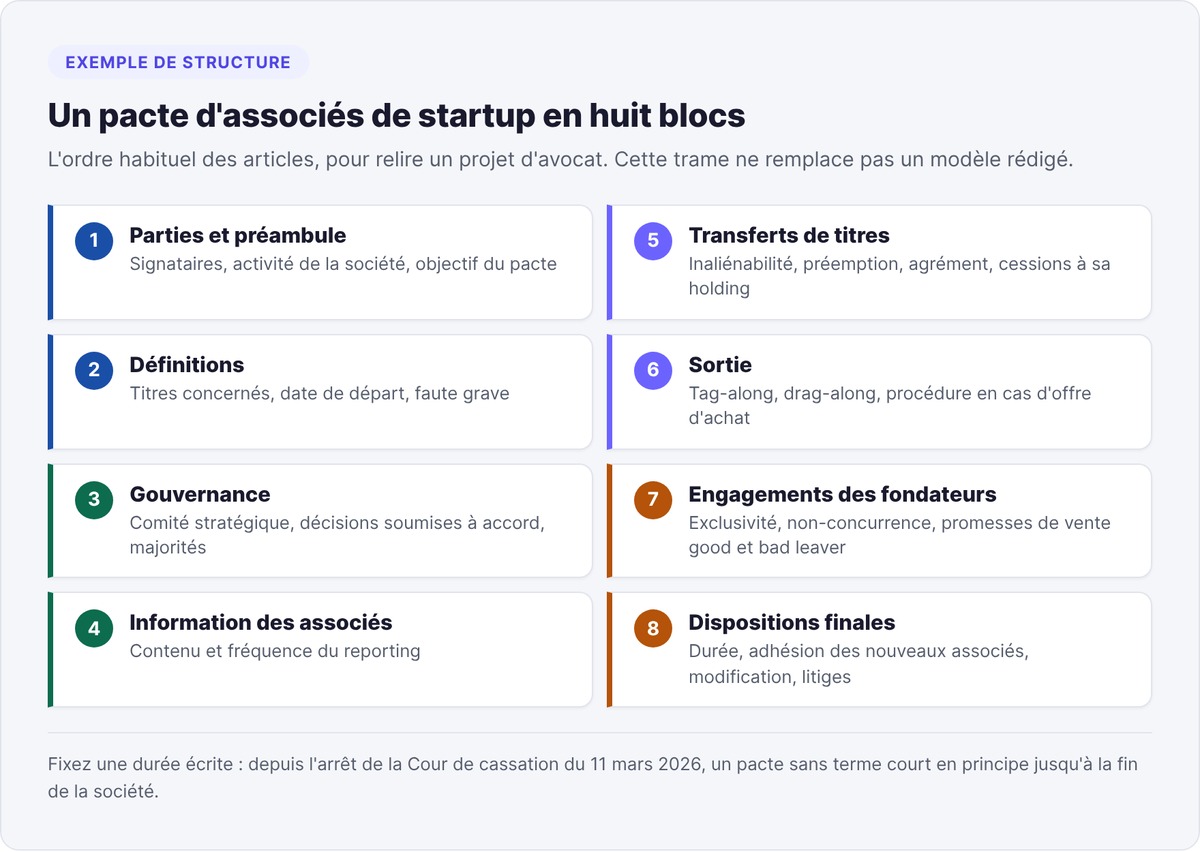
- Parties and recitals. List of signatories, a summary of the company's business and the purpose of the agreement.
- Definitions. Securities covered, departure date, meaning of gross misconduct, the investor's group. A vague definition breeds tomorrow's disputes.
- Governance. Composition of the strategic committee, decisions that require its approval, required majorities.
- Shareholder information. Content and frequency of reporting.
- Share transfers. Lock-up, pre-emption, approval, free transfers between a shareholder and their holding company.
- Exit. Tag-along, drag-along, procedure when a purchase offer comes in.
- Founder commitments. Exclusivity, non-compete, non-solicitation of employees, promises to sell tied to good leaver and bad leaver.
- Final provisions. Duration, mandatory accession of new shareholders, amendments, confidentiality, dispute resolution.
The accession clause deserves your attention. It requires every new shareholder, whether an investor or an employee exercising BSPCEs, to sign the agreement before joining the cap table. Without it, your cap table fills up with shareholders who are bound by nothing.
When to sign: at incorporation, then at every round
Between cofounders, from day one
Sign the first agreement when you register the SAS, before the equity split turns into a sensitive topic. A cofounder agreement runs a few pages: vesting, good and bad leaver, exclusivity, non-compete, and a deadlock-breaking mechanism if you each hold 50%. Our guide to finding a cofounder covers how to split equity and the questions to ask before signing.
When business angels come in
A business angel who invests in shares signs the existing agreement through an accession clause. With a BSA Air, the investor receives warrants and only joins the cap table when they convert. Plan for their accession to the agreement at that point.
At seed or Series A
The fund signs a term sheet, then its lawyers draft a new agreement that replaces the founders' one. Vesting and leaver clauses often change hands at this stage, since the fund wants to make sure every founder stays. Reread every definition, because it sets the price of your shares if you leave.
How much a shareholders' agreement costs
The agreement goes through neither the registry nor a legal notice publication, so there are no filing or publication fees. Almost the entire cost is drafting. LegalPlace breaks down the ranges in its guide to the cost of a shareholders' agreement, updated on September 16, 2026:
- Online template: from €49.90 at LegalPlace, for a SARL or SAS agreement.
- Lawyer, standard agreement: €1,200 to €3,000 excl. VAT.
- Lawyer, fundraising agreement: €3,000 to €8,000 excl. VAT.
- Voluntary registration with the tax authorities: fixed duty of €125.
A template works for a simple agreement between two cofounders who already understand vesting and leaver provisions. As soon as an investor comes in, hire a corporate lawyer with startup fundraising experience: every departure or exit clause depends on your situation. For your specific case, only a lawyer or a chartered accountant can sign off on the drafting.
How long a shareholders' agreement lasts
Set a duration in the agreement. On its shareholders' agreement page, Legalstart gives the example of an agreement signed for ten years and renewed every five.
An agreement with no set term: the March 11, 2026 ruling
If the agreement is silent, the Cour de cassation set the rule in a ruling by its commercial chamber dated March 11, 2026 (appeal no. 24-21.896, published in the bulletin). In the wording Bpifrance Création quotes, the agreement "is in principle deemed to have been concluded for the remaining life of the company, unless a contrary intention is clearly expressed." A shareholder therefore cannot terminate it unilaterally overnight.
For a startup, this rule protects founders and investors, who keep their clauses for as long as the company exists. It can also lock a minority founder into an agreement they would like to leave. Write in a duration, and provide for the agreement to end on an IPO or a sale of the company.
Amending the agreement
Article 1193 of the Civil Code, cited by Bpifrance Création, sets the principle: parties amend or revoke a contract by mutual consent. Every signatory therefore holds a veto over any amendment. To keep a long-departed shareholder from blocking an amendment, some agreements allow changes by a qualified majority of signatories.
Consequences of breaching a shareholders' agreement
Bpifrance Création lists the possible penalties: damages, contractual penalties, forced sale of shares or exclusion of the shareholder. The last three only apply if the agreement, or the articles in the case of exclusion from a SAS, provides for them in writing.
The agreement's weak point is that it cannot be enforced against third parties. If a shareholder sells shares to an outsider in breach of a pre-emption clause in the agreement, the penalty falls first on the breaching shareholder, in the form of damages. The buyer, who signed nothing, generally stays outside the agreement. For the most sensitive clauses, back up the agreement with a clause in the articles, for example an approval clause in the SAS's articles.
Also draft a penalty clause with a set amount for founder commitments. A judge awards damages based on the loss you can prove, and that loss is hard to quantify when a cofounder leaves to start a competitor.
Building your startup with one or more cofounders and preparing your shareholders' agreement? swanbase supports early-stage founders over the long term, in Paris and remotely, for €0, by application; swanbase takes equity. Apply.
FAQ
How much does a shareholders' agreement cost?
An online template starts at €49.90 at LegalPlace. A lawyer charges €1,200 to €3,000 excl. VAT for a standard agreement and €3,000 to €8,000 excl. VAT for a fundraising agreement, according to LegalPlace's guide updated on September 16, 2026. There are no registry or publication fees on top.
How long does a shareholders' agreement last?
The signatories set the duration in the agreement, for example ten years, renewable. If no duration is written in, the Cour de cassation has held since its March 11, 2026 ruling that the parties concluded the agreement for the remaining life of the company, unless a contrary intention is clearly expressed.
What happens if a shareholders' agreement is breached?
The breaching shareholder is liable for damages and, if the agreement provides for them, contractual penalties or a forced sale of their shares. Excluding a shareholder from a SAS requires a clause in the articles. The agreement does not bind third parties who have not signed it.
What is the difference between a shareholders' agreement and the articles of association?
The articles are mandatory, filed with the registry and binding on all shareholders. The agreement is optional and confidential, and binds only its signatories. Shareholders amend the agreement by mutual consent, unless it provides otherwise.
Is a shareholders' agreement mandatory?
No. No law requires a shareholders' agreement in a SAS. In startups, investors ask for one at every priced equity round, and cofounders have good reason to sign one at incorporation to cover departures.