Finding a Business Angel in France in 2026: The Complete Guide
Finding a business angel in France in 2026 comes down to five channels: the networks federated by France Angels (12,500 investors since 2001, 64 networks), online platforms (Angelsquare, EuroQuity, Sowefund, WiSEED, Tudigo), specialized events (VivaTech BA Track, Business Angels Week, the national congress), LinkedIn, and informal deal clubs. Per-investor tickets run from €10,000 to €100,000, and up to €500,000 in syndication. The most active business angels according to the 2025 Angelsquare-Challenges ranking (Thibaud Elziere, Alexandre Berriche, Andréa Bensaid, Karim Jouini, Florian Seroussi) back pre-seed and seed rounds with a bias toward B2B SaaS, deeptech, climate, and fintech. To pull off an approach, you need a pitch deck of around twenty slides, a solid data room, and a sharp read on the profile of each investor you target. This guide gives you the names, the networks, the platforms, the numbers, and the pitfalls to avoid.
What is a business angel?
A business angel is an individual who invests their personal wealth in innovative, high-potential startups. Not a fund, not a bank: a human being who writes a check from their own account.
Definition and role within a startup
A business angel steps in at the seed stage, where banks refuse to lend and VC funds find the tickets too small. Their stake stays minority (usually under 20% of equity), but their involvement goes well beyond that of a passive investor. Since 2001, France Angels has federated more than 12,500 business angels who have invested €974M in 5,345 companies1. In 2024 alone, federated BAs deployed €98.6M across 445 deals1.
Bpifrance puts it plainly: "a business angel is not a patron. Their main goal is to generate a substantial capital gain through their investment"2. Translation: they help you, but they expect a return.
Business angel vs. VC vs. classic investor
BAs and VCs are often confused. That's a strategic mistake. Three structural differences:
| Criterion | Business Angel | VC / Fund |
|---|---|---|
| Source of funds | Personal wealth | Third-party funds (LPs) |
| Ticket | €10,000 to €500,000 | €500,000 to €50M+ |
| Stage | Pre-seed, seed | Seed, Series A and beyond |
| Involvement | High (network, advice) | Board + reporting |
| Exit horizon | 3 to 5 years | 5 to 10 years |
| Decision | Individual or club | Investment committee |
A BA decides fast because they decide alone. A VC decides slowly because they answer to others. In practice: a BA can sign within two weeks, while a fund rarely moves in under four months.
Typical profiles of French BAs in 2026
The 2025 Angelsquare-Challenges ranking analyzed 1,400 investments totaling €478M3. Three takeaways for anyone preparing a round:
- 21% women among respondents. Real progress, but the ecosystem is still mostly male.
- +24% anonymous investors: more and more BAs invest without appearing in the rankings.
- Three dominant profiles: the former business owner who has sold up, the founder reinvesting their exit proceeds (the most active group), and the family office that pools its capital.
Leading sectors: B2B SaaS, deeptech, cybersecurity, climate, fintech. Health and agritech are on the rise.
Why turn to a business angel?
Capital and risk-taking
A BA funds the stages nobody else will. No short-term repayment, no lien on the founder's assets, no recurring revenue required. The average annual ticket sits around €10,000 to €20,000 per investor according to Bpifrance2, but climbs to €100,000 or €250,000 among the top names in the Angelsquare ranking. In syndication, a seed round can reach €500,000 to €1M.
Strategic support and network
This is the real differentiator. A well-chosen BA opens doors to:
- customer introductions (early signatures count triple)
- investor introductions (your Series A three years down the line)
- key hires (first CTO, first senior salesperson)
- a sector perspective (a founder who has sold their company sees your blind spots)
It isn't a check that arrives, it's a partner who shows up.
Leverage on other financing
Having a BA on board gives a deal credibility. Honor loans (Réseau Entreprendre, Initiative France, Bpifrance) become easier to secure. VCs at Series A look at who funded your seed round. The leverage isn't measured only in euros: it's measured in time saved on the next round.
The downsides worth knowing
Nobody spells this out in detail. Three recurring traps:
- Time lost in follow-up meetings. A BA who wants to be hands-on may ask for a monthly hour-long call. Multiply that by five investors and you lose a full day a month to pure communication.
- Contradictory advice. Five BAs, five visions. If you listen to everyone, you stop deciding. Learn to filter from the funding round onward.
- A poorly negotiated shareholders' agreement. Aggressive anti-dilution, broad preemption rights, hidden liquidation preferences: a junior BA signs whatever their lawyer proposes. You're the one who lives with it at Series A.
Removing a disgruntled BA is also trickier than removing a fund: a fund sells its stake, a human blocks the deal.
The 10 most active business angels in France
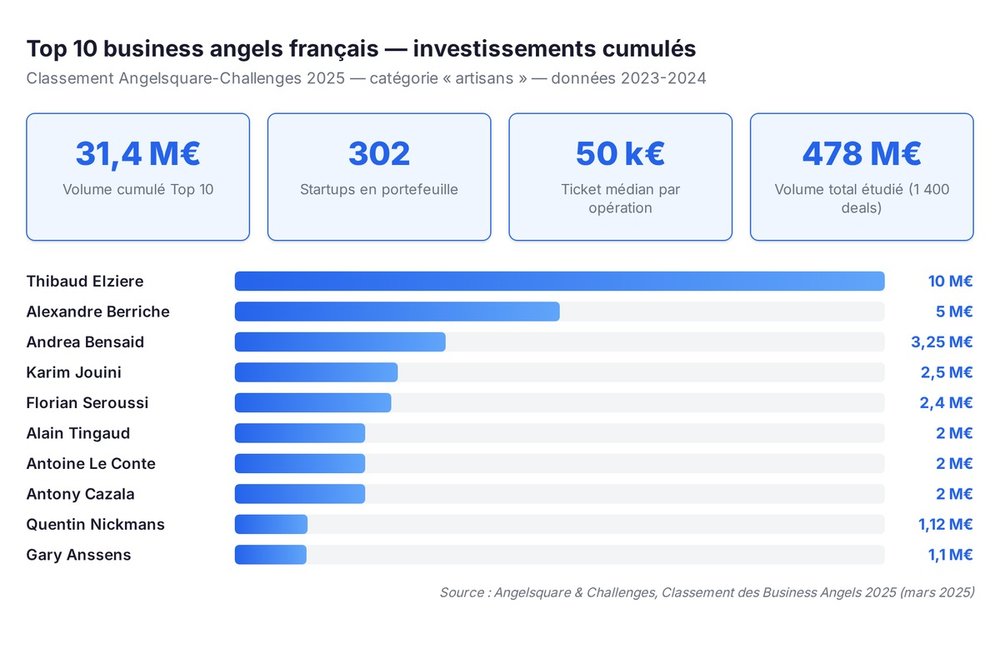
The 2025 Angelsquare-Challenges ranking publishes a list of "artisans": the independent investors who back companies directly, without a professionalized structure. Methodology: 1,400 investments analyzed, €478M in volume, data collected between January and February 2025 on 2023-2024 deals3.
The ranking comes out every 18 months. It distinguishes two categories: "artisans" (independent BAs) and "professionals" (BAs structured through a holding company or family office). The figures below cover the 2025 artisans.
The 10 named BAs
1. Thibaud Elziere: €10M invested, 50 startups (Virtuo, Yousign, Kate, Iconic House). Ticket €100-250k in pre-seed and seed. Cybersecurity, SaaS, Web3. Founder of Fotolia, runs the Hexa startup studio.
2. Alexandre Berriche: €5M across 100 startups (Finary, Bloom Ride, Circular, Kocomo, Formance). Ticket €50-100k, from pre-seed to Series B. B2B, fintech, SaaS. Founder of Fleet, invests half his capital abroad with a recent push into AI.
3. Andréa Bensaid: €3.25M across 30 startups (AB Tasty, InterCellar, inHEART, Bitstack, Sidely). Ticket €100-250k from pre-seed to Series A. Biotech, blockchain, deeptech. Founder of the Eskimoz agency.
4. Karim Jouini: €2.5M across 26 startups (Uptale, Klara RH, Bene Bono, Axeptio, Dabchy). Ticket €50-100k from pre-seed to Series A. B2B, impact, SaaS. Founder of Thundercode.ai, formerly of Expensya.
5. Florian Seroussi: €2.4M across 14 startups (Databricks, Stripe, Neuralink, Snoots, Qoddi). Ticket €100-250k in pre-seed and seed. More than 15 years of BA experience, based in New York. B2B, cybersecurity, SaaS.
6. Alain Tingaud: €2M across 8 startups. Ticket €100-250k in seed. Founder of InfoVista (1995, telecoms). Big data, deeptech, SaaS.
7. Antoine Le Conte: €2M across 25 startups (Murfy, Le Fourgon, WasteX, Tabesto, Roof). Ticket €50-100k in pre-seed and seed. Founder of Cheerz, creator of the Climate Club. Agritech, deeptech, climate.
8. Antony Cazala: €2M across 5 startups (Le Rouge Français, Care 2 Care, Fayo, Primary Care). Ticket €250-500k from pre-seed to Series A. Deeptech, foodtech, medtech.
9. Quentin Nickmans: €1.12M across 27 startups (Fintool, Blocktool, Mobile First, Upstream, Crowwd). Ticket €50-100k in pre-seed and seed. Co-founder of Hexa with Thibaud Elziere. B2B, fintech, SaaS.
10. Gary Anssens: €1.1M across 17 startups (Cowboy, Kesako, Rocapine, Artsper, Yousign). Ticket €20-50k in pre-seed and seed. Founder of Alltricks, co-founder of French Tech Paris Saclay. B2C, B2B, SaaS.
How to approach them, concretely
- Don't ask for an investment in your first message. Ask for an opinion on a product decision, feedback on your go-to-market, an intro to a target customer. The raise comes later.
- Personalize radically. A BA who sees "Hi, we're raising €500k and your profile is a fit" deletes it unread. Name a portfolio company, explain why your business resembles it (or stands apart from it).
- Find the warm intro. An intro from a founder they've already funded always beats a cold LinkedIn message or cold email. Identify the founders in their portfolio and go through them.
Where to find business angels in France
The networks federated by France Angels
France Angels organizes 64 regional and sector-focused networks1. Four deserve particular attention:
- Femmes Business Angels (FBA): 160 women investors, Europe's largest female-led network.
- Paris Business Angels: one of the largest in the Île-de-France region.
- Angels Santé: focused on medtech, biotech, e-health.
- BADGE (Business Angels des Grandes Écoles): alumni of engineering and business schools.
Standard process: submit an executive summary, get shortlisted by the network's staff, pitch to a jury, go through due diligence if there's interest, then sign. Count on 3 to 6 months between first contact and wire transfer.
Investor clubs and deal clubs
Informal deal clubs have multiplied since 2023: shared risk, larger deals, pooled due diligence. Antoine Le Conte's Climate Club and the Angelsquare clubs are examples. The entry ticket is higher (from €20,000), and the support is more intensive.
Specialized events
Four must-attend gatherings:
- VivaTech (BA Track): the big Paris showcase, every June.
- Business Angels Week (France Angels): 34 events across France, 2,500 participants in total.
- National Business Angels Congress: 350 to 450 participants, an intensive format.
- I'NOV PRO: 400 business meetings scheduled in advance.
Preparation: target 5 to 10 BAs before the event, request pre-booked slots, and arrive with a one-page project sheet.
Online platforms
The institutional pages (BPI, France Angels, the French Treasury) never list the online platforms. Yet they've changed the game over the past five years. Five platforms worth knowing:
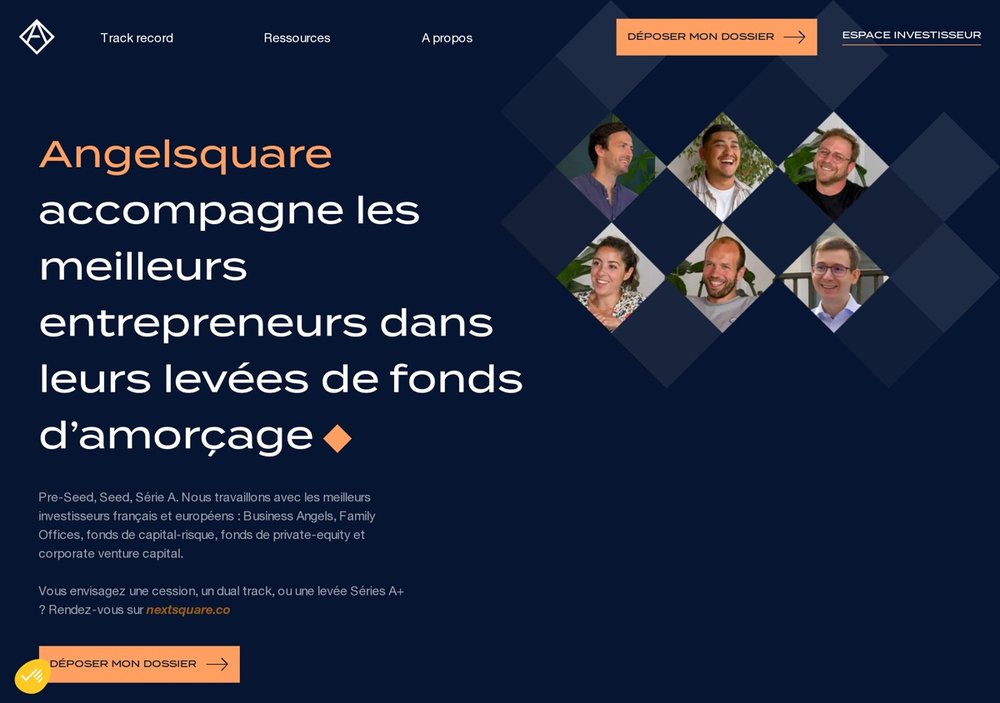
- Angelsquare: a BA/startup marketplace, the French standard for pre-seed and seed equity.
- EuroQuity (Bpifrance): a BPI-backed platform for European matchmaking, free to use.
- Sowefund: equity crowdfunding, tickets from €100, long campaigns (3-6 months).
- WiSEED: a veteran French equity crowdfunding platform focused on innovation, real estate, and transition.
- Tudigo: equity crowdfunding geared toward impact and the real economy.
On Angelsquare and EuroQuity you stay in B2B (you're talking to BAs). On Sowefund, WiSEED, and Tudigo you mobilize the crowd (public campaigns, many minority tickets).
LinkedIn and social networks
LinkedIn remains the most underused channel. Three effective uses:
- Active monitoring: follow your target BAs, understand in real time what interests them.
- Visibility: post about traction, product learnings, hires. Bring BAs to you.
- Direct outreach: a short, contextualized message, with no pitch deck attached.
Skip the "We're raising, interested?" DM. Go with "We closed X last week, your take on Y would be valuable." The second gets a reply, the first goes to the bin.
How to prepare for the meeting
Business angels receive as many as 100 pitches a week. Your preparation decides whether you stand out.
Build a sharp pitch
Florence Richardson, co-president of Femmes Business Angels, sums it up: "90% of the decision to back a company comes down to the founder and their team." The pitch isn't a product presentation, it's a demonstration of judgment. Three non-negotiable elements:
- The problem in one concrete sentence. Not "we address a growing market." Rather: "real estate agencies lose 40% of their leads because they call back 18 hours after the form is submitted."
- The solution in three lines. If you can't explain it in three lines, you don't yet understand what you're doing.
- Traction. An MRR figure, a signed contract, a retention rate. Actual numbers count for more than projections.
Personalize the message and know what they expect
BAs favor sectors where they have expertise. Don't pitch a fintech BA on a medtech project: check the last 10 startups in their portfolio before first contact. On ROI, they look for a 5x to 10x return over 5 to 7 years, and they weigh the team ahead of the market and the product. "We appreciate a strong leader, but they need to be well surrounded," notes Julien Dubois, associate member of Investessor.
Prepare the pitch deck and data room
The effective pitch deck: 15 to 20 slides, 3 ideas max per slide, a clear narrative. "A pitch deck is a maximum of 20 words and 3 ideas per slide," advises Jean de la Rochebrochard. The data room contains:
- Go-to-market: key metrics, financial history, an 18-month sales plan.
- Product: roadmap, technical choices, demos.
- Market: size (TAM/SAM/SOM), competitors, positioning.
- Team and legal: KBis registration, articles of association, cap table, key contracts.
How to nail your pitch deck: a complete guide with concrete examples.
Anticipate questions and objections
Five questions come up in most BA meetings:
- Why you, why now?
- How will you spend the money you raise?
- What are your KPIs and where do you stand?
- Who are your competitors and why will you win?
- What's the envisioned exit?
Prepare a 90-second answer for each. No longer.
Negotiating the equity entry
A BA coming on board isn't just a signed check. It's a contract that shapes the next 3 to 5 years.
Entry terms and valuation
The pre-money valuation is the first point of friction. The math: pre-money valuation + amount raised = post-money valuation. The BA takes (amount raised) / (post-money valuation) = their percentage of equity. A BA generally targets between 10% and 20% for a solid seed round. Beyond that, you dilute too early.
Shareholders' agreement (drag along, tag along)
The shareholders' agreement is the central legal instrument. Four clauses to understand before you sign:
- Drag along: if a majority decides to sell, all shareholders are required to follow. Protects the exit opportunity.
- Tag along: a minority holder can sell on the same terms as an exiting majority holder. Protects small shareholders.
- Preemption: shareholders get priority to buy back a departing holder's shares. Prevents an unwanted third party from coming in.
- Anti-dilution: protects an investor's value if the next round happens at a lower valuation (a down round). Watch out for "full ratchet" variants that are very unfavorable to founders.
"Being advised by a specialized lawyer is essential," notes Pierre-Antoine Dusoulier, CEO of iBanFirst and a business angel. Count on €5,000 to €15,000 excluding tax for a serious shareholders' agreement at this stage. Don't cut corners.
How long before you get the funds
The typical sequence:
- First contact to letter of intent: 4 to 8 weeks.
- Letter of intent to completed due diligence: 4 to 6 weeks.
- Due diligence to signing: 2 to 4 weeks.
- Signing to closing (wire): 1 to 3 weeks.
Total: 3 to 5 months between the first meeting and the transfer. Plan ahead. Don't launch your raise when you have 2 months of runway, launch it when you have 9.
How a business angel gets paid
No fees (unless there's an operational mandate): a BA is paid through the capital gain at exit. Four routes: resale to a VC fund at Series A/B (the most common in France), a trade sale, a buyback by the founders (rare), or an IPO (very rare at pre-seed/seed). On the tax side, the IR-PME scheme grants an income tax reduction of 25% of the amount invested (capped).
The business angel's exit
A 3-to-5-year horizon is typical. Beyond that, the BA grows impatient. Before 3 years, opportunities are scarce apart from a bridge or an early Series A. The exit depends on the VC market, sector competition, and macro timing. Be ready for a window 2 to 4 years longer than you expected.
Alternatives to business angel financing
Depending on your profile, other channels may suit you better.
Equity crowdfunding (Sowefund, WiSEED, Tudigo)
Suited to B2C projects, impact ventures, and strong brands. Typical raise: €200,000 to €1.5M depending on traction and community. Upside: no complex shareholders' agreement, a standard SAS. Downside: a public campaign, media dependence, and managing hundreds of small shareholders.
Honor loans (Réseau Entreprendre, Initiative France, Bpifrance)
Zero-interest loans, with no personal guarantee, granted to the founders (not the company). Tickets of €5,000 to €90,000 depending on the network. No dilution. Often combined with banking leverage (€1 of honor loan unlocks €2 to €5 of bank lending).
BSA-AIR and pre-seed instruments
The BSA-AIR (a share subscription warrant with a fast investment agreement) lets you raise without setting a valuation right away. The investor converts their BSA-AIR at the next round, usually with a discount (15-25%) or a valuation cap. Ideal between two rounds or as a bridge. The complete guide to the BSA-AIR breaks down the key parameters and the pitfalls.
Seed funds and VCs
For tickets of €500k to €3M, seed funds (Kima, Stride, Frst, Founders Future, Hexa) take over from BAs. The process is slower but the ticket is larger. How a VC fund works: inner workings and decision criteria.
How to become a business angel
The question comes up often. Three conditions:
- Financial capacity: €50,000 to €100,000 minimum available without touching your emergency savings.
- Choosing a vehicle: directly or through a wealth holding company (tax-advantageous above €100k/year). The IR-PME scheme gives a 25% tax reduction up to a cap.
- Joining a network: France Angels, a deal club, or Angelsquare. Essential for the first two years to calibrate your judgment.
Start with 5 to 10 tickets of €5,000 to €10,000 over 18 months. Diversify. Accept that 60 to 80% of your investments will return nothing.
FAQ
What's the difference between a business angel and a VC?
A BA invests their own wealth, a VC invests money from third-party LPs. A BA decides alone or in a small committee, a VC goes through an investment committee. A BA funds pre-seed and seed (€10k to €500k), a VC funds seed through Series C (€500k to €50M+). BA horizon: 3 to 5 years. VC horizon: 5 to 10 years.
How long before you get the funds?
Count on 3 to 5 months between the first meeting and the transfer: 4-8 weeks for the letter of intent, 4-6 weeks of due diligence, 2-4 weeks to negotiate the agreement, 1-3 weeks for closing. Launching a raise with less than 6 months of runway is risky.
How does a business angel get paid?
No fees: they're paid solely through the capital gain at exit (resale to a VC fund, a trade sale, more rarely a founder buyback). The IR-PME scheme gives a 25% tax reduction on the amount invested.
What percentage does a business angel take?
A BA stays a minority holder, generally between 5% and 20% for a seed round. Beyond that, the founder dilutes too early. The math: (amount raised) / (post-money valuation).
What are the downsides of a BA?
Three downsides: time lost in follow-up meetings, contradictory advice when several BAs are involved, and the risk of a poorly negotiated agreement (aggressive anti-dilution, broad preemption). Removing a disgruntled BA is more complex than removing a fund.
How do you contact a BA?
Three rules: don't ask for an investment in your first message (ask for an opinion), personalize radically (name a company from their portfolio), and find the warm intro through a founder they've already funded. A warm intro always beats a cold DM or email.
What are the advantages of a BA as an investor?
Beyond the check: customer and investor introductions, key hires, a sector perspective. Having a BA on board gives a deal credibility with honor loan programs, banks, and VCs at Series A. The leverage is measured above all in time saved on the next round.
How do you prepare for a meeting?
Three elements before first contact: a three-line pitch (concrete problem, clear solution, quantified traction), research on the portfolio's last 10 startups, and 90-second answers to the five classic questions. The pitch deck (15-20 slides) and the data room come at the second meeting.
What ROI expectations should you expect?
BAs target a 5x to 10x return over 5 to 7 years. They accept that 60 to 80% of their investments return nothing, as long as the 20% that work more than make up for it. They look for projects with strong asymmetric upside, not linear small businesses.
Footnotes
-
France Angels, Chiffres Clés (accessed May 7, 2026). https://www.franceangels.org/chiffres-cles/ ↩ ↩2 ↩3
-
Bpifrance Création, Les business angels (accessed May 7, 2026). https://bpifrance-creation.fr/encyclopedie/financements/recours-a-investisseurs/business-angels ↩ ↩2
-
Angelsquare and Challenges, Classement des Business Angels 2025 (published March 27, 2025, accessed May 7, 2026). https://home.angelsquare.co/classement-des-business-angels-2025/ ↩ ↩2