OpenVC is a free investor database founded in 2021 by French entrepreneurs Stéphane Nasser and Lucas Roquilly. It lists VC funds, business angels, family offices and accelerators, along with each one's thesis, check size and preferred contact method.
Our verdict: OpenVC is best for building a targeted investor list in an afternoon and tracking who opens your deck. Treat it as one fundraising channel among several, after your own network. The free version is enough for most pre-seed and seed rounds. Premium costs $99 per month or $299 per year, according to the pricing page we checked on September 24, 2026.
We reviewed the public platform, the France list and the co-founder's statements on reliability. Figures as of September 24, 2026.
How OpenVC works
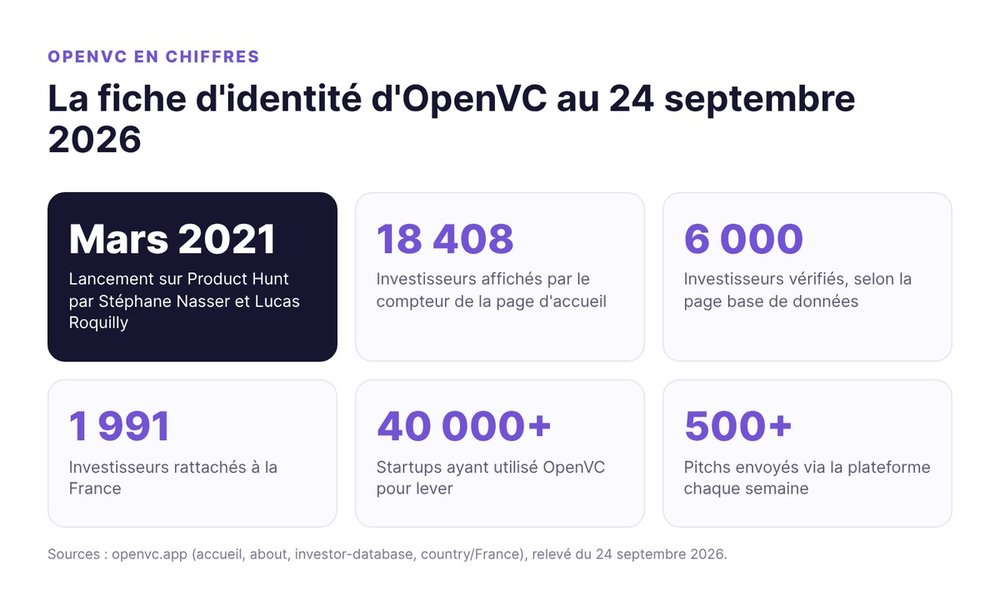
OpenVC is an online fundraising platform for early-stage startups. Its co-founders launched it on Product Hunt in March 2021 with just over 140 funds listed, according to Siècle Digital.
The original idea still holds: every investor publicly describes what they fund and how they want to receive pitches.
A database of funds, business angels and family offices
Search lets you filter investors by country, stage, round size and sector. OpenVC splits stages into six levels, from "Idea or Patent" to "Pre-IPO". You can also filter by nine investor types, including VC funds, family offices, solo business angels and startup studios.
Each profile shows a check size range, target stages, the investor's own thesis and the open rate on decks received. A "Less solicited only" filter surfaces investors who get fewer pitches.
A built-in CRM and deck tracking
The database feeds into a fundraising CRM. You add an investor to your pipeline in one click, then log every interaction. Your co-founders can join the same workspace at no extra cost.
Your deck goes out with a unique link per investor, and OpenVC shows you who opened it and for how long. You can also import your own list as a CSV or xls file, then export the CRM in the same formats.
Two companies called OpenVC
Search "OpenVC" on Google and you will also land on openvc.com. That company has nothing to do with the investor database. OpenVC.com is a US asset manager. It runs an index fund exposed to the twenty largest private US tech companies and publishes the NYSE OpenVC 500 and NYSE OPEN Venture Capital Unicorn indices.
Results for "OpenVC Index" or "OpenVC valuation" refer to that asset manager. The platform for founders lives at openvc.app.
Our OpenVC review
OpenVC saves you time on the most tedious part of a raise: finding the funds that invest at your stage, in your sector and at your check size. Your network and the strength of your pitch still matter most.
Strengths
- Each investor's contact preference. Every profile tells you whether the investor wants a deck, an email, a form submission or a warm intro. You use the right channel from your very first message.
- A free, unlimited CRM. Search, deck sharing, reading analytics, the CRM and team seats are all free with no volume cap.
- Ready-made lists. OpenVC publishes more than 400 lists by country, sector or stage. The France list can be downloaded as a dataset.
Limitations
- Outreach is capped by a quota. OpenVC advertises up to five investor contacts per day on Premium, five times the free limit. For an 80-fund campaign, expect several weeks on the free plan.
- The interface is English-only. Your messages to French funds can stay in French, but all navigation happens in English.
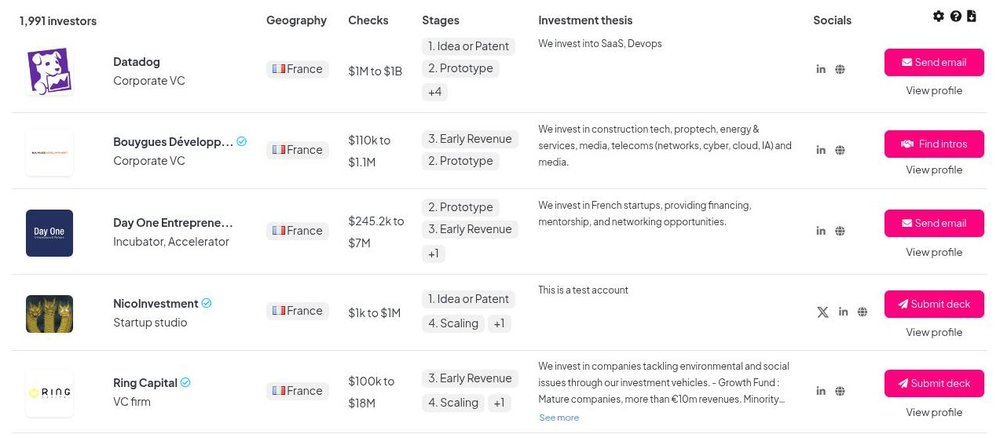
- The data needs checking. On September 24, 2026, the France list included a profile called "NicoInvestment", categorized as a startup studio and marked verified, whose thesis read "This is a test account". The "Verified" badge does not replace your own due diligence.
- Cold outreach is still cold. A fund you reach through OpenVC receives your pitch with no referral. It judges you on your traction and your deck alone.
Five different investor counts
On September 24, 2026, the site displayed five figures: 12,000 investors in the menu, 16,000 on the database page, 20,000 in the FAQ and 18,408 on the homepage counter. The bottom of the database page mentions 6,000 verified investors.
Keep the order of magnitude in mind: roughly 18,000 profiles, about a third of which carry the "Verified" badge. Send to verified profiles first. For the rest, check the fund's website before sending anything.
OpenVC pricing: free or Premium
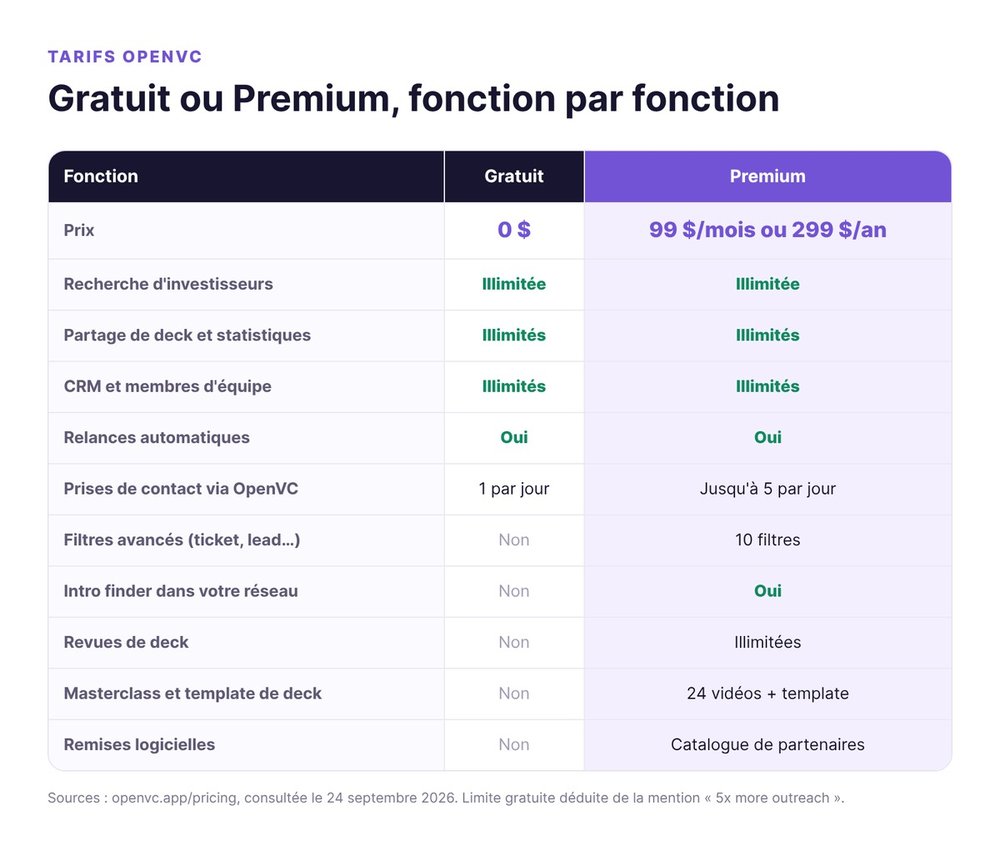
OpenVC says 90% of its features are free, and it has charged for a Premium plan since March 2023. Its pricing page lays out both plans.
The free plan
The free plan covers investor search and deck sharing with analytics, with no limits. It also includes the CRM, team seats, automated follow-ups and a "fundability" test. You can run an entire raise without paying, as long as you send most of your messages from your own inbox.
Premium at $99 per month or $299 per year
Premium adds up to five outreach messages per day through OpenVC, ten advanced filters (check size, ability to lead a round, and more) and an "intro finder". With this module, OpenVC scans your inbox contacts and identifies people who can introduce you to a target investor. You also get unlimited deck reviews, a 24-video masterclass, a pitch deck template and a catalog of software discounts.
The annual plan costs the same as three months on the monthly plan, which works out to about $25 per month.
The right plan for your raise
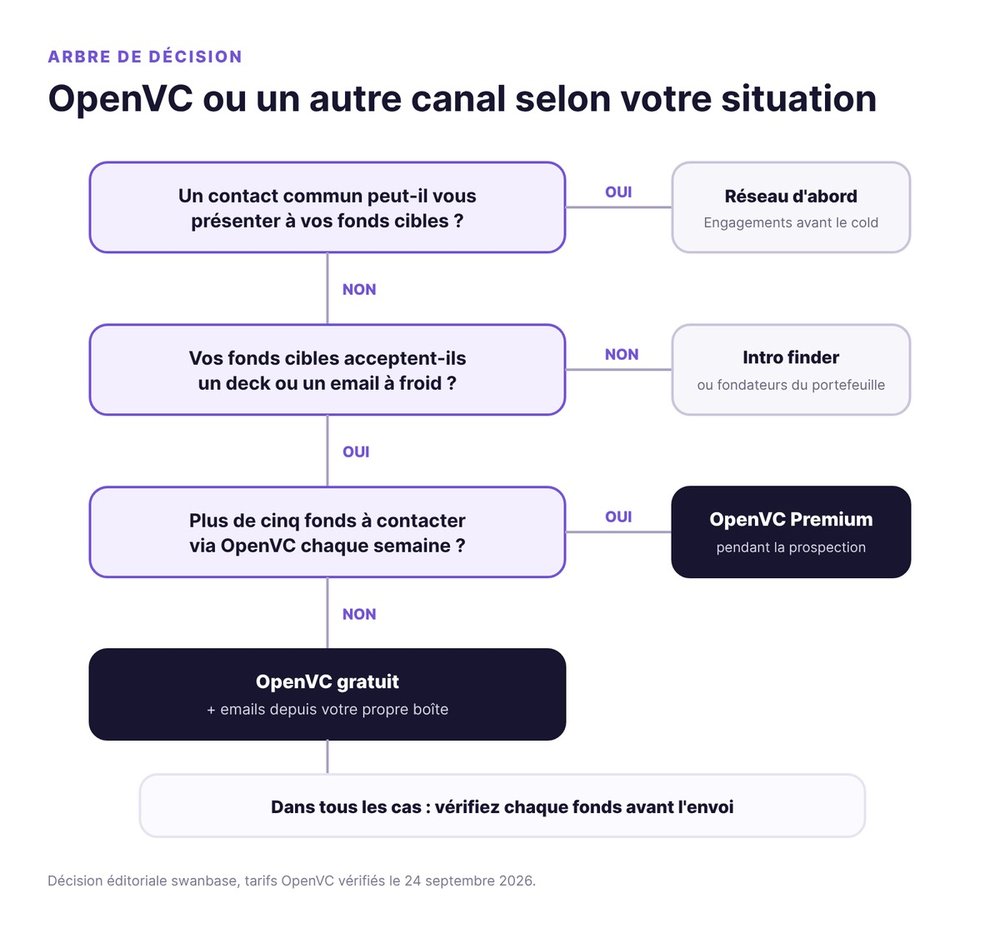
Stay on the free plan if you are raising under €500,000 from business angels and pre-seed funds you mostly reach by email. Switch to Premium during your months of heavy prospecting. The intro finder also justifies the subscription if your target funds reject cold outreach. Only go annual if your raise will take more than three months.
How to find investors with OpenVC
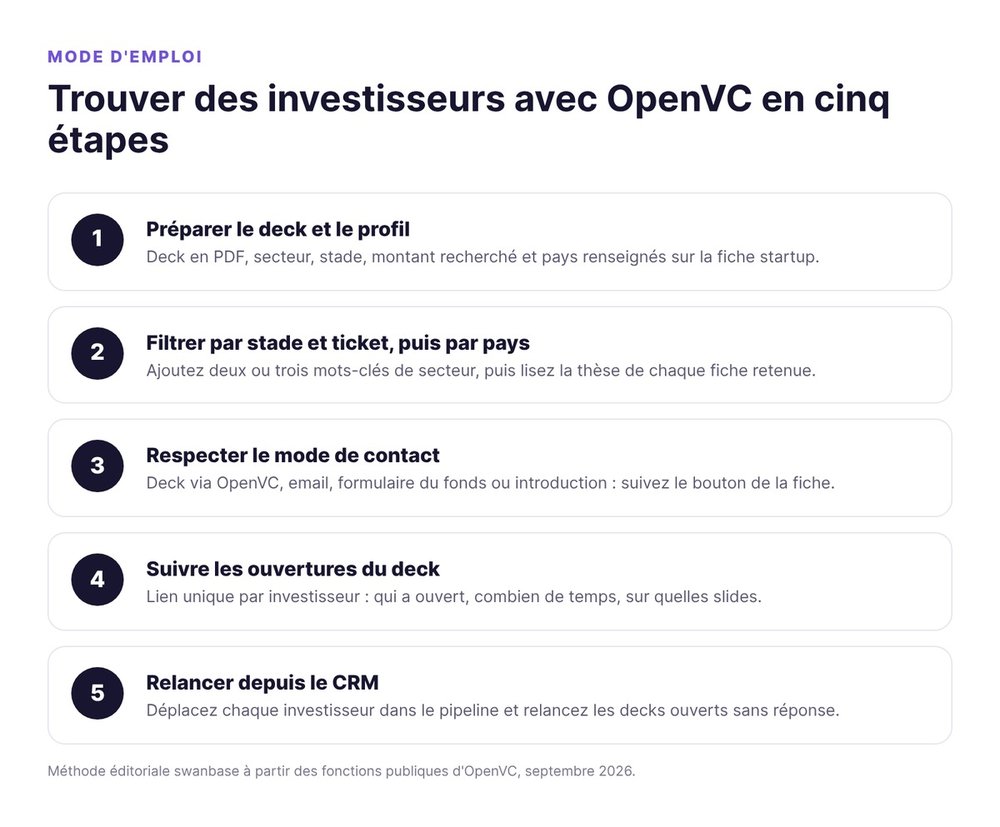
The method comes down to five steps.
1. Prepare your deck and profile
Upload your deck as a PDF and fill in your startup profile: sector, stage, amount raised, country. Investor-side filters rely on these fields. If your deck is six months old, start with our guide to building a winning pitch deck.
2. Filter by stage and check size, then by country
Then add two or three sector keywords. A B2B SaaS startup raising €800,000 at seed would filter on "2. Prototype" or "3. Early Revenue" and a matching check size. Then read the thesis on each profile: a fund can cover your stage and still explicitly exclude your sector.
3. Respect each investor's contact method
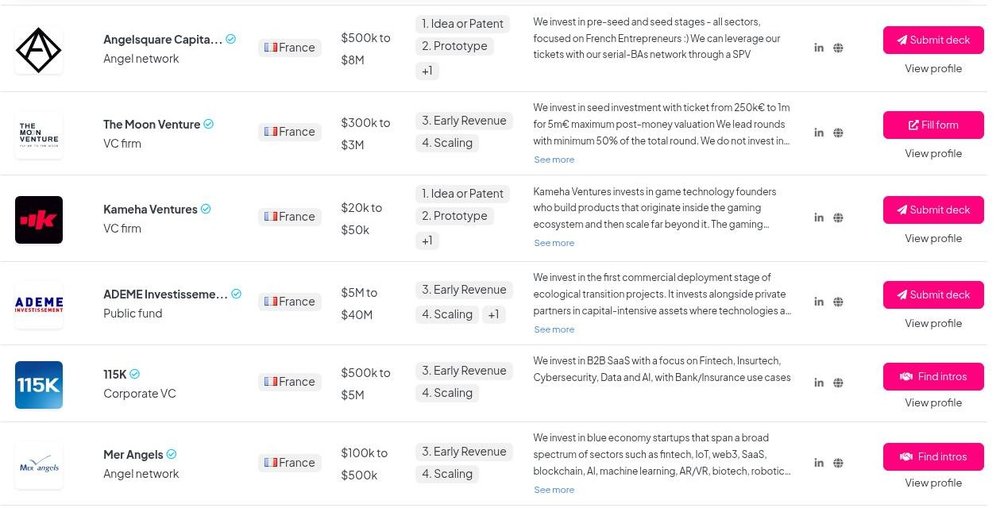
Every profile has a button matching the investor's preference: submit your deck through OpenVC, send an email, fill out the fund's form or request an intro.
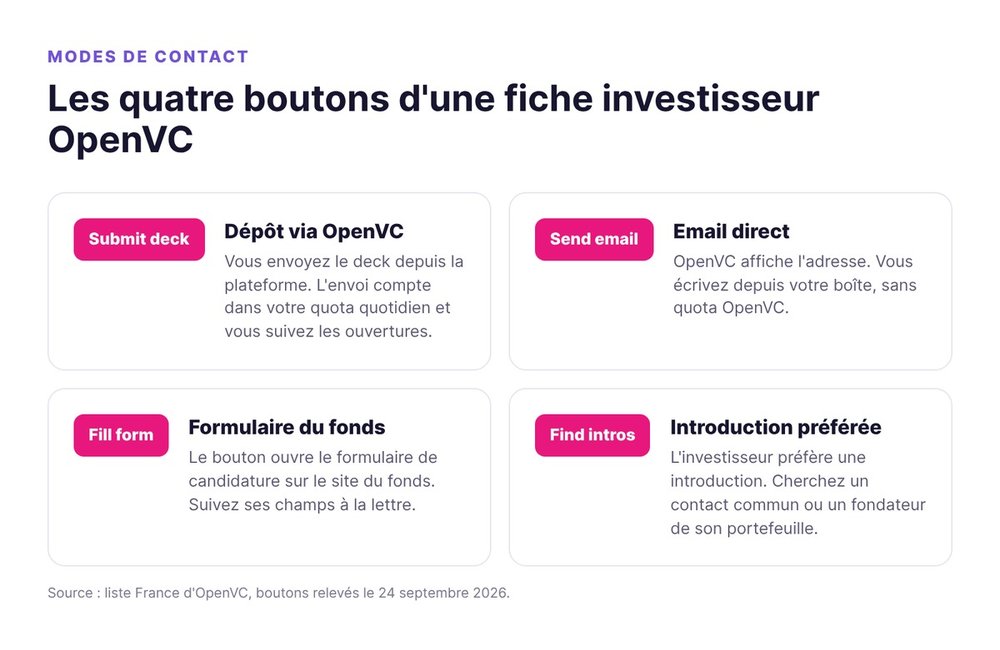
A fund that asks for intros often ignores cold emails. For those, look for a founder from its portfolio in your network. For emails, follow the structure in our guide to cold emailing VCs.
4. Track deck opens
The reading analytics show who opened your deck, for how long and which slides they viewed. A partner who spends four minutes on your deck deserves a quick follow-up. When an investor closes the deck after thirty seconds, rework the hook in your first three slides.
5. Follow up from the CRM
Move each investor through the pipeline after every exchange, and schedule a follow-up seven days out for decks that were opened without a reply. Use this time to prepare your live pitch to VCs as the first meetings come in.
OpenVC for a French startup
OpenVC targets a global audience. The success stories featured on the site mostly involve North American startups.
1,991 investors linked to France
OpenVC's France list included 1,991 investors on September 24, 2026, with an update dated that same day. The list mixes VC funds, corporate funds, business angel networks, family offices and public funds. Ring Capital, Angelsquare, ADEME Investissement and 115K were among the first entries, each with its check size and preferred channel.
This figure includes investors based abroad who target France. Filter by stage and check size before exporting: the raw list mixes $1,000 checks with ranges that go up to $1 billion.
Complement it with the French ecosystem
OpenVC covers two important French channels poorly: active business angels who are not listed on any platform, and funds that work exclusively through intros. Cross-check your OpenVC list against our selection of the best VCs in France, and decide early whether your round is aimed at funds or at business angels.
Is OpenVC reliable?
Yes for research and deck tracking, provided you vet each investor before sharing sensitive information. Co-founder Stéphane Nasser said so himself on Reddit in November 2025: security remains your responsibility.
How investors are verified
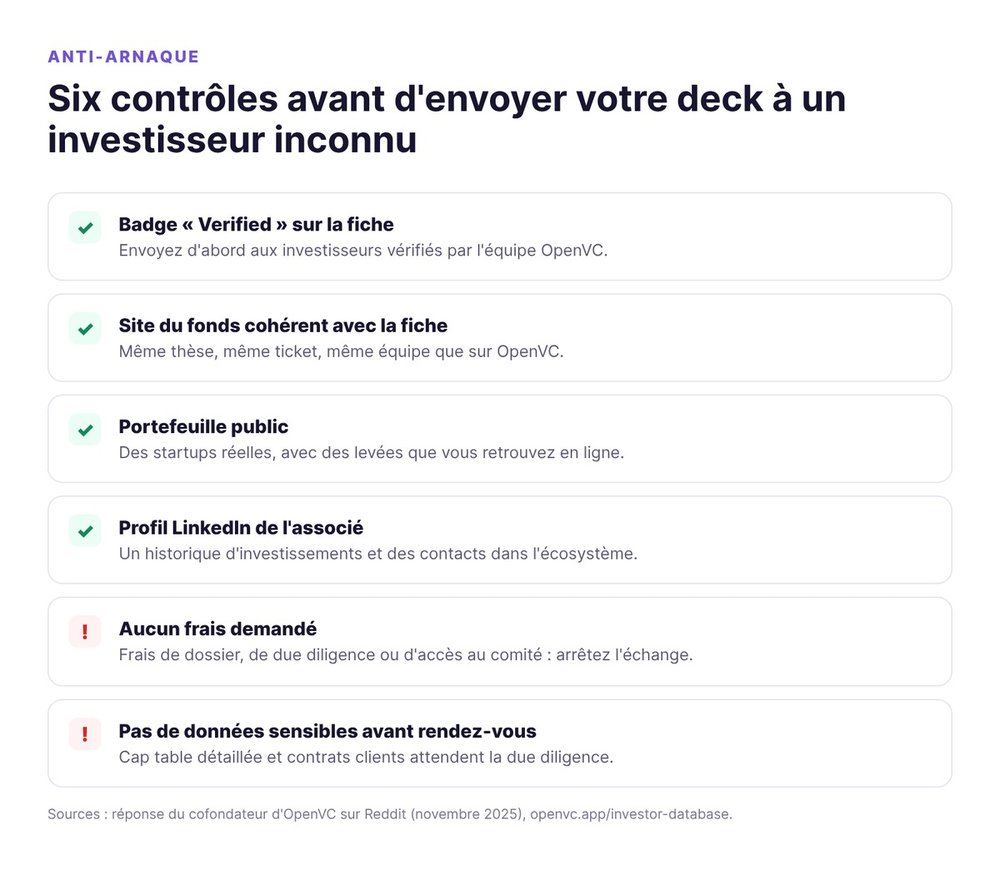
According to that post, the OpenVC team verifies investors using public sources and sometimes asks business angels for proof of past investments. OpenVC runs no KYC or anti-money-laundering checks. The team monitors unusual behavior and bans a handful of fake "investors" every year.
How outreach is filtered
OpenVC does not screen startups at sign-up. The team does, however, review messages sent to verified investors: a SaaS startup cannot mass-email 100 biotech funds. Founders therefore have to target their outreach.
Habits that protect you from fake investors
A serious investor will never ask you to pay application fees, due diligence fees or fees to access their investment committee. Check the fund's website, its portfolio and the partner's LinkedIn profile before any meeting. Keep your detailed cap table and customer contracts for the due diligence phase, after a genuine first conversation.
The co-founder also recommends a sequence: secure part of the round through your network before moving to cold outreach. Stéphane Nasser gives the example of a startup that tells unfamiliar funds "we already have $300,000 committed".
OpenVC alternatives
Pick the tool based on the job at hand.
- Crunchbase or Dealroom to study a fund's portfolio and recent deals before approaching it.
- Foundersuite or Visible if you want full investor relations software, with a data room and post-raise reporting.
- Your network and portfolio founders for funds that work exclusively through intros. A founder the fund has already backed can refer you directly to the partner.
Once the round closes, stay in touch with your backers through a monthly investor update.
Raising a seed or Series A round in France or Europe? swanbase invests €100,000 to €500,000 per startup. Tell us about your startup in ten questions.
FAQ
Is OpenVC free?
Yes. Investor search, deck sharing, reading analytics and the CRM are free with no volume cap. Premium costs $99 per month or $299 per year and mainly adds daily outreach messages and the intro finder.
How many investors are on OpenVC?
The homepage counter showed 18,408 investors on September 24, 2026. OpenVC also mentions 6,000 verified investors. The France list includes 1,991.
Who founded OpenVC?
Two French entrepreneurs, Stéphane Nasser and Lucas Roquilly, launched OpenVC in March 2021. Stéphane Nasser leads growth and Lucas Roquilly leads product. The company is separate from OpenVC.com, a US asset manager.
How many investors can you contact per day on OpenVC?
OpenVC advertises up to five outreach messages per day through the platform on Premium, five times the free limit. You remain free to write from your own inbox to investors who publish an email address.
Does OpenVC work for a French startup?
Yes, with 1,991 investors linked to France as of September 24, 2026. The interface is English-only. Complement the list with French funds that work exclusively through intros and with business angels from your network.