A startup's first hire comes down to three questions: is it really the right moment (a need that comes back every week, a founder stretched to the limit, enough runway to last at least twelve months), which profile unlocks the most value (often a senior generalist rather than a narrow specialist), and how much it truly costs once you account for payroll charges. In France, an employee costs between 1.4 and 1.6 times their gross salary. Hiring too early burns runway you don't have; hiring badly costs you three to six months and part of your culture. The good news: the best first hire is often the one you can still avoid by staying lean one more quarter. This guide walks through who to hire, when, at what cost, with how much equity, and how to avoid the misfire that sinks half of all first recruitments.
Before you hire: the first hire you can avoid
Before you write a job description, ask yourself the real question: does this work actually need to be done by a full-time employee, right now?
Many people hire on reflex, because "that's what you do when things grow." They bring on a developer when a vibe coding tool would have been enough to ship the MVP, or a salesperson before proving they can even sell the product themselves. The result: a fully loaded salary going out every month, runway melting away, and a person waiting for instructions you don't have time to give.
The simple rule: until you've confirmed that a need is recurring, structural, and time-consuming, a hire is premature. A one-off spike in activity is handled with a freelancer. A repetitive task is often handled with a tool. A function you've never performed yourself should first be validated by you, otherwise you'll neither know how to recruit the right profile nor how to evaluate them.
Stay lean as long as you can. This isn't stinginess, it's survival: every month of runway you save is another month to find your product market fit before weighing down your payroll.
When should you make your first hire?
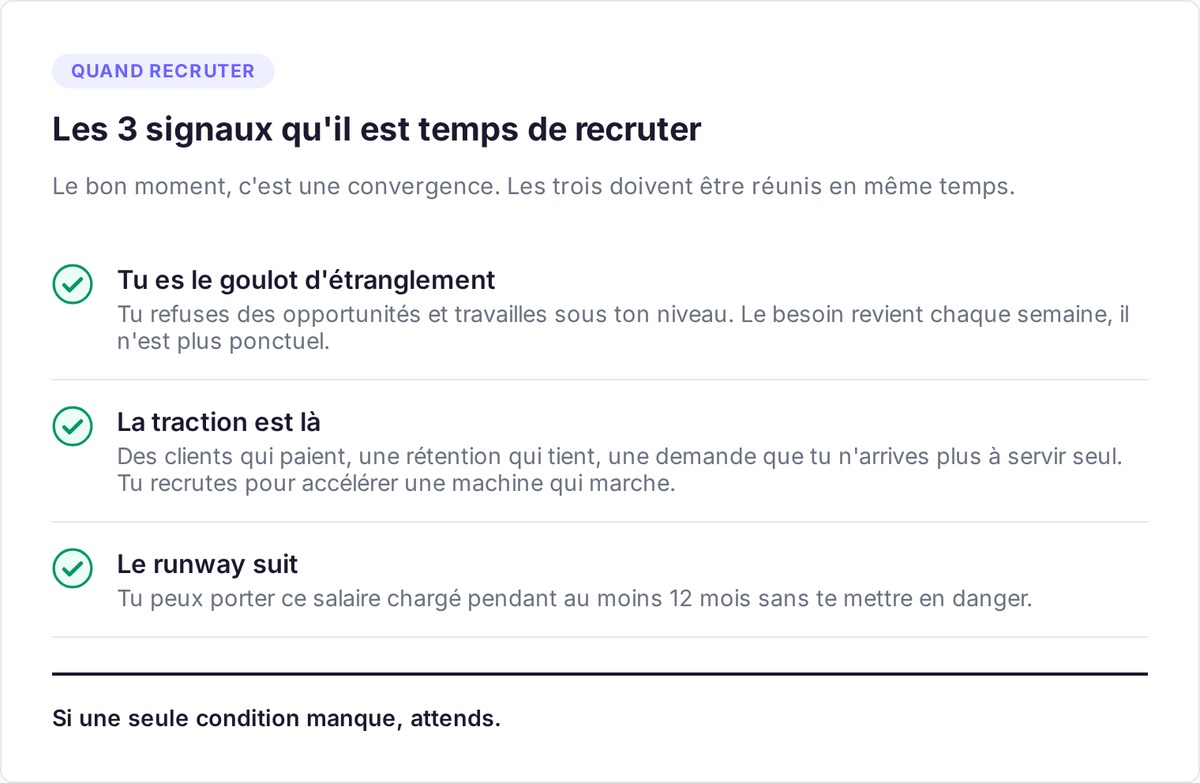
The right moment isn't a date, it's a convergence of signals. You're ready to hire when three conditions come together at the same time.
You're the bottleneck. You're turning down opportunities, pushing back deliverables, working on tasks below your level because no one else can take them. The need is no longer occasional, it comes back every week.
Traction is there. You have concrete market signals: paying customers, retention that holds, demand you can no longer serve on your own. Hiring to accelerate a machine that works, yes. Hiring in the hope that an employee will find the market for you, no.
The runway can support it. You can carry this fully loaded salary for at least twelve months without putting yourself at risk. A hire you can only fund for six months is a bet you'll probably lose, with a costly layoff at the end of it.
If even one of these three conditions is missing, wait. The right timing is when not hiring costs you more than hiring.
Who to hire first? Generalist vs specialist
At this stage, the reflex to hire a narrow expert is almost always a mistake. You don't need a technical SEO specialist or a growth hacker with ten years of AdWords. You need someone who can do ten things well and learn the eleventh fast.
An early-stage startup's first employee is a senior generalist: autonomous, resourceful, able to hold a fuzzy scope without being hand-held. The profile who asks "so what exactly is my job description?" isn't cut out for a five-person company where the job description changes every month.
Choose based on your own weakness too. If you're a technical founder with no appetite for sales, your first hire is probably business. If you're a business founder who can't hold the product together, it's the opposite. You hire to fill the most dangerous gap, not to duplicate your own strength.
One important nuance: your first hire is not a cofounder. A cofounder shares the risk, the vision, and a significant share of the equity; a first employee executes a scope with a salary package plus a bit of equity. Confusing the two creates unmanageable expectations. If what you're looking for is a partner, read our guide to finding a cofounder instead, and if it's a high-level tech profile, how to find a CTO.
What it really costs (salary + charges + equity)
This is the part HR guides gloss over and founders discover too late. A posted gross salary is not what you pay.
The fully loaded cost of a first employee
In France, the total employer cost sits between 1.4 and 1.6 times the gross salary. Employer payroll charges roughly represent 40 to 55% of gross, depending on the collective bargaining agreement and status (executive or not). In practice: an employee at €3,000 gross per month costs you around €4,200 to €4,500 per month, or more than €50,000 over the year. Before you promise a salary, run the numbers on the fully loaded cost, not gross.
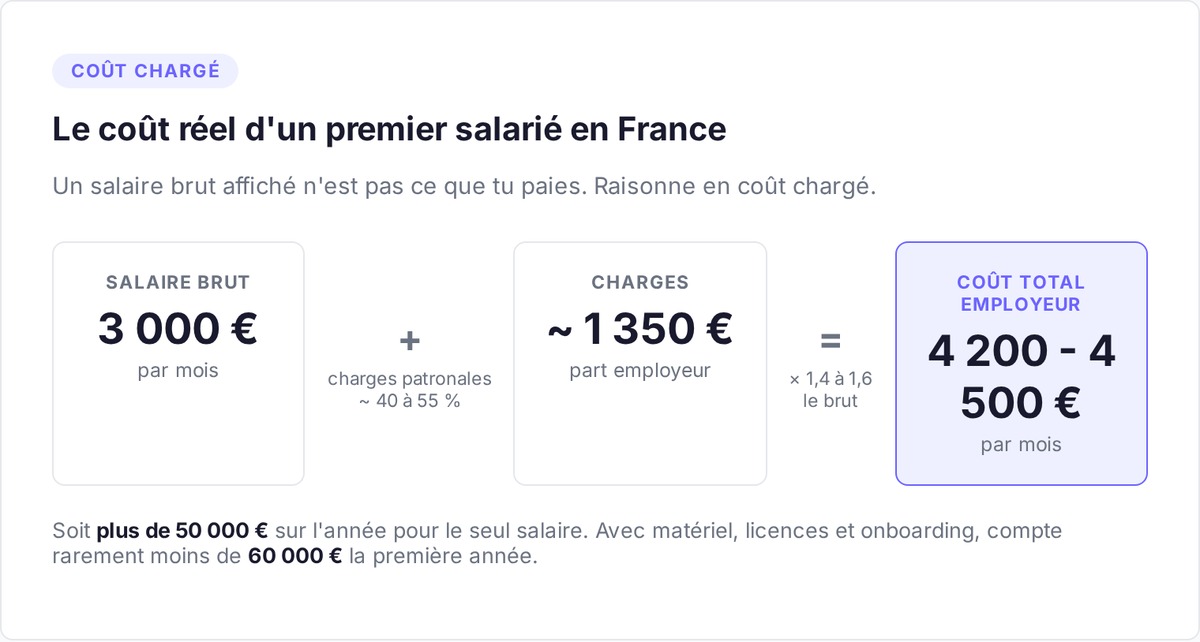
Add the hidden costs: equipment, software licenses, onboarding time (one to three months before a new hire is fully productive), and the cost of your own time spent recruiting and training. A first hire is rarely less than €60,000 in the first year, all in.
Should you give equity to your first hire?
Yes, but in moderation. Equity aligns the hire with long-term value creation and offsets a salary that's often below market. In France, this generally goes through BSPCE.
The indicative ranges, expressed as a percentage of fully diluted capital, depend on the role and the stage. The earlier you hire, the higher the risk the hire takes on, so the more generous the equity should be:
| Profile (non-founder) | Pre-seed | Seed | Series A |
|---|---|---|---|
| Tech Lead / Lead Engineer | 0.5 - 1.5% | 0.2 - 0.5% | 0.1 - 0.3% |
| Senior engineer | 0.2 - 0.5% | 0.1 - 0.25% | 0.05 - 0.15% |
| Recruited CTO (non-founder) | 1.5 - 3% | 0.5 - 1.5% | 0.5 - 1% |
These figures are market benchmarks, not a rule. A CTO who joins at the very beginning takes on risk close to a founder's, hence the higher ranges. Always plan for vesting (typically 4 years with a 1-year cliff) so that equity rewards commitment over time.
The lightweight recruiting process for an early-stage startup
You don't need a large corporation's seven-round process. You need a fast, structured, and discriminating process. Three steps are enough.
Job description and scorecard
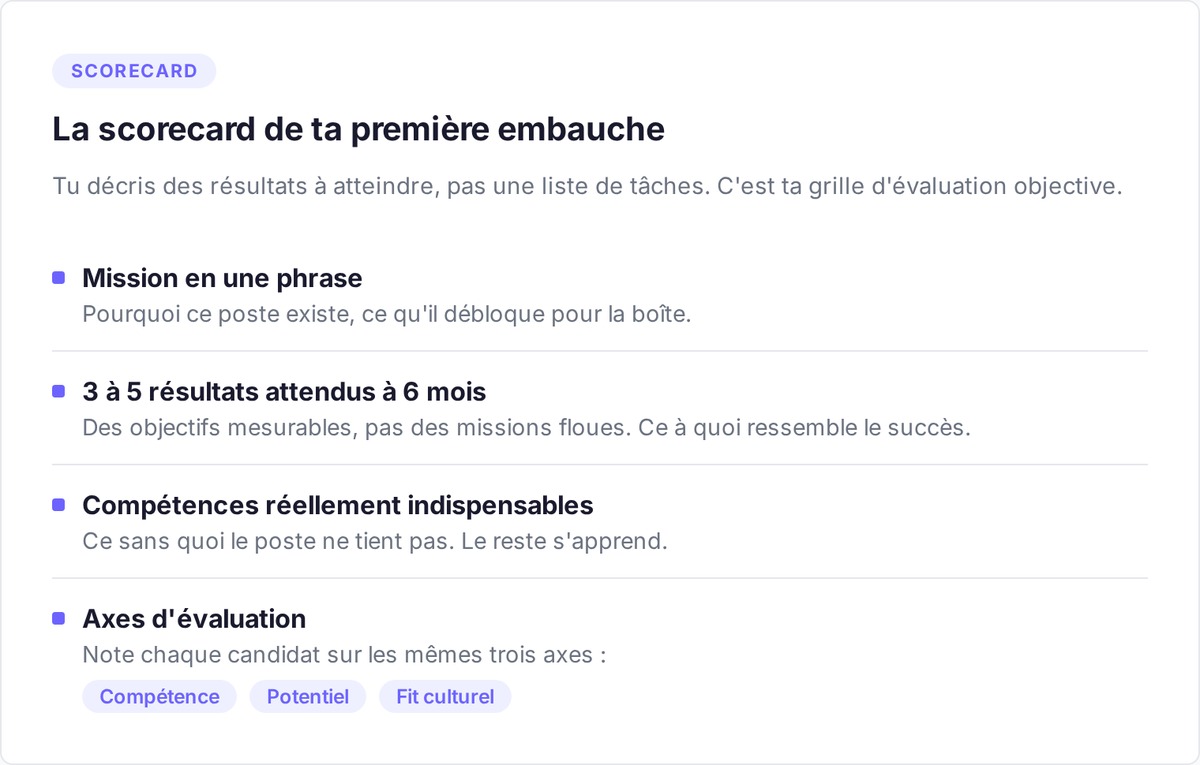
Before you publish anything, write a scorecard: the mission in one sentence, the three to five results expected over the first six months, and the skills that are genuinely essential. The difference from a classic job description: you describe results to achieve, not a list of tasks. That forces you to clarify what you really expect, and it serves as an objective evaluation grid for every candidate.
Sourcing when you're not well known
Nobody applies spontaneously to an unknown startup. Sourcing rests first on your network and that of your investors: a warm intro converts ten times better than a job ad. Tap into LinkedIn, your sector's communities, referrals from people you trust. A public ad only complements this. And own your size: a good senior generalist is looking for impact and autonomy, not a reassuring brand, so sell the project and the scope, not the security.
Assessing fit (competence + potential + culture)
Assess along three axes. Competence (can they do the work today?), potential (do they learn fast, do they adapt to ambiguity?), and cultural fit (will they hold up in a company with no process where everything changes?). At the early stage, a candidate with a little less experience but strong potential and high adaptability often beats a rigid expert. Have them work on a real case from your company rather than relying on a résumé: a half-day of hands-on work teaches you more than three interviews.
Onboarding and the trial period
Recruiting doesn't stop at the signature. The first few weeks decide whether the hire succeeds or fails.
Prepare the arrival before day one: access, equipment, first concrete assignments. A hire who spends their first week waiting for instructions loses confidence, and you lose money. Give a clear, achievable goal for the first thirty days, a "small win" that proves the person can deliver in your context.
Use the trial period for what it is: a real test, in both directions. If after two months the fit isn't there, don't wait for the legal end hoping it works itself out. A bad first hire that drags on costs more than the hard decision to end it early.
Why so many first hires fail (and how to avoid it)
A large share of first recruitments don't make it through the first year. The causes recur, and they're almost always avoidable.
The founder recruits alone, under pressure. With no HR function, many founders handle recruiting on top of everything else, fast, badly, and end up hiring the first "decent" candidate under time pressure. The fix: start sourcing before you're on the brink, not after.
The scope isn't clear. You hire "someone to help," with no precise result to achieve. The hire drifts, the founder gets frustrated, no one knows what success looks like. The scorecard settles this upfront.
You hire a senior profile for junior execution, or the reverse. A highly paid expert who spends their days on operational tasks gets bored and leaves; a junior thrown into a fuzzy scope drowns. Seniority mismatch kills more hires than people think.
You overvalue experience and underestimate fit. A brilliant résumé from a large corporation guarantees nothing in a five-person company with no process. Adaptability and autonomy matter more than pedigree.
The common lesson: a bad first hire doesn't just cost a salary, it slows growth and weakens the culture you're building. Better a month of delay and the right person than the reverse.
FAQ
When should you hire your first employee in a startup?
When three signals converge: you've become the bottleneck on a recurring need, you have real traction (paying customers, retention), and your runway can carry the fully loaded salary for at least twelve months. If any of the three is missing, it's too early. The right moment is when not hiring costs you more than hiring.
Who should you hire first in a startup?
A senior generalist, autonomous and adaptable, rather than a narrow specialist. Choose the profile that fills your biggest weakness: business if you're a technical founder, product or tech if you're a business founder. Your first hire executes a scope, they're not a cofounder who shares the vision and the risk.
How much does a first employee cost in France?
Between 1.4 and 1.6 times the gross salary, employer payroll charges included. An employee at €3,000 gross per month comes to roughly €4,200 to €4,500 per month for the employer. Adding equipment, software, and onboarding time, count on rarely less than €60,000 in the first year.
How much equity should you give your first hire?
It depends on the role and the stage. At pre-seed, a senior engineer is around 0.2 to 0.5% and a Tech Lead around 0.5 to 1.5% of fully diluted capital, via BSPCE. The earlier you hire, the more generous the equity should be, because the risk taken is higher. Always plan for vesting over 4 years with a 1-year cliff.
Why do first hires so often fail?
Four main causes: recruiting done alone and under pressure, a poorly defined scope, a seniority mismatch between the role and the profile, and overvaluing experience at the expense of cultural fit. All are avoidable with a clear scorecard, early sourcing, and evaluation on a real case.