Growth Marketing for Startups: The Complete Guide to Scaling
You've just launched your startup. You have a product, maybe a few users, and one question keeping you up at night: how do you go from 10 customers to 1,000, then to 10,000, without burning through your cash in three months? That's exactly what growth marketing is: the art of growing a startup by testing, measuring, and optimizing every acquisition and retention lever. Forget the 50,000-euro awareness campaign. Forget the theoretical "brand strategy." Growth focuses on one objective: finding the channels that generate measurable, repeatable, profitable growth. The AARRR framework (Awareness, Acquisition, Activation, Revenue, Retention, Referral) structures this approach into six stages. In France, where between 60 and 90% of startups fail in their first few years, mastering growth marketing isn't a luxury. It's a matter of survival.
What is growth marketing?
Growth marketing is a growth approach built on rapid experimentation, data analysis, and continuous optimization at every stage of the customer journey. Unlike traditional marketing, which thinks in terms of campaigns and annual budgets, growth marketing thinks in terms of loops: test a hypothesis, measure the result, keep what works, kill what doesn't. Then start over.
It's not a discipline reserved for Silicon Valley unicorns. It's a method that any startup can apply from day one, with a budget close to zero. The only requirement: accepting that your intuitions are hypotheses, not truths.
Growth marketing rests on three pillars:
- Systematic experimentation. Every marketing action is an experiment with a hypothesis, a success metric, and a decision rule (scale it, iterate on it, or stop it).
- The full funnel. You don't stop at acquisition. You optimize activation, retention, revenue, and referral.
- Data, not opinions. Decisions are made on the basis of numbers, not aesthetic preferences or "best practices" copied from some Medium article.
Growth marketing vs traditional marketing
Traditional marketing is the TV campaign, the billboard on the highway, the media budget planned six months in advance. It works (sometimes) for large companies that have millions to spend and can afford to wait 12 months for results.
For a startup, it's slow suicide.
Here are the fundamental differences:
| Criterion | Traditional marketing | Growth marketing |
|---|---|---|
| Horizon | Long-term campaigns (6-12 months) | Short sprints (1-4 weeks) |
| Budget | High, fixed | Variable, reinvested based on results |
| Focus | Awareness, brand image | Acquisition, activation, retention |
| Measurement | Impressions, reach, "awareness" | CAC, LTV, conversion rate, retention |
| Decision | The marketing director's gut feeling | Experimentation data |
| Scope | Top of funnel only | Full funnel (AARRR) |
A growth marketer doesn't ask, "was our campaign beautiful?" They ask, "did our CAC drop 15% this week?" The distinction is fundamental.
Growth marketing vs growth hacking
Growth hacking is the impulsive cousin of growth marketing. The term, coined by Sean Ellis in 2010, refers to the creative and often unconventional tactics used to accelerate growth. The Hotmail hack that added "PS: I Love You. Get your free email at Hotmail" to the signature of every email sent (which took them to 12 million users in 18 months). Airbnb's integration with Craigslist to capture traffic from an existing platform. Dropbox's referral program that gave away free storage space for every friend invited.
These hacks are spectacular. But they have a problem: they aren't repeatable. Growth marketing, on the other hand, is a system. Not a one-off stunt.
| Growth hacking | Growth marketing | |
|---|---|---|
| Approach | Tactical, opportunistic | Strategic, systematic |
| Duration | Short term | Long term |
| Repeatability | Low (the hack runs out) | High (the system improves) |
| Skills | Technical creativity | Analysis + creativity + strategy |
| Risk | High (can breach terms of service, annoy users) | Controlled (framed experiments) |
In short: growth hacking looks for the shortcut. Growth marketing builds the road.
The AARRR framework: the growth marketer's compass
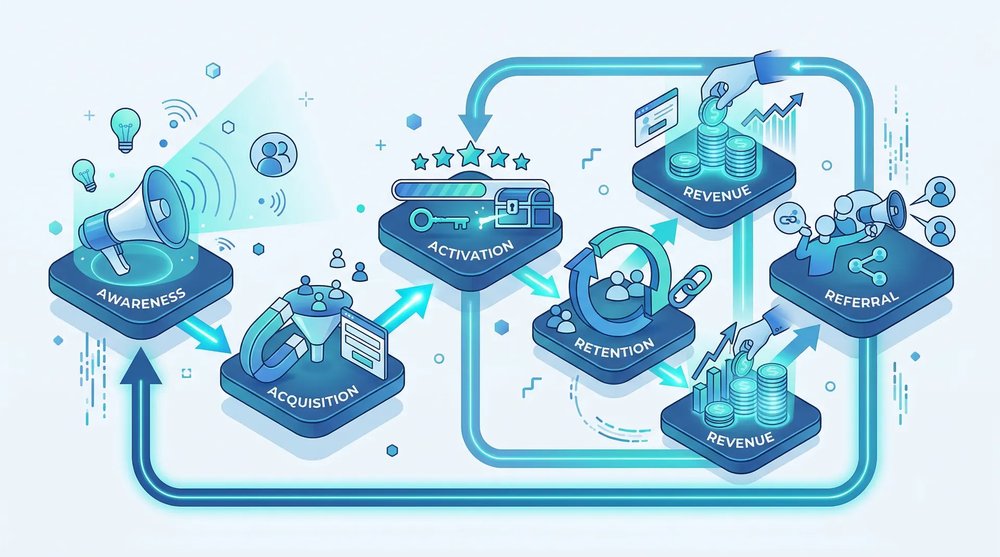
In 2007, Dave McClure (founder of 500 Startups) introduced the AARRR framework, which he dubbed "Startup Metrics for Pirates" (because AARRR, like a pirate). This analytical framework breaks the user journey down into measurable stages.
At swanbase, we use an extended version with six stages instead of five. Why? Because in B2B, a prospect is exposed to your brand more than 60 times on average before taking action (Dreamdata, 2024). Ignoring awareness means flying blind.
A crucial point: AARRR is NOT a linear funnel. It's a series of feedback loops. A referral program feeds Acquisition. Retention improves LTV, which lets you bid more in paid acquisition. Growth loops exist at every level of the funnel, not just at Referral.
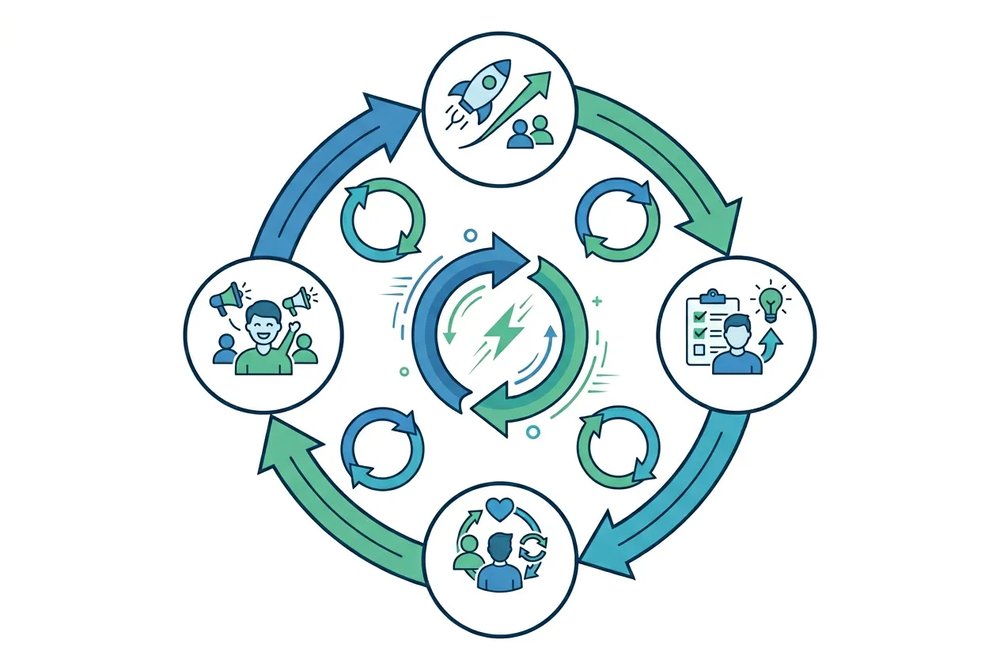
| Stage | Definition | Key question |
|---|---|---|
| Awareness | Potential customers discover the brand | How many people hear about my brand? |
| Acquisition | Users visit the platform | How many people come to my site? |
| Activation | Users experience the value for the first time | How many visitors take the first meaningful step? |
| Revenue | Users become paying customers | How many prospects become customers, and how much do they spend? |
| Retention | Customers come back | How many customers buy again or stay subscribed? |
| Referral | Customers bring in new users | How many customers recommend the brand? |
Acquisition: attracting the right users
Acquisition is the fuel for the engine. But be careful: not all visitors are equal. A growth marketer isn't looking for "more traffic." They're looking for the right traffic, the traffic with the highest probability of becoming a customer.
The classic acquisition channels for a startup:
- SEO (organic search): free, slow, but with a powerful compounding effect. A well-ranked article brings you traffic for years. It's one of the most underrated acquisition levers for early-stage startups.
- Paid ads (Google Ads, Meta Ads, LinkedIn Ads): fast, measurable, but expensive. The trap: becoming dependent.
- Outbound (cold email, LinkedIn): effective in B2B, requires volume and personalization.
- Content (blog, newsletter, podcasts): builds authority and feeds SEO.
- Community and partnerships: often overlooked, often the most profitable.
The reigning metric in acquisition: CPA (cost per acquisition). CPA = ad spend / number of conversions. If your CPA exceeds your LTV, you lose money on every customer. It's simple math.
Activation: turning first contact into an experience
Activation is the precise moment when a user grasps the value of your product. It's not the sign-up. It's the "aha" moment.
For a SaaS, it's when the user completes onboarding and uses the key feature for the first time. For an e-commerce store, it's the add-to-cart. For a marketplace, it's the first search that returns relevant results.
If your activation rate is low, no amount of acquisition will save you. You're filling a leaky bucket.
How to improve activation:
- Reduce the time between sign-up and the "first win" (the famous time-to-value)
- Remove unnecessary steps in onboarding
- Show value before asking for a commitment (free trial, freemium)
- Personalize the experience from the very first contact
Retention: bringing people back
Retention is where startups die quietly. Acquiring 100 new users a month? Wonderful. But if 80 vanish after the first month, you're not building anything. You're just pedaling in place.
The metrics vary by model:
- SaaS: monthly churn rate (target: < 5%), DAU/MAU ratio
- E-commerce: repeat purchase rate (target: > 30% over 6 months), purchase frequency
- Mobile app: D1, D7, D30 retention
Retention is also the most powerful growth lever (we'll prove it with the compound effect later in this article). A point of retention gained today compounds every month.
Referral: turning your users into ambassadors
Referral is the holy grail of growth marketing. When your customers become your acquisition channel, the marginal cost of each new customer trends toward zero.
The classic example: Dropbox. In 2008, Dropbox launched a simple referral program: invite a friend, you get 500 MB of free space, your friend does too. The result: the startup went from 100,000 to 4 million users in 15 months. The referral acquisition cost was nearly zero, compared with 233 to 388 dollars per customer through paid ads.
The referral metric: the K-factor. K-factor = number of invitations per user x conversion rate of those invitations. If K > 1, your growth is viral: each user brings in more than one new user. If K = 0.5, each user brings in half a user, which still significantly amplifies your paid acquisition.
Revenue: monetizing without killing growth
Revenue is the consequence of everything else. If awareness, acquisition, activation, retention, and referral are working, revenue follows. That's why revenue is rarely a good North Star Metric (more on that soon).
The essential revenue metrics:
- MRR (Monthly Recurring Revenue): for SaaS, it's the vital pulse
- AOV (Average Order Value): for e-commerce, the average basket
- ARPU (Average Revenue Per User): how much each user generates
- ROAS (Return on Ad Spend): revenue / ad spend
The temptation: optimizing revenue in the short term at the expense of retention. Raising prices aggressively, piling on intrusive upsells, cutting back on service. Revenue climbs for a quarter, then collapses. Growth marketing plays the long game.
How to build your growth strategy as a startup
You've understood the framework. Now, where do you start when you're an early-stage startup with a limited budget, a team of three, and a product that's only six months old?
That's exactly the situation the startups joining our accelerator program find themselves in. And here's the methodology we use with them.
The core principles
1. Identify your growth engine.
Every startup runs on one (or a combination) of three engines:
-
Virality (feedback loops). Your product spreads naturally. The Dropbox referral ("invite, earn storage"), the Hotmail signature in every email, YouTube embeds on external sites, Airbnb cross-posting to Craigslist. If your product has viral potential, tap into it first.
-
A sticky product (extreme retention). Your churn is nearly zero, switching costs are high. Every new user is a permanent addition to your base. This is the Facebook, Shopify, ChatGPT model. If your product is sticky, invest in acquisition: every customer you land stays.
-
Profitable paid acquisition (CAC < LTV). You know your numbers: "it costs me 560 euros for a new customer, and that customer generates 1,000 euros in the first year." If your unit economics are solid, scale paid acquisition. The key metric: MER (Marketing Efficiency Ratio) = total revenue / total marketing spend.
Identifying your engine means knowing where to concentrate 80% of your effort. Not everywhere. Not "a bit of everything." One primary engine.
2. Build your growth model.
The growth model is the mathematical equation of your growth. One line of rates (the marketing KPIs, the causes) and one line of volumes (the business KPIs, the consequences). The connection: Volume[n+1] = Volume[n] x Rate[n to n+1].
Example for an e-commerce store:
Product pages x Traffic/page x Conversion rate x Average order value x Repeat purchases = Revenue
3 x 2,000 x 1% x 65€ x 3 = 11,700€/month
Change one variable to see the impact:
- CVR from 1% to 1.3%: revenue goes from 11,700 euros to 15,210 euros (+30%)
- Repeat purchases from 3 to 4: revenue goes from 11,700 euros to 15,600 euros (+33%)
That's the power of the growth model: it shows you exactly which lever to pull. No guessing required. The math tells you.
3. Apply First Principles thinking.
Before copying the "best practices" from the latest trendy LinkedIn post, ask yourself six questions:
- What are the irreducible truths of my market? What assumptions am I making without checking them?
- Which constraints are real (budget, regulation) and which are artificial (habits, "we've always done it this way")?
- If I had to cut 90% of my marketing activities, what would be left?
- If my growth strategy failed completely, what would the root cause be?
- If I started from scratch, what would I build?
- What breaks if I multiply by 10?
These questions aren't theoretical. This is the methodology we apply with every startup in our program, and the answers radically change the trajectory.
Launching your first growth experiment (step by step)
Growth marketing is experimentation. Not brainstorming. Here's the template we use (the Panja methodology):
Structure of an experiment:
- Gas: the resources consumed (budget, time, human effort). How much does it cost to test this hypothesis?
- OMTM (One Metric That Matters): the single metric that decides success or failure. Not three metrics. One.
- Objective: the specific target set BEFORE launch. "Increase the conversion rate from 1% to 1.5% in 3 weeks."
- Result: the actual outcome. Three possible states: Success (scale it), Promising (iterate on it), Inconclusive (stop it).
The 4 variables to test:
- Target: who you're talking to (segment, persona, demographics)
- Message: what you say (value proposition, angle, tone)
- Channel: where you say it (Google, LinkedIn, email, SEO)
- Format: how you present it (video, text, carousel, landing page)
Target and Message are the substance variables. Channel and Format are the form variables. Always start with substance.
A concrete example: you're testing a LinkedIn Ads campaign for your B2B SaaS.
- Gas: 500 euros of budget, 2 days of work
- OMTM: number of demos booked
- Objective: 15 demos in 2 weeks
- Variables: Target (CIO vs. CMO), Message ("save time" vs. "cut costs"), Channel (LinkedIn Ads), Format (carousel vs. video)
Result after 2 weeks: 8 demos (CMO + "cut costs" + carousel). That's promising. You iterate on the CMO message, you test a new format. You don't throw it all out.
Prioritizing with the ICE framework
You have 47 experiment ideas. You can only launch 3 per sprint. How do you choose? With ICE scoring.
ICE = Impact + Confidence + Ease (each factor from 1 to 10, total score from 3 to 30)
We use the additive version (I + C + E), not the multiplicative one (I x C x E). Why? Because the multiplicative version crushes the scores: an idea with an Impact of 10 but a Confidence of 2 gets a score of 20, which masks the risk. In additive terms, a score of 16 reveals the imbalance more clearly.
Scoring grid:
Impact (if it works, how big is it?)
- 9-10: solves a critical problem at the funnel bottleneck
- 7-8: solves a critical problem OR an important problem at the bottleneck
- 5-6: solves an important or moderate problem at the bottleneck
- 3-4: solves a moderate problem or addresses a non-bottleneck stage
- 1-2: cosmetic improvement
Confidence (how certain are you?)
- 8-10: backed by specific data (exact CPA, conversion rate)
- 6-7: best practice + some data
- 4-5: reasonable hypothesis, little data
- 1-3: speculative
Ease (is it simple and fast?)
- 9-10: doable in under an hour in the interface
- 7-8: doable in 1-2 days
- 5-6: requires creative work or a landing page (1-2 weeks)
- 3-4: technical implementation required
- 1-2: organizational change, multi-week
Quick Win: ICE >= 24 AND Ease >= 7.
A concrete example to illustrate:
- Idea A: product placement with a mega-influencer. Impact: 10 + Confidence: 2 + Ease: 4 = ICE 16
- Idea B: 10 placements with mid-tier influencers. Impact: 5 + Confidence: 7 + Ease: 8 = ICE 20
Idea B wins. More likely to succeed, easier to execute. Idea A is seductive (we love imagining Kylie Jenner using our product), but ICE doesn't lie.
The essential metrics of growth marketing
Measuring without understanding is like having a dashboard in Mandarin: you see numbers, but they tell you nothing. Here are the metrics that truly matter, and above all, how to connect them to each other.
CAC (customer acquisition cost)
Formula: CAC = total marketing budget / number of customers acquired
The CAC is the price you pay for each new customer. If your CAC is 50 euros, each customer costs you 50 euros before generating a single euro of revenue.
The classic trap: calculating CAC on paid ads alone. The real CAC includes the marketing team's salaries, the tools, the content. It's often 2 to 3 times higher than founders think.
LTV (customer lifetime value)
Formula: LTV = average order value x purchase frequency x average customer lifespan
LTV tells you how much a customer is worth over the entire span of their relationship with your company. It's the metric that determines how much you CAN spend to acquire a customer.
The target ratios:
- LTV:CAC >= 3:1: sustainable growth. This is the standard benchmark for SaaS startups.
- LTV:CAC > 5:1: you're under-investing in acquisition. Spend more, you're leaving growth on the table.
- LTV:CAC < 2:1: red alert. Fix retention or reduce CAC before scaling.
An LTV:CAC ratio of 3:1 means every euro invested in acquisition brings back three. That's the threshold from which you can scale with peace of mind.
CAC Payback: CAC / monthly revenue per customer. If your CAC is 300 euros and each customer generates 50 euros/month, your payback is 6 months. You recover your investment in 6 months. Beyond 12 months, it's dangerous for your cash flow.
Conversion rate and activation rate
The overall conversion rate (visitors to customers) is a vanity metric if you don't break it down. Break it down by stage:
- Visitor to sign-up: "top of funnel" conversion rate
- Sign-up to activation: activation rate
- Activation to payment: conversion rate
- Payment to repeat purchase: retention
Each stage is a distinct lever. If your sign-up rate is excellent but your activation rate is 15%, the problem isn't acquisition. It's onboarding.
MRR and retention
MRR (Monthly Recurring Revenue) is the vital pulse of a SaaS. It breaks down into:
- New MRR: revenue from new customers
- Expansion MRR: upsells and upgrades from existing customers
- Churned MRR: revenue lost to departures
The simple formula: Net New MRR = New MRR + Expansion MRR - Churned MRR. If Net New MRR is positive, you're growing. If it's negative, you're shrinking. No ambiguity.
Choosing your North Star Metric
The North Star Metric (NSM) is the single metric that best captures the value your product creates for your users. Be careful: it is NOT revenue. Revenue is a consequence, not a cause.
The selection criteria:
- Be the primary CAUSE of growth, not the consequence
- Be the most holistic metric
- Reflect the key user experience
- Show the level of engagement
- Be simple to communicate to everyone
- Be measurable and comparable month over month
The anti-patterns (what NOT to use as an NSM):
- Number of sales (e-commerce): it's a consequence. Better: number of positive reviews (combines volume + satisfaction + advocacy)
- MRR (SaaS): it's a consequence. Better: number of uses of the key feature (a precursor to retention)
- Number of subscriptions (music app): it's a consequence. Better: total minutes listened (depth of engagement)
- Number of contracts signed (agency): it's a consequence. Better: satisfied customers with NPS >= 8 (referral + business return)
The causal chain always runs in the same direction: NSM rises, engagement rises, retention rises, paying customers increase, churn drops, revenue follows.
The compound effect: proof by the numbers
This is where growth marketing shows its structural superiority over traditional marketing. Let's take three scenarios with the same starting numbers:
Scenario 1: acquisition alone. 100 new customers per month, average order value of 30 euros. Monthly revenue: 3,000 euros. Annual revenue: 36,000 euros. LTV per customer: 30 euros. If the ads stop, revenue drops to zero.
Scenario 2: growing acquisition. Same base, but the budget is reinvested monthly, with linear growth in acquisition. Annual revenue: around 55,800 euros. LTV per customer: still 30 euros. Still 100% dependent on ads.
Scenario 3: acquisition + retention + referral. Same starting budget, but with two additions:
- 10% of buyers bring in a new customer by word of mouth each month
- One third of the quarter's new customers buy again the following quarter
The result: exponential growth. By month 12, paid acquisition represents only a shrinking fraction of revenue. Annual revenue: around 96,981 euros. Effective LTV: 96,981 euros / 1,860 customers acquired = 52 euros per customer (compared with 30 euros in scenarios 1 and 2).
And here's the decisive advantage: with an LTV of 52 euros, the startup in scenario 3 can bid up to 52 euros per customer on Google Ads or Meta Ads. Its competitors, capped at an LTV of 30 euros, can't keep up. The compound effect creates a structural competitive advantage in paid acquisition.
That's the difference between doing marketing and building a growth machine.

The growth marketer's toolkit in 2026
Tools change fast. The principles don't. Here are the essential categories and the tools that set the standard in 2026, without turning into an exhaustive catalog (you'll find a full list in our guide to AI tools for startups).
Acquisition tools (SEO, ads, outbound)
- SEO: Ahrefs or Semrush for keyword research and rank tracking. Surfer SEO for content optimization. Google Search Console (free, essential).
- Paid ads: Google Ads, Meta Ads Manager, LinkedIn Campaign Manager. For cross-channel reporting: Triple Whale or Databox.
- Outbound: La Growth Machine, Lemlist, Apollo.io. For lead scraping: Phantombuster, Clay.
Analytics and tracking tools
- Analytics: Google Analytics 4 (free), Mixpanel or Amplitude (for product analytics), Hotjar or Microsoft Clarity (for heatmaps and session recordings).
- Attribution: Segment (to centralize data), or an in-house solution with Google Tag Manager.
- Dashboards: Looker Studio (free), Databox, Metabase.
Automation tools
- Email and CRM: HubSpot (a very complete free version for startups), Brevo (formerly Sendinblue, French), ActiveCampaign.
- Workflow automation: Zapier, Make (formerly Integromat), n8n (open-source).
- Generative AI: ChatGPT, Claude for content creation, email writing, and data analysis. In 2026, AI tools are no longer a bonus. They're the growth marketer's basic kit.
Examples of growth strategies that worked
Theory without examples is philosophy. Here are some concrete cases.
The classics (Dropbox, Airbnb)
Dropbox: the perfect referral program. The problem: a CPA between 233 and 388 dollars in paid ads for a freemium product. Unsustainable. The solution: a two-sided referral program (both the inviter and the invitee earn 500 MB). The result: +3,900% sign-ups in 15 months. Referral became Dropbox's top acquisition channel, at a nearly zero cost per user. The K-factor exceeded 1 for several months.
Airbnb: leveraging an existing platform. In 2009, Airbnb built an (unofficial) integration that let hosts cross-post their listings to Craigslist, which had millions of monthly visitors. Every Craigslist listing pointed back to Airbnb. The growth hack captured massive traffic without spending a euro on advertising. It's the textbook example of platform virality.
Examples of French startups
Respire (natural personal care). A LinkedIn video from founder Justine Hutteau went viral, generating thousands of pre-orders and a deal with Monoprix. It's the virality loop through content: creating an awareness moment that directly feeds acquisition and revenue.
Alan (health insurance). Alan built a product so simple and smooth (compared with traditional insurers) that word of mouth became its top acquisition channel. The sticky product combined with an exceptional NPS created a self-sustaining growth engine.
In France, the startup ecosystem has its own specifics. The channels that work in the United States (Product Hunt, Reddit, Hacker News) have less impact here. On the other hand, LinkedIn is incredibly powerful in French B2B, and the network of accelerators and incubators plays a distribution role that startups underestimate.
Growth marketing in France: the specifics of the ecosystem
Growth marketing in France isn't American growth marketing with an accent. The ecosystem has its own dynamics.
Growth accelerators in France
While most accelerators in France focus on technology, product, or fundraising, very few provide specific support for growth marketing. It's a surprising blind spot: startups get help building a product and raising funds, but rarely help finding and retaining customers in a systematic way.
swanbase was built around this observation. The accelerator, based in Paris and accessible remotely worldwide, focuses on growth methodology (AARRR, ICE scoring, structured experimentation, growth modeling) with real startups in the program. It's not a theoretical course. It's hands-on support where each startup builds its growth model, launches its experiments, and measures its results week after week.
France also has a handful of active growth trainings and communities: Le Wagon offers growth modules, GrowthMakers (podcast and community) documents the strategies of French startups, and growth meetups exist in Paris, Lyon, and Montpellier.
Why growth is still under-used by early-stage startups
Three structural reasons:
1. The "product first" culture. In the French Tech ecosystem, priority often goes to product and engineering. "We'll finish the product, then we'll do marketing." The problem: without market feedback, the product gets built in a vacuum. Growth marketing, by forcing experimentation and measurement from day one, corrects this bias. Ask yourself the question with a lean canvas before writing a single line of code.
2. The growth = paid ads confusion. Many founders think "doing growth" means launching Facebook campaigns. Growth marketing covers the entire funnel, from awareness to referral. Paid acquisition is just one lever among many, and often not the first one to activate for a pre-seed startup.
3. The lack of data skills. Growth marketing relies on data. Yet many early-stage startups in France don't even have proper tracking. No Google Analytics set up correctly, no conversion tracking, no cohorts. Without data, growth is blind.
The good news: all three problems are solvable. And French startups that adopt structured growth marketing have a massive competitive advantage, precisely because so few of their competitors do.
FAQ
What's the difference between growth marketing and growth hacking?
Growth hacking looks for creative, one-off tactics to accelerate growth (the Dropbox referral program, the Airbnb-Craigslist integration). Growth marketing is a complete, continuous system that covers the entire AARRR funnel, from awareness to referral. Growth hacking is a subset of growth marketing: it can feed the machine, but it doesn't replace it.
How much does a growth marketing strategy cost?
A growth marketing strategy can start with a near-zero budget if you focus on SEO, content, and manual outbound. The main costs are tools (from 0 euros with the free versions of HubSpot, Google Analytics, Brevo, to 500-2,000 euros/month for a full stack) and human time. The paid ads budget depends on your model and your target CAC. The rule: only scale your ad budget once your LTV:CAC ratio exceeds 3:1.
Does growth marketing work for B2B startups?
Growth marketing works just as well in B2B as in B2C, but the levers differ. In B2B, awareness takes longer (50 to 60 touchpoints before a purchase), outbound (cold email, LinkedIn) is often more effective than paid ads, and retention is measured in months of subscription rather than purchase frequency. The AARRR framework applies identically, with adapted metrics: sign-ups, completed onboarding, MRR, churn rate, NPS.
When should you start growth marketing in a startup?
From day one. Not when you've "finished the product" (spoiler: a product is never finished). Running growth experiments as early as the pre-seed stage lets you validate your value proposition, find your first customers, and iterate on your lean canvas with real data. Startups that wait to have a "perfect" product before starting growth lose months of market feedback. Start small, measure everything, adjust.