In 2008, Eric Ries developed the Lean Startup definition after the failure of his first company, Catalyst Recruiting, which had built a product nobody wanted.
That painful experience gave rise to a groundbreaking method. The Lean Startup method aims to shorten product development cycles, measure progress regularly, and gather the essential user feedback, all with minimal upfront investment.
But it's more than just a theory. Companies like Groupon and Dropbox have proven its effectiveness by testing their concepts with MVPs (Minimum Viable Products) before fully launching. That's why Eric Ries's methodology is now adopted not only by startups, but also by large companies looking to innovate.
In this complete guide, we'll explore the core principles of Lean Startup, from its practical definition to its concrete implementation, along with essential tools like Build-Measure-Learn and the Lean Canvas.
What Is Lean Startup
"The Lean Startup method teaches you how to drive a startup-how to steer, when to turn, and when to persevere-and grow a business with maximum acceleration." (Eric Ries, Entrepreneur and author of The Lean Startup)
The Lean Startup method has its roots in the operating model Toyota developed in the 1930s, known as "The Toyota Way." This approach allowed workers to continuously improve manufacturing processes to increase the speed and quality of products.
Origins and a Simple Definition
Lean Startup, a term that translates to "streamlined startup," represents a specific approach to launching a business. This methodology lets companies take a scientific approach to creating, managing, and validating their products, while ensuring their viability in terms of cost, resources, and time.
What sets this method apart is its experimental approach and iterative development, particularly for technology products. Rather than following a rigid plan, companies continuously adapt their offering based on customer feedback.
Eric Ries's Principles
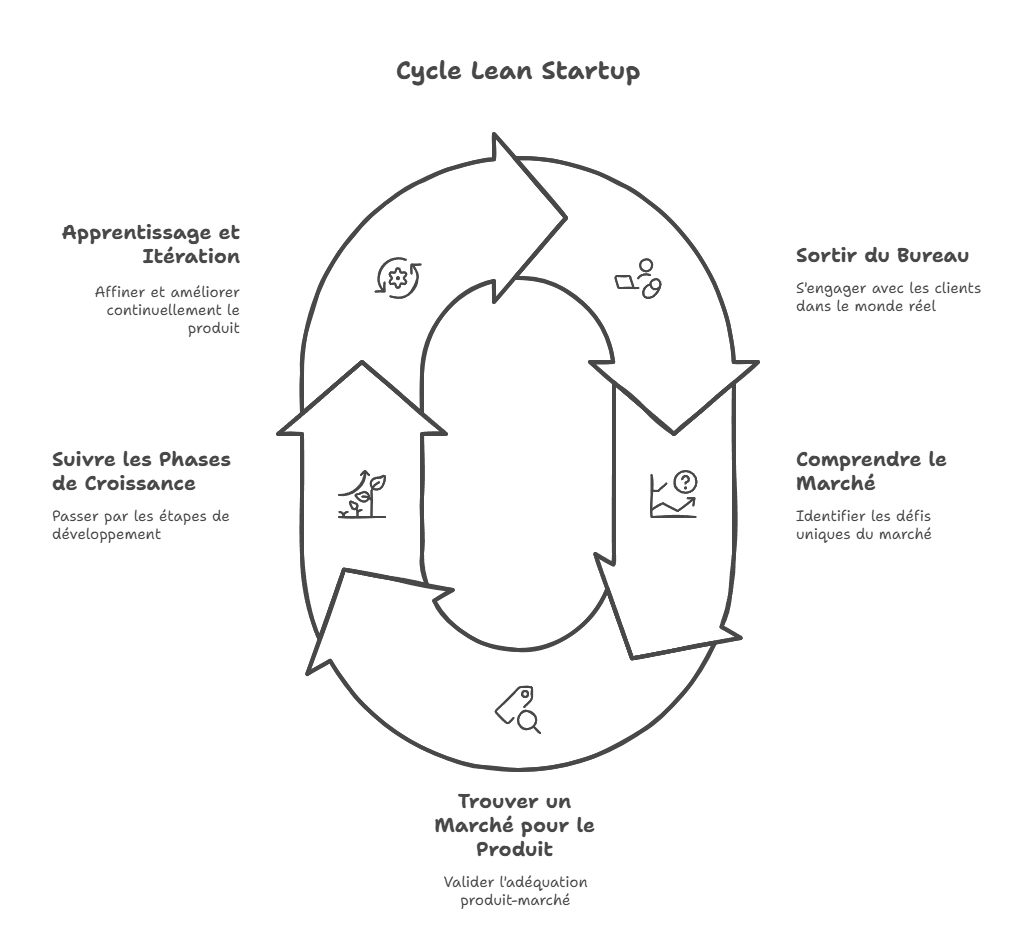
Eric Ries laid out five core principles for Lean Startup:
- Get out of the office: Building a company can't be limited to theoretical reflection
- Understand your market type: It defines the challenges you'll need to overcome
- Find a market for your product: Go meet real customers
- Follow the growth phases: Discovery, validation, customer creation, then scaling the company
- Learning and iteration: Success comes through cycles of continuous improvement
Why Use This Method
First, this approach significantly shortens product development cycles. By focusing on features validated through explicit customer feedback, companies avoid redundant practices from the earliest stages.
On top of that, Lean Startup lets you get started without needing significant funding, detailed business plans, or flawless products. This flexibility allows entrepreneurs to quickly test their initial business assumptions.
Another crucial aspect is that it removes the founder's interpretation bias. By regularly putting the product in front of end users, the company makes sure it's building an offering that truly matches market needs rather than a theoretical vision.
The method rests on the "build, measure, and learn" principle. This cyclical approach begins with developing a Minimum Viable Product (MVP), which has enough features to satisfy early customers while still allowing you to gather valuable feedback to shape the project's evolution.
The Build-Measure-Learn Cycle
"Build-Measure-Learn feedback loop is at the core of the Lean Startup model." (Eric Ries, Entrepreneur and author of The Lean Startup)
The Build-Measure-Learn cycle is the heart of the Lean Startup methodology, letting entrepreneurs experiment with their ideas quickly while minimizing financial risk. This iterative approach rests on three distinct phases that repeat continuously.
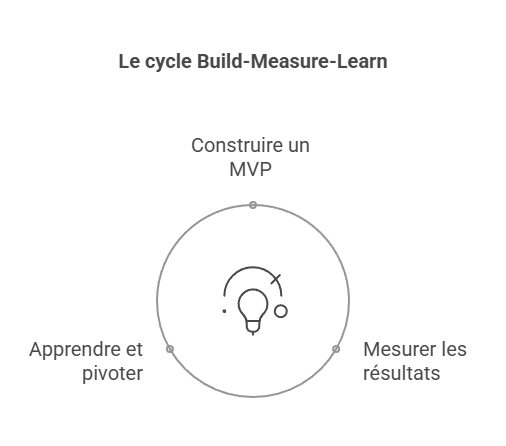
Build an MVP Quickly
The MVP (Minimum Viable Product) is a simplified but functional version of the final product. This first version should include only the essential features that address users' fundamental needs.
To develop an effective MVP, you should:
- Identify the features that address 80% of customer needs
- Focus on the core function without dwelling on aesthetics
- Design an accessible test version, such as a landing page or a demo video
Put the Offering in Front of the Market and Measure Results
Once the MVP is built, the next step is to put it in front of real users. Customer feedback is the most valuable basis for learning. To gather meaningful data, several approaches are possible:
- Offer free trials to early users
- Collect feedback through forms or chat
- Measure key metrics like conversion rate or customer satisfaction
It's essential to avoid "vanity metrics" that provide no actionable information for improving the product. Instead, focus on metrics that let you make concrete improvement decisions.
Learn and Pivot
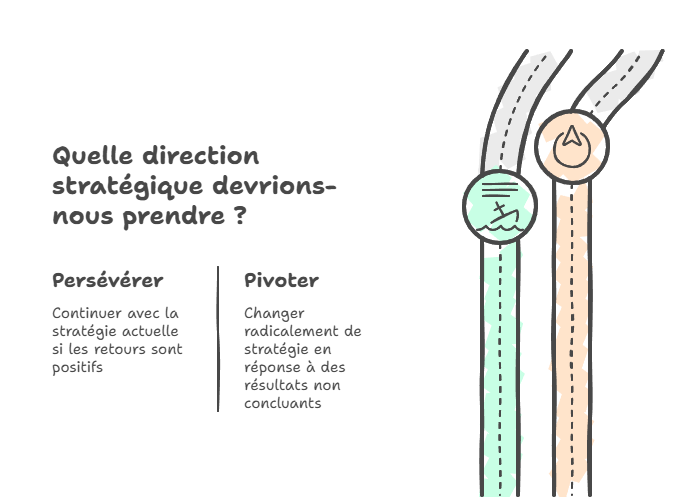
Analyzing the data you've collected then lets you decide which direction to take. Two options present themselves:
- Persevere in the same direction if the feedback is positive
- Pivot toward a new strategy if the results are inconclusive
A pivot is a radical change in strategy, which can involve the product, the target market, or the technology used. This decision is based on a thorough analysis of quantitative data (conversion rate, retention) and qualitative data (user comments).
To execute an effective pivot, you need to:
- Analyze the collected data objectively
- Clearly identify areas for improvement
- Implement the new strategy quickly
This continuous learning process lets you gradually refine your offering until you reach the perfect fit between product and market. Some startups may pivot several times before finding their definitive model.
Setting Up the Lean Canvas
The Lean Canvas, created by Ash Maurya in 2010, offers a structured approach for modeling and documenting the key assumptions behind an entrepreneurial project. This strategic tool is an adaptation of the traditional Business Model Canvas, designed specifically for companies adopting Lean Startup principles.
Canvas Structure
The Lean Canvas is made up of nine interdependent sections, divided between the product side and the market side. At the center sits the unique value proposition, the crucial element that connects these two sides. The main sections include:
- The problem and existing alternatives
- Customer segments
- The unique value proposition
- The proposed solution
- Distribution channels
- Revenue streams
- Cost structure
- Key performance indicators
- Competitive advantage
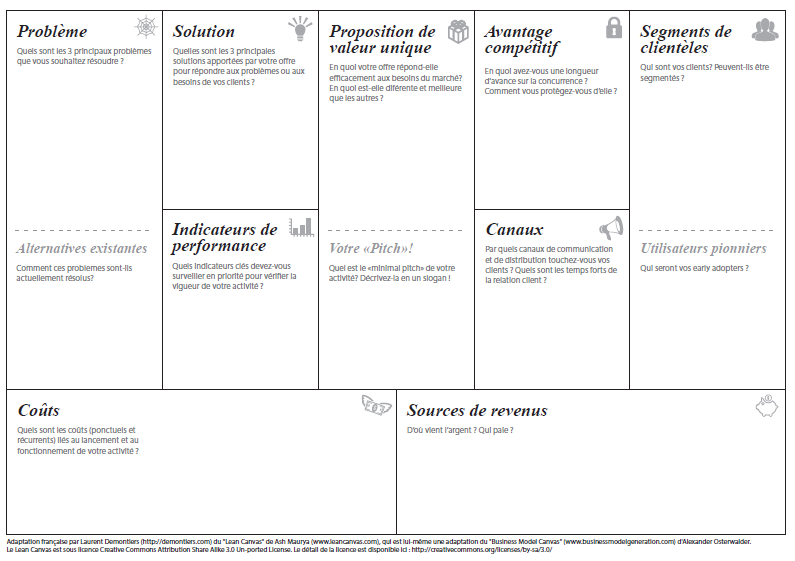
Filling In Each Section
To get the most out of the Lean Canvas, each block deserves careful attention. First, the "Problem" section should identify three major difficulties that potential customers face. These problems need to be significant enough to spark users' interest.
In the "Customer Segments" section, it's essential to distinguish users from paying customers. This distinction helps you identify the early adopters, the first users who quickly embrace innovations.
The "Unique Value Proposition" is the central message that explains why customers should choose your solution over the competition. This promise must be clear, compelling, and centered on users' needs.
For the "Solution" section, present three concrete responses corresponding to the identified problems. These solutions should make the existing alternatives on the market obsolete.
The "Channels" section details the communication and distribution methods for reaching customers. It should focus on the channels favored by your target audience.
On the financial side, the "Revenue Streams" and "Cost Structure" let you assess the project's economic viability. These elements should include all operating costs and the various revenue sources you're considering.
The "Key Metrics" should be limited to two or three essential figures. These indicators let you concretely measure the project's success and guide future decisions.
Finally, the competitive advantage represents a distinctive element that competitors can't easily copy or buy. This section can initially stay empty, since a competitive advantage often develops over time.
The Lean Canvas should be treated as a living document. It's best to fill it out quickly, in about 20 minutes, then revise it regularly based on user feedback and market learnings.
Testing Your Product
The product-testing phase in the Lean Startup method calls for a methodical approach to obtaining meaningful feedback. This decisive step lets you quickly validate or invalidate your initial assumptions before committing significant resources.
Choosing Your First Users
Early adopters are the ideal target group for testing a new product. These early users, naturally ahead of new trends, have an ultra-connected profile that helps spread feedback across social media.
To identify these first testers effectively, several approaches are recommended:
- Build a community of beta testers through social media
- Offer free trials to collect the contact details of interested users
- Target specific profiles that match the criteria you're looking for
Collecting Feedback
Collecting user feedback happens across various communication channels. The most effective methods include:
- Online questionnaires
- Live chat on your website
- Phone or video interviews
During this phase, it's essential to precisely identify the profile of the people interested in your product. This helps you better understand their mindset, their needs, and the reasons that led them to test the product.
Analyzing the Data
Analyzing feedback is a crucial phase for the future development of your offering. Testers' frustrations often reveal hidden needs that are essential to take into account.
For effective analysis, you should:
- Examine the collected data objectively, without distorting responses to fit a personal vision
- Identify recurring trends in user feedback
- Assess the impact of these comments on the overall user experience
Feedback from early adopters helps confirm some of your initial assumptions and rule out others. This analysis phase leads to three possibilities:
- Continue development if the feedback is positive
- Correct certain aspects of the product
- Abandon the project if the results are too negative
To optimize this analysis phase, specialized tools like Zendesk, Freshdesk, or HelpScout can be used. These platforms let you quickly set up contact channels between the company and its users, while making it easier to qualify and handle requests.
Validating Your Market
Market validation is a fundamental step in the Lean Startup approach, letting you confirm an idea's viability before investing significant resources in its development.
Identifying Your Target
For effective market validation, it's essential to differentiate customers from users. Paying customers aren't always the end users of the product or service. This distinction helps you identify the early adopters, those consumers who are naturally ahead of new trends and whose ultra-connected profile can generate significant resonance on social media.
In this initial phase, three essential aspects need to be explored:
- The obstacles the customer faces (costs, technical means)
- The difficulties of using existing solutions
- The fears and perceived risks (financial, social, technical)
Conducting Customer Interviews
Customer interviews are the most direct and insightful tool for understanding the market's real needs. To get the most out of them, several principles should be respected:
First, it's crucial to establish an interview framework that is both flexible and structured, with a clear introduction, generic questions, and then specific ones. The interviewer should adopt a learner's stance, staying neutral and attentive, ready to hear potentially unpleasant feedback.
It's also recommended to conduct these interviews in pairs: while one person leads the conversation, the other takes notes. This approach reduces interpretation bias and ensures a thorough collection of information.
To obtain relevant qualitative data, you should:
- Favor open-ended questions that avoid predetermined answers
- Allow silences to settle in so people have time to reflect
- Ask for concrete examples and specific stories
Adjusting Your Offering
Analyzing customer feedback then lets you refine your offering along three main axes:
- The value proposition: It should address a poorly met or unmet need, with a simple, punchy message that turns a visitor into an interested prospect.
- Distribution channels: The company can develop two types of strategies:
- Inbound: content creation (videos, blog, webinars)
- Outbound: targeted marketing actions (email campaigns, advertising)
- The business model: Feedback lets you adjust the revenue structure, whether one-off or recurring, fixed or variable depending on market conditions.
This adjustment phase requires an objective analysis of the collected data. The changes may involve the target audience, the messaging, or the product's positioning. Once these adjustments are made, it's a good idea to repeat the testing cycle to validate the changes.
Market validation is therefore part of an iterative approach, where each learning cycle lets you refine your offering until you reach an optimal fit between the product and market expectations. This methodical approach minimizes the risk of failure by ensuring that development is guided by real data rather than assumptions.
Conclusion
The Lean Startup methodology is undoubtedly a pragmatic approach for modern entrepreneurs. This method, based on Eric Ries's principles, effectively reduces the risk of failure while optimizing available resources.
Entrepreneurs who adopt this approach enjoy several essential benefits. First, the Build-Measure-Learn cycle offers a structured framework for quickly testing business assumptions. Second, the Lean Canvas provides a clear, evolving view of the business model. Finally, continuous market validation ensures an optimal fit between the product and customers' real needs.
A startup's success therefore depends less on initial resources than on the ability to learn and adapt quickly. Entrepreneurs should stay focused on customer feedback, measure their progress objectively, and adjust their strategy based on the data they gather. This methodical approach turns the process of building a company into a scientific one, significantly increasing the chances of success.
FAQs
Q1. What is the Lean Startup method and how does it work? The Lean Startup method is an entrepreneurial approach that aims to reduce the risks and costs of launching a business. It relies on rapid cycles of building, testing, and learning, letting entrepreneurs continuously adjust their product based on customer feedback.
Q2. What are the main benefits of using Lean Startup? The main benefits include shorter development cycles, reduced financial risk, the elimination of the founder's interpretation bias, and the ability to quickly test business assumptions with minimal upfront investment.
Q3. How does the Build-Measure-Learn cycle work in Lean Startup? The Build-Measure-Learn cycle is at the heart of the Lean Startup method. It involves quickly building a Minimum Viable Product (MVP), putting it in front of the market to measure results, and then learning from that feedback to improve the product or pivot if needed.
Q4. What is the Lean Canvas and how do you use it effectively? The Lean Canvas is a strategic tool adapted from the Business Model Canvas for startups. It includes nine key sections, including the problem, the solution, customer segments, and the value proposition. To use it effectively, fill it out quickly, focus on the essentials, and revise it regularly based on what you learn.
Q5. How do you validate your market with the Lean Startup approach? Market validation in Lean Startup involves precisely identifying your target, conducting customer interviews to understand their real needs, and adjusting your offering accordingly. This iterative approach lets you continuously refine your product until you reach an optimal fit with market expectations.