Y Combinator accepted 0.6% of applications for the Summer 2025 batch, the lowest rate in its history. For a French founder, the path is shorter than you'd think, but tougher than people admit. In practice: you fill out an online form (deadlines every three months, since YC now runs four batches a year), you spend ten minutes on a video call facing two or three partners who interrupt you, and if you get in you receive $500,000 for 7% of your equity. Three months in San Francisco, a Demo Day in front of 2,500 investors, and then the YC network for life. Algolia, PhotoRoom, Finary, Bitstack, Bravi, Blaxel, Leadbay, Nao Labs, and more than thirty French startups have been through it. Here's the playbook.
Y Combinator in 2026: what you need to know before applying
The model: $500k, 7%, three months in San Francisco
Y Combinator is the most selective accelerator in the world. The deal is public and it has barely moved since 2005: you receive $500,000, YC takes 7% of your equity (through a two-tranche SAFE mechanism), and you spend three months on site. In San Francisco, in person, in an intensive program of mentorship, office hours with partners, and pitches in front of other founders.
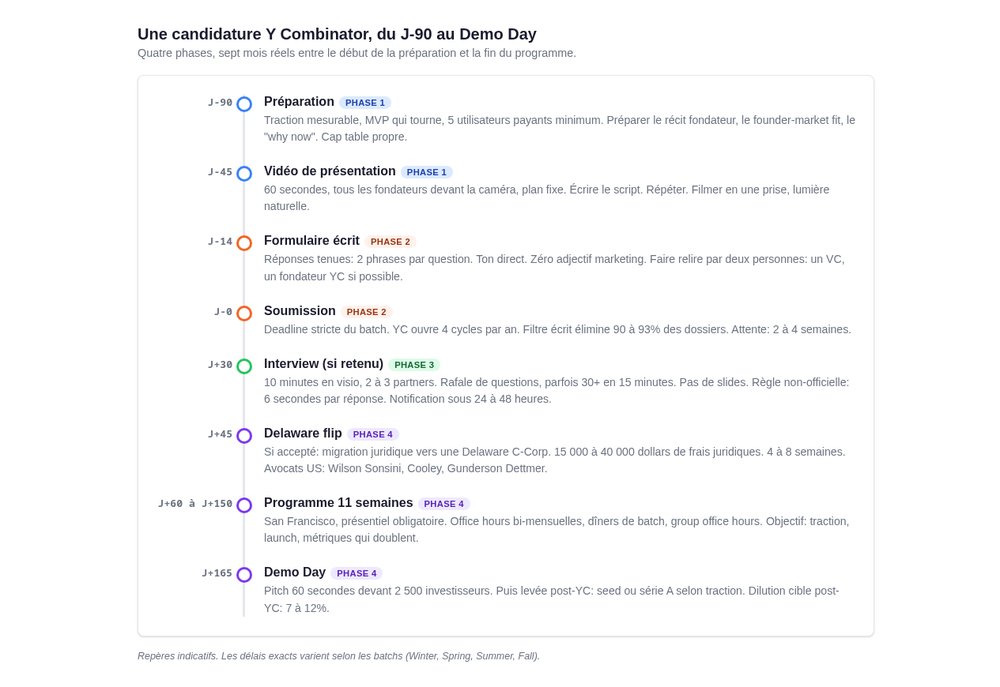
The program ends with Demo Day: one slide, one minute, in front of roughly 2,500 investors. It's the climax of the batch. For many, it's also the funding round that follows immediately after.
Four batches a year since 2025: Spring, Summer, Fall, Winter
The big recent change: since 2025, YC runs four cohorts a year instead of two. Spring (X25), Summer (S25), Fall (F25), Winter (W26). Each cohort is smaller (140 to 200 startups funded, down from 250 to 400 before), but the deadlines come around more often. You no longer have to miss a window.
For a French founder, this changes two concrete things. First: you can try again after a rejection every three months, instead of every six. Second: the cohort will be more intimate. 200 people instead of 400 is a whole different level of network.
The current acceptance rate: 0.6% to 1%
The popular "1 to 2%" figure is outdated. Here's the 2026 reality.
| Batch | Startups funded | Estimated acceptance rate |
|---|---|---|
| Spring 2025 (X25) | 144 | ~0.7% |
| Summer 2025 (S25) | 160-169 | 0.6% (record low) |
| Fall 2025 (F25) | 157 | ~0.8% |
| Winter 2026 (W26) | 196 | ~1% |
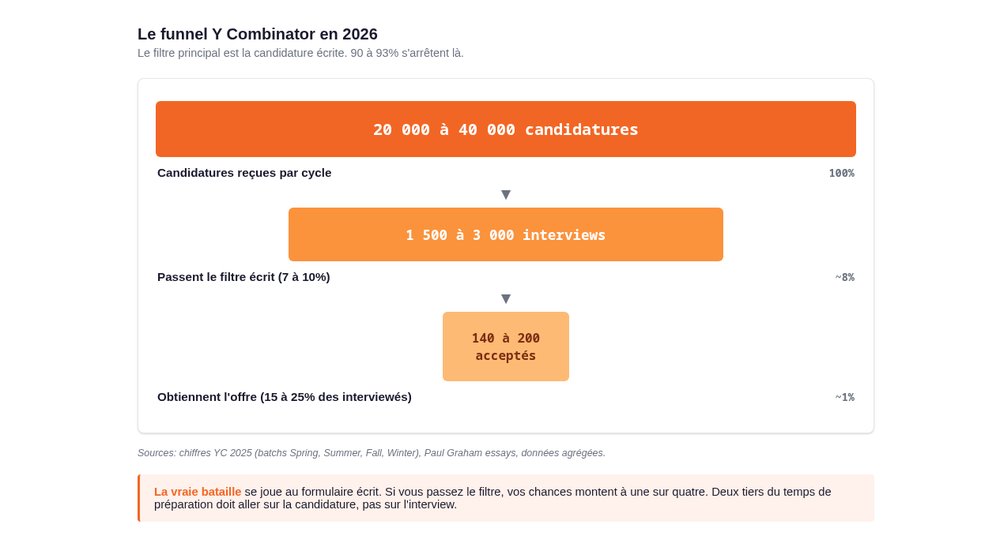
YC receives between 20,000 and 40,000 applications per cycle. The main filter isn't luck: it's the written application, which eliminates 90 to 93% of submissions right at the door. Which means your real odds of getting in aren't 1 in 100. They're either much higher or much lower, depending on the quality of your application and your traction.
French startups at YC: twenty years of history, fast-forwarded
Roughly thirty French startups have been through YC since 2010. Four waves, four distinct moods.
The pioneers (2014-2020): Algolia, Front, Trackin, PhotoRoom
Algolia paved the way in Winter 2014. Nicolas Dessaigne and Julien Lemoine, two engineers from Nantes, took the leap. Algolia would go on to reach a $2 billion valuation. Today Nicolas Dessaigne has been a General Partner at YC since 2021. More than 2,000 office hours logged, six batches mentored. A Frenchman at the very core of the YC engine. And nobody in France talks about it.
Front followed in Summer 2014 with Mathilde Collin. A collaborative email company, valued at $1.7 billion in 2022.
Trackin got in during Winter 2015 with Bruno Didier, as a solo founder, which is almost heresy at YC. The story is told on Maddyness:
An hour and a half later, Michael Seibel advised me to apply to YC, even as a solo founder. It would certainly be very hard, but if Trackin kept growing, he could take another look at my application online and give me his opinion. Which he did. Bruno Didier, Trackin (Winter 2015)
PhotoRoom closed out the first wave in Summer 2020 with Matthieu Rouif (Polytechnique, Stanford, ex-GoPro) and Eliot Andres. PhotoRoom has now passed 40 million downloads and raised $19 million in a Series A. Valued at $500 million in 2024. Based in Paris.
The Covid wave (2020-2022): Finary, Bitstack and remote YC
Finary joined Winter 2021 in the middle of the pandemic. Mounir Laggoune and Julien Blancher did the batch fully remote, without setting foot in San Francisco. Finary would raise €37.7 million in total, including a €25 million round in 2025. On his memories of YC, Mounir Laggoune recalls:
The founders of Stripe, Coinbase and Airbnb told us their stories during workshops. It was concrete and inspiring. They explained to us that five to ten companies in the batch would become unicorns. And every week, we watched former YC startups go public. It was wild. Y Combinator really is the embodiment of the American dream. Mounir Laggoune, Finary (Winter 2021)
Bitstack followed in Summer 2022. A bitcoin savings app, founded by Alexandre Roubaud. This time it was back to in-person. The batch would let them raise €2 million at Demo Day.
The new generation (2025-2026): Blaxel, Leadbay, Nao Labs, Bravi
This is the wave that no French article has covered yet. And yet here it is.
Blaxel joined Spring 2025 (X25). A rare case: all six co-founders did the batch together, even though YC generally limits it to 1 to 4 co-founders on site. Vikram Vaswani wrote in their 2025 recap: "By the time YC ended, we had developed a clear vision for our business, and we eventually raised $7.3M in a seed round from First Round, Y Combinator, Liquid 2, Multimodal and others." Infrastructure for the AI era.
Nao Labs joined Winter 2025. Christophe Blefari and Claire Gouze, founded in December 2024 in Clichy. An AI code editor built specifically for data teams. No booming press release, no "revolutionary." One line about the batch and a very clean niche.
Leadbay joined Fall 2025 (F25). Ludovic Granger (CEO, ex-VC) and Milan Stankovic (CTO, PhD in AI). Predictive B2B prospecting on the SMBs that LinkedIn and Clay miss. $700k raised.
Bravi also joined in Fall 2025 with Pierre-Habté Nouvellon. And the list goes on with Combinely, Moby Analytics, Probo, Kaelio, Lucis, Nomi, Flott HQ and Tinfoil in the Spring 2025 cohort.
Summary table of French founders at YC
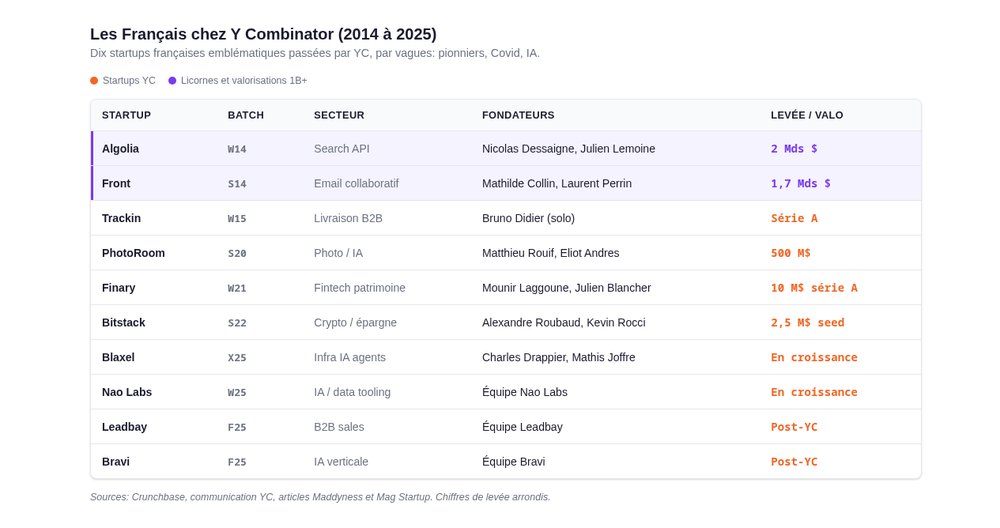
An analysis by Mag Startup on 29 French startups that went through YC between 2010 and 2024 turned up an interesting figure: 100% survived, but 72% stagnate. YC doesn't guarantee growth. It guarantees you won't die, which is already a lot, and it guarantees a network. The rest is up to you.
The five criteria YC actually looks at
YC doesn't judge an application on ten criteria. Five, in this order.
The team (the number-one criterion, by a wide margin)
YC invests in founders. Not ideas, not markets, not products. The line gets repeated endlessly, but it's true. In practice, here's what they look at:
- How many of you there are (two to four co-founders is the sweet spot; a solo founder can get in but it's harder)
- How long you've worked together
- Your technical skills (at least one founder must be able to code the product)
- Your track record (what you've done before, even if it wasn't a company)
- Your ability to pivot (Airbnb pivoted during the batch, and so did Twitch)
Traction (proof that people use it and pay for it)
You don't need revenue to apply. But showing that you have users who come back transforms an application. If you have 50 paying customers, say so early. If you have 5,000 active free users, say so early. The rest of the application becomes confirmation.
The market (TAM, speed, dynamics)
YC likes markets that can produce billion-dollar-revenue companies. Not a billion-dollar valuation: a billion in revenue. That mechanically rules out niches that are too narrow. But YC also accepts markets that are small today if they're growing fast (vertical AI and LLM infrastructure are the current examples).
The product (already in users' hands if possible)
No product rarely gets in. An MVP that runs and can be tested changes everything. For many recent cohorts, YC accepts startups whose product has been in private beta for three weeks. They care about build velocity, not just the result.
The why: founder-market fit
The trick question: why you, on this topic? If you're building a tool for data engineers, are you a data engineer? If you're attacking B2B finance, have you worked in banking or VC? Founder-market fit isn't a bonus, it's a signal of durability. Founders who dig into what they know move faster and last longer.
The written application: how to get past the 90% filter
90 to 93% of applications stop at the written form. That's where almost everything is decided.
Anatomy of the YC form
The YC form comes down to about twenty questions. The most important ones:
- Describe what you do in 50 words or less. If you can't do that, you won't be able to do your Demo Day. First impression, first filter.
- Why you, for this problem? Founder-market fit, spelled out.
- What do you do technically? How does it work? Be concrete. No buzzwords.
- How many users / customers? How much revenue? Raw numbers, precise dates.
- Why now? What recent change makes your company possible today and not three years ago?
- A one-minute intro video of the co-founders. Fixed camera, no editing, no music. They want to see you talk. The same instincts that apply to pitching a VC apply here: clarity, proof, zero filler.
The mistakes French founders make every single time
Four patterns keep coming up. If you recognize yours, rewrite.
- Corporate jargon. "Innovative solution," "ecosystem," "synergistic platform." These words trigger a wariness signal. YC is a room full of engineers. Talk technical.
- PowerPoint presentation mode. French founders write their application like a slide deck. YC wants a conversation. Short sentences, direct tone, "you" and "we."
- Abstraction. "We want to revolutionize the X sector." No. "We've signed seven construction clients who pay €200/month for Y." Concrete beats abstract.
- Leaving out the traction. Many French founders think their traction isn't impressive enough to mention. Wrong. Five paying customers beats no mention at all. YC wants to see movement, not just size.
Nicolas Dessaigne's advice
The only French General Partner at YC. Co-founder of Algolia (W14), he has done more than 2,000 office hours across six batches. His main piece of advice, given in an Algolia interview:
My main advice would be to focus on your customers, listen to them and learn from them. Your first 100 customers must love your product, because you solve a problem better than anyone else. There's no point chasing everyone: focus on your first customers and build a solution perfectly suited to their needs. Nicolas Dessaigne, GP at YC, co-founder of Algolia
Translated into the context of an application: your submission must show that you talk to your users. How many interviews this month? Which insight changed your roadmap last week? These are the proofs YC is looking for.
The one-minute video pitch: do you really need to polish it?
No. You need to make it clear. Clean framing, decent lighting, audible sound, you talking. No jingle, no title sequence, no overlays. Introduce the co-founders, say what you do, show the product if you can. Sixty seconds. First five seconds: your name and what you do. The rest: why you.
The YC interview: ten minutes, forty questions, zero mercy
If you get past the written filter, you're among the 7 to 10% who make it to the interview. There, your odds rise to 15-25%. In practice, two out of ten founders who interview land the offer.
The real format, described by those who lived it
Ten minutes. Two or three partners. Over video, barring special cases. No presentation, no slides. Nothing but questions, in rapid fire. Alexandre Roubaud, founder of Bitstack (Summer 2022), describes it:
You have to answer around forty questions in twenty minutes. The pace is very intense, it's a real challenge. Rumor has it you shouldn't go over six seconds per answer. Alexandre Roubaud, Bitstack (Summer 2022)
Note carefully: forty questions in twenty minutes for Bitstack, ten to fifteen minutes for the recent batches. The ratio is the same. It's fast, it's dense, it's designed to see how you react under pressure. The goal is to test you, not to let you shine.
The typical questions
The classics you need to prepare:
- What do you do (in one sentence)
- Why you (founder-market fit)
- How much revenue, how many customers, since when
- What's your month-over-month traction
- Why now
- Who are your competitors and how are you different
- What's your price and how did you set it
- How long before you run out of money
- If we give you $500k, what do you spend it on first
- What's your product roadmap for the next six months
- What would you do if Google shipped an identical product tomorrow
The partners test your clarity, your speed of thought, your honesty. Don't embellish. If you don't know, say so and give your best hypothesis.
How to prepare: mock interviews, alumni, anti-pitch
Three things, in this order.
Mock interviews with YC alumni. They know the questions, they know the rhythm. If you don't have an alumni network, the r/ycombinator subreddit regularly has threads of founders willing to help. Bruno Didier of Trackin did this before he left: "To prepare well, three days before my interview I met with YC alumni who were kind enough to give me a bit of their time."
Anti-pitch. List the twenty hardest questions you could be asked. The ones that tear your project apart. Prepare a fifteen-second answer for each. On the day, whatever they ask, one of your twenty answers will be useful.
Six seconds per answer. Practice answering short. The unofficial six-second rule doesn't come from YC but from founders who've been through it. It forces you to cut the rambling.
What to do when you get torn apart
It happens. You will be interrupted. You'll be told your idea is bad. Roubaud recalls:
They started without even saying hello. From the very first question, they cut us off to explain that our solution was doomed to fail. We got torn apart for twenty minutes. Despite this seemingly disastrous interview, the outcome was favorable for Bitstack: at the end, Michael Seibel, the co-founder of Twitch, said he had one last question and asked whether we wanted to join the next batch. Alexandre Roubaud, Bitstack
The disastrous interview can be the winning interview. The partners test your resilience. Hold your ground, defend your numbers, don't apologize. But listen too: some criticism is well-founded. A perfect answer combines "here's why you're wrong on this specific point" with "here's what I learned when I tested the other approach."
What changes when you're French
This is the part that's missing everywhere in French. And yet it shapes everything.
The Delaware flip: why YC requires it and how to do it cleanly
YC invests via a SAFE under US law. That assumes your company is incorporated in the United States, in Delaware in practice. If your company is a French SAS, you'll need to do a Delaware flip: your SAS becomes a subsidiary of a newly created Delaware C-Corp.
The operation costs between $15,000 and $40,000 in fees for specialized US lawyers (Wilson Sonsini, Cooley, Gunderson Dettmer are the classics). Budget 4 to 8 weeks. YC connects you with their preferred lawyers once you're admitted. Plan ahead if you're French: this isn't a detail, it's a legal project in its own right.
Important consequence: your pre-YC French investors (angels, convertible notes, etc.) have to agree to move their stake into the new C-Corp. Which means you need to have briefed them well in advance.
The visa: O-1, B-1, and the three-month question
The program runs for three months in person in San Francisco. For a French founder, that means:
- B-1 (business visa) for the duration of the program. Possible but limited, doesn't allow a US salary.
- O-1 (extraordinary ability) for the medium term if you stay after the batch. Long and expensive (budget 12-18 months and $15-25k).
- ESTA for short round trips, valid for 90 days per trip.
Plan ahead. Founders who struggle with their visa during the batch lose one month out of three. Soris Avocats, a French firm specialized in YC, recommends starting the O-1 as soon as you know you're in.
Your French investors before YC: how to handle them
If you've already raised in France (angels, funds, convertible notes), three rules.
- Brief them before you apply. Not after. The prospect of YC dilution plus a Delaware flip always comes as a surprise when nobody was warned.
- Calculate the post-YC dilution. YC takes 7% for $500k (technically: $125k for 7% via a post-money SAFE plus $375k via an uncapped MFN SAFE). If you plan to raise $5M after Demo Day, calculate your target cap table and show it to your French investors.
- Prepare the Delaware flip on the French side. Your SAS stays, but becomes a subsidiary. Your French accountant and lawyer need to be in the loop to handle the filings.
Doing YC remotely: the Covid option is no longer the norm
During Covid, several batches were 100% remote (Finary W21, for example). Since 2022, YC has gone back to mandatory in-person attendance. You must be physically in San Francisco for three months. Non-negotiable.
A very few rare exceptions are granted (an unforeseen visa problem, a critical family situation), but they are the exception, never the expected norm. If you're applying while planning to stay in Paris, don't apply.
After YC: Demo Day and the round that follows
Three months go by fast. The end of the batch isn't the end of the adventure, it's its tipping point.
How you prepare a one-minute pitch in front of 2,500 investors
Demo Day is the technical objective of the batch. One slide. Sixty seconds. Not one more. You present your company to 2,500 investors at once (over video since 2024, which multiplies the audience).
Mounir Laggoune sums it up well:
It's basically the final goal of the program. You realize just how much you can say in a single slide. On that day, the balance of power with investors is flipped. They're the ones competing, and they come to talk to us. Mounir Laggoune, Finary
Preparation: you write your pitch from week 1 of the batch. You rewrite it twenty times. You test it in front of the other founders and in front of your partners. On the day, you've rehearsed it fifty times.
The real numbers: what French founders raised after their batch
| Startup | Batch | Post-Demo Day round | Details |
|---|---|---|---|
| Finary | W21 | €2M + €8M Series A | €37.7M raised in total (2025: €25M) |
| Bitstack | S22 | €2M | Next round in progress |
| PhotoRoom | S20 | $19M Series A (2022) | Valued at $500M in 2024 |
| Blaxel | X25 | $7.3M seed | Led by First Round + YC |
| Algolia | W14 | $18.3M Series A in 2015 | Valued at $2.25B |
YC often keeps participating in later rounds. For Finary and Bitstack, YC put money back in during the Series A and B.
The YC network for life: what it actually gives you
The Bookface network (YC's closed directory) is used every day by founders old and new. You have direct access to more than 5,000 alumni for:
- Customer referrals (B2B especially)
- Hiring (YC founders hire from each other)
- Technical advice (LLMs, infra, data, legal)
- Investor intros (often what makes the difference on a Series A)
For many, this is the real reason to do YC rather than another funding option.
The alternatives to YC for French founders
YC isn't the only door. Here are the serious options.
YC Startup School: the free, online version
YC offers Startup School for free. Online courses with Sam Altman, Paul Graham, Michael Seibel and others. It's the YC teaching without the funding or the network. An excellent prerequisite before applying to the official program. Do it if you've never touched YC before.
US accelerators open to French founders
- Antler: a global accelerator, present in Paris since 2023. More accessible than YC, with more modest capital (~$125k).
- Techstars: multiple programs (Boulder, NYC, Berlin). Each program has its own thesis.
- HF0 (Hacker Fellowship Zero): an intensive 12-week residency in SF, for very technical early-stage founders. Smaller, more selective on the tech profile.
The French ecosystem
- Station F: Not an accelerator in itself but the ecosystem. Integrated programs (Founders Program, Fighters Program, etc.).
- eFounders (now Hexa): A studio that co-founds B2B SaaS companies. A different model: they find you a co-founder and support you over 24 months.
- The Family (closed in 2022).
- Sista: a network and program dedicated to women founders.
When to apply to YC, and when not to
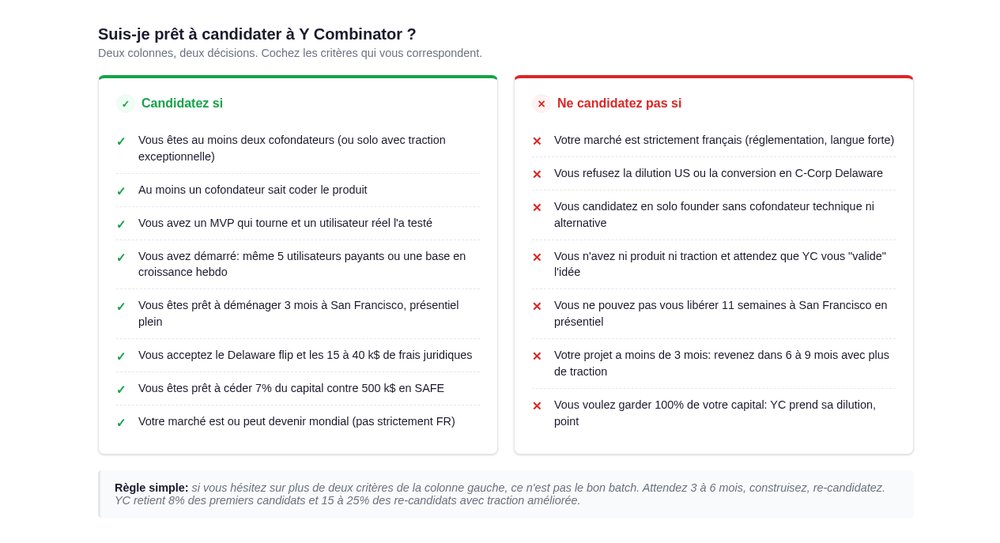
Apply to YC if:
- You have at least two co-founders (or you're solo with exceptional traction)
- At least one co-founder can code the product
- You have an MVP that runs
- You've started (even 5 paying users) or you're ready to pivot fast
- You're ready to move to San Francisco for 3 months
- You're ready to give up 7% of your equity
- You accept the Delaware flip and its constraints
Don't apply to YC if:
- You want to stay in Paris during the program
- Your market is strictly French (regulation, strong language barrier)
- You refuse US dilution or the C-Corp
- You're applying without a technical co-founder and without an alternative
- You have neither a product nor traction and you're waiting for YC to "validate" the idea for you
FAQ
What is Y Combinator's real acceptance rate in 2026?
The YC acceptance rate dropped to 0.6% for the Summer 2025 batch, its lowest level ever. For Winter 2026, it climbed back to roughly 1% across 196 startups funded. The typical range in 2026 is between 0.6% and 1%. The popular "1 to 2%" figure dates from when YC ran two batches a year and is no longer accurate. YC receives between 20,000 and 40,000 applications per cycle.
How much does Y Combinator invest and what does it take in return?
YC invests $500,000 per startup. The structure is two SAFEs: $125,000 for 7% of equity (post-money) and $375,000 as an uncapped MFN (Most Favored Nation) SAFE, which will take the price of the next round. So the final dilution depends on your next raise. In practice, plan for 7 to 12% total dilution post-YC.
Do you absolutely have to move to San Francisco to do YC?
Yes. Since 2022, YC has gone back to mandatory in-person attendance. The program runs about 11 weeks in San Francisco, with required presence for office hours, batch dinners and Demo Day prep. A very few rare exceptions are granted for visa or personal reasons, but they're never the norm. If you apply while planning to stay in Paris, don't apply.
How many French startups have been through Y Combinator?
Roughly 30 French startups went through YC between 2010 and 2024, according to aggregated public data. The best known: Algolia (W14), Front (S14), Trackin (W15), PhotoRoom (S20), Finary (W21), Bitstack (S22), Blaxel (X25), Nao Labs (W25), Leadbay (F25), Bravi (F25). Of the 29 analyzed by Mag Startup, 100% survived beyond five years, but 72% stagnate in valuation.
Can you do Y Combinator remotely in 2026?
No, except in exceptional cases. The 2020-2021 (Covid) period saw several batches run entirely remote, including Winter 2021 when Finary did its YC from Paris. Since 2022, YC has returned to in-person and no longer accepts remote as the norm. A few exceptions are granted for unforeseen situations (visa, family emergency).
How does the YC interview actually work?
The YC interview lasts 10 minutes over video (or up to 20 minutes for the older batches). Two to three partners fire a barrage of questions at you, sometimes more than 30 in under 15 minutes. No presentation, no slides. The partners interrupt, challenge, and test your clarity and speed of thought. The unofficial rule: don't go over six seconds per answer. Afterward, you're notified within 24 to 48 hours by email or a call.
What should I do if my Y Combinator application is rejected?
Reapply. YC explicitly encourages reapplying. With four batches a year since 2025, you can try again every three months. Many YC alumni were rejected one to three times before getting in (Brian Chesky of Airbnb was rejected twice). Between applications, attack the weak points flagged by, or inferred from, the rejection: insufficient traction, an incomplete team, a market that's too niche. A YC rejection isn't a verdict on your company, it's a signal of what you still have to build.
How much does Y Combinator cost a French founder?
YC itself costs nothing (it pays you). But going through YC involves additional costs for a French founder:
- Delaware flip and US legal fees: $15,000 to $40,000
- Visa (O-1 if you stay): $15,000 to $25,000 over 12-18 months
- Housing in San Francisco (3 months): $15,000 to $25,000 depending on the standard
- Flights and travel: $5,000 to $10,000
Estimated total: between $50,000 and $100,000 in related costs for the French founder who does the full YC and stays afterward. Factor these costs into your cash burn.