How Does a Venture Capital Fund Work? (A Founder's Guide)
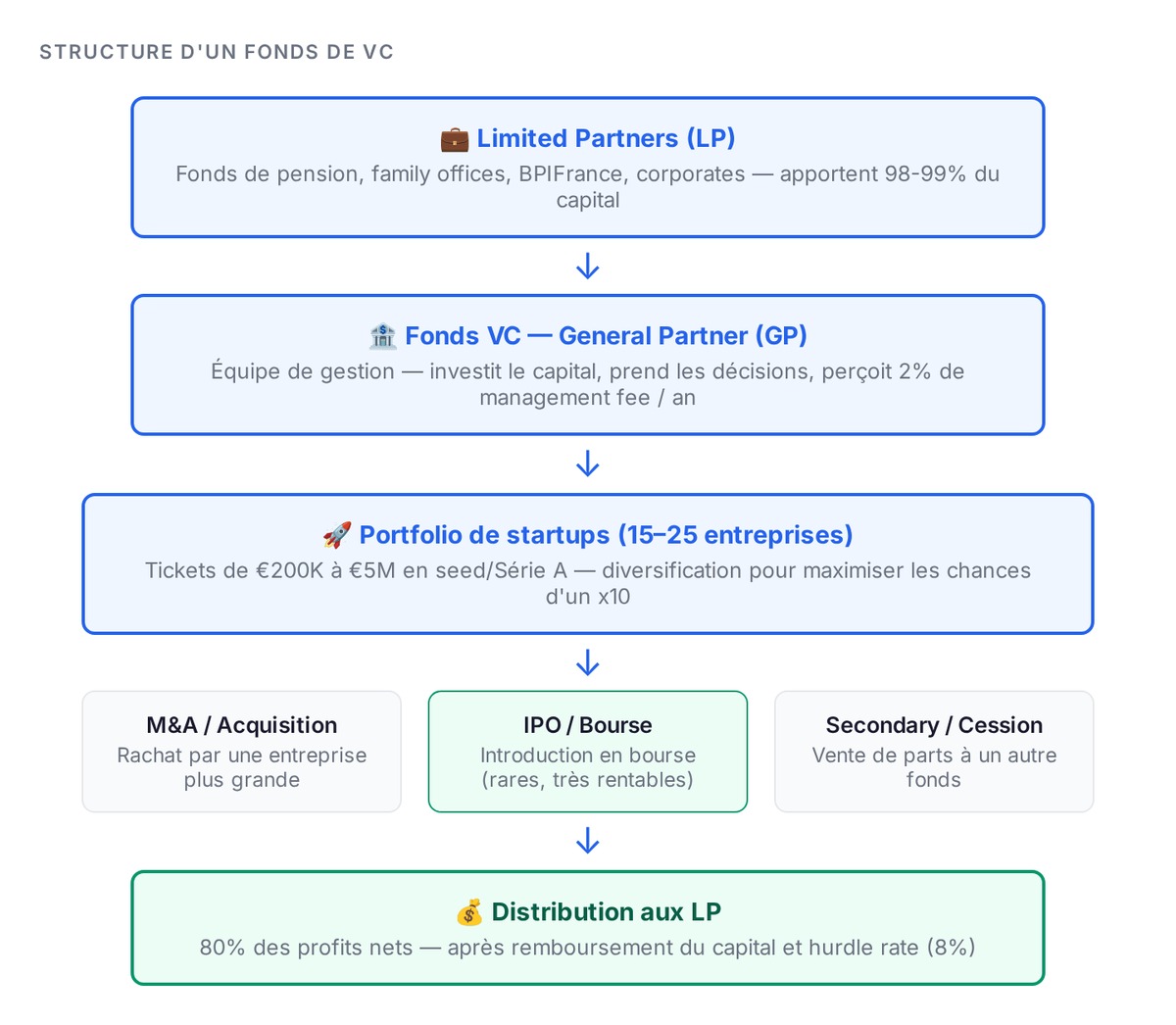
A venture capital fund raises money from institutional investors (LPs) and deploys it into startups through a management team (GPs). A fund lives for around 10 years: 3 to 4 years to invest, then 6 to 7 years to support its holdings and organize exits. The economics rest on two revenue streams for the GP: annual management fees (2% of committed capital) and a share of the profits at exit (20%, the carried interest). This mechanic explains why a VC needs your startup to return 10x, and why they turn down 95% of the deals that cross their desk.
What is a VC fund?
A venture capital fund is an investment vehicle that pools capital from several investors to deploy it into startups with high growth potential. In exchange for their capital, investors receive shares in the fund. When a startup is sold (acquisition or IPO), the gains are redistributed according to precise rules laid out in the fund's legal documents.
The key distinction from other forms of investing: VCs chase extreme returns, not modest ones. A VC portfolio that generates +15% a year is considered a failure in the industry. The structure of the model itself demands 10x or 20x returns on some lines to cover the losses on the others.
LPs and GPs: who puts up the money and who runs the fund?
LPs (Limited Partners): who funds it
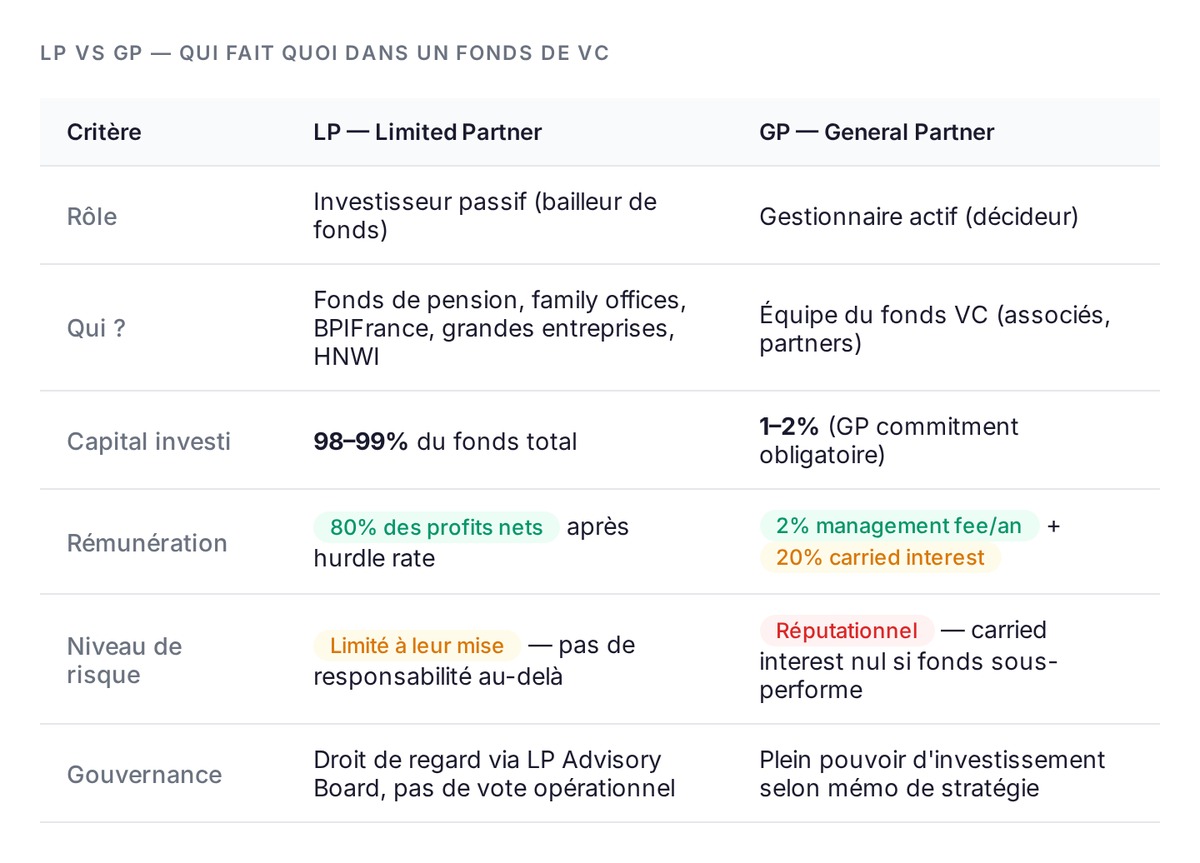
LPs provide the capital. They are mainly institutional investors: pension funds, insurance companies, university endowments, family offices, sovereign wealth funds, and sometimes corporates. They invest in the fund like any other asset class. They put up the capital and they wait for the returns.
LPs don't take part in investment decisions. They don't pick which startups the fund backs. Their role stops at the capital and at reviewing quarterly reports. In return, their liability is limited: they can only lose what they invested.
GPs (General Partners): who manages and invests
GPs are the fund's management team. They are the partners you meet in your pitch, the ones who sign term sheets and sit on your board. They make the investment decisions, manage the holdings, and organize the exits.
In France, GPs are required to co-invest a portion of their own capital in the fund, at least 1% of the total, to access the favorable tax treatment of carried interest. The alignment of interests is structural, not just rhetorical: if the fund performs poorly, the GP loses their own money too.
A fund's economics: the 2/20 rule
A VC fund's compensation rests on two flows. The "2/20" rule is the standard shorthand in the industry.
Management fees (2%)
The GP collects roughly 2% of the fund's total capital each year to cover operating costs: team salaries, rent, travel, due diligence, and legal fees. On a €100M fund, that's €2M a year, enough for a team of 4 to 6 people in Paris.
These fees are paid regardless of performance. Even if every startup in the portfolio goes under, the GP still collected its management fees. This is the base income that keeps the team running over the fund's entire lifespan.
Carried interest (20%)
Carried interest is the share of profits the GP pockets after the LPs have recovered their initial investment plus a minimum return, the hurdle rate, usually set between 5% and 8% in France. Above that threshold, the GP receives 20% of the net gains.
A concrete example: a €20M fund returns €28M at exit with an 8% hurdle rate. The LPs first recover their capital (€20M) and their hurdle (about €5.2M). On the remaining €2.8M, the GP takes 20%, or roughly €560,000. The rest goes back to the LPs according to the waterfall.
What this means for you as a founder
Carried interest changes the entire dynamic of the pitch. A VC investing €1M in your startup only earns meaningfully if you return at least 5x. On a €1M line that returns 3x (an exit at €3M), the GP earns about €400,000 in carried interest. On a line that returns 10x (an exit at €10M), they earn about €1.8M. The difference between a good and a bad investment is not linear for the GP. That's why they filter so hard.
Why a VC needs you to return 10x
This is the piece of math that first-time founders understand least when they pitch.
A VC fund typically invests in 20 to 30 startups. The statistical reality of VC portfolios is brutal: around 50% of investments return nothing or next to nothing (bankruptcy, or a disappointing acquisition below the entry price). Another 30 to 40% return 1x to 3x the capital invested. The remaining 10 to 20% have to cover all the losses and generate the fund's target return for the LPs.
In practice: if a fund has raised €100M with a 3x target (returning €300M to the LPs), and most investments manage 2x at best, it only takes one or two exits at 20x or 30x to hit the overall target. This is the power law in action: 1 investment out of 10 often generates more than 90% of a fund's total returns.
What this means for your pitch: a VC cannot invest in a startup that honestly targets €5M in revenue over 5 years. That isn't enough to move the return of a €100M fund, even with a good exit. They look for markets where a startup can reach €100M in revenue, because that's the only scenario that shifts the dial on the portfolio.
That's why they turn down 95% of deals. Not because your business is bad, but because it lacks the 10x potential that would justify the risk and the portfolio slot.
The life of a fund: from first closing to exit
A VC fund has a defined lifespan, usually 10 years. That span is split into phases with direct implications for founders looking to raise.
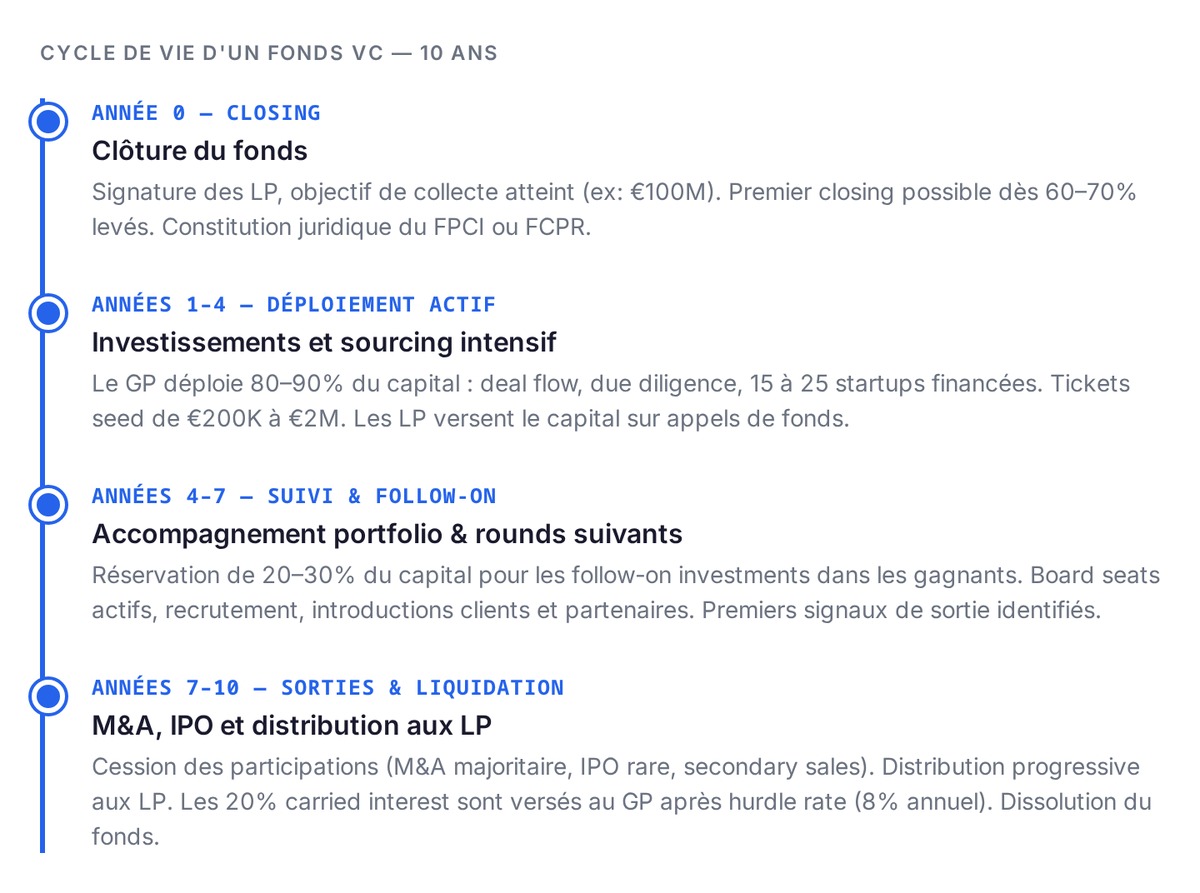
Raising the fund (fundraising and closings)
Before it can invest, the GP has to raise money from LPs itself. This process can take 12 to 24 months. The fund holds one or more closings: at each closing, a batch of LPs signs and the money is wired in.
A fund that announces a "first close" of €50M against a €150M target already has the means to invest, but keeps raising in parallel. The "final close" officially kicks off the investment period.
The deployment phase (years 1-4)
The GP generally has 3 to 4 years to deploy the capital. During this period, it evaluates thousands of deals and invests in 20 to 30 startups. The pace is high: active GPs meet 5 to 10 founders a week.
This window is when you have the best shot at a serious meeting. A fund in active deployment has a strong incentive to invest. Its time is limited, and so are its commitments to LPs.
The support and exit phase (years 4-10)
After the investment period, the GP stops doing new deals (except follow-ons in the existing portfolio) and focuses on growth and exits. This is the longest phase and, on the surface, the quietest: regular board meetings, follow-on rounds, and preparation for acquisitions or IPOs.
A fund near the end of its life (years 8-10) may seem less responsive or less enthusiastic about a new investment. That's not a negative signal about your startup: its attention is simply focused on existing exits, not new entries.
What VCs look for in a deal
A large addressable market
Market size is the first filter. A VC looks for a total addressable market (TAM) of at least €1B in France or Europe. A smaller market can't support the startup that will return 10x, even with flawless execution. It's not that small markets are bad for doing business. They're incompatible with the logic of a VC portfolio.
Founders who can execute
VCs invest in the founders as much as in the idea. The recurring criteria: complementary skills across the founding team, sector experience or an entrepreneurial track record, and the ability to recruit and win over talent better than themselves. A solo founder with no technical background in a deep-tech startup is a warning sign, not an absolute deal-breaker, but a real point of friction.
A clear exit path (M&A, IPO)
The VC needs liquidity: an event where it can sell its shares at a gain. The possible exits are acquisitions (a large company buys the startup) or an IPO. A market with no identifiable potential acquirers is a barrier to investment, even if the business is solid.
What sets French VC funds apart
The FPCI structure
In France, private equity funds most often take the form of an FPCI (Fonds Professionnel de Capital Investissement), regulated by the AMF. The FPCI is reserved for professional investors or subscriptions above €100,000. It's the structure that lets the GP benefit from the favorable tax treatment of carried interest, subject to personal co-investment (a minimum of 1% of the fund's capital) and a minimum holding period.
BPIFrance as a systematic co-investor
BPIFrance is everywhere in French Seed and Series A rounds. Its policy is to invest alongside private funds as a co-investor, rarely as lead. For a founder, that means two concrete things: if you already have an interested private fund, BPI can top up the round easily and lend the deal credibility. But don't try to raise from BPI alone. The public bank doesn't replace a private VC fund, which also brings its network, its introductions, and its operational value.
The French funds to know by stage
The French VC ecosystem in 2026 covers every stage. For a detailed list of VC funds in Paris sorted by stage and ticket size, see our dedicated guide. In short:
- Kima Ventures (Xavier Niel's family office): fixed ticket of ~€150K, ~100 deals a year, decisions in 48-72h. Ideal as a fast-moving first investor at pre-seed.
- Elaia: focused on deep-tech B2B, tickets of €1-15M, a 23-year track record (Criteo, Mirakl, Shift Technology).
- Breega: operator-VC (every partner is a former founder), an in-house Scaling Squad, focused on digital and climate.
- Partech: multi-stage (Seed through pre-IPO), €2.7B under management, international coverage including sub-Saharan Africa.
- Daphni: a community model (300+ entrepreneurs in its network), a strong deep-tech pivot with the Blue fund (€260M, January 2026).
FAQ
What's the difference between a VC fund and a business angel?
A business angel invests their own money, often between €10,000 and €200,000, at a very early stage (pre-seed or seed). A VC fund manages money on behalf of institutional investors and invests much larger amounts (from €500K to several tens of millions). VCs also have more formalized due diligence processes, more structured board rights, and a return obligation to their LPs that shapes their selection criteria. To learn more about early-stage financing instruments, our guide on the BSA AIR for startups covers an alternative to traditional equity.
How much can you raise from a VC?
It depends on the stage and the fund you target. For a seed round in France: typically €500K to €3M. For a Series A: €3M to €15M. For a Series B: €15M to €50M and up. Kima Ventures invests fixed tickets of ~€150K at pre-seed. Growth funds like Partech deploy €10M to €100M into scale-ups. The ticket is a consequence of the fund's investment thesis, not a parameter you can choose freely.
How long does a raise with a VC take?
Between the first contact and signing the term sheet: 4 to 12 weeks for a seed, 3 to 6 months for a Series A. The legal closing (signing the final documents and wiring the funds) then takes another 4 to 8 weeks. All in, count on 3 to 9 months end to end, depending on the deal's complexity and the number of investors involved.
When can a VC fund invest in my startup?
A VC invests once you've proven something: traction (active users, revenue), early product-market fit, or defensible technology with a credible team. Most seed funds want at least an MVP tested with real users. At pre-seed, some funds (Kima, Daphni, Breega) invest on conviction about the team and market, without revenue. A complete absence of market signal makes the deal very hard to defend in front of the LPs.