Strasbourg has one flagship incubator, SEMIA, founded in 1999 and awarded "incubator of excellence" status by the Grand Est region, plus a national network (1Kubator), a business centre run by the Eurométropole (pH8) and specialist structures in health (Nextmed), space (ISU), culture (Fluxus) and newcomer support (SINGA). Prices run from free to 600 euros excl. VAT for a two-month Starter Class, and only one player takes equity: 1Kubator, 10% for 25,000 euros.
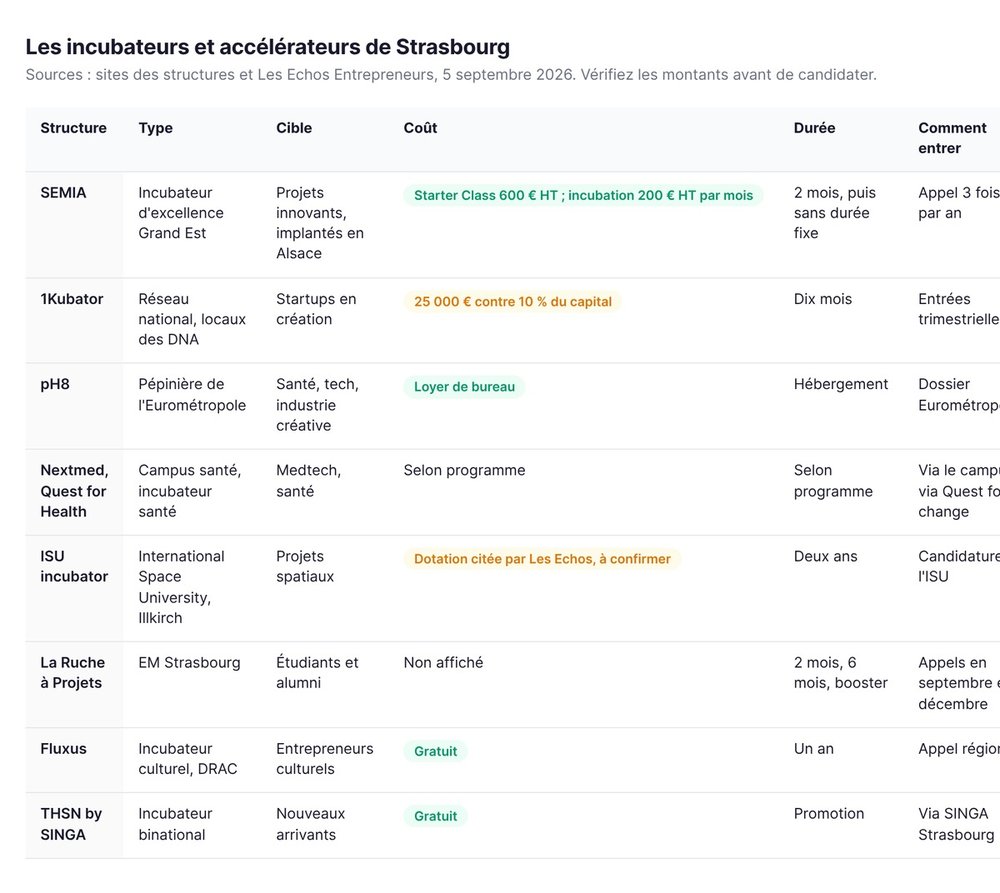
The table compares every structure on target audience, cost, duration and how to apply. The article then covers SEMIA in detail, the generalists, the specialists, the student routes, which path suits your stage, and the geographic advantage the usual listings leave out.
Strasbourg's incubators in one table
| Structure | Type | Who it's for | Cost | Duration | How to get in |
|---|---|---|---|---|---|
| SEMIA | Grand Est incubator of excellence, Strasbourg and Mulhouse | innovative projects, all sectors, based in Alsace | Starter Class €600 excl. VAT; one-to-one incubation €200 excl. VAT per month (€100 if the company isn't yet registered) | Starter Class 2 months; incubation open-ended, review every 6 months | call for applications 3 times a year (January, April, September) |
| 1Kubator Strasbourg | local branch of a national network, hosted in the DNA offices | startups at formation stage | €25,000 invested for 10% of equity | 1kréation programme, around ten months | quarterly intakes |
| pH8 | Eurométropole business centre | health, new technology and creative industry startups | office rent (13 to 40 m²) | hosting | application to the Eurométropole |
| Nextmed | medical technology campus, university hospitals | health and medtech projects | depends on programme | depends on programme | through the campus and its partners |
| Quest for Health | health incubator within the Quest for change network | health | depends on programme | depends on programme | through Quest for change |
| ISU incubator | International Space University incubator, Illkirch | space projects | offices provided; €50,000 grant reported by Les Echos, to be confirmed | two years | application to ISU |
| La Ruche à Projets | EM Strasbourg incubator | students and alumni of the school | not published | pre-incubation 2 months, incubation 6 months, booster | calls in September and December |
| Fluxus | regional cultural incubator, DRAC Grand Est | cultural and creative entrepreneurs | free | one year | regional call for applications |
| THSN by SINGA Strasbourg | binational French-German incubator | newcomers | free | cohort | through SINGA Strasbourg |
| SATT Conectus | technology transfer, University of Strasbourg | projects out of public research | n/a | n/a | through the labs |
Sources: the structures' own websites and the Les Echos Entrepreneurs feature, accessed 5 September 2026. The figures come from the pages cited in each section. Check them at source before applying, as they change from one cohort to the next.
SEMIA: Alsace's flagship incubator
🏛️ Running since 1999, in Strasbourg and Mulhouse. Generalist, with strong verticals in health, industry, IT and the bioeconomy.
Starter Class, two months to get structured
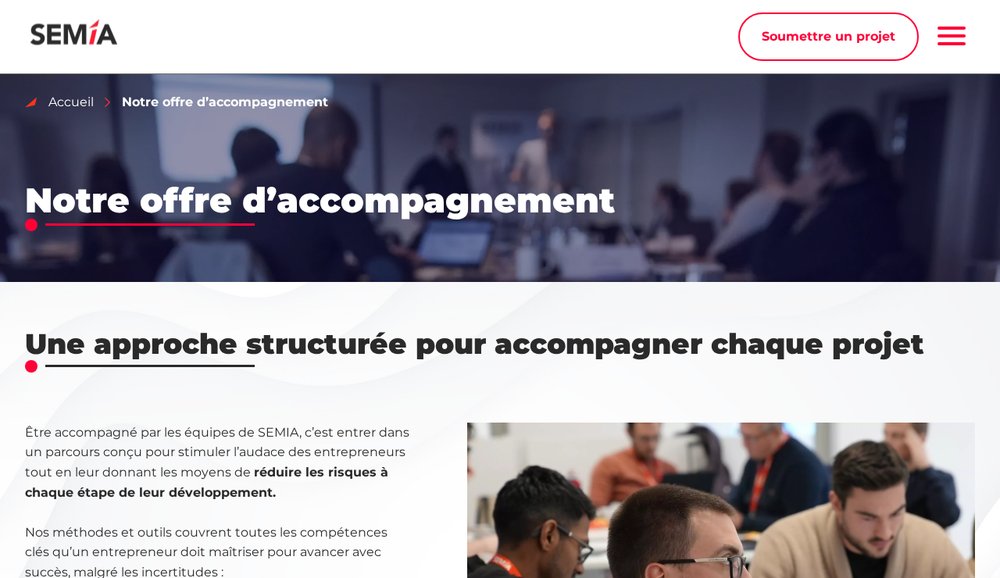
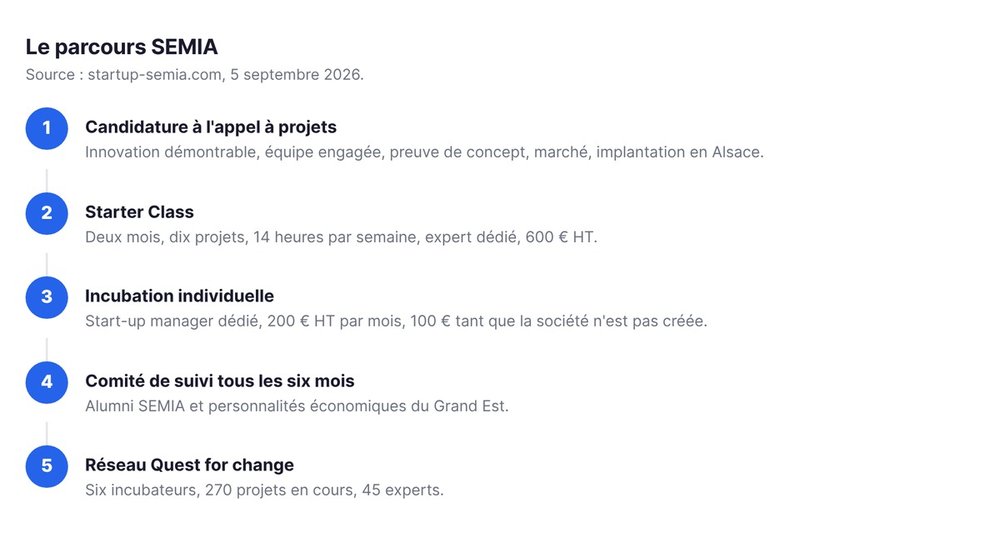
SEMIA's support page describes two tiers. The first, the Starter Class, takes a maximum of ten founders per cohort for 14 hours a week with a dedicated expert, over two months, three times a year (January, April, September). Price: 600 euros excl. VAT. The stated goals: validate the market, build a product strategy, put together a roadmap and financial forecast, and learn to pitch.
The call open as of 5 September 2026: the September 2026 cohort, ten projects, 18 workshop days, applications closing 11 September 2026, according to SEMIA's website. Point Éco Alsace, the CCI's publication, put cohort 36 in spring 2025.
Long-form incubation and the verticals
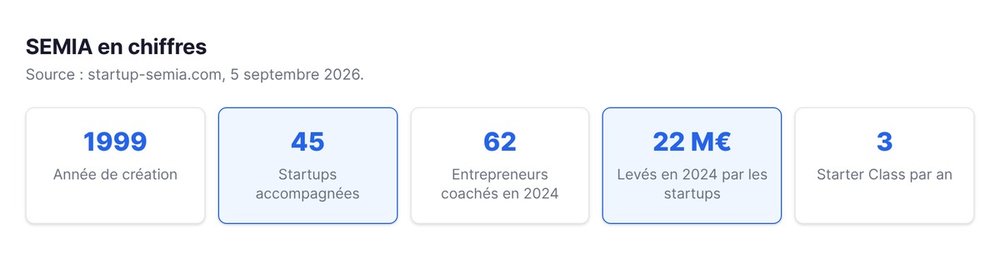
The second tier, one-to-one incubation, is aimed at more mature projects: a dedicated startup manager with sector expertise, a review committee every six months, and no minimum or maximum duration. Price: 200 euros excl. VAT per month, 100 euros for as long as the company isn't registered. The site reports 45 startups supported, 62 entrepreneurs coached in 2024 and 22 million euros raised in 2024 by portfolio startups.
SEMIA is part of Quest for change, the network of six Grand Est incubators of excellence (Innovact, Quai Alpha, Rimbaud'Tech, SEMIA, The Pool, Quest for Health) that share a common incubation method and report 270 projects currently supported and 45 experts.
How to apply
The eligibility criteria SEMIA lists: technological, technical or use-case innovation; a committed founder and team; a technical proof of concept; a high-potential market; and a base in Alsace. The call also spells out what SEMIA does not support: buy-and-resell businesses, training, service delivery and consulting. If your project is a SaaS with no technical proof of concept, build a demo before you apply.
1Kubator, pH8, Scal'E-nov: the other generalists
🧱 Three different models. Equity, office space, regional funding.
1Kubator: 25,000 euros for 10%
According to the Echos Entrepreneurs feature, 1Kubator's Strasbourg branch opened in summer 2020 in the offices of Dernières Nouvelles d'Alsace, a network partner. Its 1kréation programme accepts applications year-round with an intake every three months. The model: 1Kubator puts 25,000 euros into each startup in exchange for 10% of equity; half of that funds the project as the team sees fit, the other half pays for the ten months of incubation and the services.
It's the only structure on this list that takes equity, so work out what 10% of your company will be worth in three years and compare that with 600 euros for a Starter Class.
pH8, the Eurométropole business centre
pH8, opened in 2012 by the Eurométropole de Strasbourg, is a business centre dedicated to health, new technology and creative industry startups, and sits within the Nextmed campus perimeter. Almost 900 m² across three floors, 35 offices from 13 to 40 m², a ten-desk open space, meeting rooms and support from the on-site team. The page reports 32 companies hosted and 200 direct jobs. pH8 is a place with follow-up rather than an incubation programme.
Scal'E-nov, regional acceleration
Scal'E-nov, run by the regional agency Grand E-nov, supports innovative companies with up to one million euros in revenue over three years, with workshops, one-to-one follow-up and an honour loan, according to Les Echos. It's the step after the incubator. The Accélérateur PME Grand Est, often named in the same lists, targets SMEs with 6 to 50 million in revenue, so it's out of scope for a startup.
The specialist incubators: health, space, culture, impact
🔬 Four niches you won't find in Lyon or Nantes.
Nextmed and Quest for Health
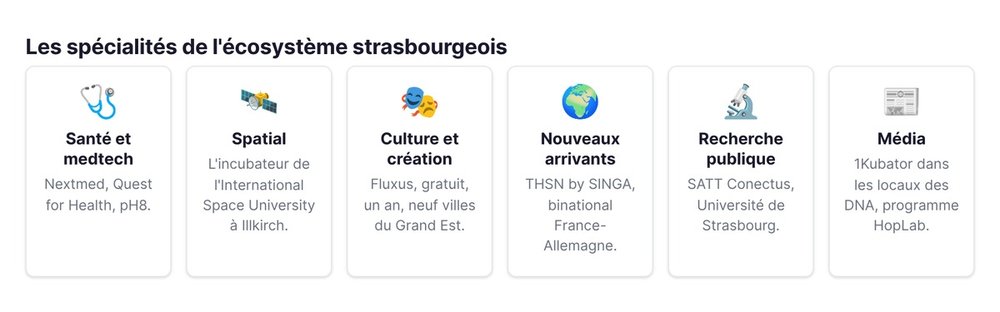
Nextmed is the medical technology campus attached to the Strasbourg university hospitals, described by its managing director as a meeting point for manufacturers, clinicians, researchers and engineers. The site highlights access to the Swiss and German markets and introductions to European key opinion leaders. Quest for Health, the health incubator within the Quest for change network, rounds out the picture. A Strasbourg medtech has a natural trio: pH8 for the office, Nextmed for the hospital, SEMIA or Quest for Health for incubation.
ISU, the space incubator in Illkirch
The International Space University, in Illkirch-Graffenstaden, hosts an incubator for space projects. Les Echos describes offices of 15 to 27 m² for two years, a flat 50,000-euro grant, a possible further 30,000 euros through a partnership with SEMIA, and routes into CNES via the Booster Rhinespace programme. The incubator page on isunet.edu wasn't responding on 5 September 2026, so confirm the figures with ISU directly.
Fluxus and SINGA
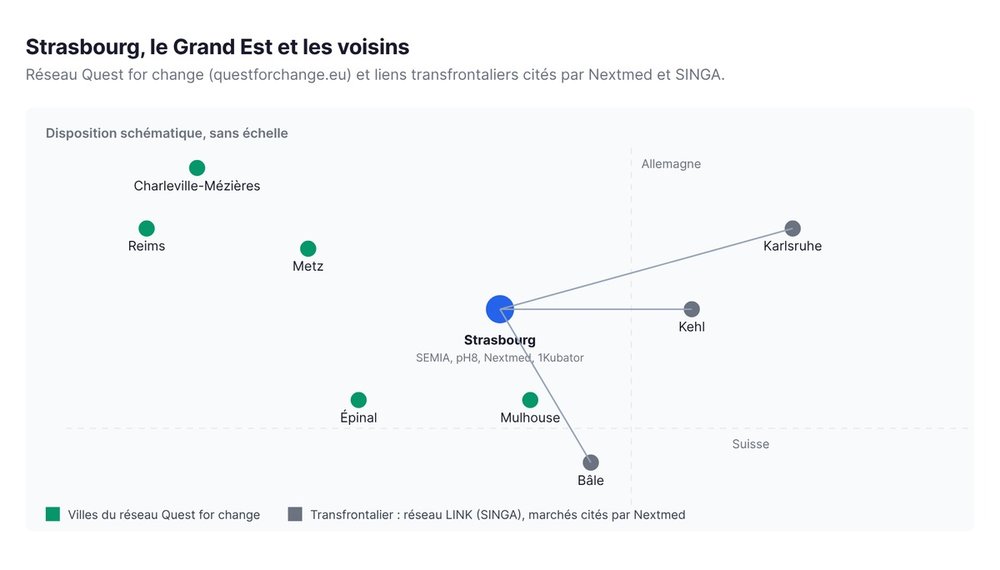
Fluxus is the regional cultural incubator backed by DRAC Grand Est: a year of intensive, multidisciplinary support that moves between nine Grand Est cities, for founders of creative projects. Cost: free, according to Les Echos. SINGA Strasbourg, together with The Human Safety Net foundation, runs a binational French-German incubator for newcomers. It's free, based at the Kaleidoscoop, with a cross-border network reaching into Karlsruhe.
Students and researchers: the dedicated routes
🎓 Two reserved entry points.
EM Strasbourg's La Ruche à Projets
La Ruche à Projets supports projects with at least one EM Strasbourg student or alumnus on the team, across three tracks: a two-month pre-incubation with 58 hours of group support (call in September, starting early October), a six-month incubation with 117 hours of group and one-to-one support (call in December, starting late January), and a 12-hour one-to-one booster, recruiting year-round. The school presents it as the only grande école incubator in Alsace.
SATT Conectus and the university
SATT Conectus, set up in 2012 by the University of Strasbourg, spots innovations coming out of public labs and helps move them into companies. Les Echos counted 23 startups supported and 122 projects backed. If your project comes out of a PhD or a lab, this is your first port of call.
Which incubator for your stage
🧭 Three stages, three answers. The existing lists give you the names. Here's the order.
Idea, prototype, first sales
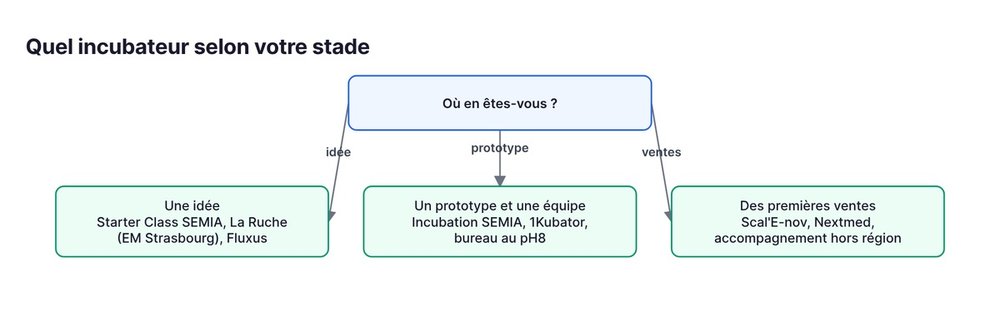
- An idea and no product yet. SEMIA's Starter Class if the innovation is demonstrable, La Ruche if you're EM Strasbourg, Fluxus if the project is cultural. The goal: come out with a validated market and a financial forecast.
- A prototype and a team. SEMIA's one-to-one incubation, or 1Kubator if you'd rather have 25,000 euros right away for 10%. An office at pH8 if you're in health, tech or creative industries.
- First sales. Scal'E-nov for regional acceleration, Nextmed to open up hospitals and the Swiss and German markets, and longer-term support that reaches beyond the region.
What it actually costs
| Path | Direct cost | Equity given up |
|---|---|---|
| SEMIA Starter Class then 12 months of incubation | €600 excl. VAT + 12 × €200 excl. VAT = €3,000 excl. VAT | 0% |
| 1Kubator, ten months | €0 out of pocket (the €25,000 covers incubation and the project) | 10% |
| Fluxus, one year | €0 | 0% |
| pH8, a 13 m² office | rent per the Eurométropole's rate card | 0% |
The 1Kubator maths comes down to a single variable: what 10% of your company will be worth. At a 500,000-euro exit valuation, that 10% is worth 50,000; at 5 million, it's 500,000. The 25,000 euros cost you little if you go nowhere, and a great deal if you succeed.
Strasbourg, Grand Est, Kehl, Basel: playing the geography
🗺️ The one French ecosystem with Germany within walking distance and Switzerland an hour away. No incubator listing mentions it.
Three sourced facts. Nextmed presents access "to the Swiss and German markets" as a campus advantage and cites BioValley, the trinational competitiveness cluster. SINGA runs a cross-border network between Strasbourg and Karlsruhe. SEMIA belongs to Quest for change, which applies the same method in six Grand Est cities, from Charleville-Mézières to Mulhouse: a Strasbourg founder gets access to a regional network of 270 projects, not to a single incubator.
For a B2B startup, that means first German customers without setting up a subsidiary, Swiss hospitals for a medtech, and a bilingual market test before Paris. It's an argument for a SEMIA application and for an investor meeting.
After the local incubator
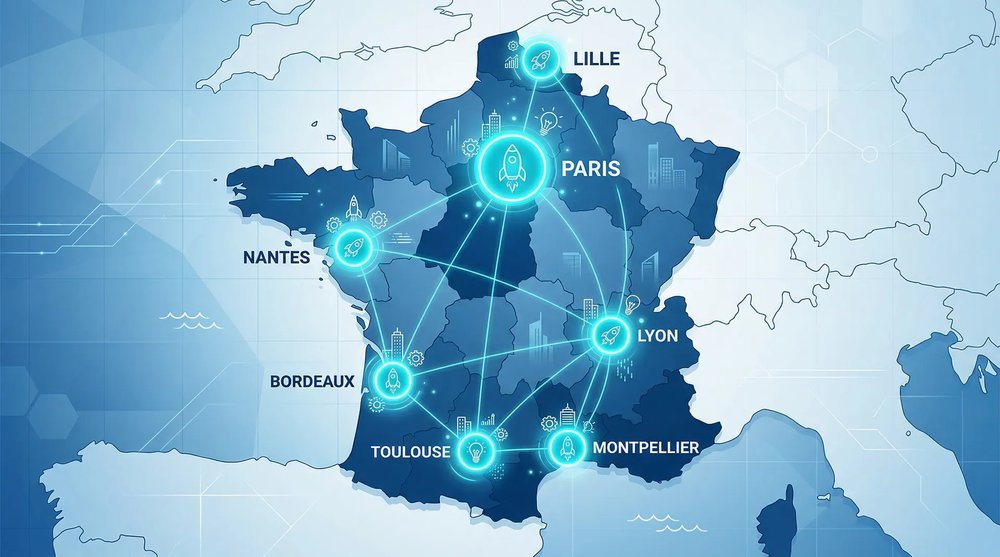
A Strasbourg incubator gives you an office, a method and a regional network. What it gives you less of: a national network of investors and first customers outside the Grand Est. Two habits to plan ahead: compare structures in other cities in the guide to accelerators and incubators in France, with the same format for Lyon and Lille, and fill the gaps in your team, starting with finding a cofounder. Remote support, like swanbase's, stacks on top of a local incubation, and you can apply from Alsace.
FAQ on incubators in Strasbourg
Which is the best incubator in Strasbourg?
There's no ranking, there's a fit. SEMIA for a generalist innovative project with a proof of concept, 1Kubator for immediate funding in exchange for equity, Nextmed and Quest for Health for health, ISU for space, Fluxus for culture, La Ruche for an EM Strasbourg student.
Do incubators take equity?
In Strasbourg, only one on this list does: 1Kubator, 10% for 25,000 euros. SEMIA charges fees (600 euros excl. VAT for the Starter Class, 200 euros excl. VAT per month for incubation), Fluxus and SINGA are free, and pH8 is rent.
Can you be incubated without being from Alsace?
SEMIA lists a base in Alsace among its eligibility criteria. La Ruche requires a link to EM Strasbourg. 1Kubator, Fluxus (across the Grand Est) and pH8 publish no origin requirement, but all assume a local presence. A team that moves to Strasbourg for the project meets the condition.