Startup cloud credits are balances that providers add to your account to pay for servers, databases and AI models. As of October 26, 2026, AWS Activate gives a bootstrapped startup $1,000. A startup that presents the Org ID of an Activate Provider can get up to $200,000. Google for Startups Cloud Program ranges from $2,000 to $350,000 over two years for funded AI startups. Microsoft for Startups unlocks its Azure credits in tiers, from $200 to $150,000.
Two things drive the amount: whether you have raised from an investor, and whether one of the provider's partners backs you. Every figure below comes from the official pages, read on October 26, 2026.
Startup cloud credits: what each program offers as of October 26, 2026
What a cloud credit covers
A cloud credit is a balance applied to your bill with a single provider. AWS applies it each month to new eligible usage, never retroactively, and across all eligible charges until the credit runs out or expires.
Each provider excludes part of its catalog. AWS excludes AWS Professional Services, AWS Managed Services, Amazon Mechanical Turk and AWS training. Google covers its own usage-billed products. It excludes subscription-billed products and third-party products from Google Cloud Marketplace and Model Garden. AWS forbids passing credits on to your customers, and Google forbids sharing or reselling them.
The programs side by side
| Program | Maximum amount | Without funding | Duration | Key condition |
|---|---|---|---|---|
| AWS Activate | $200,000 (more by invitation for AI) | $1,000, up to $5,000 | 1 to 2 years depending on package | Activate Provider Org ID for Portfolio |
| Google for Startups Cloud | $350,000 (AI startups) | $2,000 (Start tier) | 2 years for Scale | Verifiable Pre-Seed to Series A round |
| Microsoft for Startups | $150,000 | $200, then $5,000 | 90- and 180-day deadlines | Azure usage tiers over 60 days |
| Cloudflare for Startups | $350,000 | $10,000 | 1 year | Affiliated partner above $10,000 |
| Claude for Startups | $45,000 in partner offers | Cohort full | n/a | Applications closed as of 10/26/2026 |
| Scaleway Startup Program | €36,000 (Growth) | €1,000 (Founders) | 6 or 12 months | Under 5 years old, new customer |
| OVHcloud Startup Program | €100,000 (Scale) | €10,000 (Start) | 12 months | Criteria not published on the page |
| NVIDIA Inception | Amount not published | Free | No cohort | Under 10 years old, uses NVIDIA |
| Notion for Startups | 6 months of Business | 3 months | 1, 3 or 6 months | Fewer than 100 employees |
AWS Activate: $1,000 without funding, $200,000 with an Activate Provider
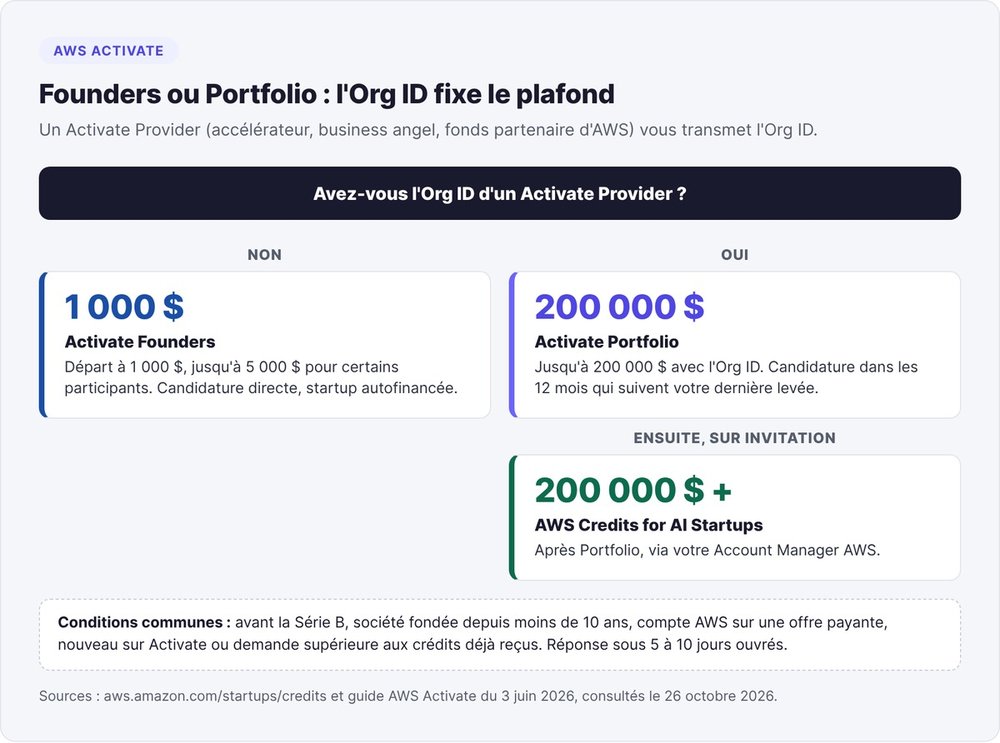
AWS Activate, the Amazon Web Services program, has three tiers: Founders, Portfolio and AWS Credits for AI Startups.
Activate Founders, the bootstrapped tier
The Founders tier targets bootstrapped startups. According to the official AWS Activate credits page, you start at $1,000 and some participants go up to $5,000. You apply on your own, with no partner involved.
AWS requires you to be pre-Series B, founded less than ten years ago, with an AWS account on a paid plan (Paid Tier Plan). You must also be new to Activate, or be requesting more than the credits you have already received.
Activate Portfolio and the Activate Provider Org ID
The Portfolio tier goes up to $200,000 and requires an Organization ID (Org ID). You get it from an Activate Provider: an accelerator, business angel or fund that partners with AWS.
Without an Org ID, you cap out at $5,000. AWS claims "thousands" of providers and names Andreessen Horowitz, Brex, Carta, Greylock Partners, Sequoia and Y Combinator. Ask your fund or accelerator for the Org ID before you fill in the form.
AWS also asks you to apply to Portfolio within 12 months of your latest funding round (AWS Activate guide, June 3, 2026).
Above that, AWS Credits for AI Startups goes beyond $200,000. It is by invitation from your AWS Account Manager, after Portfolio.
Applying to AWS Activate
AWS describes four steps:
- create an AWS Builder ID with a work email, or sign in;
- choose Founders if you are bootstrapped, or Portfolio with your provider's Org ID;
- describe your product, your funding stage and your company;
- link or create an AWS account, then submit the application.
AWS replies within 5 to 10 business days. Your credits and their expiry date then appear in the console, under Billing, then Credits.
AWS Activate pitfalls
First pitfall: an account still on the free plan does not qualify. AWS requires a paid plan.
Second pitfall: AWS credits usually expire within one to two years. Apply once your product is actually consuming resources.
Third pitfall, for agencies: AWS terms dated January 22, 2026 reserve credits for your own use and do not allow transfers to your end customers.
Google for Startups Cloud Program: from $2,000 to $350,000
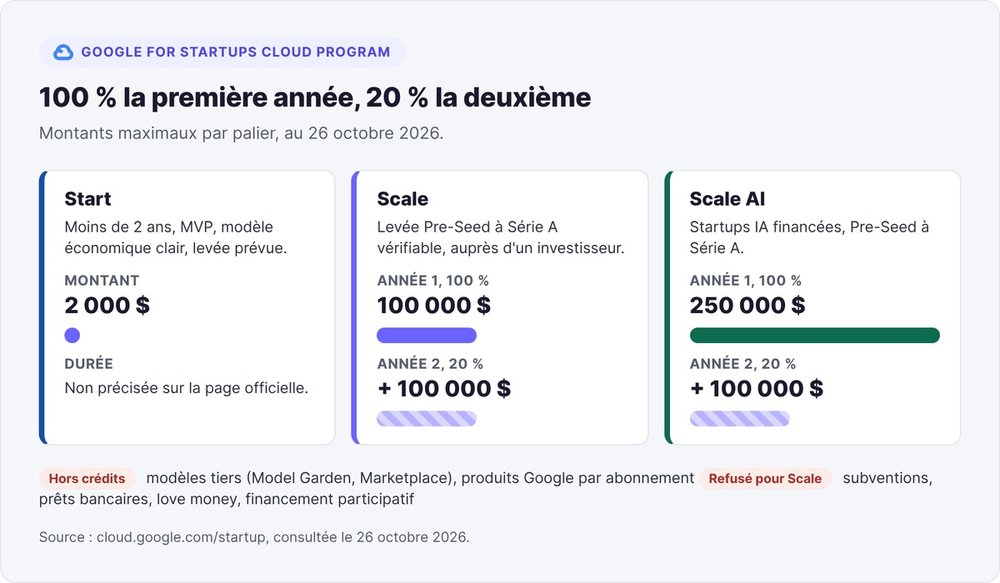
The Google for Startups Cloud Program has one tier for unfunded startups (Start) and two funded tiers (Scale and Scale AI).
The Start tier, for unfunded startups
The Start tier gives $2,000. Google reserves it for startups founded less than two years ago, with a working MVP, a clear business model and plans to raise soon.
If you are turned down, Google may point you to the $300 free trial or to AI Studio, its Gemini testing environment.
Scale and Scale AI: 100% in year one, 20% in year two
The funded tiers ($200,000 to $350,000) target startups that raised between Pre-Seed and Series A within the last three to five years. The official Google for Startups Cloud Program page details the split:
- AI startups: 100% up to $250,000 in year one, then 20% up to an additional $100,000 in year two;
- other startups: 100% up to $100,000 in year one, then 20% up to an additional $100,000 in year two.
In year two, credits only cover a fraction of the bill, so start budgeting for it in year one.
The funded tiers add 12 months of Google Workspace Business Plus and monthly Google Maps Platform credits, each with its own application. For Workspace, your domain must not have had a paid subscription in the previous 31 days.
The Google application: billing ID, domain email, live website
Google asks for three things before you apply:
- your Google Cloud billing account ID (18 characters), where Google will deposit the credits;
- an email address on your public website's domain;
- a live website that presents the company, the team and the product.
A user from the company's domain must administer the billing account. Google usually replies within 5 to 7 days, or 10 days or more if the application is incomplete. If you are in stealth mode, have your fund or accelerator confirm your round.
Google for Startups pitfalls
Google screens out AI-generated websites: its FAQ says an application can be rejected if the website contains a lot of generated content. A landing page built with a vibe coding tool and no team page is at risk of rejection.
Google also excludes non-venture funding for the Scale tier: private equity, bank loans, public innovation programs, grants, crowdfunding and friends-and-family money. A startup funded only by a public grant and friends-and-family money therefore does not qualify for Scale.
Microsoft for Startups: Azure credits unlocked in tiers
At Microsoft for Startups, your Azure credits grow with your actual usage. You apply at startups.microsoft.com, and Microsoft usually replies within three business days.
Microsoft requires:
- a software product owned by the company;
- a private, for-profit company;
- headquarters in a country where Azure is available;
- no more than $350,000 in free Azure credits received;
- no Series C or later round.
Microsoft excludes educational institutions, public bodies, consulting firms, agencies and cryptocurrency mining.
The five tiers, from $200 to $150,000
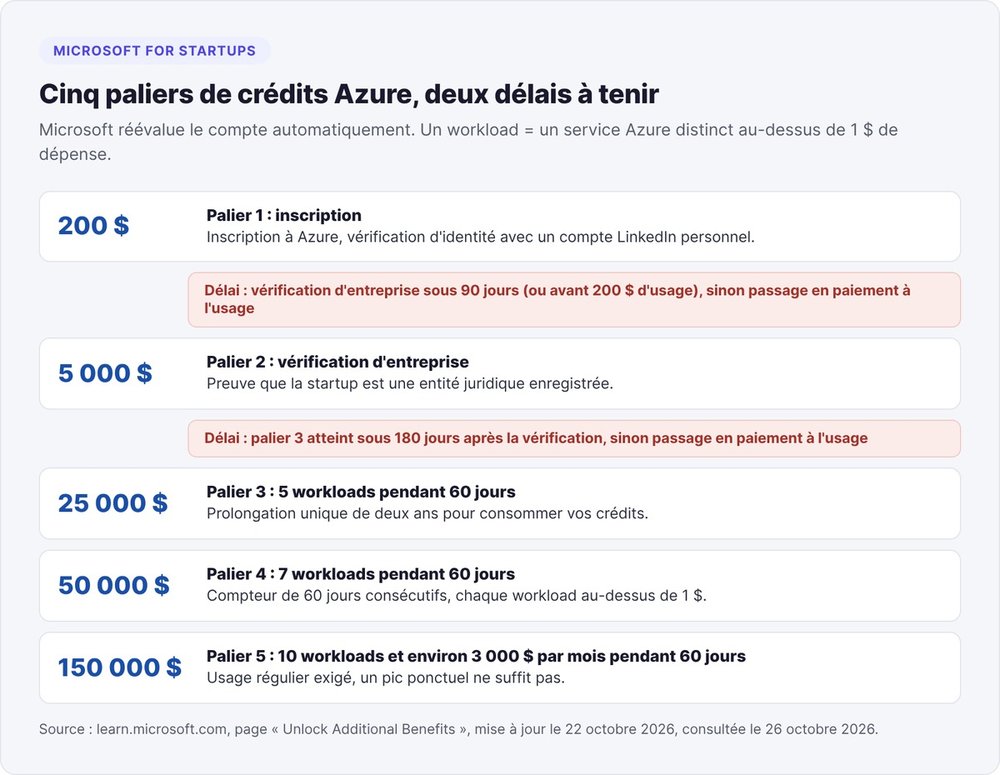
The Microsoft documentation on credit progression, updated October 22, 2026, sets five tiers:
- $200: Azure sign-up and identity verification with a personal LinkedIn account;
- $5,000: verification that your startup is a registered legal entity;
- $25,000: five or more Azure workloads for 60 days;
- $50,000: at least seven workloads for 60 days;
- $150,000: ten or more workloads and about $3,000 of Azure usage per month for 60 days.
A workload is a distinct Azure service your product uses: virtual machines, AI models, databases, hosting. Each one must stay above $1 of spend for 60 consecutive days. Microsoft looks at sustained usage, so a one-off spike does not count. Microsoft reassesses your account automatically, so you don't need to apply again.
The 90- and 180-day deadlines
Microsoft cuts off credits at two deadlines. If you don't complete business verification within 90 days of signing up, or before you reach $200 in cumulative usage, Microsoft cancels the sponsorship and switches the subscription to pay-as-you-go. If you don't reach tier 3 within 180 days of business verification, Microsoft applies the same conversion.
At the $25,000 tier, Microsoft grants a one-time two-year extension to use up your credits.
Investor Network benefits
A member of Microsoft's Investor Network (a VC, accelerator, incubator or university) gives you a referral code. You enter it when you apply or later in the portal.
The code unlocks up to $150,000 in credits depending on your eligibility, 24/7 Azure Standard support, GitHub Enterprise for 20 users and Microsoft 365 Business Premium for 50 seats. To reach the cap you still need the same thresholds (ten services, $3,000 per month, 60 days), and the update can take up to 30 days.
AI credits: Anthropic, OpenAI and the models your cloud credits pay for
Claude for Startups is no longer accepting applications
As of October 26, 2026, Anthropic is no longer accepting applications to Claude for Startups. According to its official page, the cohort is full and Anthropic has set aside the applications still under review. Its newsletter will announce the next cohort.
Members keep their benefits: up to $45,000 in partner offers, sessions with Anthropic's Applied AI team, and up to $100,000 in additional API credits through a VC in the partner network. Our Claude for Startups guide covers what the program includes, and our roundup of AI tools for startups in 2026 lists the other subscriptions to plan for.
OpenAI for Startups
OpenAI advertises a program for startups. On October 26, 2026, however, OpenAI was blocking automated access to its pages, and we could not find any official amount or eligibility criteria. Check the terms with OpenAI or your fund before you count on it in your budget.
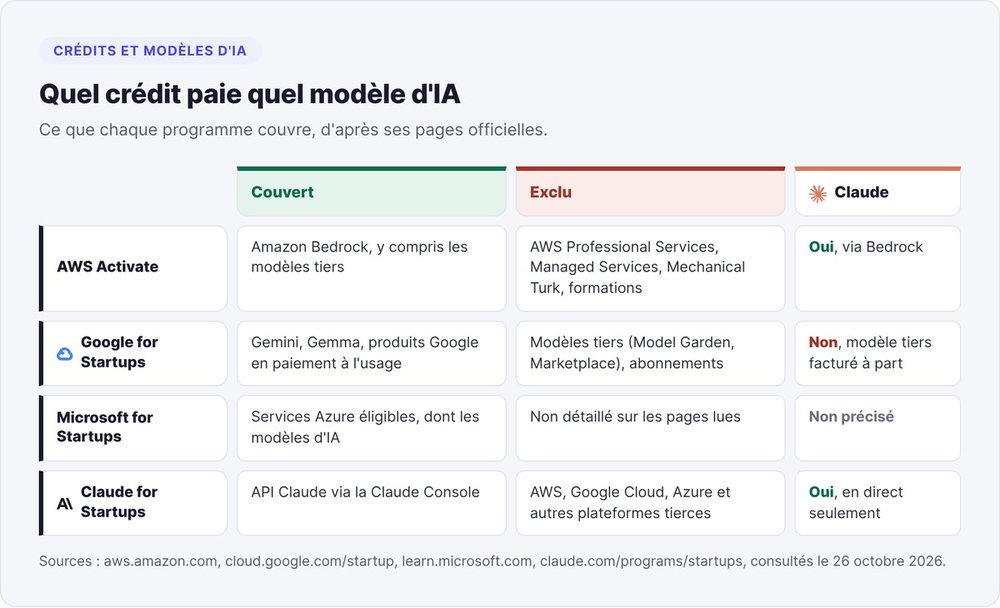
Which credit pays for which AI model
- AWS Activate covers third-party models available on Amazon Bedrock. AWS terms also allow credits to be used on AWS Marketplace fees for third-party foundation models.
- Google for Startups covers Gemini and Gemma. Google bills third-party models, such as those in Model Garden, separately, outside the credits.
- Microsoft for Startups counts AI models as Azure workloads, which credits pay for on eligible services.
- Claude for Startups credits pay only for the Claude API through the Claude Console. Anthropic specifies that they do not work on AWS, Google Cloud or Azure.
If your product calls Claude, your AWS Activate credits pay for it through Bedrock. Your Google credits do not cover it on Google Cloud.
Cloudflare, Scaleway, OVHcloud, NVIDIA and Notion: complementary programs
Cloudflare for Startups
Cloudflare offers three tiers:
- $10,000 for a startup that has raised less than $1M;
- $100,000 for a startup that has raised under $5M, with an affiliated partner;
- $350,000 for a startup that has raised $5M or more, also with an affiliated partner.
Credits last one year or until they run out. Cloudflare requires a company under ten years old, at Series B at most, with a live website and a domain email. Our Cloudflare for Startups guide details the covered services and per-product caps.
Scaleway and OVHcloud, the French programs
Scaleway offers three tiers:
- Founders: up to €1,000 over one year;
- Early Stage (pre-seed to seed): €1,500 per month for six months, or €9,000;
- Growth (seed to Series A): €3,000 per month for twelve months, or €36,000.
The FAQ on the same page says Early Stage starts "from €500" per month, so confirm the amount with Scaleway.
Scaleway accepts companies under five years old with fewer than 50 employees that are not yet customers. It reviews applications weekly and does not let you move from Early Stage to Growth.
OVHcloud offers two 12-month levels. Start gives €10,000 in credits and 6 hours with an engineer. Scale goes up to €100,000 and 20 hours of support. OVHcloud's page does not publish any age or funding criteria.
NVIDIA Inception
NVIDIA Inception is free and takes no equity. Members get access to cloud credits from NVIDIA and its partners (no amount published), training and hardware discounts. NVIDIA requires a registered company under ten years old, a live website and a clear use of its technologies. NVIDIA runs no cohorts and sets no deadline.
Notion for Startups
Notion offers up to six months of the Business plan with Notion AI:
- six months through a startup partner;
- three months with a website and a domain email;
- one month otherwise.
You need fewer than 100 employees, and you can't have paid for a subscription or received a Notion promotion before. Notion values the offer at up to $12,000, based on $20 per member billed annually.
Which program to start with, by stage
No funding and no support program
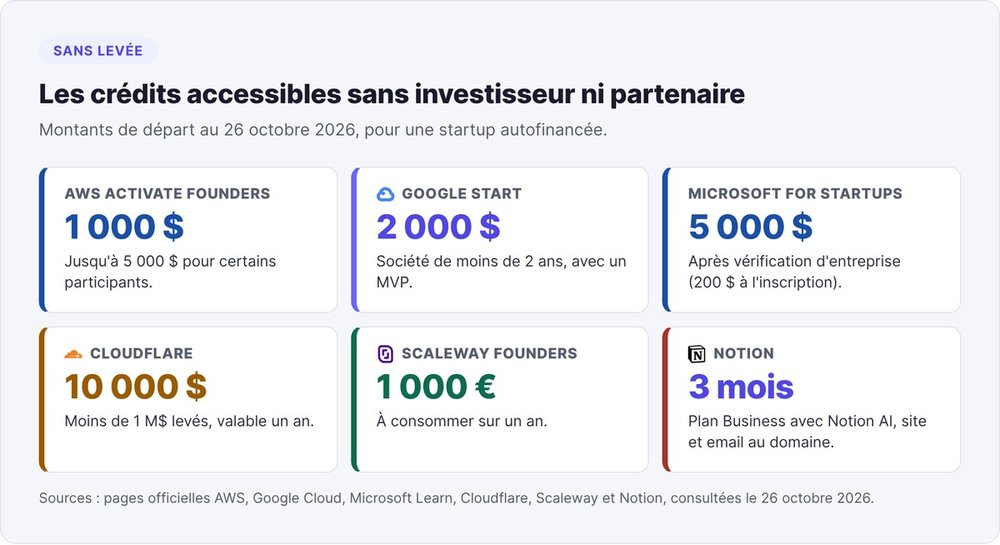
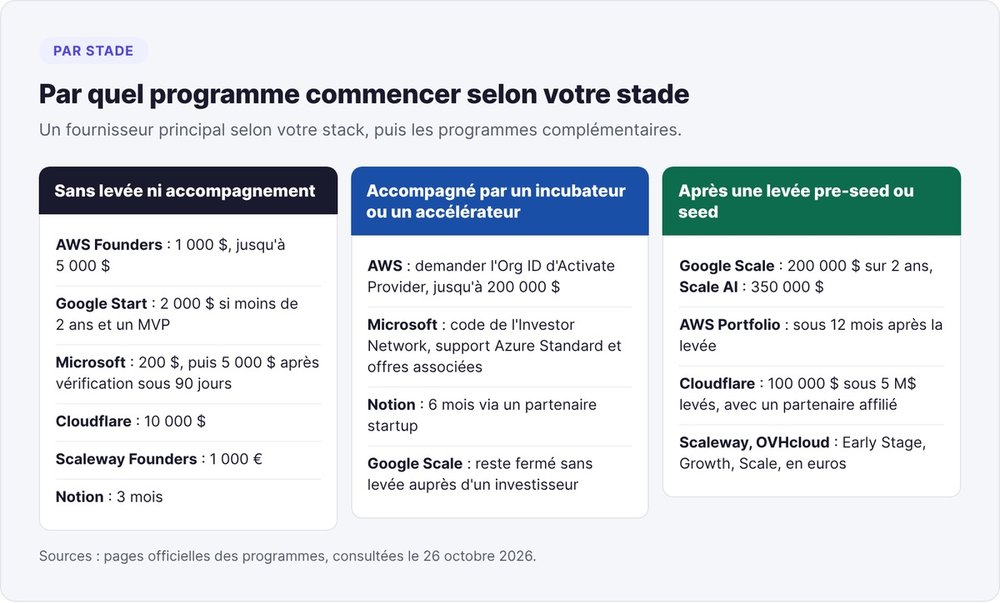
With no investor or partner, six offers are open to you: AWS Founders ($1,000, up to $5,000), Google Start ($2,000 if your company is under two years old and has an MVP), Microsoft ($200, then $5,000 after verification), Cloudflare ($10,000), Scaleway Founders (€1,000) and Notion (three months).
Pick a main provider based on your stack and apply once your product is consuming resources. With Microsoft, sign up only after the company is registered, since business verification must follow within 90 days.
Backed by an incubator or accelerator
Ask your incubator or accelerator three questions:
- Is it an AWS Activate Provider? The Org ID unlocks up to $200,000.
- Is it a member of Microsoft's Investor Network? The referral code unlocks support and the associated offers.
- Is it a Notion startup partner? You get six months instead of three.
For Google's Scale tier, being in a program is not enough, since Google requires a round raised from an investor. Our guide to accelerators and incubators in France compares the options. If you are building your company inside a studio, also read our article on the startup studio.
After a pre-seed or seed round
After a round, Google Scale ($200,000 over two years) or Scale AI ($350,000) offers the largest amount. Apply to AWS Portfolio within 12 months of the round, using your fund's Org ID if it is a provider. On the Cloudflare side, the $100,000 tier requires less than $5M raised and an affiliated partner. In France, Scaleway Early Stage or Growth and OVHcloud Scale add euro-denominated options.
Don't automatically go for the largest amount: $350,000 in Google credits is worth little if your team builds on AWS.
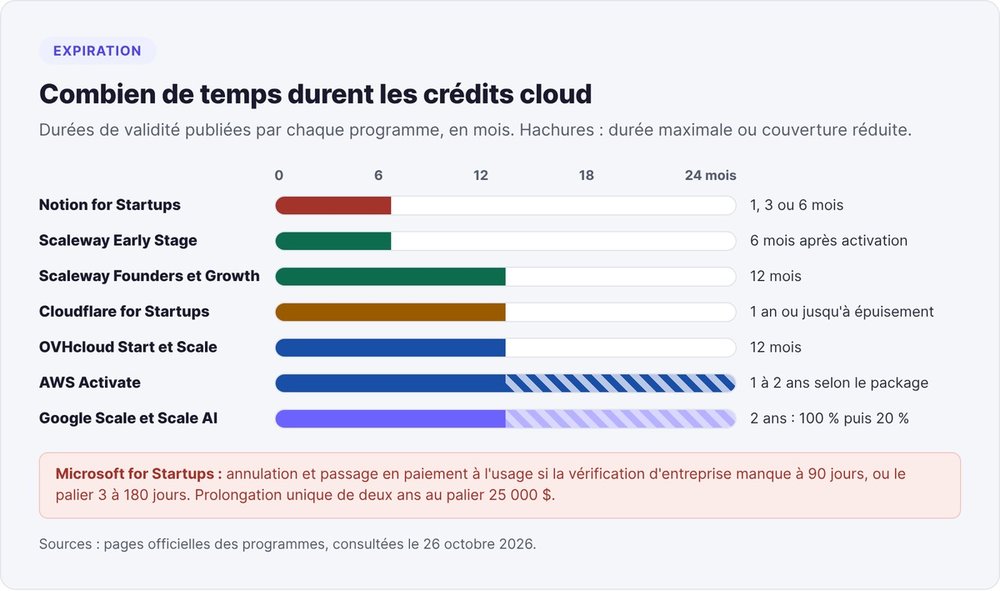
Cloud credit expiry: planning for the end
Validity periods, program by program
| Program | Credit validity |
|---|---|
| AWS Activate | 1 to 2 years depending on package, date shown under Billing, then Credits |
| Google for Startups Scale and Scale AI | 2 years, at 100% then 20% (Start tier duration not specified) |
| Microsoft for Startups | Cancelled at 90 or 180 days if you miss a step, one-time 2-year extension at the $25,000 tier |
| Cloudflare for Startups | 1 year or until used up |
| Scaleway | 12 months for Founders, 6 or 12 months after activation for Early Stage and Growth |
| OVHcloud | 12 months |
| Notion | 1, 3 or 6 months |
When credits expire
Once credits expire, AWS and Microsoft keep billing your usage. AWS applies credits before charging you, and once they are used up or expired, usage is charged to your payment method. If the sponsorship is cancelled, Microsoft converts the subscription to pay-as-you-go. When AWS Business Support credits expire, you drop back to Basic support.
Note each credit's expiry date as soon as you receive it. Estimate what your last covered bill would cost at full price, and shut down test environments that have no users before the credits end.
FAQ
How do you get AWS Activate credits for a startup?
Create an AWS Builder ID with a work email, choose Founders ($1,000, up to $5,000) or Portfolio (up to $200,000 with an Org ID), and link an AWS account on a paid plan. AWS replies within 5 to 10 business days.
What is an AWS Activate Provider?
An Activate Provider is an accelerator, business angel or venture capital fund that partners with AWS. The partner gives its startups an Organization ID (Org ID), which the Portfolio tier requires. AWS lists Y Combinator, Sequoia and Andreessen Horowitz among them.
Is the Google for Startups Cloud Program free?
Yes. The Start tier gives $2,000 to startups under two years old with an MVP. Scale and Scale AI give up to $200,000 or $350,000 over two years to startups funded between Pre-Seed and Series A.
Does Microsoft for Startups Founders Hub still exist?
The official Microsoft pages we checked on October 26, 2026 describe a single entry point, Microsoft for Startups, and no longer use the Founders Hub name. Azure credits start at $200, rise to $5,000 after business verification and go up to $150,000 depending on your Azure usage.
Does OpenAI give credits to startups?
OpenAI advertises a program for startups, but as of October 26, 2026 we could not find any official amount or eligibility criteria. To pay for AI with credits, the routes we could verify are AWS Activate (third-party models on Bedrock) and Microsoft for Startups (Azure AI models).
Is Notion free for six months for startups?
Yes, through a Notion startup partner and with fewer than 100 employees: six months of the Business plan with Notion AI. Without a partner, if you have a website and a domain email, the offer drops to three months.
Can you stack AWS, Google and Microsoft credits?
None of the official pages we read on October 26, 2026 prohibits holding credits with another provider. Each program only looks at the credits you received from it in the past. AWS requires you to be new to Activate, Google reviews your past use of Google Cloud credits, and Microsoft caps free Azure credits received at $350,000.
Do cloud credits expire?
Yes. They usually last one to two years at AWS, one year at Cloudflare, and two years on Google's Scale tiers. After that, your usage is charged to your payment method.