A startup studio is a company that builds startups itself, one after another. The studio comes up with the idea, recruits the founders, lends them its team and funds the company's first months. In return, it takes equity from day one: 33.33% at Hexa (formerly eFounders, Paris) for €700,000 invested, 5% at Inria Startup Studio.
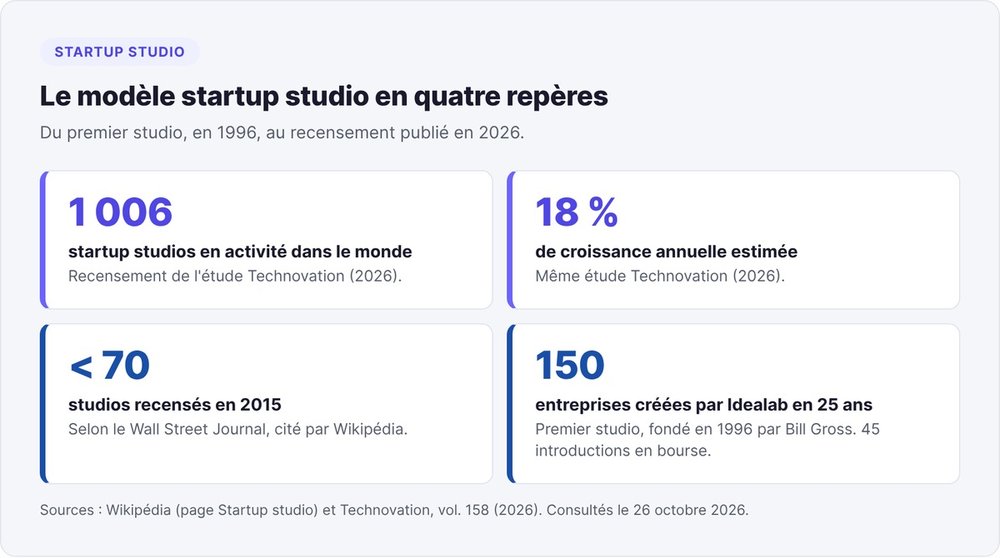
The same model also goes by "venture studio" or "company builder". A study published in 2026 in the journal Technovation counts 1,006 active startup studios worldwide.
All terms quoted here come from the studios' official pages, checked on October 26, 2026.
What is a startup studio?
Startup studio definition
The Wikipedia page on startup studios defines one as "a company that creates startups using shared resources and a multidisciplinary team". Wikipedia lists three fundamentals: the studio creates the startup itself, provides human and financial capital to each project, and repeats the process.
La Fabrique by CA, Crédit Agricole's studio, puts it simply: "a startup studio is a company that creates companies". A corporate startup studio does the same thing on behalf of a large group.
In the most common model, the studio's partners validate an idea, then recruit a CEO and a CTO to run it.
Venture studio, company builder, startup factory: different names, same model
Wikipedia lists five synonyms: venture studio, startup factory, company builder, venture builder and startup studio. Hexa calls itself a "venture studio", Kamet a "venture builder". In both cases, the studio is a cofounder and shareholder.
How many startup studios exist worldwide in 2026
The first studio, Idealab, founded by Bill Gross in 1996, created 150 companies over 25 years, 45 of which went public, according to Wikipedia.
In 2015, the Wall Street Journal counted fewer than 70 startup studios worldwide. The Technovation article published in 2026 (Viglialoro, Sansone, Ughetto, Landoni and Lukeš) counts 1,006 active studios and estimates their growth at 18% per year.
In France, Thibaud Elzière, cofounder of Fotolia, founded eFounders in Paris in 2011. The studio is now called Hexa.
How a startup studio works, step by step
A startup studio works in five steps, from the idea to the company's independence. Hexa runs them over 12 months. Inria Startup Studio funds a year of work before the company is incorporated.
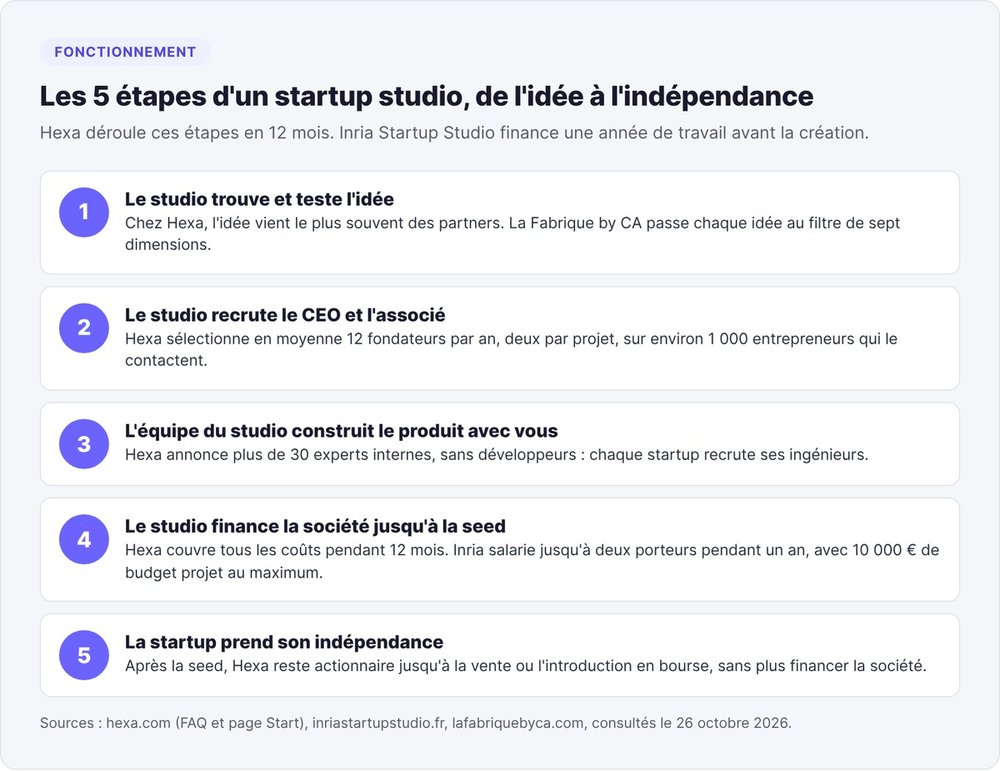
Step 1: the studio finds and tests the idea
At Hexa, the initial idea usually comes from the studio's partners: a problem to solve and a first MVP mockup. Hexa publishes the ideas that need founders on its Start page. In October 2026, the list includes a shared file system for AI agents and a customs duty recovery tool for European manufacturers.
La Fabrique by CA runs every idea through seven dimensions, including market, business model and regulatory risk. Each startup must also serve a goal of Crédit Agricole's medium-term plan, ACT 2028.
Step 2: the studio recruits the CEO and the cofounder
Around 1,000 entrepreneurs contact Hexa every year. Hexa selects 12 on average, meaning two founders per project, and helps find a cofounder when the first founder arrives alone.
At La Fabrique by CA, a studio employee designs the offer and launches the first product with the CTO. The studio recruits a dedicated team when it incorporates the company.
Step 3: the studio's team builds the product with you
The studio lends you its experts: Hexa cites more than 30 in-house experts, La Fabrique by CA 25 fintech experts.
Hexa has no developers on its core team: each startup hires its own engineers. If you're non-technical, that hiring falls on you from the first weeks. Our guide on finding a CTO for your startup covers the channels.
Step 4: the studio funds the company until the seed round
Hexa covers all costs for 12 months, founder salaries included, then prepares the seed round with them. Inria Startup Studio employs up to two project leads for one year, on Inria's salary scales, with a project budget of up to €10,000.
Step 5: the startup becomes independent
After the seed, the startup operates like any other funded company. Hexa remains a shareholder until a sale or IPO, but stops funding the company.
How much equity does a startup studio take
Wikipedia states that a studio "takes a stake, sometimes a majority one". Three French programs publish their exact terms: from 5% to 33.33% at incorporation.
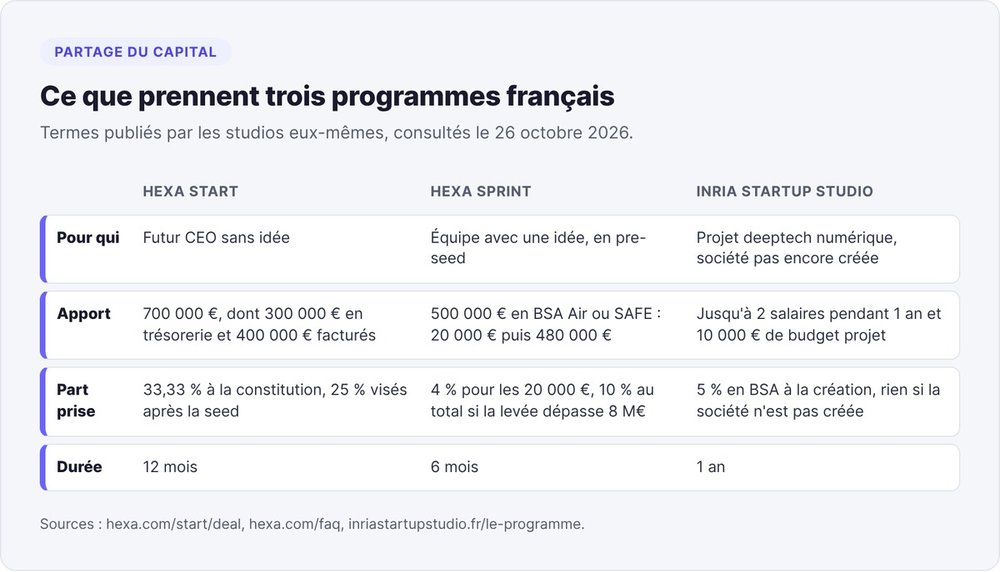
Hexa Start: €700,000 for 33.33% of the equity
The Hexa Start deal, updated on December 16, 2025, provides €700,000 invested at incorporation in exchange for 33.33% of the equity. The founders split the remaining 66.67%, whether there are two or three of them.
Hexa splits the €700,000 into two parts. The studio bills €400,000 for its support and access to its team. The remaining €300,000 goes into the company's bank account: founder salaries, first hires, tools, travel. The startup's actual cash is therefore €300,000.
Hexa can invest more during the studio phase, through an instrument that converts at the next round.
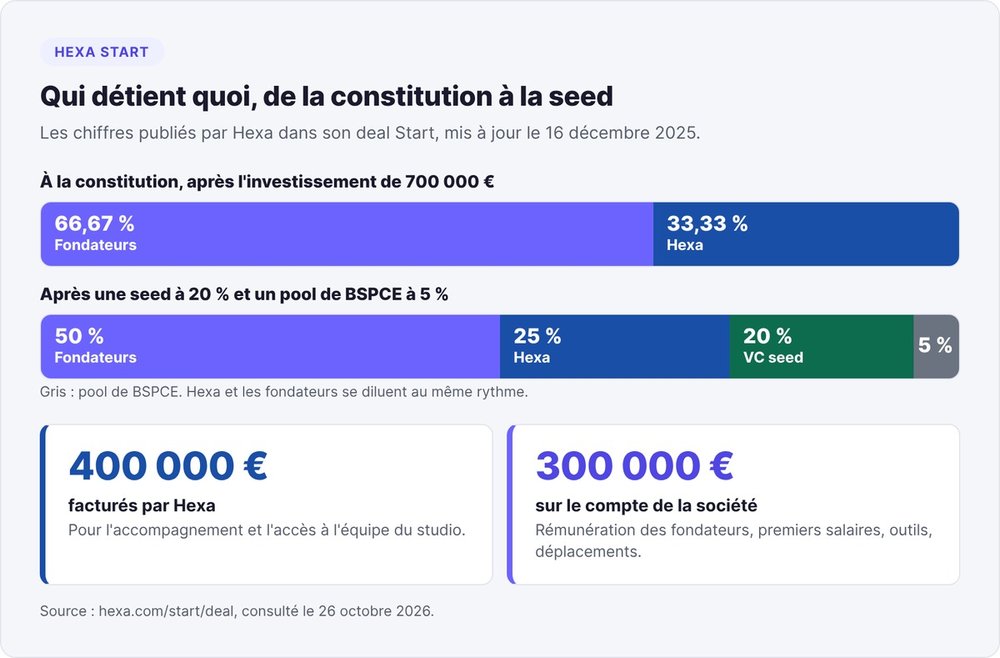
The founders' stake after the seed
Hexa and the founders dilute at the same rate in each round. Hexa publishes two scenarios:
- 20% seed and 5% BSPCE pool (French employee stock options): founders 50%, Hexa 25%, seed investors 20%, pool 5%;
- 15% seed and 5% pool: founders 53%, Hexa 27%, seed investors 15%, pool 5%.
Hexa holds preferred shares with a 1x non-participating liquidation preference, like the seed investors. In a sale, Hexa receives the higher of two amounts: its investment, or its pro rata share of the price.
Inria Startup Studio: 5% in BSA at incorporation
According to the Inria Startup Studio program page, Inria takes 5% of the startup at incorporation, in BSA (share warrants). That 5% also pays for the exclusive operating license on everything the funded people developed during the program. If you don't incorporate the company, Inria asks for nothing else in return.
Hexa Sprint: €500,000 for 10% when you already have an idea
Hexa Sprint targets teams that already have an idea and are looking for their first pre-seed check. The program lasts six months and invests €500,000 through two instruments. The first puts in €20,000 via BSA Air or SAFE in exchange for 4% of the company. The second puts in €480,000 via BSA Air or SAFE capped at an €8M valuation, with an MFN clause. If your first round closes above €8M, Hexa holds 10% for €500,000.
Four lines to check in a studio deal
Before signing, ask the studio for four pieces of information in writing:
- The stake taken at incorporation and the target stake after the seed. Hexa states 33.33%, then 25%.
- The share of the investment billed for support. At Hexa, €400,000 out of €700,000.
- The type of securities the studio holds. Common shares, BSA, or preferred shares with a liquidation preference.
- What you owe if the company is never incorporated. Inria asks for nothing in that case.
The success rates attributed to studios
Specialized websites credit studio startups with a 53% rate of return, citing reports from the GSSN (Global Startup Studio Network) from 2020 and 2022. Their figures differ: 72% of studio startups reportedly reach Series A according to one site, 60% according to another. We were unable to access the original reports on October 26, 2026, so ask any studio that quotes them for the source.
Startup studio vs incubator vs accelerator
A startup studio starts from its own idea and cofounds the company. Incubators and accelerators support your project, at different stages.
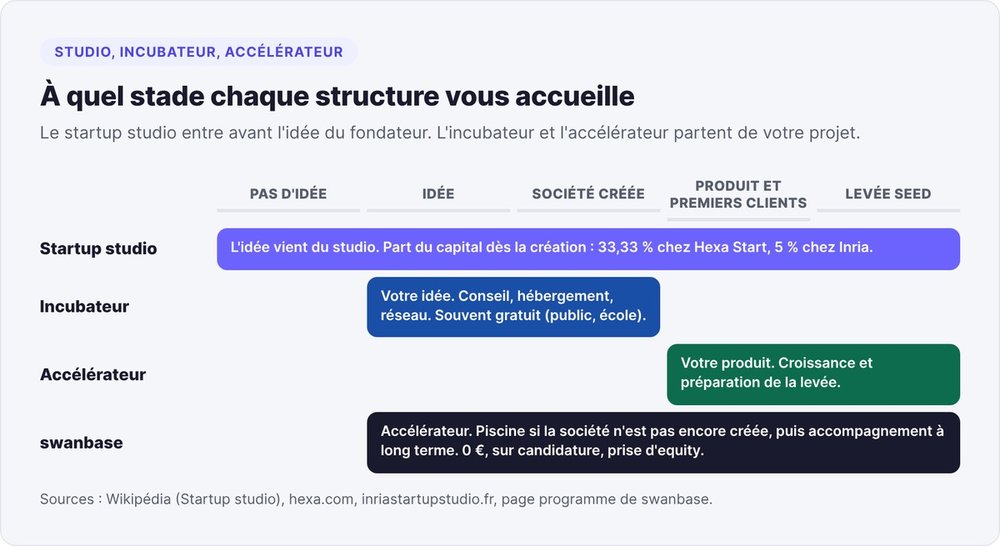
| Criterion | Startup studio | Incubator | Accelerator |
|---|---|---|---|
| Source of the idea | The studio | The founder | The founder |
| Entry point | Before the company is incorporated | Idea or recently founded company | Product and first customers |
| What it costs you | Equity at incorporation (5% to 33.33% in published examples) | Often free for public and school incubators | Varies by program |
| Role | Cofounder and shareholder | Advice, office space, network | Growth and fundraising prep |
| Examples | Hexa, La Fabrique by CA, Inria Startup Studio | Agoranov, HEC Paris incubator | Y Combinator, swanbase |
Source of the idea and entry point
Wikipedia classifies startup studios as early-stage structures that step in before the company exists. An incubator takes in projects at various stages, for a fixed period. Our article on the HEC Paris incubator and its entry criteria describes a typical school incubator selection process.
What you give in return
The more involved the studio, the more equity it asks for: 12 months of salaries and a borrowed team are worth a cofounder's share. Our guide to accelerators and incubators in France compares terms program by program.
Where swanbase fits
swanbase is an accelerator based in Paris. You apply with your own project, at any time of year. The support costs €0, admission is by application, and swanbase takes equity. If your company isn't incorporated yet, you start in the Piscine: a real-world trial period, judged on the traction you generate. After that, support continues over the long term, with no batch end date, through office hours and an annual retreat.
Startup studios in France in 2026
The lists of French startup studios available online date from 2022 and 2023. We opened each studio's website on October 26, 2026 and kept the ones that describe an active startup-building practice.
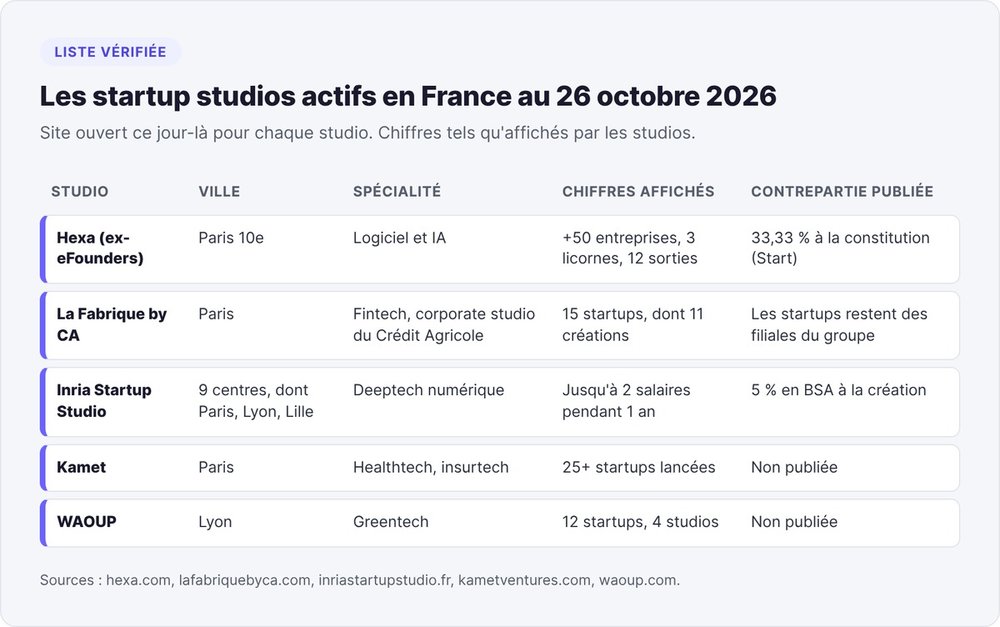
Hexa (formerly eFounders), Paris: software and AI
Hexa, the Paris startup studio that grew out of eFounders, reports more than 50 companies launched, $6 billion in combined valuation, three unicorns and 12 exits. Aircall, Front, Spendesk and Swan all came out of it. The studio offers three tracks: Start to build a company without an idea, Sprint for a pre-seed team, and Scale for established companies looking for a majority investor. Hexa requires you to work from its headquarters on rue Martel, in Paris's 10th arrondissement.
Our overview of incubators and accelerators in Paris places Hexa among the city's other programs.
La Fabrique by CA, Paris: fintech for Crédit Agricole
La Fabrique by CA describes itself as Europe's first corporate startup studio, created in 2018 within Crédit Agricole's New Businesses division. The studio reports 15 startups: 11 built from scratch, 2 acquisitions and 2 equity stakes, totaling 400 people and more than 500,000 customers. La Fabrique hands its startups to entrepreneurs it recruits, and these companies remain autonomous subsidiaries of the group.
Inria Startup Studio, 9 cities: digital deeptech
Inria Startup Studio hosts project leads in 9 Inria centers: Bordeaux, Grenoble, Lille, Lyon, Nancy, Paris, Rennes, Saclay and Sophia Antipolis. The program requires a digital deeptech project, the technical ability to build the proof of concept, and a full-time commitment. Inria requires neither a prior link to the institute nor a PhD. At least one project lead must live in France, and the startup must not exist yet.
Unlike Hexa, you bring the idea or the technology, and Inria provides the salary and the workspace.
Kamet, Paris: healthtech and insurtech
Kamet describes itself as a venture builder specializing in healthtech and insurtech, based on rue de Prony in Paris. The studio reports more than 25 startups launched, more than $1.8 billion in total portfolio valuation and more than 1,000 employees across its companies. Kamet does not publish its equity terms on its website.
WAOUP, Lyon: greentech
WAOUP, based on avenue Tony Garnier in Lyon, reports 12 startups created, 4 startup studios and more than €50M under management. Its studios build greentech companies, ranging from SaaS and AI for industry to deeptech for the energy transition.
Names to double-check in older lists
Two names from older lists no longer match an active studio. The domain of Sparkling Partners, a Lille studio cited by Wikipedia, redirects to a parking page. Founders Future now presents itself as a tech and AI investment platform, with no studio offering on its website. Before contacting a studio you found in a list, open its website and look for a recent date.
Should you join a startup studio? The decision table
The right choice depends on what you already have.
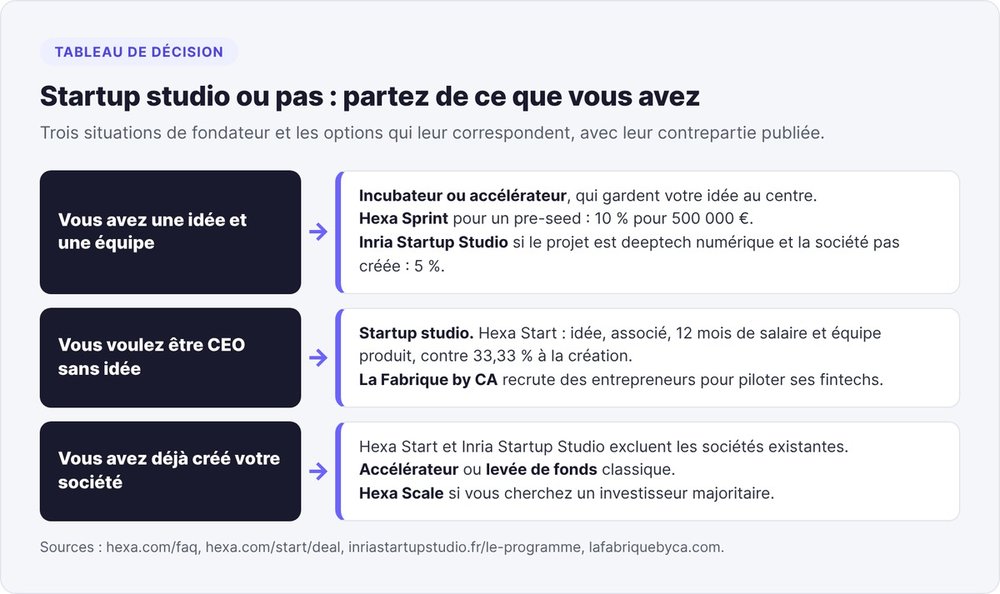
You have an idea and a team
A studio like Hexa Start would cost you a third of your equity for an idea you already have. Look instead at an incubator or an accelerator, or a program that funds pre-seed like Hexa Sprint (10% for €500,000). For a digital deeptech project with no company yet, Inria Startup Studio takes only 5%. During this phase, cloud and AI credits cut your infrastructure bill: our guide to cloud and AI credits for startups lists the programs.
You want to be a CEO but have no idea
A startup studio is a good fit. Hexa Start gives you the idea, the cofounder, 12 months of salary and a product team, in exchange for 33.33% at incorporation. Hexa justifies that price: according to its deal page, a pre-seed raised on your own rarely covers 12 months of runway. La Fabrique by CA also recruits entrepreneurs to run its fintechs.
You've already incorporated your company
Hexa Start and Inria Startup Studio exclude existing companies, and Inria's FAQ states the condition in writing. That leaves an accelerator, a traditional fundraise, or Hexa Scale if your company has solid revenue and you're looking for a majority investor.
Applying as a CEO to a startup studio
Studio selection criteria
Hexa sums up its criteria in three words: ambition, humility, execution. The studio looks for people "who will start their company one day, with or without us". Interviews cover your background, how much you buy into the idea and make it your own, then how well you get along with the cofounder if one is already on board.
Inria Startup Studio looks at your technical ability to build the proof of concept and your full-time availability.
Preparing your application
Pick the published idea where you have industry experience, and show up with customer conversations about that problem already done. At Hexa, a partner owns each idea, and that's the person you'll meet. Plan your availability too: Hexa requires you to be in Paris and to spend time in San Francisco during the Start program.
With 12 founders picked from around 1,000 applicants a year at Hexa, apply to other paths in parallel. To compare these paths with a program built around your own project, check out the swanbase program.
FAQ
How does a startup studio make money?
A startup studio makes money from the equity it takes at incorporation, then from the capital gain at a sale or IPO. Hexa also bills for its support: €400,000 of the €700,000 invested.
How much equity does the founder keep in a startup studio?
At Hexa Start, the founders hold 66.67% at incorporation and 50% after a 20% seed round with 5% in BSPCE, versus 25% for Hexa. At Inria Startup Studio, the project leads keep 95% at incorporation, with Inria taking 5% in BSA. At Hexa Sprint, the studio holds 10% if the first round closes above an €8M valuation.
Do you need an idea to join a startup studio?
No. At Hexa Start, the idea usually comes from the studio's partners, and the program matches you with one of them. Inria Startup Studio and Hexa Sprint, on the other hand, require a project or a technology.
How do you apply as a CEO to a startup studio?
Apply through the studio's website, choosing a published idea where you have industry experience. Hexa receives around 1,000 applications a year and selects 12 founders, based on ambition, humility and execution.
What's the difference between a startup studio, an incubator and an accelerator?
A startup studio creates the startup from its own idea and becomes a cofounder and shareholder. An incubator supports your project from the idea stage, often for free. An accelerator works with a company that already has a product.
Which startup studios operate in France?
As of October 26, 2026, active French studios include Hexa (Paris, software), La Fabrique by CA (Paris, fintech) and Inria Startup Studio (9 cities, digital deeptech). Kamet (Paris, healthtech and insurtech) and WAOUP (Lyon, greentech) round out the list.
Is there a startup studio in Lyon?
Yes. WAOUP, based on avenue Tony Garnier in Lyon, reports 12 startups created by its greentech studios. Inria Startup Studio also has a center in Villeurbanne, on the Doua campus, for digital deeptech projects.