A bridge is interim financing between two funding rounds. You use one when your cash won't last until the next round, or when your metrics need a few more months before you face investors.
The BSA Air (Bon de Souscription d'Actions par Accord d'Investissement Rapide, a French share warrant for fast investment) is the most common bridge instrument in France. Created in 2013 by SB Avocats and The Family, it lets an investor wire funds immediately and receive shares later, at the next round, at a discount on the price per share. SeedLegals analyzed thousands of BSA Air contracts signed on its platform and found that two thirds of founders grant a 10 to 20% discount.
This guide covers when a BSA Air bridge makes sense, how it compares with convertible bonds, bank loans and shareholder current account advances, which terms to set (cap, floor, discount, trigger events), and how to negotiate with your investors.
When to consider a BSA Air bridge
The right time for a bridge shows up in your cash position and in the timeline of your next round. A BSA Air fits when you need the money in weeks rather than months and you don't want to lock in a valuation today.
Signs you need bridge financing
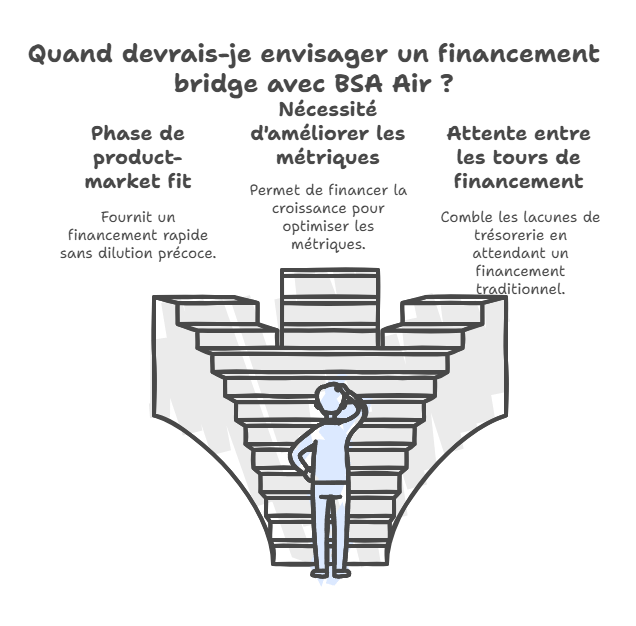
Four situations come up again and again. You're still looking for product-market fit, and a traditional round would force you to defend a valuation your numbers can't support yet. Your metrics are improving and you want a few more months to go in front of VCs with stronger figures. Your cash is running out before a round in progress closes, because it's taking longer than planned. The market is tightening, investors are getting more selective, and securing funds quickly matters more than optimizing terms.
Strategic advantages of the BSA Air in uncertain times
A BSA Air gets you the money at signing: the investor wires the funds to the company's account as soon as they subscribe to the warrants, with no need to wait for a round to close.
You postpone the valuation discussion, which often stalls a priced equity round. In a shifting market, you avoid locking in a number you might regret six months later.
A BSA Air can also increase your borrowing capacity. Investor money on the balance sheet makes it easier to secure an additional bank loan, since banks look at what shareholders have put in before they lend.
You pay no interest on the funds received, unlike a loan or a convertible bond. Every euro goes into growing the business.
In return, the investor gets a discount when the warrants convert into shares. Across the contracts SeedLegals analyzed, two thirds of discounts fall between 10 and 20%, a quarter of contracts have no discount at all, and discounts of 25 to 50% are rare.
Comparing the BSA Air with other bridge financing options
Three other mechanisms are used for interim financing: convertible bonds, bank loans and shareholder current account advances.
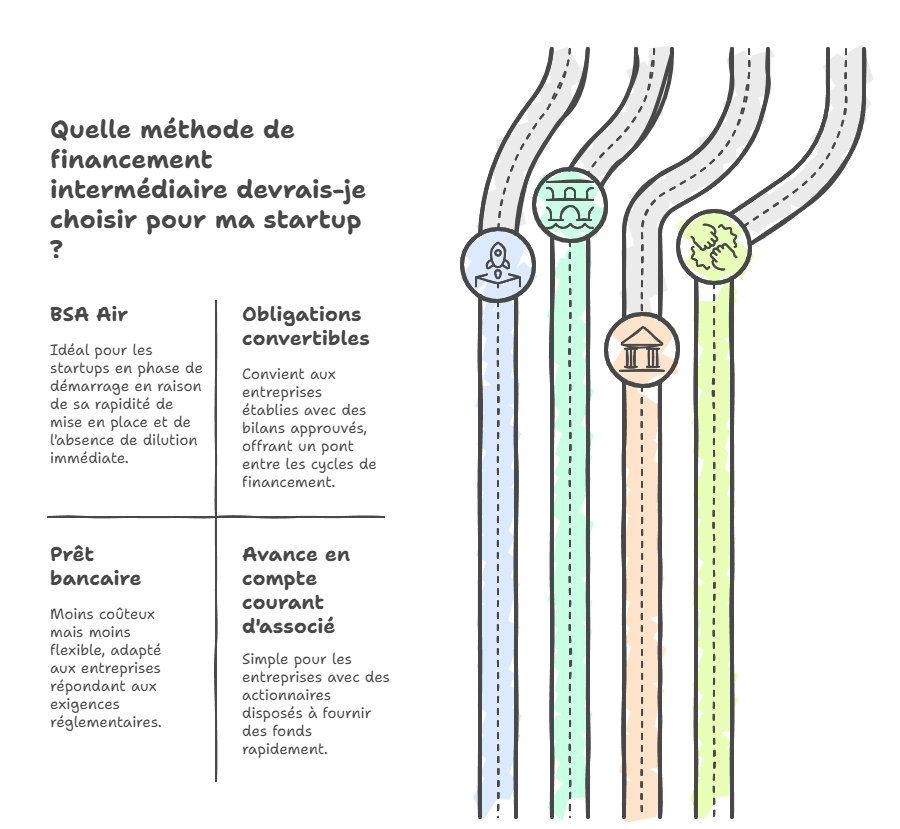
BSA Air or convertible bonds
A BSA Air is an equity instrument, with no debt component. Article L.228-39 of the French Commercial Code, which requires companies without two approved balance sheets to have their assets and liabilities verified before issuing bonds, therefore does not apply to BSA Airs.
Issuing convertible bonds requires a statutory auditor, an extra cost for a young company. A BSA Air only needs a trigger event agreed between you and the investor.
In venture capital, more mature companies with two approved balance sheets tend to choose convertible bonds to bridge between two rounds.
BSA Air or a bank loan
A bank loan remains the cheaper form of capital: you give up no equity. But the bank reviews your file under its prudential rules and often turns down companies with no track record or collateral. A BSA Air relies on the conviction of a private investor willing to take a risk the bank won't.
BSA Air or a shareholder current account advance
A current account advance is simple to set up and doesn't change who controls the company. The PACTE law removed the requirement for a shareholder to hold at least 5% of the capital to make such an advance.
It does require existing shareholders willing to lend money. A BSA Air, by contrast, brings new investors onto your cap table.
Choosing the right option for your situation
The choice depends on your company's stage.
- Early-stage startup: the BSA Air, for its speed and the absence of immediate dilution.
- Company with two approved balance sheets: convertible bonds become available and reassure more institutional investors.
- Strong existing shareholder base: a current account advance, if your current shareholders can inject funds quickly.
Setting the right terms for your equity bridge
The terms of your BSA Air directly shape your future dilution and how attractive the deal looks to investors.
Setting the valuation range (Cap and Floor)
The valuation range frames how the BSA Airs will later convert into shares.
- The Cap valuation sets a ceiling on the conversion basis. If the next round's valuation is higher, the investor converts at the Cap and receives more shares. At seed stage, SeedLegals sees a Cap of €1 to 3 million in most contracts.
- The Floor valuation sets the minimum conversion basis and protects you from excessive dilution if the next round happens at a low valuation. According to the same analysis, founders most often set the Cap at twice the Floor.
Base both figures on tangible evidence: your stage, commercial traction and progress toward product-market fit. Our guide to negotiating the discount, cap and valuation gives benchmarks by stage.
Setting a balanced discount rate
The discount rewards the BSA Air investor for the risk they take. Across the contracts SeedLegals analyzed, two thirds of founders agree to a 10 to 20% discount.
The discount tracks the company's stage: the closer the company gets to a Series A or B, the higher the discount tends to be. Founders who set a 10 to 20% discount most often pair it with a Cap between €2 and 3 million, again according to SeedLegals.
Defining the right trigger events
Trigger events determine when the BSA Airs convert into shares. The most common are:
- a qualifying funding round;
- an IPO;
- an acquisition or sale of the company;
- the dissolution or liquidation of the company.
Also set a long-stop date. If no round happens before that date, the BSA Airs automatically convert at the default valuation set in the contract, usually the Floor. In a market where rounds take longer to close, negotiate a later long-stop date than the one the investor first proposes.
To prevent a minor capital increase from triggering conversion, set a minimum round size as the threshold.
Write the calculation formulas using indisputable accounting figures. That way you avoid a dispute between investors and management at conversion time.
Negotiation strategies for a successful bridge
The instrument matters, and so does the negotiation: it determines how good your bridge terms turn out to be.
Position your bridge as an investment aligned with your interests
Present the BSA Air as a mechanism that aligns your interests with the investor's. The investor receives warrants that convert later, and their return depends on how the startup performs at the next round. They have every reason to help you in the meantime.
Remind them how the BSA Air works: the discount on the price per share at conversion gives them more shares for the same amount invested.
Techniques for securing favorable terms
In a market where rounds take longer, negotiate a long long-stop date. Define precisely the size of the qualifying round that triggers conversion.
On the discount, offer a rate that decreases depending on when the trigger event occurs, or one that varies with the amount invested. You attract the investor without giving away your equity cheaply.
Managing the expectations of existing and new investors
Have a lawyer or legal advisor review the contract so the terms stay clear and workable over time. Keep your investors informed throughout the process to avoid misunderstandings at conversion.
Also bear in mind that the BSA Air terms and the Commercial Code provisions protecting holders of securities giving access to capital require you to take the investor's position into account in every subsequent capital transaction, on a fully diluted basis.
This article provides general information and is no substitute for legal advice: consult your lawyer before setting up a BSA Air.
Frequently asked questions
Does a BSA Air bear interest? No. You pay no interest on the funds received, unlike a loan or a convertible bond. The investor is rewarded through the discount at conversion, which SeedLegals measures at 10 to 20% in two thirds of contracts.
What happens if no round takes place before the long-stop date? The BSA Airs automatically convert at the default valuation set in the contract, usually the Floor. Set that figure carefully: it's the one that applies in the worst-case scenario.
Do you need a statutory auditor to issue BSA Airs? No. Article L.228-39 of the Commercial Code and the statutory auditor requirement apply to bond issues. BSA Airs are equity instruments, so they fall outside that scope.
Can you sign several BSA Airs with different investors? Yes. Each investor signs their own contract, with its own discount, cap and long-stop date. At the next round, your lawyer calculates one conversion per contract. Beyond a handful of contracts, a standard priced round becomes easier for your future lead investor to read.
Preparing a bridge for your startup? swanbase supports early-stage founders for the long term, in Paris and remotely, at €0, by application. swanbase takes equity. Apply.