The business angel just emailed you their counter-proposal. Cap of €2.5M, 25% discount, 12-month deadline. You read it at 11pm and wonder whether it's fair, aggressive, or a straight-up rip-off. The short answer: a reasonable BSA Air discount in France sits between 15% and 25%, with two-thirds of deals landing in the 10-20% range (based on SeedLegals' analysis of thousands of contracts). The valuation cap runs around €1M to €3M post-money at the seed stage, and most contracts set a cap equal to twice the floor. The standard deadline is 12 to 24 months. Above 25% discount or below a €1M cap, start asking questions. This guide gives you the 2026 market benchmarks, the sentence-by-sentence negotiation scripts, and the founder deal-breaker matrix. A lawyer is still mandatory before you sign.
Quick refresher: discount, cap, floor, what they actually mean
Three parameters, three different logics. Confuse them and you get burned.
The discount is the reduction applied to the price per share of your next round. The Air investor pays less than the new entrants. It's their reward for putting cash in ahead of the official valuation.
The cap is the maximum valuation used at conversion. If your next round closes above the cap, the investor converts at the cap. It's their protection in the scenario where you knock it out of the park.
The floor is the minimum valuation used. If you raise below it, conversion happens at the floor. This is your protection.
The French Commercial Code requires a floor. The cap is optional, but nearly every contract includes one: without a cap, the investor takes on unlimited dilution risk and won't sign. For the full mechanics, see the complete BSA Air guide.
What counts as a reasonable BSA Air discount in 2026?
Here are the real numbers from the French market, not the fantasies floating around Slack forums.
SeedLegals analyzed thousands of BSA Air contracts on its platform: two-thirds of founders settle on a discount of 10% to 20%. A quarter of deals happen with no discount at all. Discounts of 25-50% exist but are rare. The bsa-air.fr site, the canonical reference (created by SB Avocats and The Family in 2013), confirms the official range: 15% to 25%.
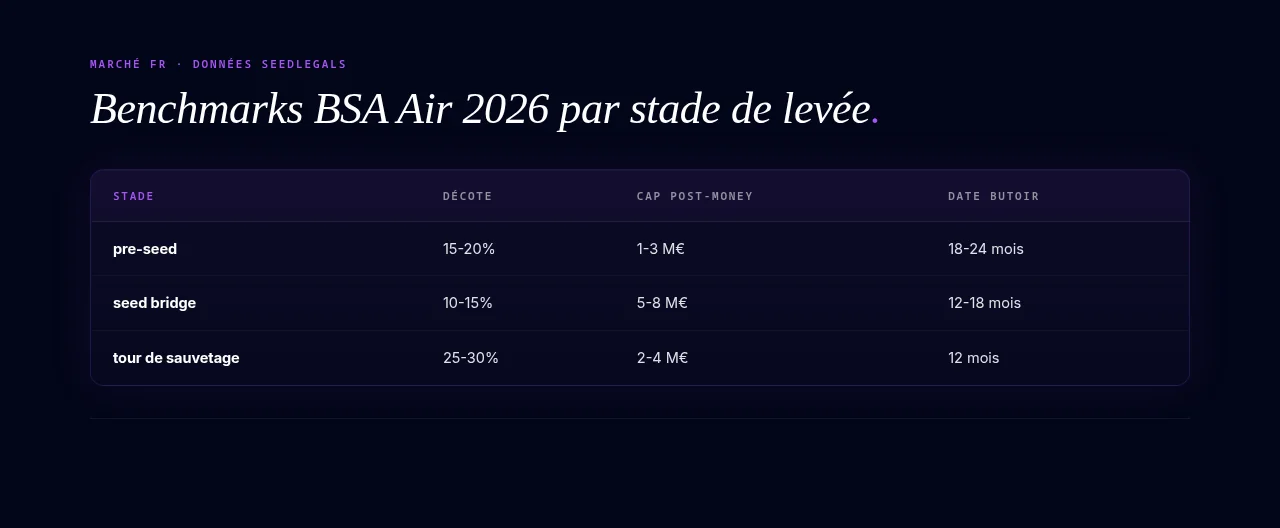
Pre-seed: 15-20% discount
You're raising €50,000 to €300,000 from business angels or friends and family. No product, no revenue, just a team. Reasonable range: 15-20%. Lower than that and the investor would rather wait for your seed. Higher than that and they're taking advantage of your weak position.
Seed bridge: 10-15% discount
First round already done, seed expected within 6 to 12 months. Conversion arrives fast, the time risk is limited, and the angel doesn't need a big reward. If someone asks for 20% on a six-month bridge, it means they don't believe you can raise afterward. Listen to that signal.
Rescue round: 25-30% discount
Short runway, uncertain valuation. The discount rises mechanically. 25-30% is defensible on the investor's side: the risk they never see their check again is real. At that point the conversation shifts from the discount to the floor: the higher the discount, the harder you need to push your floor to avoid a massive conversion on a broken valuation.
What to make of a discount above 30%
Rare. Either the startup is in critical shape and the investor is playing lender of last resort, or you're dealing with an opportunistic angel. Ask to see other term sheets before you sign. If no one else wants in, that tells you something on its own.
Valuation cap: 2026 market ranges
The cap is where the negotiation gets tougher, because it sets your maximum dilution ceiling.
The SeedLegals data gives the reference point: at the seed stage, the cap generally sits between €1M and €3M. Founders negotiating a 10-20% discount typically set a cap between €2M and €3M. For 2026, here are the ranges by stage.
Pre-seed: €1M to €3M post-money cap
Early pre-seed (team, no product): cap between €1M and €2M. With an MVP and early signals: €2.5M to €3M, or even €4M with serial founders or a hot market.
Seed bridge: €5M to €8M cap
The bridge comes after a first round and should reflect the traction you've built. If your seed targets €8-10M post-money, your bridge cap lands between €5M and €8M. The goal: conversion happens at the cap in your optimistic scenario, which aligns the angel's interest with the success of your seed.
Rescue round: €2M to €4M cap
The rescue bridge often breaks the previous valuation. An honest €3M cap beats no cap at all and an investor who never signs.
How to justify your cap
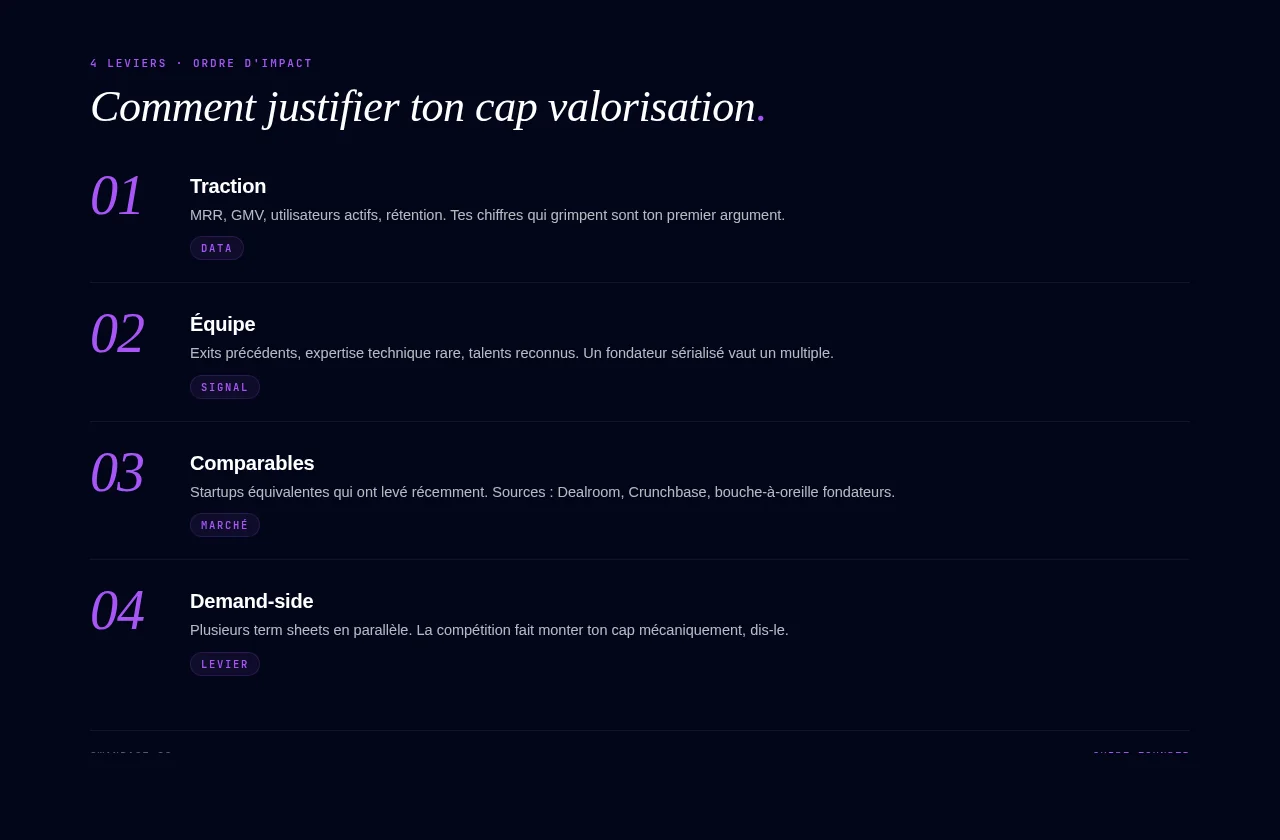
Four levers, in this order.
- Traction: MRR, GMV, active users, retention. Your numbers climbing are your first argument.
- Team: prior exits, rare technical expertise, recognized talent. A serial founder is worth a multiple.
- Comparables: similar startups that raised recently (Dealroom, Crunchbase, founder word of mouth).
- Demand side: if you have several term sheets, say so. Competition raises your cap mechanically.
Valuation date: the clause people forget
You focus on the discount and the cap, and you forget the deadline. Yet it's the parameter that decides what happens if you don't raise in time.
Why it exists
The deadline (longstop date) protects the investor. Without it, your BSA Air could float for years without converting. It forces automatic conversion at the floor if nothing has happened.
Standard window: 12-24 months
The bsa-air.fr site says it plainly: the windows are generally set between 12 and 24 months. Confirmed by Judith Benoudiz (Kanopée Avocats) in Village de la Justice.
Negotiate 24 months if you can. 12 months puts you under pressure: if your seed slips, the forced conversion at the floor lands on you. 18 months is a common compromise.
What happens if you don't raise by the deadline
Three scenarios cover most contracts. Automatic conversion at the floor (maximum dilution, priced in for you). Amicable renegotiation, where the investor may agree to extend by 6 to 12 months if you show them an investor pipeline. Conversion at a valuation negotiated at the trigger moment, if the contract provides for it.
Negotiation scripts: how to say what you want
You have the numbers. Now you have to say them without breaking the relationship.
"The angel proposes a €2M cap, I want €3.5M"
"I hear your proposal at €2M. That's the low end of the market for our stage. On my side, three things justify a higher cap: [quantified traction], [team], [recent comparables]. I'm proposing €3.5M. What would make you say yes at that level?"
The open question at the end turns a head-on clash into a technical discussion. The angel doesn't lose face by conceding, they accept the justifications.
"The angel wants a 25% discount, I want 15%"
"25% is the top of the range. The SeedLegals data shows two-thirds of deals sit between 10 and 20%. My case: [expected conversion speed, quality of the next round, other angels already committed at 15%]. I'm proposing 15%."
Referencing public data lifts you out of "haggling at the bazaar" and into "market discussion." The angel can't tell you you're making it up.
"Valuation date at 12 months, I want 24 months"
"12 months is short for a clean seed. It forces me to start running by month 4. At 24 months I work properly, which improves both our odds of a conversion at the cap rather than the floor."
You frame the extension as an alignment of interests. And it genuinely is one.
"The angel insists on a high floor"
"A floor at [X] million is the same as fixing a valuation today. That's exactly what we wanted to avoid by choosing the BSA Air. If you want a fixed price, we switch to straight equity. If we keep the BSA Air, the floor stays low."
The argument that works: remind the investor they chose the BSA Air precisely so the valuation wouldn't be locked in.
The founder BSA Air deal-breaker matrix
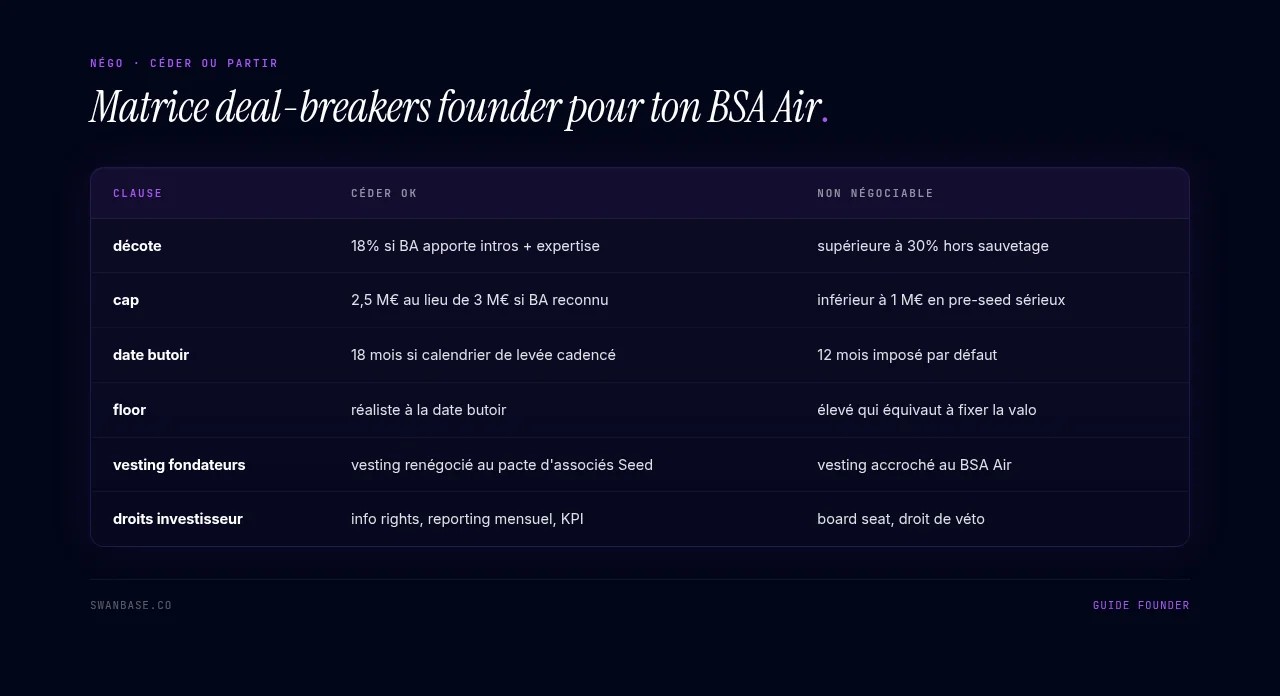
Deal-breakers (you don't sign)
- Cap below €1M at pre-seed for a company with a serious team: you burn yourself for the following rounds.
- Discount above 30% outside an explicit rescue situation: a sign of opportunism.
- A high floor that amounts to fixing the valuation: you lose the whole point of the BSA Air, so you might as well do an equity round.
- Founder vesting tied to the BSA Air: unacceptable. Vesting is negotiated in the shareholders' agreement at the time of the seed.
- Governance rights (board seat, veto right) granted to the Air investor: market practice, as Judith Benoudiz points out, is zero governance rights for BSA Air investors.
Fine to concede
- 18% discount instead of 15% if the angel brings real support (intros, expertise).
- A slightly low cap (€2.5M instead of €3M) if the angel is a recognized player who lends credibility to your next round.
- An 18-month deadline if you already have a paced fundraising calendar.
- A stronger information clause (monthly reporting, KPI access). Not a governance right, so fine.
When to prefer an equity round over a BSA Air
The BSA Air is a fast tool. Past a certain threshold, it becomes a bad one.
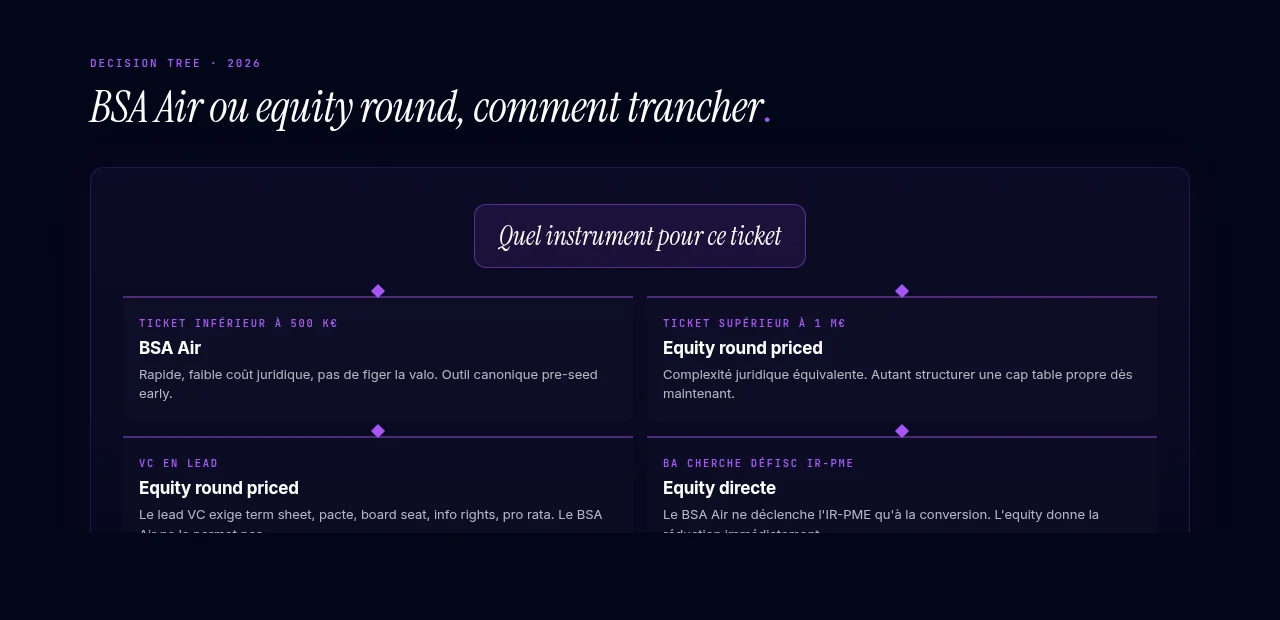
If you're raising more than €500,000 to €1M, equity becomes relevant
Above that check size, the complexity of a BSA Air (multiple contracts, different cap/floor/discount for each) exceeds that of a clean equity SPA. You pay a lawyer either way. You might as well raise cleanly and structure the cap table now.
If a VC leads the round, equity is often required
Institutional VCs leading a round want an equity term sheet, a shareholders' agreement, and governance rights (board seat, info rights, pro rata). The BSA Air doesn't allow for that. If your lead is a VC, prepare a priced round, even if you host a few angels on a BSA Air in parallel.
Legal cost compared
For a BSA Air with a single investor, the legal cost stays limited. For 10 angels at €50,000 each, you multiply contracts, subscription forms, and conversions. A clean equity round becomes competitive.
The tax trap people often forget
The BSA Air doesn't grant the IR-PME income tax reduction at subscription. It only kicks in at conversion, under strict conditions (a cash capital increase by set-off of a claim, qualifying company status, a five-year holding commitment starting from conversion). For an angel chasing 2026 tax optimization (18% for a standard SME up to 40% for a JEII), direct equity is mechanically more advantageous: the reduction triggers immediately. Worth knowing when an angel tells you "I want a BSA Air for the tax break." They're wrong.
For term sheet negotiation in an equity round, see VC term sheets in France and the clauses to negotiate.
Common founder BSA Air negotiation mistakes
Accepting a cap that's too low to move fast
Short runway, an angel offering a BSA Air in 48 hours at a €1.5M cap. You sign. Three months later, a seed at €8M post-money. The angel converts at the cap, gets far more shares than expected, and dilution explodes. The cap protects the investor, not you. Always model the optimistic scenario before signing.
Not checking the valuation date
You sign a 12-month BSA Air expecting to raise your seed in 6. The raise takes 14 months. Forced conversion at the floor. A healthy company, a founder diluted for nothing. Negotiate 18-24 months minimum.
Confusing discount and cap in your cap table projection
The angel takes "whichever is better" between the discount on the actual valuation and conversion at the cap. Not one or the other as you please. Model both and take the worse one for yourself.
Accepting a high floor in a bear market
In 2024-2025, several founders signed BSA Airs with a floor at the valuation of their last round, without realizing that in a contracting market they were committing to convert above the new reality. Frustration on both sides at conversion. The floor should reflect a realistic valuation at the deadline, not an emotional attachment to the last round.
To dig into the cap table impact, read BSA Air and its impact on the cap table. For liquidation scenarios, BSA Air liquidation and dissolution.
FAQ
Can you renegotiate the terms of a signed BSA Air after the fact?
Yes, through an amendment signed between the company and the investor. Renegotiation most often concerns the deadline (extension) or the floor (downward adjustment in a deteriorated context). Renegotiating the discount or the cap is much rarer: it requires the investor's agreement to give up rights they've already acquired.
Are multiple BSA Airs with different terms workable?
Workable but heavy. Each contract has its own discount, its own cap, its own floor, its own deadline. At the seed, your lawyer calculates as many different conversions as there are contracts. Past 5 or 6 BSA Airs, a clean equity round is simpler and more readable for your future lead VC.
Do you need a lawyer to negotiate a BSA Air?
Yes, on both sides. On the company side, the lawyer drafts the contract, the president's report, and the subscription forms, and checks compliance with the Commercial Code (mandatory floor). On the investor side, the lawyer flags clauses that depart from standard practice. Platforms like SeedLegals speed things up and cut costs, but they don't replace a lawyer's review on a company's first BSA Airs.
How much does setting up a BSA Air legally cost in 2026?
The cost varies by channel: automated platform (entry level), specialized lawyer (mid-range), traditional fundraising firm (high end). Get three quotes. Prices range from one to five on the French market for the same work. The setup timeline is consistent across the board: 1 to 2 weeks from decision to signature.