Your business angel just wired €50,000 through a BSA Air. Three months later, you open your cap table to prepare your Seed round. How many shares does the angel get at conversion, and how much does that cost you in percentage terms? The impact of a BSA Air is measured at conversion, when you close your qualified financing round. The formula: Shares received = Investment / min(round price × (1 − discount) ; cap / total shares). Example: a solo founder (1M shares) raises €200K through a BSA Air (€8M cap, 20% discount), then closes a Seed at a €10M pre-money. The angel receives 25,000 shares, or 2.44% post-conversion before the VC round. This guide walks you through the full worked example, the multi-round BSA Air trap, and a checklist for building it all into your spreadsheet. Talk to a lawyer before signing for the legal fine print. To build the underlying cap table (columns, fully diluted view, example from incorporation to Seed), see our cap table guide.
Quick refresher: what a BSA Air is, in 30 seconds
A BSA Air (Bon de Souscription d'Actions Accord d'Investissement Rapide) gives the investor the right to subscribe for shares on terms agreed upfront, at a price calculated at conversion. The angel puts cash in now without locking in a valuation. That valuation gets set later, at the next qualified financing round (typically the Seed).
For the full mechanics, tax treatment, and background, head to the complete BSA Air guide. Here, we focus on the cap table impact.
How BSA Air dilution is calculated, in plain English
The formula, in one line
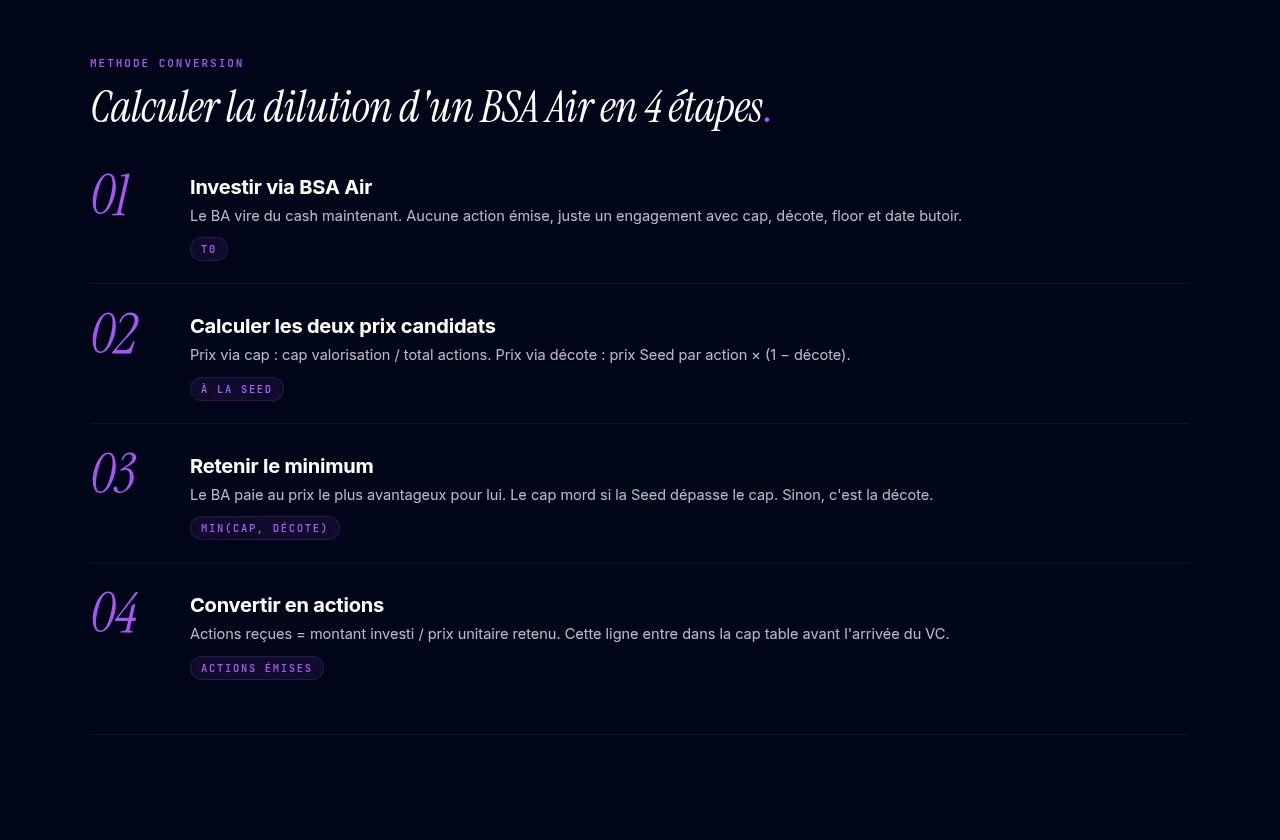
Number of shares received = Investment / conversion price per share
The conversion price per share is whichever is more favorable to the BSA Air investor. There are two candidates:
- Discount price: price per share of the qualified round × (1 − discount)
- Cap price: valuation cap / total number of shares at conversion
The angel gets the lower of the two, without stacking them, and never below the floor if the contract includes one. That's the standard convention, as noted by SWIM Legal and covered in the complete BSA Air guide. Some contracts apply the discount on top of the cap, so reread the wording before you run the numbers.
When the cap kicks in, when the discount kicks in
If your Seed closes at a valuation above the cap, the cap applies: the angel pays for their shares based on the cap. If your Seed closes below the cap, the discount applies. At the break-even point (Seed valuation = cap / (1 − discount)), both prices are the same.
Quick example: €200K, €8M cap, 20% discount, Seed at €10M
Solo founder, 1,000,000 shares. You raise €200,000 through a BSA Air (€8M cap, 20% discount). Twelve months later, you close a Seed at a €10M pre-money.
- Cap price: 8,000,000 / 1,000,000 = €8/share
- Discount price: (10,000,000 / 1,000,000) × 0.80 = €8/share
- The two prices match (a textbook case). Price used: €8.
- Angel shares: 200,000 / 8 = 25,000 shares
Post-conversion, the angel holds 25,000 / 1,025,000 = 2.44%, before the VC round. The VC who invests next dilutes you further, on that same base.
Full worked example: from solo founder to Seed round
Here's an example broken into four steps, showing what happens at each move.
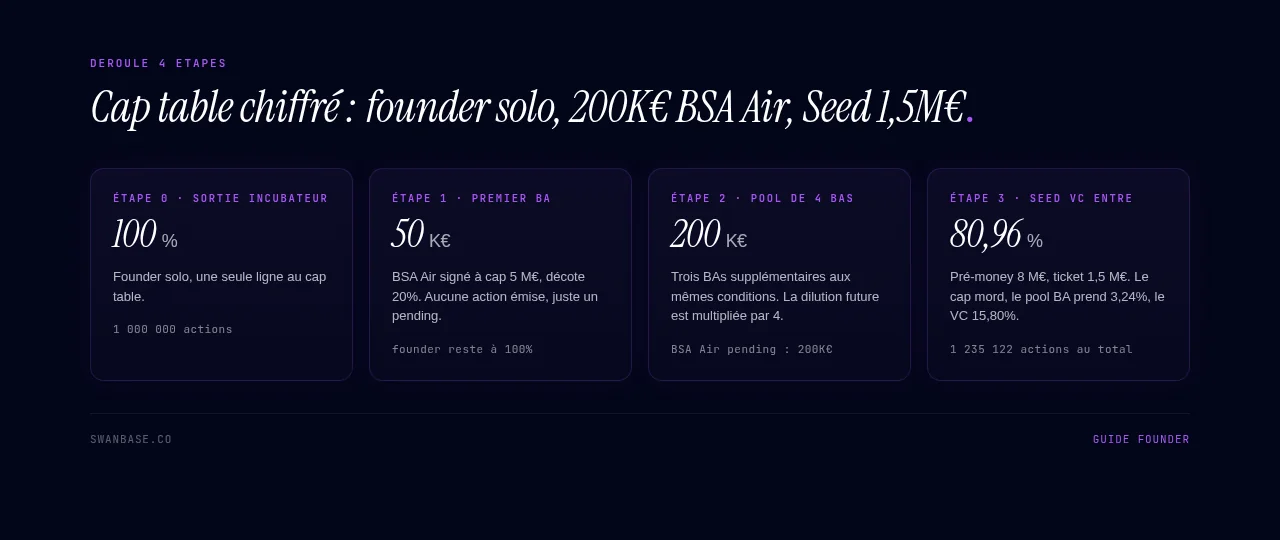
Step 0: starting cap table
You've just left an incubator and haven't brought anyone on board yet. Your cap table fits on a single line.
| Shareholder | Shares | % |
|---|---|---|
| Founder | 1,000,000 | 100% |
| Total | 1,000,000 | 100% |
Step 1: a first angel puts in €50K through a BSA Air
€5M cap, 20% discount, 18-month long-stop date. The angel wires €50,000. They don't get shares right away: they get a BSA Air, which will convert at the Seed.
On the cap table, nothing changes in issued shares. At the bottom of the table, you add a "Pending BSA Air" line to record the commitment.
| Shareholder | Shares | % | Pending BSA Air |
|---|---|---|---|
| Founder | 1,000,000 | 100% | n/a |
| BA 1 | n/a | n/a | €50,000 @ €5M cap, 20% discount |
On paper, you still own 100%. In reality, you've already diluted part of your future cap table.
Step 2: three more angels in the same round
You close another €150,000 on the same terms. Total BSA Air outstanding: €200,000.
| Shareholder | Shares | % | Pending BSA Air |
|---|---|---|---|
| Founder | 1,000,000 | 100% | n/a |
| BA pool (4 people) | n/a | n/a | €200,000 @ €5M cap, 20% discount |
Still 100% on paper. Your future dilution has quadrupled.
Step 3: Seed at €8M pre-money, €1.5M ticket
Twelve months later, a VC comes in. Post-money: €9.5M.
First, convert the BSA Air:
- Cap price: 5,000,000 / 1,000,000 = €5/share
- Discount price: (8,000,000 / 1,000,000) × 0.80 = €6.40/share
- Min = €5/share. The cap kicks in.
- Shares received by the BA pool: 200,000 / 5 = 40,000 shares
Next, calculate the VC price on a fully diluted basis (the pre-money includes the converted BSA Air):
- VC price: 8,000,000 / (1,000,000 + 40,000) = €7.69/share
- VC shares: 1,500,000 / 7.69 = 195,122 shares
Final cap table, line by line
| Shareholder | Shares | Final % |
|---|---|---|
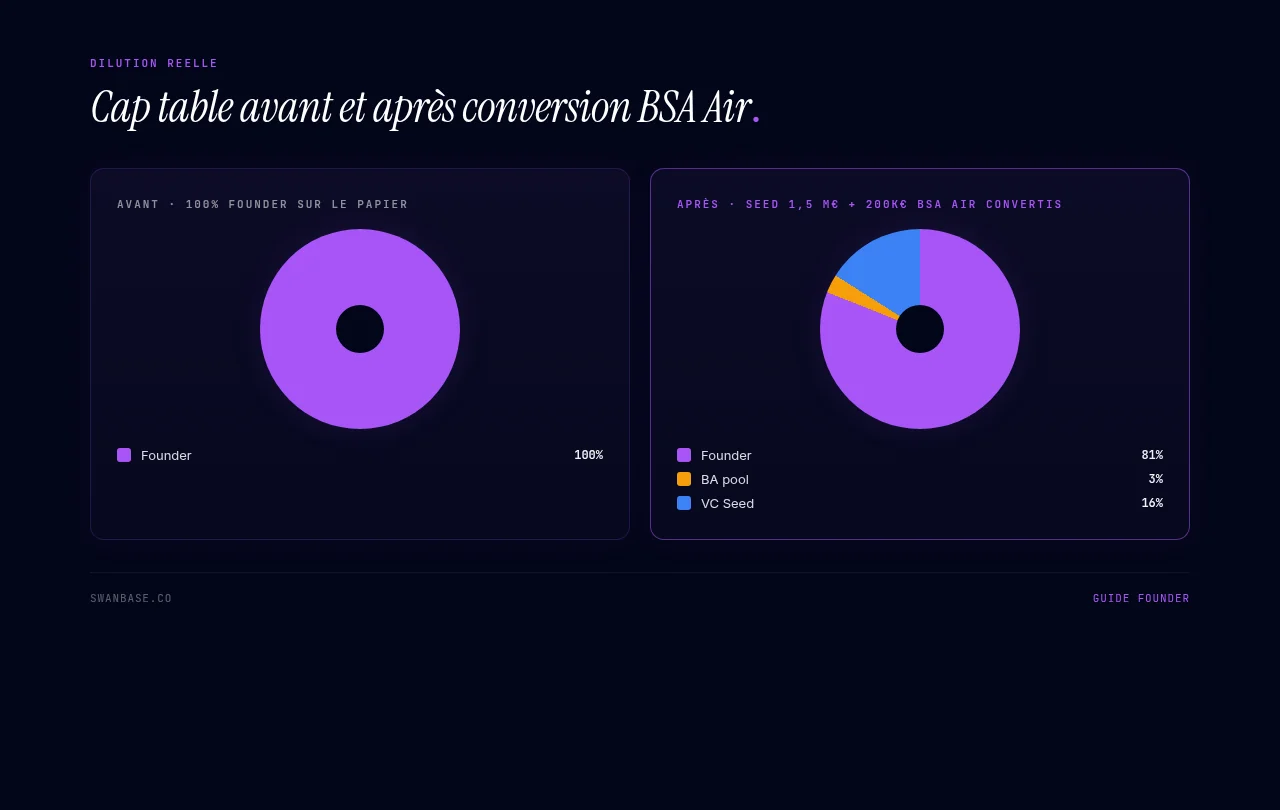
| Founder | 1,000,000 | 80.96% |
| BA pool (converted BSA Air) | 40,000 | 3.24% |
| Seed VC | 195,122 | 15.80% |
| Total | 1,235,122 | 100% |
You went from 100% to 80.96%. The BSA Air cost you roughly 3.2 extra points of dilution compared to a scenario without it (84.2%). What you got in return: €200K twelve months earlier, without having to negotiate a valuation back when it would have been lower.
The multi-round BSA Air trap
Why 3 or 4 BSA Airs on different terms wreck your cap table
First angel in June at a €5M cap. Second in September at a €7M cap (you landed a customer). Third in December at an €8M cap (revenue is starting to come in). Three sets of terms, three conversion prices, three calculations to run side by side when the Seed closes.
A VC who sees this will react in one of two ways: either they agree to model the whole thing (rare with a junior investor), or they ask you to harmonize the terms, or even buy back the earlier BSA Airs before they come in, with all the legal fees that implies.
A concrete case: BSA Air 1 at a €5M cap, BSA Air 2 at a €7M cap
Two BSA Airs: €80K at a €5M cap, €120K at a €7M cap. When your Seed closes at a €10M pre-money, BSA Air 1 converts at the €5M cap (€5 price) and BSA Air 2 at the €7M cap (€7 price). Two investors pay different prices for the same underlying share. That's legally defensible, as long as your spreadsheet tracks the two lines separately.
The simple fix: harmonize or group
If you're bringing in several angels over several months, set a single subscription window (one BSA Air round with a deadline) on the same terms. You negotiate once, and your next VC won't wince.
Discount, cap and floor: a quick primer on the math
Discount (typically 15-25%)
The reduction applied to the price per share of the next round. The reference site bsa-air.fr gives a range of 15 to 25%, the same one used in the complete guide.
Valuation cap (€1M to €3M at pre-seed, €5M to €8M for a bridge)
The maximum valuation used at conversion. SeedLegals sees €1M to €3M post-money for French pre-seed deals. For a bridge ahead of a Seed, expect €5M to €8M depending on your traction.
Floor (often set low)
The floor is an optional clause that many contracts leave out, and it protects you. It sets the minimum valuation used as the basis for conversion: if you end up raising in a hurry at a very low valuation, the number of shares issued to the angel stays capped, and so does your dilution. According to SeedLegals, the cap is often set at twice the floor.
For line-by-line negotiation on these three parameters, see discount, cap, valuation: how to negotiate in 2026.
How to add a BSA Air to your cap table spreadsheet
Before conversion: a "Pending BSA Air" line
Create a "Pending BSA Air" tab. For each signed BSA Air, record: amount, cap, discount, floor, long-stop date, and estimated conversion date. At the bottom, estimate the number of converted shares (optimistic and pessimistic scenarios). The VC should see this line upfront instead of stumbling on it during due diligence.
After conversion: issued shares and new percentages
When the Seed is signed, you convert. The pending line disappears, and a line of ordinary shares appears in each angel's name. Recalculate every percentage in the table (founder, ESOP, BSA Air, VC).
Recommended tools
Three options depending on your stage:
- Carta (carta.com): the US VC standard. Expensive, but it's what VCs ask for at Series A.
- SeedLegals cap table: built into their BSA Air platform, free if you sign with them.
- Google Sheet template: Eldorado publishes a free downloadable template, which is enough at pre-seed/seed.
4 BSA Air cap table mistakes to avoid
1. A cap that's too low for your plan
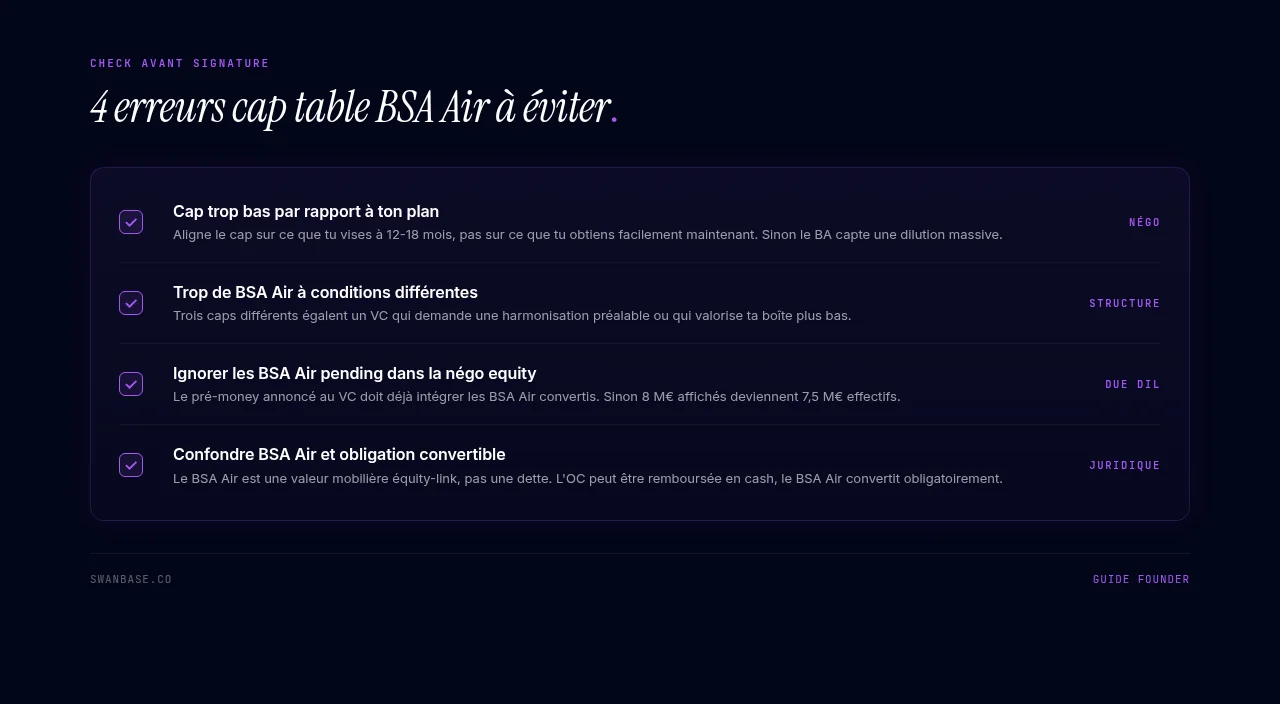
If you sign at a €3M cap and your Seed closes at a €10M pre-money, the angel converts at the cap and captures a massive chunk of dilution. Set your cap based on where you expect to be in 12 to 18 months, rather than on what you can get "easily" today.
2. Too many BSA Airs on different terms
See the multi-round trap above. Three BSA Airs at three different caps means a VC who asks you to harmonize first, or who values your company lower.
3. Ignoring "pending" BSA Airs when negotiating your equity round
The pre-money you present to the VC must already factor in the converted BSA Airs. Otherwise, you realize too late that the €8M pre-money you thought you were worth is really €7.5M in effective terms for you.
4. Confusing a BSA Air with a convertible bond
A BSA Air is a security that gives access to equity. A convertible bond (OC, obligation convertible) is debt: it can be repaid in cash if you don't raise, whereas a BSA Air must convert at the qualified round. Check what your lawyer puts in the contract.
What about conversion if the round falls through or the company is liquidated?
If you don't raise before the long-stop date, or if the company enters insolvency proceedings, BSA Airs follow a different set of rules. We cover this in a dedicated guide: BSA Air in case of liquidation or dissolution.
FAQ
Does a BSA Air dilute you immediately or only at conversion?
Only at conversion. Until the BSA Air converts, no shares are issued and your ownership percentage stays the same. In practice, any serious VC models the future dilution during due diligence: economically, you're already diluted, even if legally nothing has been issued.
How many BSA Airs can a cap table have before an equity round?
There's no set limit. In practice, the higher your cumulative BSA Air dilution before your first Seed, the more likely the VC is to demand a renegotiation before coming in.
How should you present a BSA Air to a VC?
Show your fully diluted cap table with the BSA Airs already converted under a "Seed valuation = cap" scenario. The VC can clearly see the BSA Air angels' post-conversion stake. That's more honest than a 100% founder cap table that hides €200K in commitments.
Do you need to record a BSA Air in your accounts?
Yes. A BSA Air is a security recorded in the share transfer register. Tax treatment (IR-PME in particular) only applies at conversion, subject to conditions, and not when the BSA Air itself is subscribed. Your accountant and your lawyer need to be aligned before you sign.