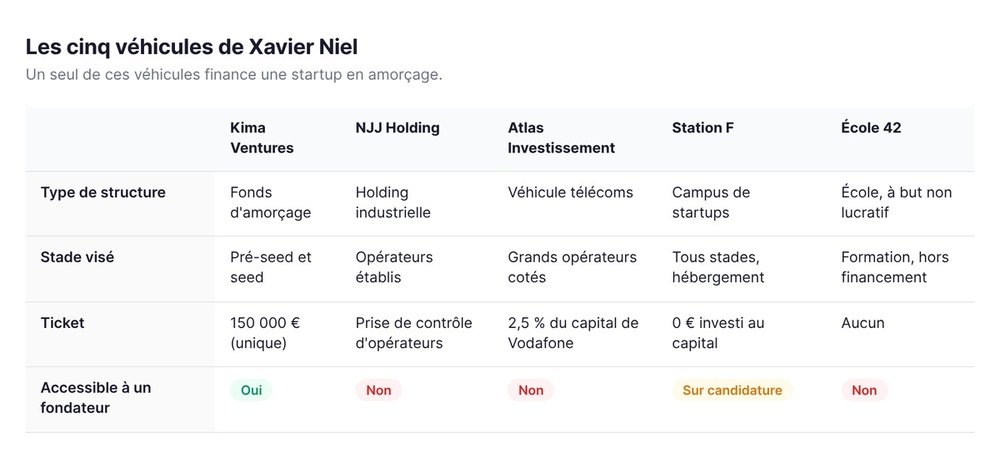
Xavier Niel invests through four investment vehicles. Kima Ventures backs startups, writing single €150,000 tickets into 100 new deals a year, according to the fund's homepage. NJJ, his personal holding company, buys telecom operators and takes strategic stakes. Atlas Investissement and Vega hold his positions in listed operators, including Vodafone since July 2026. Station F and École 42 round out the picture, though neither takes equity in startups.
For a pre-seed or seed startup, Kima Ventures is the only way in. This guide covers each vehicle's ticket size, target stage and decision-makers, then lists Xavier Niel's latest investments in 2026. To pitch Kima, jump straight to How to approach Xavier Niel's funds.
Which funds does Xavier Niel invest through?
The press files all of these vehicles under Xavier Niel's name. Yet each one has its own team, its own ticket size and its own point of entry. Cheques range from €150,000 at Kima to several billion euros at Vega. Send the same email to all of them and you'll waste your time on most.
The six vehicles at a glance
Kima Ventures is the seed fund, and the only vehicle that invests in early-stage startups. If you're building a startup, this is the one that matters to you.
NJJ (NJJ Holding, NJJ Capital) is Xavier Niel's personal holding company. It controls telecom operators in Europe and Latin America, and takes minority stakes in strategic deals, such as TikTok in the United States or Exaion in France.
Atlas Investissement holds stakes in listed operators. Together with related parties, it owns 46.7% of Millicom, the Latin American operator behind the Tigo brand, according to TeleGeography. It also acquired 2.5% of Vodafone Group in 2022.
Vega, set up in July 2026 and owned by Xavier Niel's family group, holds the 16.2% of Vodafone bought from the Emirati operator e&.
Station F is a campus. Xavier Niel funded it with €250 million of his own money, and it opened on 29 June 2017. It hosts around 1,000 startups across 34,000 square metres and takes no equity in any of them.
École 42 and the related philanthropic commitments sit inside a non-profit structure. You won't find any funding for your startup there.
Where the money comes from: Iliad, Free and the family holding structure
The fortune is industrial in origin: Free, and later the Iliad group, feed every one of these vehicles. The practical consequence for you is that Kima invests Xavier Niel's own money and depends on no fundraising cycle with institutional LPs. A traditional fund raises every three or four years, deploys on a schedule, then reports back to its investors. Kima operates like an entrepreneur's family office, which explains its decision speed and the absence of any seasonality.
You can pitch Kima in August just as well as in December.
Stages and sectors outside the scope
Xavier Niel doesn't lead Series A rounds through Kima. Kima writes a single ticket sized at €150,000, which positions it at pre-seed and seed, as a minority participant in a round.
NJJ, Atlas and Vega invest hundreds of millions or billions of euros in established operators. None of them funds seed-stage startups.
Station F takes no stake in the startups it hosts. Partners run some of the campus programmes and invest on their own account.
Xavier Niel's latest investments in 2026
Since January 2026, Xavier Niel has closed five deals, all outside Kima:
| Date | Deal | Vehicle | Amount | Source |
|---|---|---|---|---|
| 10 July 2026 | Purchase of the 16.2% of Vodafone held by e&. Xavier Niel becomes the group's largest shareholder. | Vega | £4.4 billion, or €5.1 billion | France 24 |
| 29 June 2026 | Stake in Millicom (Tigo) raised to 46.7% | Atlas Investissement | undisclosed | TeleGeography |
| 20 February 2026 | 10% stake in Mara France, which is acquiring Exaion, an EDF subsidiary | NJJ | undisclosed | Le Monde |
| 10 February 2026 | Acquisition of Telefónica Chile, 51% alongside Millicom (49%) | NJJ | $1.215 billion | Reuters |
| 22 January 2026 | Minority stake in TikTok USDS, the joint venture that runs TikTok in the United States | NJJ Capital | undisclosed | TikTok |
The Vodafone share purchase is still awaiting regulatory approval, according to BeBeez. At Exaion, Xavier Niel sits on the board alongside Fred Thiel, Mara's CEO.
On the startup side, Kima took part in 45 funding rounds in France in 2025, up from 39 in 2024, according to the JDN's count. Kima announces every investment on its LinkedIn page, so that's the page to watch if you want to track Xavier Niel's startup investments.
Kima Ventures, the early-stage vehicle
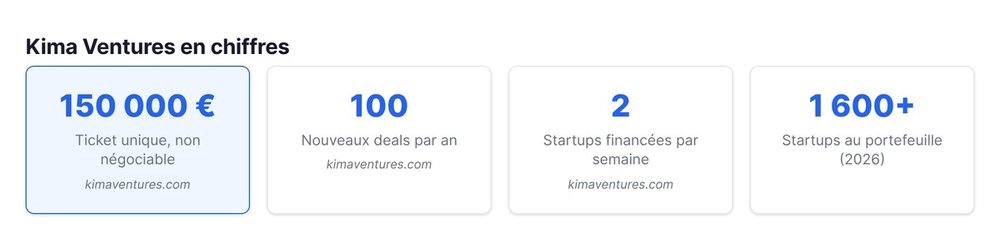
Kima Ventures describes itself as the most active business angel in the world, backing two startups a week. Our profile of Kima Ventures covers its history, team and portfolio in detail.
Ticket size, stage and deal pace
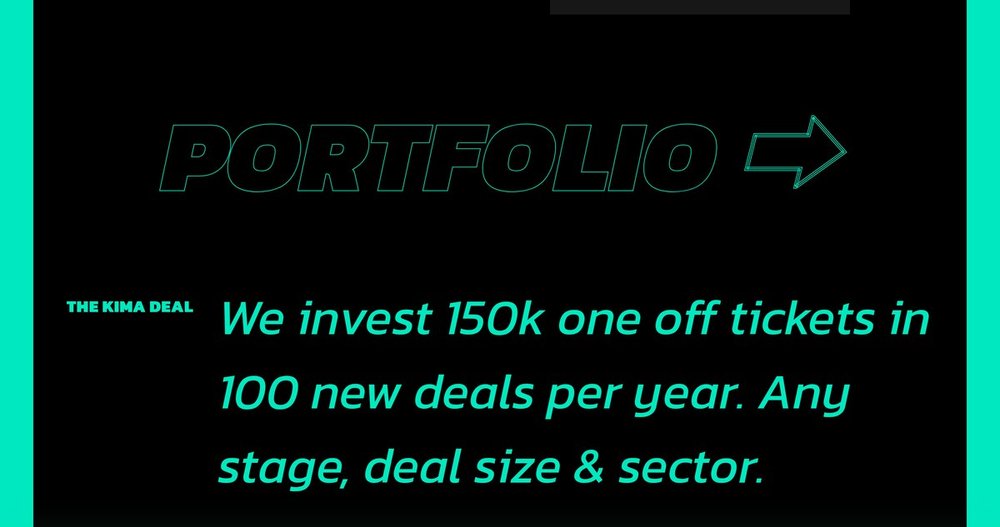
Kima writes single €150,000 tickets into 100 new deals a year, at any stage, whatever the round size or sector.
The ticket is fixed: you get a yes or a no on a set cheque, with no negotiation over the amount. Be ready for one question: does €150,000 make sense in your round?
At a hundred deals a year, roughly two per working week, Kima listed 984 portfolio companies on its website as of September 2026.
Kima has no sector thesis. The fund states it in black and white: "any stage, deal size & sector". You don't have to squeeze your project into a vertical thesis.
Who makes the day-to-day decisions
The Kima Ventures team reads your deck, led by Jean de La Rochebrochard, managing partner since 2015. The team sources deals, runs the meetings and picks the investments. When it wants to invest, it sends a green light to Xavier Niel, who signs off, according to Jean de La Rochebrochard.
If you spend three weeks hunting for an intro to Xavier Niel, you've optimised the wrong path: he approves deals the team has already chosen. Aim for the team. Our profile of Jean de La Rochebrochard details what he looks for in a meeting.
Follow-on policy
Kima talks about "one off tickets": the fund comes in once, at that amount, and doesn't reinvest in the next round. No official fund page describes a follow-on policy beyond that phrase.
The implication for you is simple: don't build your financing plan on the assumption that Kima will follow on at Series A. Treat the €150,000 as starting capital and as a credibility signal to other investors.
How decisions are made, and what that means for your pitch
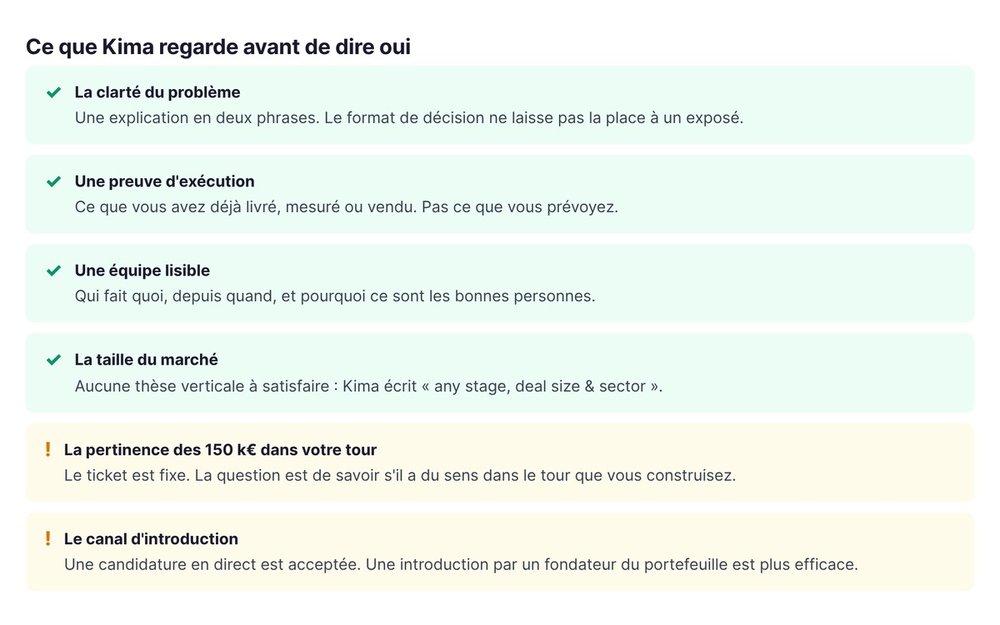
Kima receives around 250 applications a week and funds two. The team can't spend six weeks of due diligence on each one, so it judges on how clear the first few minutes are.
Prepare a two-sentence explanation of the problem, proof of traction or execution, and a team that's easy to read. Nobody will open appendix 7 of your data room at this stage.
This format has a cost: the team drops any metric you don't explain clearly, and there's no third meeting to recover it. It also has an upside: a fast answer. When cash is your constraint, a no in ten days beats a maybe dragged out over two months.
NJJ, Atlas and Vega: the telecom holdings
These three vehicles hold Xavier Niel's industrial stakes and attract most of the press coverage.
Controlled operators and listed stakes
NJJ controls or co-owns several telecom operators: Monaco Telecom, Salt in Switzerland, eir in Ireland, lifecell in Ukraine and, since February 2026, Telefónica Chile. Here Xavier Niel acts as an industrial investor: he buys, restructures and runs businesses for the long haul.
Atlas Investissement and Vega apply the same approach to listed operators, with Millicom and Vodafone. In the Vodafone announcement, Xavier Niel pointed to his stakes in Tele2 and Millicom as evidence of what he brings operationally.
Why these vehicles stay out of early-stage startups
Teams that buy a national operator don't process €150,000 cheques, and there's no path leading from a seed-stage startup to NJJ. NJJ Capital's minority stakes, such as TikTok USDS or Mara France, follow an industrial or digital-sovereignty logic.
If you run a later-stage telecom infrastructure startup with established revenue, the question might come up. In every other case, go to Kima.
Station F, École 42 and the endowment fund
This is the most visible part of the ecosystem, and the one that provides the least funding.
Station F: what the campus offers, and where funding stops
Station F is a 34,000-square-metre campus, opened on 29 June 2017, which Xavier Niel funded with €250 million of his own money. It hosts around 1,000 startups.
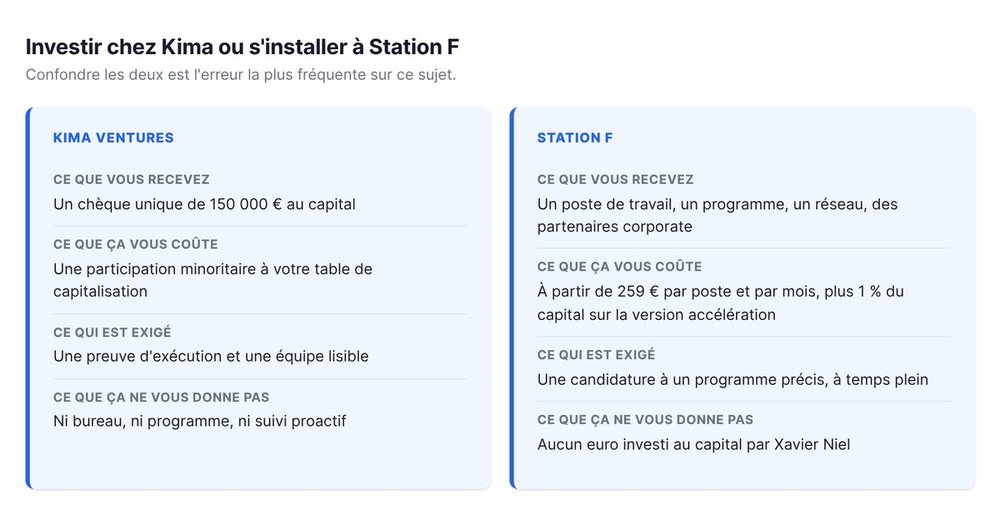
You get a desk, a support programme, a network and access to corporate partners. The flagship programme, the Founders Program, is billed per desk per month. In 2022, Station F launched an accelerator version that takes equity in return.
You won't get a cheque from Xavier Niel there: the campus hosts you and doesn't invest.
École 42 and the philanthropic model
Xavier Niel founded École 42 in 2013. The school is free, open to anyone regardless of qualifications, and asks students for nothing in return. It takes no stake in the projects that come out of it.
How Xavier Niel funds École 42
Xavier Niel funds the school from his personal wealth on a non-profit basis: around €20 million to set it up, plus an operating budget announced at €50 million over the first ten years, held in a non-profit structure. Les Échos covered the announcement back in March 2013.
No founder can apply for this money: Xavier Niel's endowment fund has no application process.
Which vehicle for which stage: the decision matrix
Pre-seed and seed
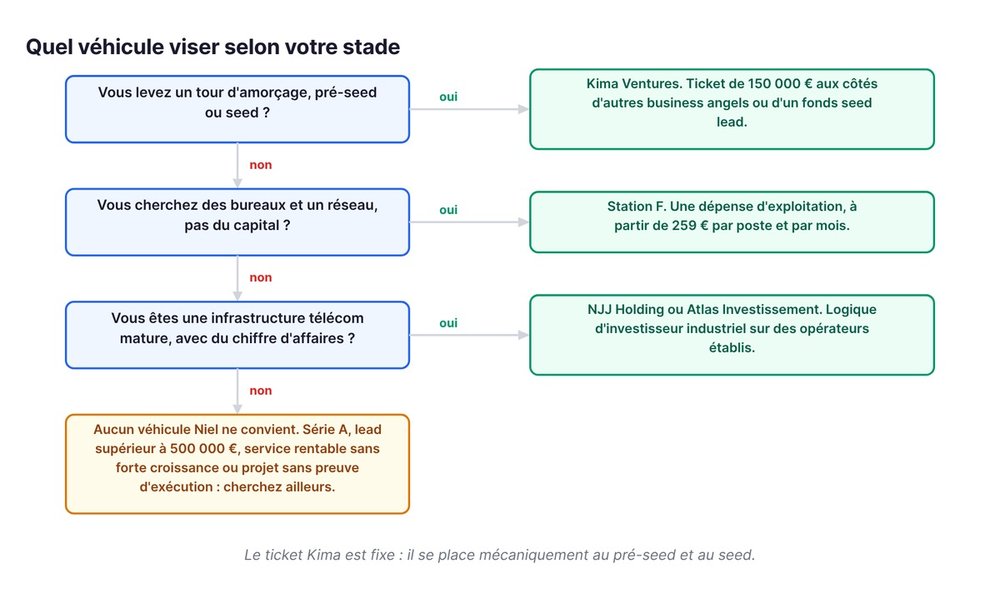
Go for Kima: it's the only case where the Niel ecosystem directly meets your need for capital. The €150,000 ticket slots into a seed round alongside other business angels or a lead seed fund.
In parallel, Station F can make sense if you're looking for an environment and a network. In that case, treat it as a monthly operating expense.
Make the two decisions at different times. Mix up the timelines and you end up applying everywhere, arriving on campus without funding, and kicking off your round from a desk you're paying for with no revenue. The order that works: proof of execution first, then capital, and the location last.
Series A and beyond
No Niel vehicle funds a Series A in a standard format. The Kima ticket is too small to matter in a multi-million round, and the industrial vehicles play in a different league. At this stage, find the funds that lead rounds of that size in France: our overview of French venture capital funds and our map of Paris-based investors list them.
Profiles outside the scope
Three profiles fall outside the scope. Projects looking for a lead investor with a ticket above €500,000. Profitable service businesses without a high-growth trajectory. Projects so early that they have no proof of execution yet: for them, an incubator or accelerator comes before an investor, as we explain in our guide to Paris incubators and accelerators.
How to approach Xavier Niel's funds
Channels for reaching Kima
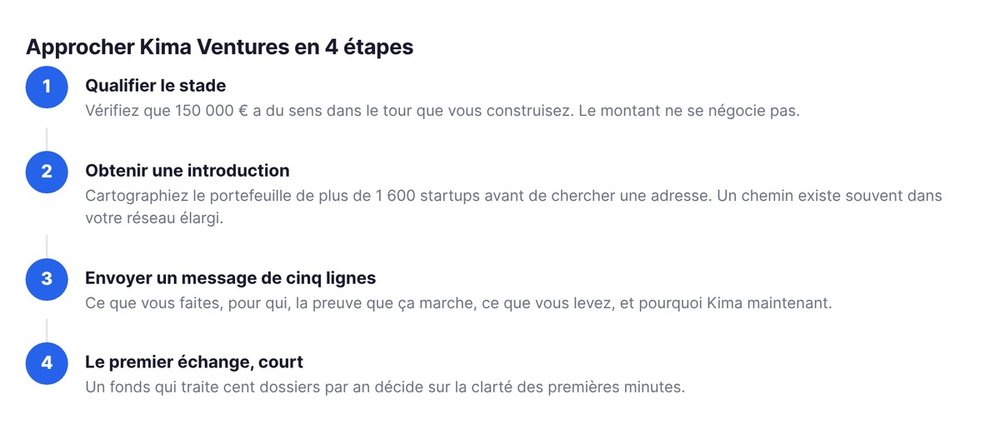
The kimaventures.com website has no application form and no contact address (checked on 23 September 2026). Three channels work: an intro from a portfolio founder, a direct email to a team member, and LinkedIn. Our Kima profile covers them in the section How to apply to Kima Ventures.
Your outreach message should fit in five lines: what you do, who it's for, proof that it works, what you're raising, and why Kima now.
For that last point, describe the round you're putting together, the investors already committed and where Kima's €150,000 fits. The team signs a hundred cheques a year and can tell immediately whether the amount makes sense.
The most costly targeting mistakes
First mistake: targeting Xavier Niel personally instead of the team that makes the decisions. Second: sending a forty-page deck to a fund that handles hundreds of applications a week. Third: asking for an amount that doesn't exist, since the ticket is fixed. Fourth: listing Station F as a funding source in your own financing plan, which signals a poor grasp of the landscape.
Raising €100k to €500k with swanbase
If your round goes beyond Kima's ticket, swanbase invests €100,000 to €500,000 at seed and Series A, in France and across Europe. Our six investment theses and the application form are on the raise funds with swanbase page.
To dig deeper, our profile of Kima Ventures breaks down the fund's model, and our article on how a venture capital fund works explains the general mechanics.
FAQ
What is Xavier Niel's investment fund?
For startups, it's Kima Ventures: €150,000 per deal, around a hundred new deals a year, at any stage and in any sector. Xavier Niel also invests through NJJ, his personal holding company, and through Atlas Investissement and Vega for his stakes in listed telecom operators.
What is Xavier Niel's latest investment?
On 10 July 2026, Vega, the vehicle of Xavier Niel's family group, signed the purchase of the 16.2% of Vodafone held by e&, for £4.4 billion. The deal makes him Vodafone's largest shareholder, subject to regulatory approval. On the startup side, Kima Ventures announces two new investments a week.
Does Xavier Niel have a family office?
Yes. TikTok describes NJJ Capital as "the family office of Xavier Niel" in the TikTok USDS press release. Kima Ventures also operates like a family office: the fund invests only Xavier Niel's money, with no outside LPs.
What is Kima Ventures' average ticket size?
Kima Ventures writes single tickets of €150,000. The fund presents this amount as its standard, regardless of stage, round size or sector.
How many startups does Xavier Niel fund each year?
Around 100 a year through Kima Ventures, or two a week according to the fund's own communication. The portfolio page on its website listed 984 companies as of September 2026. Xavier Niel's other vehicles don't invest in seed-stage startups.
Can you contact Xavier Niel directly?
To raise money, go to the Kima Ventures team, led by Jean de La Rochebrochard since 2015. The team selects the deals and Xavier Niel approves the ones it puts forward. Emailing Xavier Niel won't shorten that process.
Does Kima Ventures take a board seat?
Kima's model rests on a single ticket and several hundred portfolio companies, which rules out a systematic presence on boards. For a €150,000 cheque in a seed round, the market norm is a minority stake with no seat.