Friday, 2 p.m., the meeting room of a Paris VC. The partner opens your deck and says: "Go ahead, I'm listening." What you think you're going through is one pitch. What you're actually going through is three different exercises: the PDF deck (read alone, in two minutes flat according to DocSend1), the spoken pitch (3 to 15 minutes in the meeting, where you carry the story), and the French Q&A (where most deals are won or lost). This guide gives you the structure of each, the timing by duration, the 10 most common trick questions with answer scripts, the follow-up playbook, and the method for choosing the right VCs to approach.
Before the pitch, choose the right VCs
A pitch isn't a lottery, it's an exercise in targeting. Before you send a single deck, ask one question: has this fund already backed a startup like yours, at the stage you're at, in the amount you're raising?
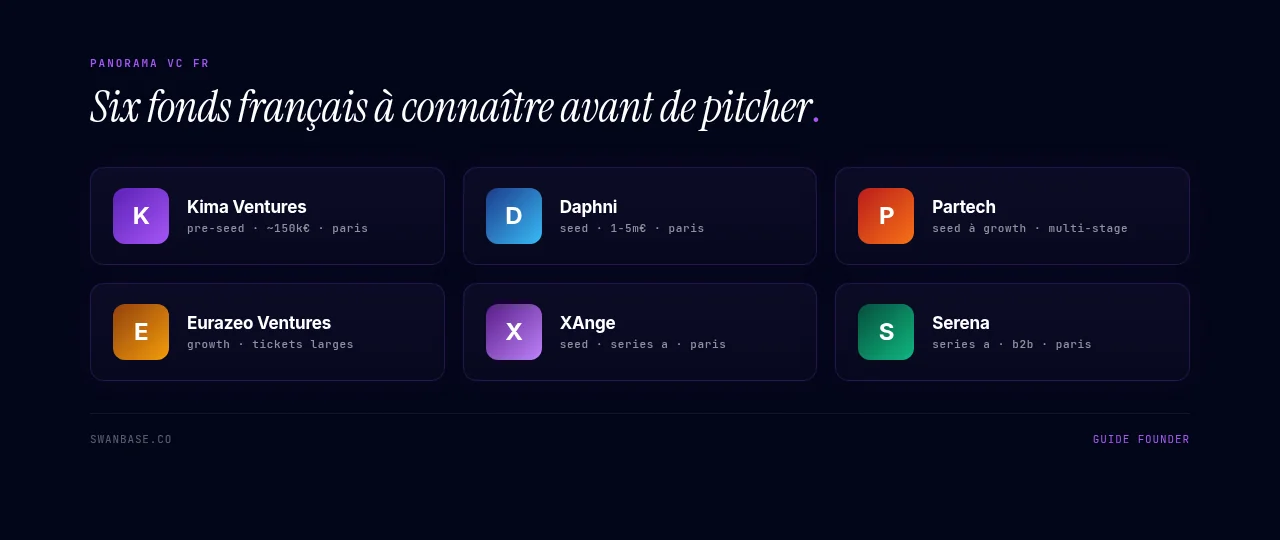
Testing the fit (stage, ticket, sector, geography)
Four filters, in order.
Stage. Pre-seed, Seed, Series A, Series B. A Series B fund doesn't do Seed. Read the portfolios: if the last ten deals are all €5M+ and you're raising €800k, wrong place.
Ticket. French market ranges: pre-seed angels and micro-funds €50k to €500k, Seed VC €500k to €2M, Series A €2M to €10M. Asking a fund whose average ticket is €300k for €1.5M doesn't work. Neither does the reverse.
Sector. A B2B SaaS fund won't back a B2C marketplace. A deeptech fund won't back a no-code app. Read the investment thesis on the website, and if it's vague, look at the last 20 deals on LinkedIn or Crunchbase.
Geography. Most French funds invest FR + Europe. A few (Sequoia, Index, Accel) look in from London or Silicon Valley, but the bar to get in is high.
Doing your homework on the VC
Before every meeting, two hours minimum:
- The fund's 10 most recent investments (who, how much, what stage).
- The partner who covers your vertical. That's the person you want, not an associate.
- The podcasts and essays the partners have published: they give away their thesis for free.
- Recent exits. No exit in 5 years means a fund at the end of its cycle, with reduced capacity to invest.
How to land the first meeting (warm intro vs cold)
The truth nobody says out loud: the best VCs don't read cold decks. They read the decks their portfolio founders or co-investors recommend. The warm intro is still the royal road.
Three ways to get an intro:
- A portfolio founder introduces you. Ask them to sanity-check your deck first.
- Another VC refers you (often when they can't invest themselves but believe in the deal).
- A senior operator in the sector (advisor, former CEO, recent exit).
Cold email works about 5% of the time, and only with a razor-sharp subject line: "[My startup] [traction figure] [sector] [ticket sought]". Skip "Hello, I'd love to tell you about my project": you'll be filed away.
The structure of a VC pitch deck that works
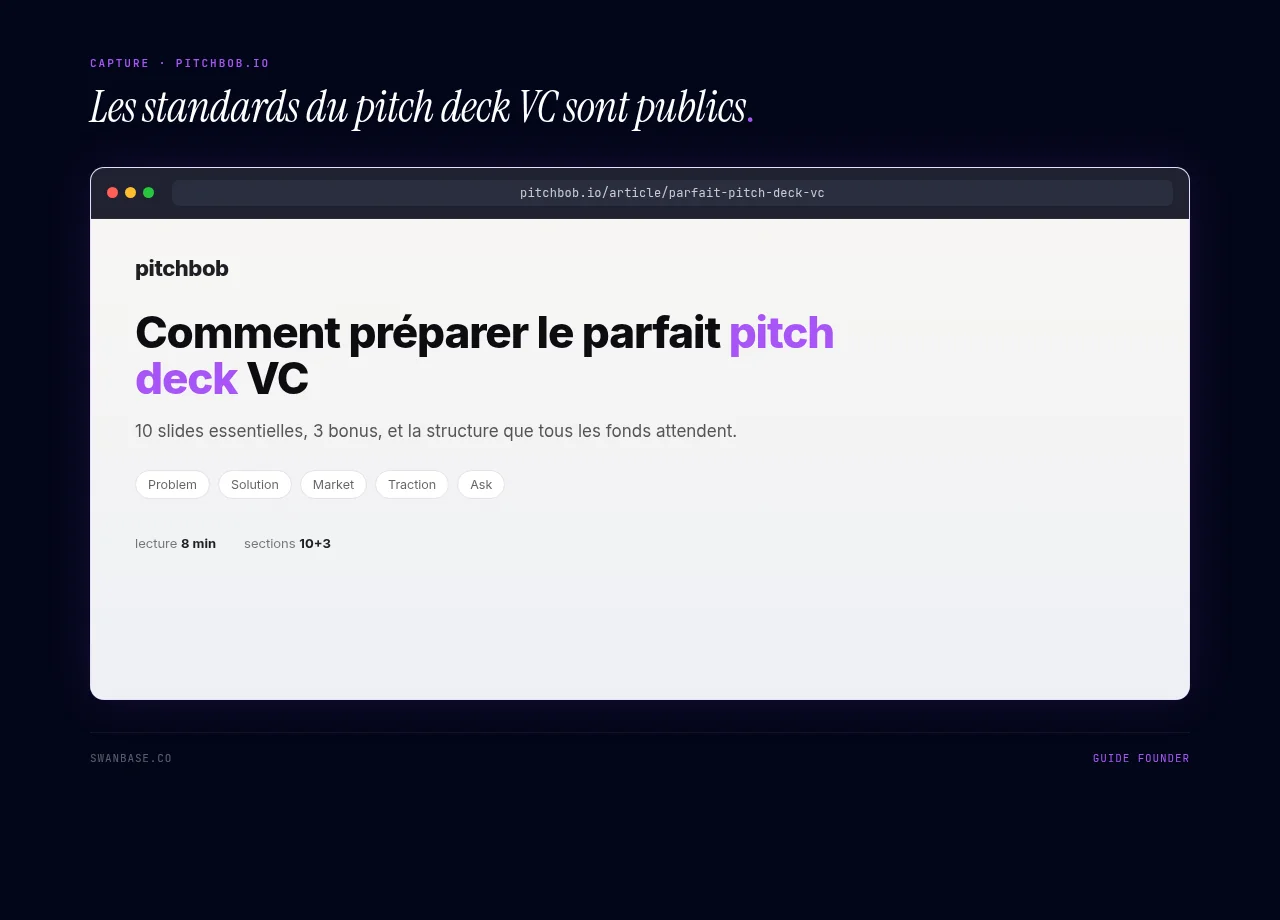
Every VC expects the same structure. It's a convention: following it won't win you the deal, but breaking it will lose it. Industry sources converge on 10 essential slides2, plus 3 bonus slides depending on the case3.
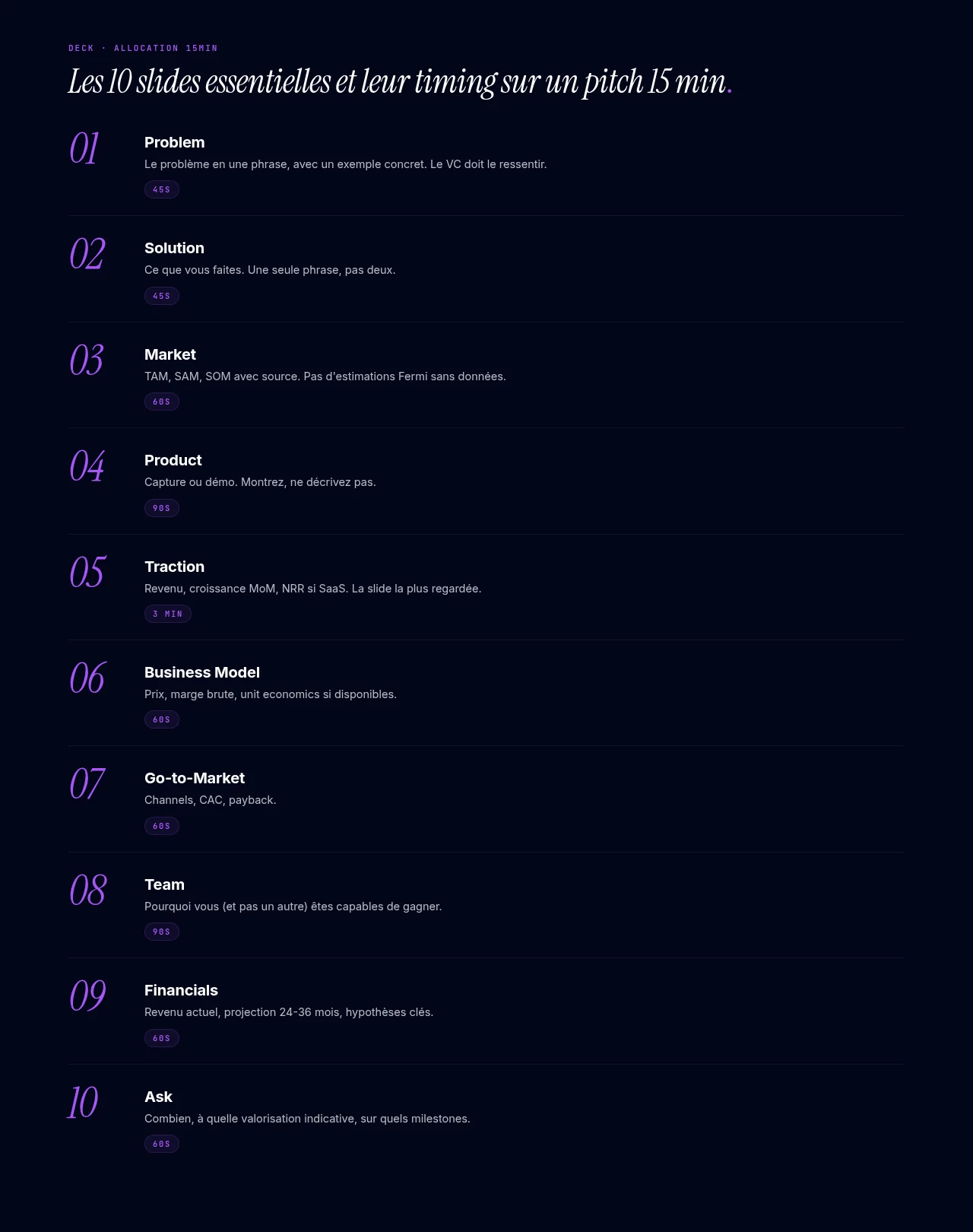
The 10 essential slides
- Problem. The problem in one sentence, with a concrete example. The VC has to feel it.
- Solution. What you do, in one sentence. Just one.
- Market. TAM, SAM, SOM with a source. No Fermi estimates without data.
- Product. Screenshot or demo. Show, don't describe.
- Traction. Concrete numbers: revenue, users, MoM growth, NRR if SaaS, GMV if marketplace. The most-studied slide.
- Business Model. How you make money. Pricing, gross margin, unit economics if available.
- Go-to-Market. Channels, CAC, payback.
- Team. Photos, names, backgrounds. Why you (and not someone else) are the ones who can win.
- Financials. Current revenue, 24-36 month projection, key assumptions.
- Ask. How much you're raising, at what indicative valuation, against which milestones.
3 optional bonus slides
- Vision (slide 11). Where the project goes in 10 years. Useful for funds that invest in visions (Index, Sequoia).
- Moats (slide 12). Why a competitor can't copy you: network, data, patent, brand, switching cost.
- Roadmap (slide 13). What you'll do over the next 12-18 months with the cash. Worth including if your traction is still young.
The pitch, section by section (timing per slide)
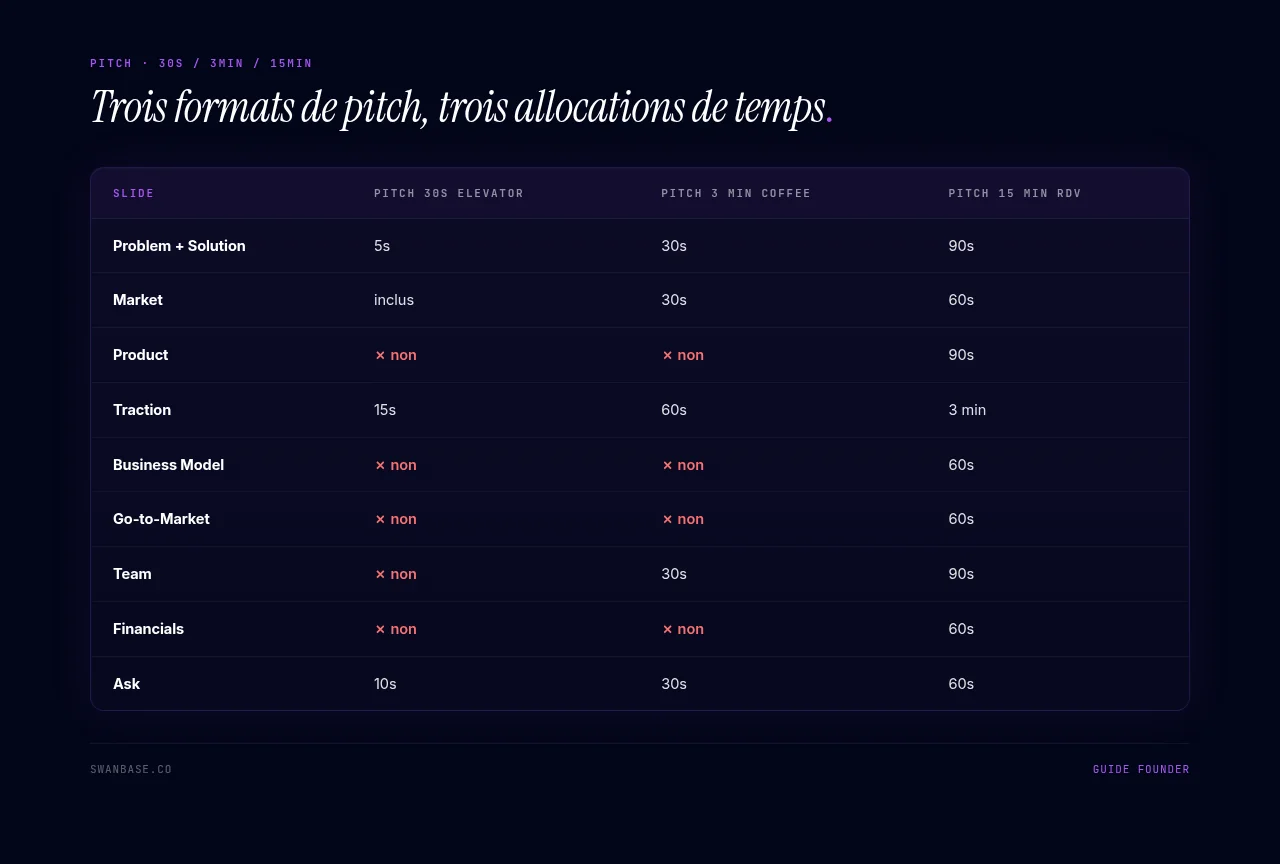
What competitors forget: the pitch doesn't always last 15 minutes. Depending on the context, you have 30 seconds, 3 minutes, or 15. Three distinct exercises, to be prepared separately.
30-second pitch (elevator)
You run into a VC at an afterwork event, in the time it takes to eat one canapé:
- 5s: "We do X for Y." (who, for whom)
- 15s: "We have Z in traction, market W." (proof + size)
- 10s: "We're raising €K to do L." (ask + use of funds)
If they're interested, they'll ask for more. If not, you've lost 30 seconds instead of 15 minutes.
3-minute pitch (first call / coffee chat)
The trickiest format: too short to say everything, too long to wing it. Allocation:
- 30s Problem + Solution
- 30s Market (with numbers, source)
- 60s Traction (the most time, it's what decides)
- 30s Team
- 30s Ask
No slides. You talk. At the end, one question: "Does this resonate with your thesis?"
15-minute pitch (in-person meeting or long Zoom)
Indicative allocation across the 10 slides:
- Slides 1-2 (Problem + Solution): 90s
- Slide 3 (Market): 60s
- Slide 4 (Product): 90s (demo if possible)
- Slide 5 (Traction): 3min (the key moment)
- Slides 6-7 (Business Model + GTM): 2min
- Slide 8 (Team): 90s
- Slides 9-10 (Financials + Ask): 2min
- Buffer: 3min for questions along the way
Long Q&A at the end. If the VC interrupts on slide 2, don't fight to stay linear: answer, then get back to your thread.
Spoken pitch vs written pitch, two different exercises
Classic trap: using the same deck for the PDF sent ahead and for the live presentation. Bad idea. Two objects, two reading contexts.
The PDF deck sent ahead
Read in 2 minutes, alone, on a screen, without you there to defend it1. So:
- Explicit text on every slide (otherwise the reader understands nothing).
- Dense slides, self-contained data.
- Nothing "to explain out loud": everything is written down.
- Footnotes for the sources behind your numbers.
The live pitch
You carry the story, the deck supports it. So:
- Clean slides: 1 idea per slide, a big visual, little text.
- You talk, the VC looks at the visual, your voice carries the message.
- Video demos beat static screenshots whenever possible.
- A customer anecdote on slide 1 or 2, not a paragraph.
The "reading" deck vs the "presentation" deck
Simple solution: two versions. The reading deck (PDF, dense, self-explanatory) goes out before and after the meeting. The presentation deck (clean, visual) is what you project live. Same structure, two densities. Most founders make only one, and lose in both contexts.
The 10 trick questions from French VCs (and how to answer them)
The 10 questions you'll get 80% of the time, and the scripts that keep you from losing your air4.
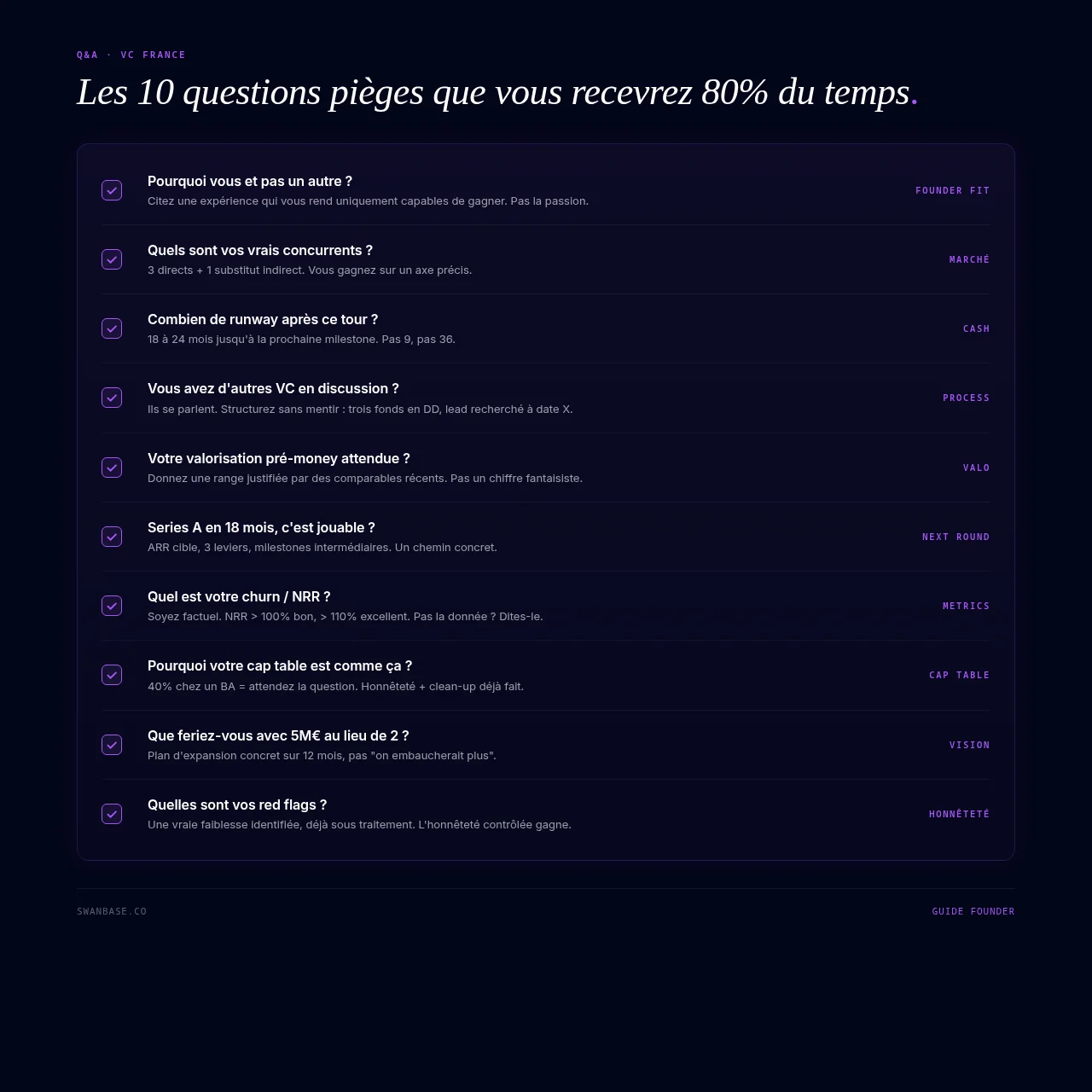
"Why you and not someone else?"
Worst answer: "We're passionate." Good answer, a fact: "We spent 4 years in [sector], we saw the problem from the inside, we know the 3 reasons nobody has solved it yet." Cite an experience that makes you uniquely capable of winning.
"Who are your real competitors?"
Never say "We have no competitors." Instant red flag. Name 3 direct competitors and 1 indirect substitute. Explain why you win on one specific axis (speed, price, vertical, distribution).
"How much runway after this round?"
Expected answer: 18 to 24 months, up to the next milestone (Series A, breakeven, target ARR). 9 months means you'll be back raising from a position of weakness. 36 months means you're burning too little to grow fast.
"Are you talking to other VCs?"
Don't lie, they talk to each other. But frame it: "Three funds are in due diligence, we're looking for a lead by [date]." If you have no one, say "We're starting to talk to 5 funds this week." Honest, and it implies momentum.
"What pre-money valuation are you expecting?"
Give a range, not a fixed number. "We're targeting X to Y depending on the lead and the ticket." Back it up with recent public comparables (TechCrunch, Maddyness, Capital Finance). No made-up figures.
"Can you reach a Series A in 18 months?"
The VC is testing whether you understand Series A KPIs: ARR > €1-2M in SaaS, MoM > 15%, NRR > 110%, a fleshed-out team. Answer with a concrete path: "By T+18, we're targeting [ARR target] through [3 levers]. Here are the intermediate milestones."
"What's your churn / NRR?"
If you don't have the number, say so. Lying shows. NRR > 100% is good, > 110% excellent. NRR < 90%, have an explanation ready (early cohort, segment you exited, pivot).
"Why is your cap table like this?"
A broken cap table kills a deal in 30 seconds. 40% given away to an angel means expect the question. Honest answer: "We made a choice 2 years ago, here's why, and here's how we've cleaned it up since." For contractual clauses (BSA, BSPCE, anti-dilution): see the term sheet clauses to negotiate.
"What would you do if I gave you €5M instead of €2M?"
A test of elastic vision. Bad answer: "We'd hire more." Good: "We'd accelerate EU expansion over 12 months instead of 24, here are the 3 markets and the plan." Show you know what to do with more cash without squandering it.
"What are your red flags?"
Worst answer: "We don't have any." Good: name one real weakness, already identified, already being addressed. "Our churn is at 6% monthly in the SMB segment, two actions underway to bring it down to 3% in Q3." Controlled honesty builds more trust than performative perfection.
The ask: how much to request and how to defend it
The last slide, and the one where half of founders trip up. Too much and you look like you miscalculated. Too little and you'll run out before the milestones.
Calculating your ask (runway × burn × milestones)
Formula: (monthly burn × 18 to 24) + (20% buffer) + (one-off investments). Burn = team + tools + acquisition + overhead, without forgetting social charges (roughly ×1.42 on gross salary in France). Burn of €80k/month × 20 months of runway = ~€1.9M + buffer, so ~€2.3M.
What you need to justify (use of funds)
The VC isn't writing a check, they're funding milestones. Break it down:
- Team (X hires: who, when, why)
- Product (what to build, what value it creates)
- Acquisition (channels, target CAC)
- Buffer and operations
One clear use-of-funds slide is worth 30 minutes of Q&A.
Connecting to the term sheet
Pitch done, investor interested: you move into negotiation. Many founders think they're home free and then lose on the clauses. A topic in its own right: the VC term sheet clauses to negotiate first (anti-dilution, liquidation preference, drag-along).
Follow-up and reading VC responses
Pitch over, you leave the room. That's when 80% of founders passively wait for an answer that never comes. Follow-up is a separate exercise.
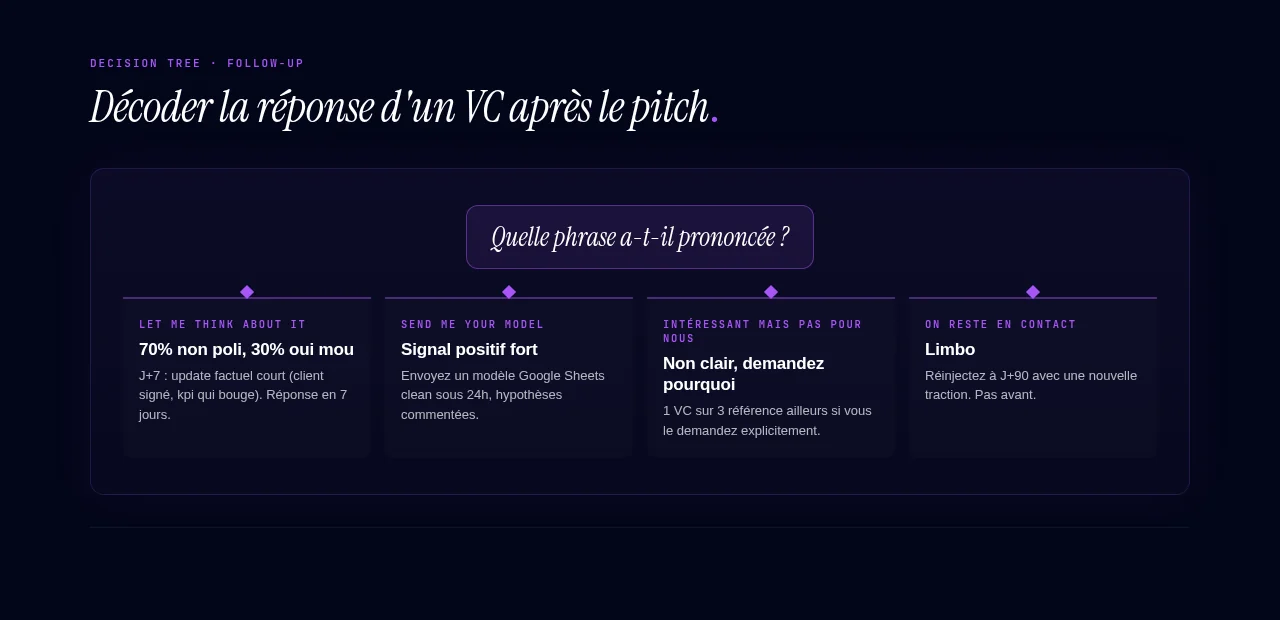
What "let me think," "send me a model," and "interesting but not for us" mean
Quick decoding:
- "Let me think about it." → 70% of the time, it's a polite no. 30%, a soft yes. You'll know within 7 days.
- "Send me your financial model." → A strong positive signal. Send a clean model (Google Sheets, commented assumptions) within 24h.
- "Interesting, but this one isn't a fit for us." → A clear no. Ask why exactly, and whether the VC can refer you elsewhere. 1 in 3 will.
- "Let's stay in touch." → Limbo. Come back 3 months later with new traction.
How to follow up at 1 week, 1 month, 3 months
- Day 7: A short factual update (customer signed, a KPI moving). Not "Have you decided?" but "Quick update: we just signed X."
- Day 30: If no reply, an explicit update: "We're finalizing our round with [lead], we're keeping a spot open if you're interested."
- Day 90: Closing: "We're closing the round next week. Last call if you want in." Honestly, not as a threat.
When to drop a fund
Three signals: no reply after 3 follow-ups, no intro to a senior partner after the first call, an endless DD request with no written commitment. Don't put 40% of your energy into 10% of your list.
Classic mistakes that kill a pitch in 30 seconds
An over-optimistic market slide
"The global SaaS market is €200 billion." Fine. And what share do you actually address? TAM-SAM-SOM with no numbered assumptions means an instant loss of credibility.
A team that isn't credible
CVs too junior with no complementarity, or two founders with the exact same profile. A VC checks whether the team covers tech + go-to-market + operations. Two engineers in B2B SaaS means a gap in GTM. Own it and explain how you'll fill it (advisor, planned hire).
No moats / no differentiation
"We're simpler / faster / more user-friendly." All your competitors say that. What's the structural moat? Proprietary data, brand, network effect, switching cost? If the answer is "nobody else dared," you'll be copied within 6 months.
A broken cap table
40% held by an absent angel, 25% held by a cofounder who left 18 months ago with no clean-up, free BSA signed at an accelerator with no cap. This kills a deal before financial due diligence even starts. The swanbase program takes 2% equity and structures cap tables from the early stage to head off these traps upfront.
FAQ
Should you send your deck before the meeting or wait?
Send it beforehand, always. A VC who shows up without having read your deck isn't serious. A VC who has read it arrives with targeted questions and the conversation is infinitely more productive. 48h ahead, as an attachment or via DocSend (a tracked link).
How many VCs should you contact in parallel?
15 to 25 funds in the first wave, over 6 to 8 weeks. Fewer means not enough signal. More makes personalized follow-up impossible. Prioritize by fit (stage, ticket, sector), not by prestige.
Do you need to sign an NDA before pitching?
No. No serious VC signs an NDA for a first pitch. Your idea isn't your moat, your execution is. If you insist, you'll be filed away. Keep the genuinely sensitive secrets (code, data, key contracts) out of the initial deck.
How long does a full VC round take?
4 to 9 months between the first call and closing. Seed can move faster (3-4 months with clear traction). Series A is slower (6-9 months on average). If you have 6 months of cash when you start raising, you're already behind.
Preparation = 80% of the conversion into a term sheet. The rest is luck. And luck favors the ones who are ready.
Footnotes
-
DocSend Pitch Deck Metrics: https://www.docsend.com/index/pitch-deck-metrics/ ↩ ↩2
-
Funding Blueprint 10-slide pitch deck structure: https://fundingblueprint.io/pitch-deck-10-slide-structure ↩
-
Sequoia Capital pitch template (bonus slides): https://www.lunarmobiscuit.com/pitching-sequoia/ ↩
-
15 fundraising mistakes (trick questions, due diligence, rejection signals): https://www.magstartup.com/erreurs-levee-de-fonds-15-pieges-qui-tuent-une-startup/ ↩